Clean, oxide-free solder joints and consistent results can be achieved under high vacuum conditions. This is precisely where the vacuum soldering process from iew comes in: The systems work with precisely coordinated vacuum technology from Pfeiffer Vacuum+Fab Solutions and enable stable processes with minimal energy consumption and low maintenance requirements.
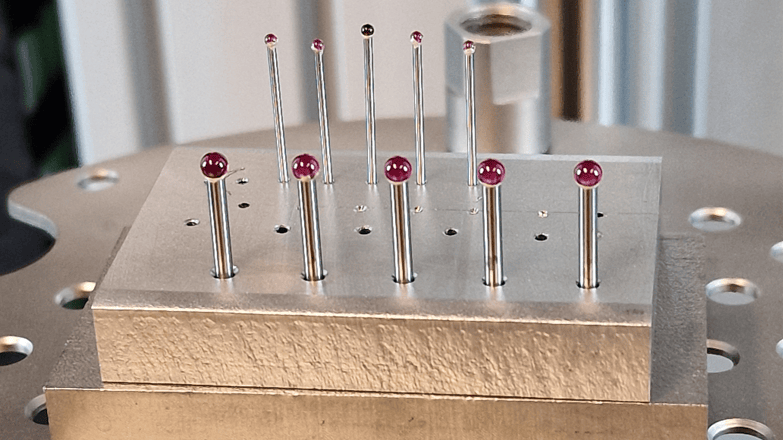
Vacuum-brazed probes.
(Image: iew inductive heating systems)
For the development of a new generation of vacuum soldering systems, iew needed a reliable high-vacuum solution that is both technically robust and economically efficient. Together with Pfeiffer Vacuum + Fab Solutions, a system concept was developed, consisting of a combination of a turbomolecular vacuum pump and a backing pump. This ensures an ultimate vacuum of up to 8×10⁻⁶ hPa (mbar). As a result, reproducible solder joints are achieved even with temperature-sensitive materials because oxidation is prevented under these nearly gas-free conditions, heat transfer is precisely controlled, and the components are evenly bonded with the solder alloy. At the same time, the oil-free vacuum pumps reduce maintenance efforts and prevent contamination in the process chamber—a crucial factor for the high quality of the manufactured components.
Where Precision Meets Innovation
Originating from a thesis on induction heating, the company was founded in 1996 by Dipl.-Ing. Martin Schweikhart as Ingenieurbüro Schweikhart. Just a year later, it was renamed iew induktive Erwärmungsanlagen GmbH. With around 20 employees, iew now serves customers worldwide. In addition to individually configurable induction heating systems, iew's vacuum soldering systems make up an increasingly significant portion of revenue. The company is the only provider globally offering both technologies from a single source—which is an advantage for many customers who require both processes for their production. The systems are used in applications such as soldering high-performance diamond tools, shrinking, annealing, and hardening metals, as well as in testing technology and research. In the vacuum soldering business area, approximately 80 percent of applications are in tool technology. Manufacturers of measuring probes and companies in the medical technology sector also show significant interest in the soldering technology.
Vacuum Soldering Under Optimal Conditions
The vacuum soldering process begins with the preparation of the components to be joined, which may consist of hard metal, polycrystalline diamond, or ceramics, depending on the application. After applying the solder paste, the workpieces are positioned in a quartz glass vacuum chamber. The chamber is then evacuated until a pressure of about 5×10⁻⁴ hPa (mbar) is reached. This removes oxygen, nitrogen, and moisture from the process chamber—crucial to prevent oxidation and contamination at the solder joints.
During the soldering process, infrared heaters provide precise heating of the components. Initially, they are uniformly preheated to avoid any stress in the material. Once the soldering temperature is reached, the vacuum pumps lower the pressure further to about 5×10⁻⁵ hPa (mbar). This high vacuum level minimizes heat conduction through residual gases and ensures uniform melting of the solder alloy at typically around 700 to 900 °C (approx. 1290 to 1650 °F).
After the soldering process is completed, the vacuum level is further increased—to about 8 to 9×10⁻⁶ hPa (mbar). In this nearly gas-free environment, the workpieces can cool down slowly and controlled, without oxygen or nitrogen reacting with the surface. Only when the temperature has dropped to about 150 °C (approx. 302 °F) is ambient air gradually allowed back in to ensure a gentle pressure equalization.
The interplay of precise temperature control and stable high-vacuum conditions guarantees reproducible results, dense and clean solder joints, and consistently high product quality. The robust systems are designed for continuous industrial operation and impress with their long lifespan and minimal maintenance requirements.
Tailored Vacuum Technology Instead of Off-the-Shelf Solutions
In 2016, iew began developing the first prototypes for vacuum soldering systems, which were later to be available in two versions—a compact variant for smaller batch sizes and a larger system for industrial mass production. The aim was to create a reliable and resource-efficient alternative to conventional systems, which often operated with oil diffusion pumps. During startup, the oil had to be brought to operating temperature, and there was always a risk that oil vapors would enter the vacuum chamber, contaminating sensitive surfaces. Additionally, maintenance and cleaning were correspondingly labor-intensive.
Date: 08.12.2025
Naturally, we always handle your personal data responsibly. Any personal data we receive from you is processed in accordance with applicable data protection legislation. For detailed information please see our privacy policy.
Consent to the use of data for promotional purposes
I hereby consent to Vogel Communications Group GmbH & Co. KG, Max-Planck-Str. 7-9, 97082 Würzburg including any affiliated companies according to §§ 15 et seq. AktG (hereafter: Vogel Communications Group) using my e-mail address to send editorial newsletters. A list of all affiliated companies can be found here
Newsletter content may include all products and services of any companies mentioned above, including for example specialist journals and books, events and fairs as well as event-related products and services, print and digital media offers and services such as additional (editorial) newsletters, raffles, lead campaigns, market research both online and offline, specialist webportals and e-learning offers. In case my personal telephone number has also been collected, it may be used for offers of aforementioned products, for services of the companies mentioned above, and market research purposes.
Additionally, my consent also includes the processing of my email address and telephone number for data matching for marketing purposes with select advertising partners such as LinkedIn, Google, and Meta. For this, Vogel Communications Group may transmit said data in hashed form to the advertising partners who then use said data to determine whether I am also a member of the mentioned advertising partner portals. Vogel Communications Group uses this feature for the purposes of re-targeting (up-selling, cross-selling, and customer loyalty), generating so-called look-alike audiences for acquisition of new customers, and as basis for exclusion for on-going advertising campaigns. Further information can be found in section “data matching for marketing purposes”.
In case I access protected data on Internet portals of Vogel Communications Group including any affiliated companies according to §§ 15 et seq. AktG, I need to provide further data in order to register for the access to such content. In return for this free access to editorial content, my data may be used in accordance with this consent for the purposes stated here. This does not apply to data matching for marketing purposes.
Right of revocation
I understand that I can revoke my consent at will. My revocation does not change the lawfulness of data processing that was conducted based on my consent leading up to my revocation. One option to declare my revocation is to use the contact form found at https://contact.vogel.de. In case I no longer wish to receive certain newsletters, I have subscribed to, I can also click on the unsubscribe link included at the end of a newsletter. Further information regarding my right of revocation and the implementation of it as well as the consequences of my revocation can be found in the data protection declaration, section editorial newsletter.
In response to these issues, a compact high-vacuum solution was developed with the support of Pfeiffer Vacuum + Fab Solutions, which operates without diffusion pumps and works significantly more efficiently. The jointly realized system architecture combines turbomolecular vacuum pumps with dry or oil-lubricated backing pumps—depending on the process requirements. This combination ensures stable pressure conditions down to the range of 8×10⁻⁶ hPa (mbar) and enables clean, reproducible soldering with minimal energy and maintenance effort.
In the smaller system variant, a Hi-Pace turbopump and an oil-free Hi-Scroll series scroll vacuum pump are used, complemented by precise vacuum gauges, dust separators, and robust valves. For higher throughput, the larger system utilizes a HiPace turbopump in conjunction with an oil-lubricated DuoVane rotary vane vacuum pump. All components are perfectly coordinated and designed for operation under continuously varying thermal loads with occasional dirt ingress—a prerequisite for high process stability in daily use.
Simon Riefling, responsible for international sales at iew, emphasizes: "We chose the vacuum solutions from Pfeiffer Vacuum + Fab Solutions in 2018 because the company stands for top quality and excellent service. As a German manufacturer with strong high-tech expertise, Pfeiffer is a market leader, whose products we regularly see at universities, colleges, and in renowned companies. For us, Pfeiffer embodies maximum reliability, which is why we use their vacuum pumps in our vacuum soldering systems; we want to ensure the best possible quality for our customers." The installed vacuum solutions are characterized by easy maintenance and long service life. The turbopumps, for example, are designed for a maintenance-free runtime of up to five years.



:quality(80)/p7i.vogel.de/wcms/81/c6/81c6f01476cd66350d1a6467efede21d/screenshot-202026-01-28-20174921-783x440v1v1.png "Vacuum-brazed probes. (Image:iew inductive heating systems)")
:quality(80)/p7i.vogel.de/wcms/40/c5/40c5051cebdb10fdee9a283303434d9d/0129881741v1.jpeg "3D-printed tools and other components contribute to energy-saving, precise processes. (Image:Gerhard Schubert GmbH)")
:quality(80)/p7i.vogel.de/wcms/ae/bd/aebda515c684825e97579175874ea6bd/0129920231v1.jpeg "Hensoldt, a sensor specialist for critical defense applications among other things, now has a strategic milestone ahead of it. The company is planning to acquire Nedinsco, an optronics company from Venlo in the Netherlands. Here's what's to come ... (Image:Hensoldt)")
:quality(80)/p7i.vogel.de/wcms/c3/6f/c36f031df46d22615d941d077d32313c/0129800025v1.jpeg "The laser-assisted process is intended to make wafer cutting significantly more productive. (Image:Trumpf)")
:quality(80)/p7i.vogel.de/wcms/73/17/7317794432521bf911711b91287cfc28/0129961259v1.jpeg "ABB Robotics and Nvidia are enabling the widespread use of physical AI in the world of robotics. This means that systems can be created virtually and with high precision and optimized much more cost-effectively. In the large image the virtual system, next to it the real robot cell ... (Image:ABB)")
:quality(80)/p7i.vogel.de/wcms/09/a2/09a2e832b1c0271d299fc130201e5717/adobestock-1767409934-4191x2360v1.jpeg "(Source: © ImageFlow - stock.adobe.com)")
:quality(80)/p7i.vogel.de/wcms/3e/1c/3e1c58be6be95c1f511fc6fd6812cf20/0129887455v1.jpeg "The picture shows an aerial view of the existing site, supplemented by a visualization of the Smart Factory. The new production facility is to be built on the current parking lot. (Image:Siemens AG)")
:quality(80)/p7i.vogel.de/wcms/ee/2e/ee2ed86ee6920e691aaab10cc7d2dec6/0128979319v1.jpeg "Humanoid robots can support people without adapting the environment. (Picture: ©Gorodenkoff - stock.adobe.com)")
:quality(80)/p7i.vogel.de/wcms/28/00/28008d9477bb07daa3b28ce4ac0ae907/newsimage418436-1536x864v1v1.jpeg "Researchers have produced elastic ear cartilage from human cells in the laboratory, which remains dimensionally stable in animal models. (Image:ETH Zurich)")
:quality(80)/p7i.vogel.de/wcms/1e/7d/1e7d6a316cdd7a7ba5e84d7c9a3efb80/newsimage418837-3000x1687v1v1.jpeg "Driverless shuttles can strengthen public transport, especially in rural areas. (Image:ZF Friedrichshafen)")
:quality(80)/p7i.vogel.de/wcms/85/e8/85e89606edeeec55feac9ab5617e2440/newsimage418885-3500x1969v1v1.jpeg "Flexible: The solid electrolyte based on silicone is expandable and thus compensates for the cavities that form in solid-state batteries during charging and discharging. (Image:Empa)")
:quality(80)/p7i.vogel.de/wcms/e8/dc/e8dc27a8d9fba8fbd081987400bf6848/0127426198v1.jpeg "3D FEM models are detailed, large and computationally intensive. Thanks to ROM and the support of Cadfem, Wago has succeeded in setting up an e-shop for thermal simulation. (Image:WAGO)")
:quality(80)/p7i.vogel.de/wcms/a7/22/a722a06c823b5d7405eb9fb15a0b4e7d/0129931201v1.jpeg "The company offers access to its charging network, which now has more than 1,000,000 charging points across Europe, via the Elli app. (Image:Elli | Volkswagen)")
:quality(80)/p7i.vogel.de/wcms/89/5d/895dfb4fb9a90c33ddd287c7d09c9ffd/0129938355v1.jpeg "Ganfeng Lithium has developed semi-solid batteries for eVTOLs together with Geely subsidiary Aerofugia. (Image:Aerofugia)")
:quality(80)/p7i.vogel.de/wcms/7c/b5/7cb53f75b7254936bca07deea6df4ed7/0129926273v1.jpeg "Windrose and Hubjekt cooperate on Plug&Charge authentication. (Image:Wind rose)")
:quality(80)/p7i.vogel.de/wcms/09/5a/095a3ffb6f8fa4c4ccdd40e99ad4eb57/0129947820v1.jpeg "The developers at Irlbacher prevent the glass surface from falling below the dew point with 3D printing in the form of filigree conductor tracks on flat glass. (Image:Irlbacher)")
:quality(80)/p7i.vogel.de/wcms/64/97/6497d264fcf62cf4325443498b3826f3/0129930890v1.jpeg "Switching without mechanical contacts (Image:Endrich)")
:quality(80)/p7i.vogel.de/wcms/f3/c0/f3c0040f2b655e91b80158029c65b0cc/0127314142v1.jpeg "Nexperia's assembly and testing fab in Guangdong, China. (Image:Nexperia)")
:quality(80)/p7i.vogel.de/wcms/eb/06/eb069fcd5423295876bad3277dbea0bf/0129955418v1.jpeg "The Iran war and the supply chains: Electronic components are currently hardly affected by bottlenecks. (Image:Markus Kammermann)")
:quality(80)/p7i.vogel.de/wcms/ee/75/ee7566bf98b05455703bb7521fcb98a4/0129937679v1.jpeg "The search for new semiconductor materials is progressing. (Image:Dall-E / AI-generated)")
:fill(fff,0)/images.vogel.de/vogelonline/companyimg/76800/76895/65.jpg "FAULHABER_120mm.jpg ()")
:fill(fff,0)/p7i.vogel.de/companies/67/eb/67eba621ef6ea/logo2.png "logo2 (Wuxi InfiMotion)")
:quality(80)/p7i.vogel.de/wcms/be/04/be04b9fbd25ff981c2ef86cfd4457563/0126197795v1.jpeg "The Lorenz Hoffmann company has four CNC milling machines that were previously supplied by four rotary vane vacuum pumps (symbolic image). (Picture: ©lucky pics - stock.adobe.com)")
:quality(80)/p7i.vogel.de/wcms/fb/a0/fba0d7559dab6fbdde49cbd32b968636/0126113524v1.jpeg "For the energy transition to succeed, machines and systems must operate energy-efficiently. (Image: ©OlegDoroshin - stock.adobe.com)")