Chip manufacturers are focusing on the so-called software defined vehicle. With their Systems on a Chip, they aim for new functions and shorter development cycles.
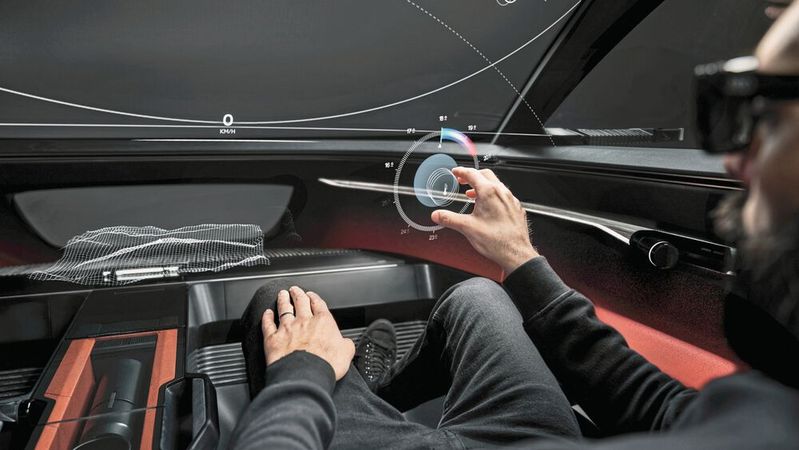
In Audi's "Activesphere Concept," occupants use virtual controls, which are displayed using mixed-reality glasses.
(Image: Audi)
Smartphones and computers offer chip manufacturers only limited growth opportunities. Therefore, the major providers are discovering the automotive industry for themselves. With their Systems on a Chip, manufacturers can develop new functions more easily and quickly - this is also referred to as the Software Defined Vehicle.
Intel has long been represented in cars. Over 50 million vehicles use chips from the US company. "We have done a lousy job of communicating this so far. We're going to change that," says Jack Weast, head of the automotive division at Intel.
Computing center in the car
The role of semiconductors in cars became apparent to every interested buyer due to logistics problems during and after the COVID-19 pandemic. However, at that time, the focus was primarily on chips for individual functions or control units. Now, the focus of major providers from AMD to Intel is on something different: The car of tomorrow is built like a data center. In the Software Defined Vehicle (SDV), a central processing unit (CPU) addresses all control units (ECU). The operating systems are designed so that each control unit can execute commands regardless of which supplier the hardware comes from.
This structure gives car manufacturers control over all the software in the car for the first time. Furthermore, it speeds up vehicle development. "We're reducing the time for a new model to 12 to 18 months, instead of the previous two to five years," says Weast. In the SDV, new functions can be realized more quickly and transferred to the car as an update. The vehicle remains up to date and, in the best case, stable in value.
System on a Chip from AMD and Intel
With their initiative, traditional semiconductor manufacturers aim to break the dominance of Nvidia, Mobileye, and Qualcomm, which have been leading in assistance systems and infotainment functions. With its System on a Chip (SoC), Intel aims to take on a central role in the car. The move is understandable, as growth in the traditional areas of computers and smartphones is no longer as strong. With the chiplet design, Intel is betting on an open platform, where car manufacturers can integrate semiconductors from their preferred partners into the SoC.
Competitor AMD is also focusing on its own System on a Chip with Embedded+. Here, chips from the "Versal AI Edge XA" series and the "Ryzen Embedded V2000A" processors are used. The SoC meets the requirements for security and computing power in the car, enabling the use of hypervisors. These create virtual environments in which different operating systems can run in parallel, independent of the hardware. AMD does not yet mention any example customers in the product descriptions, but there are media reports that Tesla is using the new chip generation.
Mobileye standardizes basic functions
With its investment in Mobileye, Intel has gained another foothold in the automotive industry. The Israeli company also aims to make programming easier for its customers in the SDV car. To this end, they are introducing the Driver Experience Program (DXP) for assisted driving functions. "Whoever develops an iPhone app doesn't have to reinvent iOS every time," Mobileye CEO Amnon Shashua compares it to the smartphone.
The processing of sensor data in the vehicle is identical for all OEMs. "However, each manufacturer can determine the driving style of the car," says Shashua. Every vehicle must stop at a red light, but whether the car rolls out slowly or comes to an abrupt stop in front of the traffic sign is determined by the manufacturer.
Qualcomm replaces Nvidia
The industry was quite surprised when it was revealed that Nvidia had even agreed on a revenue share for assisted driving functions with Mercedes-Benz. In a study by the CLA, the water-cooled Orin chip from Nvidia was highlighted. It was then clear that semiconductors have replaced the engine as the most important component in a car.
However, in autumn 2023, three years after the start of the collaboration with Nvidia, the Stuttgart-based company decided to use Qualcomm's Snapdragon Digital Chassis. Either they wanted to decrease dependency on one supplier, or they saw more potential in the competitor. In the new E-Class, different semiconductors are used. With the "Ride-Flex System," the US company also offers a System on a Chip. For cloud connectivity, they collaborate with Amazon and for distribution with Bosch, an established supplier.
Date: 08.12.2025
Naturally, we always handle your personal data responsibly. Any personal data we receive from you is processed in accordance with applicable data protection legislation. For detailed information please see our privacy policy.
Consent to the use of data for promotional purposes
I hereby consent to Vogel Communications Group GmbH & Co. KG, Max-Planck-Str. 7-9, 97082 Würzburg including any affiliated companies according to §§ 15 et seq. AktG (hereafter: Vogel Communications Group) using my e-mail address to send editorial newsletters. A list of all affiliated companies can be found here
Newsletter content may include all products and services of any companies mentioned above, including for example specialist journals and books, events and fairs as well as event-related products and services, print and digital media offers and services such as additional (editorial) newsletters, raffles, lead campaigns, market research both online and offline, specialist webportals and e-learning offers. In case my personal telephone number has also been collected, it may be used for offers of aforementioned products, for services of the companies mentioned above, and market research purposes.
Additionally, my consent also includes the processing of my email address and telephone number for data matching for marketing purposes with select advertising partners such as LinkedIn, Google, and Meta. For this, Vogel Communications Group may transmit said data in hashed form to the advertising partners who then use said data to determine whether I am also a member of the mentioned advertising partner portals. Vogel Communications Group uses this feature for the purposes of re-targeting (up-selling, cross-selling, and customer loyalty), generating so-called look-alike audiences for acquisition of new customers, and as basis for exclusion for on-going advertising campaigns. Further information can be found in section “data matching for marketing purposes”.
In case I access protected data on Internet portals of Vogel Communications Group including any affiliated companies according to §§ 15 et seq. AktG, I need to provide further data in order to register for the access to such content. In return for this free access to editorial content, my data may be used in accordance with this consent for the purposes stated here. This does not apply to data matching for marketing purposes.
Right of revocation
I understand that I can revoke my consent at will. My revocation does not change the lawfulness of data processing that was conducted based on my consent leading up to my revocation. One option to declare my revocation is to use the contact form found at https://contact.vogel.de. In case I no longer wish to receive certain newsletters, I have subscribed to, I can also click on the unsubscribe link included at the end of a newsletter. Further information regarding my right of revocation and the implementation of it as well as the consequences of my revocation can be found in the data protection declaration, section editorial newsletter.
"The collaboration underscores our shared commitment to technological innovation in the automotive sector," says Nakul Duggal, Senior Vice President of Automotive and Cloud Computing at Qualcomm. "The fusion of infotainment and ADAS functions on a System on a Chip is a milestone for the industry."
Nvidia now has Thor, the next, more powerful generation of chips on the market. The Americans have ensured that Thor is compatible with the existing development kit (SDK). This means that previous development efforts are not lost, and the step back to the provider is not obstructed.
"An existential moment for the auto industry"
"In the automotive sector, the perfect storm is brewing," says Jack Weast. What one should greatly respect in nature, is to the advantage of the Intel man: assisted and autonomous driving, SDV, electromobility, and a variety of new car brands. "It's an existential moment for the auto industry. It will look completely different by the end of this decade," Weast is convinced. In his appearance at the CES tech fair at the beginning of the year, he draws a comparison to smartphone development. "There were several reasons for the breakthrough, but the fact that half of all globally installed 4G antennas were in Asia made the growth curve skyrocket." A typical Leapfrogging effect. It skips developments and forsakes online banking and e-commerce in favor of mobile versions.
It took just ten years for smartphones to reach a market share of 80 percent by 2020. The US manager sees parallels here too and estimates that the SDV car with electric drive will reach this market share by 2035. "Especially because of the various new electric car brands." As with smartphones, Weast also sees the greatest opportunities in Asia. At the CES presentation, he invited Andy An to the stage. He is the President of the Chinese manufacturer Geely and CEO of the car brand Zeekr.
Focus on energy management
The electric car of tomorrow will not only sell because of its assistance functions. Range continues to play a crucial role in electric drive. Those who manage energy efficiently have the advantage. Jack Weast has internalized this as well. Therefore, he announces the acquisition of the French company Silicon Mobility, subject to approval from antitrust authorities. With their chip and software, Silicon Mobility ensures more range in the electric car. All energy flows in the vehicle, their heat generation, and efficiency in the conversion from DC to AC and DC to DC are monitored by a Field Programmable Control Unit (FPCU).
Intel intends to use this know-how for its SDV concept. Additionally, Intel is establishing a working group on the topic of energy within the engineering association SAE. Stellantis and map provider Here are also involved. The goal is to develop a standard (J3311), similar to the "Advanced Configuration and Power Interface" (ACPI) that already exists in the PC industry.
Consumers in the electric car should automatically turn off when they are not needed. For instance, the screens in the back would remain off if no one is sitting in the rear seats. Jack Weast is confident in his presentation and talks about a 30 to 40 percent efficiency gain in energy use. To make his commitment in the automotive sector more visible externally, we might soon see electric cars with the sticker: Intel inside.



:quality(80)/p7i.vogel.de/wcms/a0/47/a04725ef9bd09fb6c9341a1bea1b5d93/0130443083v1.jpeg "Here, a type of plastic pallet is produced by thermoforming (vacuum forming or deep drawing) at the corresponding division of New England Plastics in the USA. This division, which specializes in so-called liners, is now part of Ringmetall ... (Image:New England Plastics)")
:quality(80)/p7i.vogel.de/wcms/e3/42/e342b3c593ea92d56604d3be969e9c9a/0130437231v1.jpeg "Daimler Truck will be building even more trucks at its Czech plant in Cheb in the future. This is because it is now being expanded for strategic cost-saving reasons ... (Image:Daimler Truck)")
:quality(80)/p7i.vogel.de/wcms/23/99/23992bf2dcdc432c9b7209c34a4a7c48/0129733089v1.jpeg "Stork relies on the modular Neoswiss turning system from Iscar to shorten the set-up times for its sliding headstock lathes and work more productively. (Image:Iscar)")
:quality(80)/p7i.vogel.de/wcms/7d/e2/7de2923434b2f1a78ba5482d8d335269/0113143253v1.jpeg "In our China Market Insider we regularly provide you with relevant information directly from China. (Image:© Eisenhans - stock.adobe.com)")
:quality(80)/p7i.vogel.de/wcms/b7/36/b736dfebc16c42d6901d0d0e1f390493/3d-druck-20factory-20--20ki-20generiert-1920x1079v1.png "(Source: AI-generated)")
:quality(80)/p7i.vogel.de/wcms/79/b2/79b21aad663f4a7bd4472afc1c1afc62/0130433994v1.jpeg "Mission Joyride: The free-flying robot (shown here in the rendering) will relieve the ISS crew of logistics tasks from 2027 with its two mechanical arms. (Image:Icarus Robotics)")
:quality(80)/p7i.vogel.de/wcms/6b/45/6b4546fa6ebf305c3660326909363f32/0130437089v1.jpeg "Industrial AI in action: Rockwell Automation presents practical solutions for self-controlling production systems at the Hannover Messe. (Image:Rainer Jensen, Deutsche Messe)")
:quality(80)/p7i.vogel.de/wcms/78/e9/78e9188c25a8a94e67c34c9bf8ffe495/visual-agile-20robots-20and-20google-20deepmind-20partner-20to-20bring-20intelligence-20to-20robotics-2500x1406v1v1.jpeg "Together, the partners are developing adaptable, intelligent robots for a wide range of applications (Image:Agile Robots SE)")
:quality(80)/p7i.vogel.de/wcms/59/a2/59a2b11f0aa1b700eff02addd5de8703/adobestock-1788280853--c2-a9-20satria-20-e2-80-93-20stock-adobe-com-5081x2860v1v1.jpeg "Quantum computers require extreme cooling to temperatures close to absolute zero in order to keep qubits stable. (Image:satria - stock.adobe.com)")
:quality(80)/p7i.vogel.de/wcms/62/5f/625f41e87ebfef156a98c8e6393e32fd/0130211654v1.jpeg "Axial flux motors have some advantages over radial flux motor—but their production is currently still expensive. (Image:RWTH Aachen University)")
:quality(80)/p7i.vogel.de/wcms/f6/ae/f6aec4f6241b36ed5e3a990ac9176b42/0130429460v1.jpeg "Verne, Pony.ai and Uber want to launch a robotaxi service in Europe. (Image:Verne)")
:quality(80)/p7i.vogel.de/wcms/d7/88/d788699f2974708a332baa4e7a62fa9e/0130438967v1.jpeg "Skoda is withdrawing from China. The brand has produced well over three million vehicles there. (Image:Skoda car)")
:quality(80)/p7i.vogel.de/wcms/b0/43/b043b86899837532aad62d63368a917a/0130371361v1.jpeg "Skoda leaves the chinese market.
(Image:Skoda)")
:quality(80)/p7i.vogel.de/wcms/c3/c4/c3c4ce270b083eeac55654148611f064/0130237945v1.jpeg "China is not giving up on hydrogen, but is intensifying its efforts. (Image:freely licensed from Pixabay)")
:quality(80)/p7i.vogel.de/wcms/ee/09/ee09acbd6dc896df25affaa9e871e6e5/0130440053v1.jpeg "IMS chip module for simple system integration into an ion mobility spectrometer. (Image:Fraunhofer IPMS)")
:quality(80)/p7i.vogel.de/wcms/10/6c/106cd22de5f68a0f74639d654827228c/0130345302v1.jpeg "Made in India: According to the India Electronics and Semiconductor Association (IESA), the country should be able to produce between 75 and 80 million chips by the beginning of 2027, once the plants currently under construction become operational. (Image:Pixabay (Montage: Sebastian Gerstl))")
:quality(80)/p7i.vogel.de/wcms/a5/ed/a5ed6fda029d362732a293d6b19d74c4/0130444216v1.jpeg "Thirteen executives from the Chinese chip industry have drawn up a plan to achieve an 80% self-sufficiency rate for semiconductors by 2030. (Image:Maxim_Kazmin - stock.adobe.com)")
:quality(80)/p7i.vogel.de/wcms/31/a6/31a646018b34d8e0a44bfc8bf17837f6/0130361632v1.jpeg "For many companies, PFAS are considered indispensable in electronics production. (Image:freely licensed)")
:fill(fff,0)/images.vogel.de/vogelonline/companyimg/76800/76895/65.jpg "FAULHABER_120mm.jpg ()")
:quality(80)/p7i.vogel.de/wcms/ee/4a/ee4a50015dc3e4f80367de0eff47d82b/0125051586v1.jpeg "Since the pandemic, the demand for semiconductors has been growing. (Image: ©Edelweiss - stock.adobe.com)")
:quality(80)/p7i.vogel.de/wcms/a8/d7/a8d748a29612695eec22e0fad4cbf61a/0128735143v1.jpeg "The CES takes place in Las Vegas from January 6 to 9, 2026. (Image:Consumer Technology Association (CTA))")