The properties of Single Pair Ethernet (SPE) provide real added value for modern communication infrastructures. Phoenix Contact contributes technical solutions and cross-industry expertise with a comprehensive product portfolio in the area of SPE.
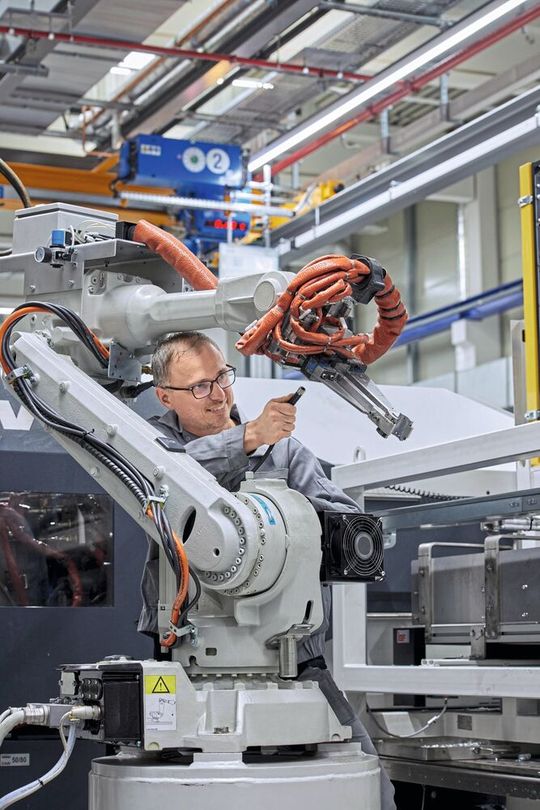
Use case robot: Single Pair Ethernet offers new solution approaches in many application areas for successful digitalization.
(Image: Phoenix Contact)
Unlike traditional Ethernet solutions, which traditionally require two or even four wire pairs, SPE operates with just one wire pair—enabling it to transmit both data and power.
The transmission rates of this technology—10 megabits per second at a maximum transmission length of 0.62 miles up to 1 gigabit per second at a maximum transmission length of 130 feet—are sufficient even for the most demanding tasks, such as intensive use of connected sensors with smart measurement devices or camera systems. This makes Single Pair Ethernet suitable for many areas that were previously affected by limitations in data rates, ranges, and seamless communication.
A key limitation of conventional standard Ethernet solutions is the maximum length of 330 feet for a point-to-point connection. To cover greater distances in industrial facilities, such as conveyor and assembly lines, additional repeaters or switches had to be installed so far—interference-prone interfaces that entail additional maintenance effort. SPE technology, on the other hand, enables devices to connect at a transmission speed of 10 megabits per second over a distance of up to 0.62 miles using a single cable and optionally utilize Power over Data Line (PoDL) technology. This allows specific fieldbus technologies to be replaced by SPE solutions with data rates of up to 10 megabits per second in the future.
SPE is also suitable for implementing complex network topologies. The high transmission speeds enable various applications to be realized with SPE. Currently, SPE standards with extended performance frameworks are being discussed within the IEEE 802.3 consortia. This could allow for higher data rates of over 10 gigabits for short distances of less than 50 feet as well as 100 megabits per second over a length of up to 0.31 miles. Such new SPE standards could open up entirely new application areas.
Seamless And Secure Data Communication
Traditional industrial facilities have often relied on an Ethernet network alongside a larger number of fieldbus systems at the field level. The emergence of the Industrial Internet of Things (IIoT), with the need to replace fieldbuses with more efficient communication systems, is rendering these established setups obsolete. A similar shift can be observed in any application area that requires seamless communication between sensors and/or networks. For such use cases, a seamless, secure data connection is crucial.
Already today, an average factory generates about one terabyte of data per day—and the trend is rising. Continuous communication is essential for the effective analysis of this data. Here, SPE can ensure seamless networking from the sensor to the cloud. With the increasing number of sensors and smart devices in industrial applications, SPE offers the ideal cabling solution—simple, secure, compact, and cost-efficient. When building infrastructures, SPE solutions will also be significantly more cost-effective in the future than the currently common combinations of bus and Ethernet components.
SPE And Robots: Space-Saving And Powerful
The use of autonomous and collaborative robots offers many advantages with SPE. Thanks to its higher data transmission rate compared to conventional fieldbus systems, communication between the robot and control unit operates with increased sampling rates and higher data volumes. Additionally, simplified cabling with data and power in a single line is achieved. For power requirements beyond the defined PoDL standards, hybrid SPE solutions with data and power contacts in one connector will be available in the future. A reduced number of cables and connections contributes to fewer fatigue failures, faster troubleshooting, and easier maintenance. Due to the smaller bending radius, SPE can also significantly optimize the design of robot handling.
Standardized Connector Interface for industrial applications
In the field of Single Pair Ethernet, a significant decision has now been made regarding a standardized connector interface. This decision brings clarity and certainty to a long-awaited issue. Particularly in the area of factory automation, where Profinet plays a vital role, this is seen as an important milestone. With the help of a uniform connector interface for applications in control cabinets, in the field, and for hybrid installations, a unifying element is created, paving the way for a universal SPE standard.
The "universal SPE standard" refers to the extension of the already known IEC-63171-7 specification initiated by the PNO, which is based on the SPE hybrid connector interface. Currently, the SPE connector system is being submitted for international standardization. This new generation represents another step into the future for the industry.
Date: 08.12.2025
Naturally, we always handle your personal data responsibly. Any personal data we receive from you is processed in accordance with applicable data protection legislation. For detailed information please see our privacy policy.
Consent to the use of data for promotional purposes
I hereby consent to Vogel Communications Group GmbH & Co. KG, Max-Planck-Str. 7-9, 97082 Würzburg including any affiliated companies according to §§ 15 et seq. AktG (hereafter: Vogel Communications Group) using my e-mail address to send editorial newsletters. A list of all affiliated companies can be found here
Newsletter content may include all products and services of any companies mentioned above, including for example specialist journals and books, events and fairs as well as event-related products and services, print and digital media offers and services such as additional (editorial) newsletters, raffles, lead campaigns, market research both online and offline, specialist webportals and e-learning offers. In case my personal telephone number has also been collected, it may be used for offers of aforementioned products, for services of the companies mentioned above, and market research purposes.
Additionally, my consent also includes the processing of my email address and telephone number for data matching for marketing purposes with select advertising partners such as LinkedIn, Google, and Meta. For this, Vogel Communications Group may transmit said data in hashed form to the advertising partners who then use said data to determine whether I am also a member of the mentioned advertising partner portals. Vogel Communications Group uses this feature for the purposes of re-targeting (up-selling, cross-selling, and customer loyalty), generating so-called look-alike audiences for acquisition of new customers, and as basis for exclusion for on-going advertising campaigns. Further information can be found in section “data matching for marketing purposes”.
In case I access protected data on Internet portals of Vogel Communications Group including any affiliated companies according to §§ 15 et seq. AktG, I need to provide further data in order to register for the access to such content. In return for this free access to editorial content, my data may be used in accordance with this consent for the purposes stated here. This does not apply to data matching for marketing purposes.
Right of revocation
I understand that I can revoke my consent at will. My revocation does not change the lawfulness of data processing that was conducted based on my consent leading up to my revocation. One option to declare my revocation is to use the contact form found at https://contact.vogel.de. In case I no longer wish to receive certain newsletters, I have subscribed to, I can also click on the unsubscribe link included at the end of a newsletter. Further information regarding my right of revocation and the implementation of it as well as the consequences of my revocation can be found in the data protection declaration, section editorial newsletter.
SPE Via Connector or Terminal
Thanks to its versatile functionalities, SPE can demonstrate its capabilities both in industrial applications and across many other sectors. When developing smart devices, such as sensors, device manufacturers also need to consider connection technology. The choice of connection technology often depends on the application. For field devices, IP protection is frequently required. Alongside the option of integrating an IP-protected connector into such field devices, there is also the possibility of achieving the desired IP protection using a cable gland. Inside the devices, PCB terminals tested and suitable for SPE data transmission can now be used.
This offers many advantages. On one hand, the device manufacturer has the flexibility to position the small SPE terminals on the circuit board in a way that suits them. On the other hand, on-site installers also benefit from the familiar screw or push-in connection technology. Depending on where such devices are installed, technicians face different challenges. Thanks to the clear color coding, the white and blue cores of the SPE cable can be clearly and intuitively assigned, even in hard-to-reach environments or those with suboptimal lighting conditions, thereby avoiding installation errors.
Space-Saving Connection Technology Also in Building Technology
In addition to the installation of IP-protected field devices, SPE PCB terminals can also demonstrate their strengths in IP20 environments, such as in building technology, where a connector is only partially suitable due to space constraints. Application cases could include distribution boxes or flush-mounted junction boxes. This is where the terminals provide an extremely space-saving alternative. Flush-mounted or DIN rail devices can be directly connected via an SPE installation cable and integrated into the network.
There are many other areas where IP-based networks with Single Pair Ethernet can represent meaningful additions or new design solutions—essentially all applications that require seamless and IP-based communication with long range and limited space availability.
Phoenix Contact recognized the great potential of Single Pair Ethernet early on and provides support for its integration. The possibilities of this key technology are enormous. In the expansive field of digitalization, the experts offer extensive knowledge, suitable tools, and tailored services to implement and utilize Single Pair Ethernet for future challenges in various areas.



:quality(80)/p7i.vogel.de/wcms/dd/08/dd086510d9ae7b50181f6070e4463b44/0129363730v1.jpeg "Typical application for ionizing devices: Wrapping films. (Picture: ©Adobe Stock/SMC)")
:quality(80)/p7i.vogel.de/wcms/35/57/3557c819943c53acec41a0ccba87da4f/0130049064v1.jpeg "Researchers at the Fraunhofer IWU in Chemnitz have long known that many typical sheet metal parts can be manufactured more cost-effectively using hollow embossing rollers. Now there is news to report ... (Image:Fraunhofer IWU)")
:quality(80)/p7i.vogel.de/wcms/59/02/590246e3b3f415c65edbee377c14ca77/26-06-pi-fraunhofer-iws-41450-direktplattieren-pic-01-7771x4369v1v1.jpeg "The Fraunhofer IWS has developed the new \"direct laser cladding\" process, which creates a functional layer directly on the base body by applying a strip-shaped metal to rotationally symmetrical components in a spiral and bonding it locally by laser. (Image:Christoph Wilsnack/Fraunhofer IWS)")
:quality(80)/p7i.vogel.de/wcms/73/60/73608418789b1d9c393f5e2fa974eda2/0130209906v1.jpeg "The robots of the X6 generation from b+m enable very high painting quality and are also particularly compact and easy to maintain. (Image:Beckhoff)")
:quality(80)/p7i.vogel.de/wcms/78/e9/78e9188c25a8a94e67c34c9bf8ffe495/visual-agile-20robots-20and-20google-20deepmind-20partner-20to-20bring-20intelligence-20to-20robotics-2500x1406v1v1.jpeg "Together, the partners are developing adaptable, intelligent robots for a wide range of applications (Image:Agile Robots SE)")
:quality(80)/p7i.vogel.de/wcms/e7/66/e7669ecf0260ae8fc54c214e34e4902a/0130316817v1.jpeg "Siemens and Palo Alto Networks offer tested cybersecurity solution for industrial 5G. (Image:Siemens)")
:quality(80)/p7i.vogel.de/wcms/9f/55/9f55324832c4f426958031375124d9de/siemens-20ubtech-20hmnd-1920x1079v1v1.png "Ready for the factory floor: While Ubtech is planning mass production, Siemens is already testing humanoids in real factory applications in Erlangen. (Image:Siemens)")
:quality(80)/p7i.vogel.de/wcms/11/36/113695ed260e29c8c2d9d39dc5f9d869/0130213768v1.jpeg "AI can work cheaply in China and deliver the results rapidly all over the world. (Image:Dall-E / AI-generated)")
:quality(80)/p7i.vogel.de/wcms/62/5f/625f41e87ebfef156a98c8e6393e32fd/0130211654v1.jpeg "Axial flux motors have some advantages over radial flux motor—but their production is currently still expensive. (Image:RWTH Aachen University)")
:quality(80)/p7i.vogel.de/wcms/77/9b/779b0685d010dfe45c9c2cb1cfecd467/0128886425v1.jpeg "The BlueEye is the first \"real\" hyperspectral camera for the UV range and covers the wavelength range from 220 to 380nm. (Image:Inno-spec GmbH)")
:quality(80)/p7i.vogel.de/wcms/e4/51/e451d52ce0182fb0aaa46a5774f832ef/26-04-pi-fraunhofer-iws-21160-bioslide-pic-01-4128x2321v1v1.jpeg "With the BioSlide research project, the Fraunhofer IWS is investigating how sliding systems can be designed to be more sustainable and energy-efficient. New materials can be tested in a particularly application-oriented manner on this plain bearing test stand. (Image:Fraunhofer IWS)")
![Thanks to advanced 3D printing technology, a more efficient use of resources should contribute to lower-emission aviation—this is the goal of ['skai]-lab. (Image:Oleksandr Pashchenko - stock.adobe.com / AI-generated)](https://cdn1.vogel.de/nghHNSbySccfOjG3n1qCA-FVOjQ=/288x162/smart/filters:format(jpg):quality(80)/p7i.vogel.de/wcms/62/64/626424c97a16e69f871bf216c9629c2a/adobestock-1927043193--c2-a9-20oleksandr-20pashchenko-20-e2-80-93-20stock-adobe-com-ki-generiertv1v1.jpeg "Thanks to advanced 3D printing technology, a more efficient use of resources should contribute to lower-emission aviation—this is the goal of ['skai]-lab. (Image:Oleksandr Pashchenko - stock.adobe.com / AI-generated)")
:quality(80)/p7i.vogel.de/wcms/c3/c4/c3c4ce270b083eeac55654148611f064/0130237945v1.jpeg "China is not giving up on hydrogen, but is intensifying its efforts. (Image:freely licensed from Pixabay)")
:quality(80)/p7i.vogel.de/wcms/4e/c0/4ec0bd19390b169edfa23677373dcdf1/0130260089v1.jpeg "Renewable fuels can supply European road traffic, according to a study. (Image:Aral)")
:quality(80)/p7i.vogel.de/wcms/6f/c9/6fc9050301d745cad25585c6780f8f51/0130197341v1.jpeg "Production facilities are a worthwhile target and are therefore at risk. (Image:ABB Robotics)")
:quality(80)/p7i.vogel.de/wcms/b6/62/b662adc2cec8227d8172509bbfb6ee42/25c0207-107-4961x2789v1v1.jpeg "The GLB is the second model based on Mercedes' new MMA platform. Apparently, Geely's platform is better and cheaper, which is why the two companies are negotiating a partnership. (Image:Mercedes-Benz)")
:quality(80)/p7i.vogel.de/wcms/4d/dd/4dddf438e91f394c04a095dbfd109d1c/0130236430v1.jpeg "Measurement modules: The 720301 module in combination with the SL2000 enables RMS and power calculations, among other things. (Image:Yokogawa)")
:quality(80)/p7i.vogel.de/wcms/61/fc/61fcf95f5cca15494ad18343901ae585/0130317237v1.jpeg "With the AGI CPU, Arm says it is taking a \"historic step\": With the processor aimed at AI in data centers, the company is presenting itself for the first time as a provider of its own chips, not just as a pure IP licensor. (Image:Arm)")
:quality(80)/p7i.vogel.de/wcms/82/90/8290dfe3595b6c6b33726ae8b76172c7/0130319587v1.jpeg "The concept image illustrates how the pattern of tiny protrusions and depressions created on the substrate (MgO, bottom) controls the arrangement of atoms in the superconducting material (YBCO, top). At the interface between the two layers, an electronic structure enables superconductivity to occur at higher temperatures than previously possible. (Image:Chalmers University of Technology / Riccardo Arpaia)")
:fill(fff,0)/images.vogel.de/vogelonline/companyimg/76800/76895/65.jpg "FAULHABER_120mm.jpg ()")
:fill(fff,0)/p7i.vogel.de/companies/67/eb/67eba621ef6ea/logo2.png "logo2 (Wuxi InfiMotion)")
:quality(80)/p7i.vogel.de/wcms/a8/b0/a8b05561ecd114221844a34a58ce0633/0125078749v1.jpeg "Via PoDL, the SPE PCB terminal enables not only 10 Mbit/s data transmission but also power supply to the field device.(Image: Phoenix Contact)")
:quality(80)/p7i.vogel.de/wcms/f5/80/f580931f22d98f4eec21c88ef887f42f/0125078737v1.jpeg "Andy Schäfer is Product Manager PCB Connectors at Phoenix Contact.(Image: Phoenix Contact)")
:quality(80)/p7i.vogel.de/wcms/17/43/1743a97d0b2aa8804164382f34639ebf/0125078744v1.jpeg "The Profibus User Organization e.V. (PNO) advocates for a standardized SPE connector interface.(Image: G.roman@shutterstock/Phoenix Contact)")
:quality(80)/p7i.vogel.de/wcms/05/81/0581c5fe07c739bb2f10391d7cf7b03b/0125078740v1.jpeg "In the field of robotics, SPE excels with its performance and compact design.(Image: Phoenix Contact)")
:quality(80):fill(efefef,0)/p7i.vogel.de/wcms/67/ad/67adf92d254d2/elatec-wp-smart-factory.png "Elatec WP Smart Factory")
:quality(80)/p7i.vogel.de/wcms/4e/85/4e858d1ecec06dab411fa4e31501d5a8/0127057552v1.jpeg "Lapp offers Single Pair Ethernet cables for fixed and flexible applications, as well as long distances, along with specially designed cables for Ethernet-APL. (Image:LAPP)")
:quality(80)/p7i.vogel.de/wcms/ea/30/ea30854185b5389cbb48db55a48a23e5/0126026509v1.jpeg "Single Pair Ethernet: SPE connectors are based on international standards (IEC 63171), which promote compatibility and ensure reliable use in various applications. (Image:Rosenberger)")