Single Pair Ethernet stands for high data volumes, high reliability, and low space requirements. Thomas Keller, Product Manager Industries at Rosenberger Hochfrequenztechnik, discusses the advantages that SPE offers for mechanical and plant engineering—and the new industrial standard IEC 63171-7 ED2 for connectors.
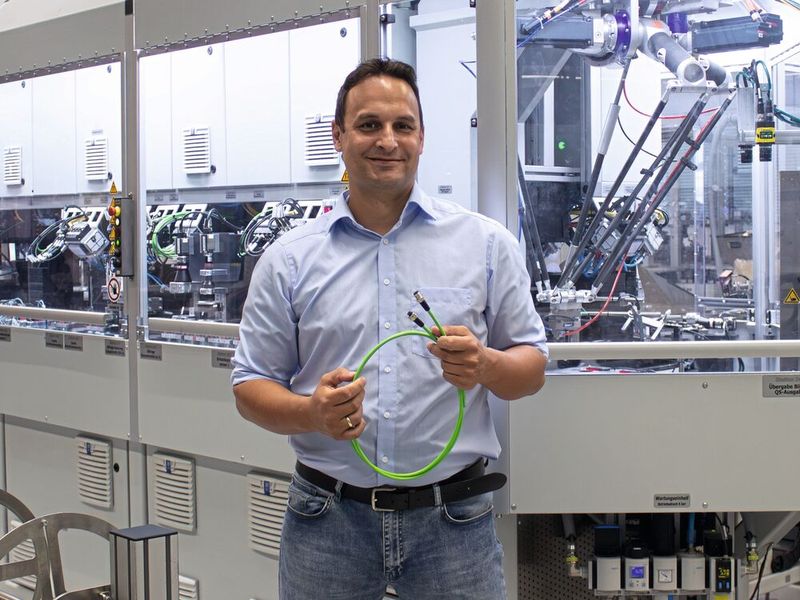
Thomas Keller, Product Manager Industries, Rosenberger Hochfrequenztechnik
(Image: Rosenberger Hochfrequenztechnik GmbH & Co. KG)
Mr. Keller, Single Pair Ethernet (SPE) is primarily known from the automotive industry. Why is the technology now so interesting for the industrial sector as well?
Thomas Keller: SPE has established itself in the automotive industry as the ideal solution for space-saving, high-performance data and power transmission, such as for driver assistance systems, sensors, and battery management. We are increasingly finding these exact requirements in industrial networking as well: large data volumes, high reliability, and minimal space requirements. Applications in areas such as Industry 4.0, digital twins, virtual commissioning, or the digital product passport require seamless data availability, covering the entire product lifecycle. With SPE, this can be implemented efficiently and cost-effectively.
Where do you see specific applications of SPE in mechanical and plant engineering?
Especially in automation and robotics, where space-saving and flexible cabling is required, SPE showcases its strengths. The significantly thinner and more bendable cables offer greater freedom of movement, which is a clear advantage, particularly in dynamic applications. But we also see great potential in machine networking, such as in CNC systems: Here, in collaboration with TU Munich (Germany) on a project, we were able to save up to 25% in development costs by standardizing communication structures and eliminating gateways. Electromobility and agricultural technology, where data on soil conditions or weather becomes central, are also increasingly benefiting from SPE.
Gallery
How Does SPE Change the Planning And Design of Machines And Systems?
With SPE, developers can approach cabling in a completely different way. Instead of complex, multi-layered protocol landscapes with elaborate gateway solutions, a continuous Ethernet infrastructure can be utilized directly. This not only simplifies electrical planning but also mechanical integration, for example through smaller bending radii and more compact cable channels. For designers, this means greater freedom and shorter development times.
What Role Does SPE Play in Increasing Efficiency And Reducing Costs?
Currently, the industry uses over 80 different communication protocols, each with its own requirements, interfaces, and necessary expertise. This diversity not only makes integration laborious but also expensive. Gateways and specialized knowledge significantly drive up development costs. If an entire system instead operates on a unified Ethernet protocol, it reduces both complexity and costs. Additionally, material savings are achieved through smaller cable cross-sections and fewer connectors, while simultaneously enabling data and power transmission. This can be crucial in IoT environments, where many small devices need to be supplied with energy and data cost-effectively.
And How Do You Assess the Long-Term Cost Development of SPE Components?
Currently, the unit costs of SPE components are still higher than those of traditional Ethernet solutions, which is normal for new technologies. However, as market penetration increases, economies of scale will come into play. We expect prices to drop significantly in the coming years, similar to what has been seen in the automotive industry. Even now, as previously mentioned, substantial overall cost advantages can be realized by eliminating additional components such as gateways and power supplies.
Many Companies are Cautious When it Comes to New Technologies. What is the Reason for this With SPE?
A key reason was the uncertainty surrounding connectors. There was a variety of different, partly non-standardized connector interfaces, which unsettled the market. The lack of interoperability slowed companies down. This makes the step now taken by the Profibus User Organization all the more important: with the specification of the connector according to IEC 63171-7 (ED2) as an industrial standard, it establishes a unified foundation. This makes SPE significantly easier to plan and deploy.
What Exactly is Behind This New Standard?
The IEC 63171-7 ED2 includes all relevant connectors in one standard. In addition to the previous hybrid connectors (SPE + additional power pins for higher power transmission), it now also describes pure SPE connectors. This extension of the standard covers areas for protected applications (IP20) and unprotected areas (IP67 in M8 and M12). The design is heavily based on our experiences from the automotive industry: Rosenberger has been using a fully shielded high-speed modular connector there since 2016, which is now produced millions of times. This expertise has been directly integrated into the standardization work. The similarity is no coincidence: the connector interface is optimized for high data rates, miniaturized, and highly automated in production.
In Which Areas will IEC 63171-7 Be Particularly Relevant in the Future?
Essentially everywhere standardization and miniaturization need to come together: mechanical engineering, robotics, building automation, charging infrastructure, energy systems, or agricultural vehicles. The new connector interface covers a very wide range: from just a few centimeters in robotic arms to hundreds of meters in greenhouses or chemical plants. And it matches the typical transmission speeds in the industry: 10 to 100 Mbit/s are entirely sufficient for around 80 percent of use cases. The new standard thus not only provides technical clarity but also ensures economic planning reliability.
Date: 08.12.2025
Naturally, we always handle your personal data responsibly. Any personal data we receive from you is processed in accordance with applicable data protection legislation. For detailed information please see our privacy policy.
Consent to the use of data for promotional purposes
I hereby consent to Vogel Communications Group GmbH & Co. KG, Max-Planck-Str. 7-9, 97082 Würzburg including any affiliated companies according to §§ 15 et seq. AktG (hereafter: Vogel Communications Group) using my e-mail address to send editorial newsletters. A list of all affiliated companies can be found here
Newsletter content may include all products and services of any companies mentioned above, including for example specialist journals and books, events and fairs as well as event-related products and services, print and digital media offers and services such as additional (editorial) newsletters, raffles, lead campaigns, market research both online and offline, specialist webportals and e-learning offers. In case my personal telephone number has also been collected, it may be used for offers of aforementioned products, for services of the companies mentioned above, and market research purposes.
Additionally, my consent also includes the processing of my email address and telephone number for data matching for marketing purposes with select advertising partners such as LinkedIn, Google, and Meta. For this, Vogel Communications Group may transmit said data in hashed form to the advertising partners who then use said data to determine whether I am also a member of the mentioned advertising partner portals. Vogel Communications Group uses this feature for the purposes of re-targeting (up-selling, cross-selling, and customer loyalty), generating so-called look-alike audiences for acquisition of new customers, and as basis for exclusion for on-going advertising campaigns. Further information can be found in section “data matching for marketing purposes”.
In case I access protected data on Internet portals of Vogel Communications Group including any affiliated companies according to §§ 15 et seq. AktG, I need to provide further data in order to register for the access to such content. In return for this free access to editorial content, my data may be used in accordance with this consent for the purposes stated here. This does not apply to data matching for marketing purposes.
Right of revocation
I understand that I can revoke my consent at will. My revocation does not change the lawfulness of data processing that was conducted based on my consent leading up to my revocation. One option to declare my revocation is to use the contact form found at https://contact.vogel.de. In case I no longer wish to receive certain newsletters, I have subscribed to, I can also click on the unsubscribe link included at the end of a newsletter. Further information regarding my right of revocation and the implementation of it as well as the consequences of my revocation can be found in the data protection declaration, section editorial newsletter.
Is There A Right Time to Address SPE Within Your Own Company?
Definitely now! The high level of interest from customers shows that many companies are already in the starting blocks. Especially in the current economic climate, where many budgets are being scrutinized, there is an opportunity to explore new, cost-saving technologies. Those who evaluate today the specific advantages SPE can bring to future products or systems gain a competitive edge. It is particularly important for manufacturers to consider SPE in new developments now, whether in mechanical engineering, the food industry, or building technology.
What is Needed for SPE to Establish Itself As An Industry Standard?
In addition to standardization on the connector side, education is especially needed, as many companies do not yet know SPE well enough. Consulting is required to select the optimal physical layer and the appropriate protocol for each specific application. If this succeeds, SPE can establish itself as quickly as it has in the automotive sector.



:quality(80)/p7i.vogel.de/wcms/dd/08/dd086510d9ae7b50181f6070e4463b44/0129363730v1.jpeg "Typical application for ionizing devices: Wrapping films. (Picture: ©Adobe Stock/SMC)")
:quality(80)/p7i.vogel.de/wcms/35/57/3557c819943c53acec41a0ccba87da4f/0130049064v1.jpeg "Researchers at the Fraunhofer IWU in Chemnitz have long known that many typical sheet metal parts can be manufactured more cost-effectively using hollow embossing rollers. Now there is news to report ... (Image:Fraunhofer IWU)")
:quality(80)/p7i.vogel.de/wcms/59/02/590246e3b3f415c65edbee377c14ca77/26-06-pi-fraunhofer-iws-41450-direktplattieren-pic-01-7771x4369v1v1.jpeg "The Fraunhofer IWS has developed the new \"direct laser cladding\" process, which creates a functional layer directly on the base body by applying a strip-shaped metal to rotationally symmetrical components in a spiral and bonding it locally by laser. (Image:Christoph Wilsnack/Fraunhofer IWS)")
:quality(80)/p7i.vogel.de/wcms/73/60/73608418789b1d9c393f5e2fa974eda2/0130209906v1.jpeg "The robots of the X6 generation from b+m enable very high painting quality and are also particularly compact and easy to maintain. (Image:Beckhoff)")
:quality(80)/p7i.vogel.de/wcms/78/e9/78e9188c25a8a94e67c34c9bf8ffe495/visual-agile-20robots-20and-20google-20deepmind-20partner-20to-20bring-20intelligence-20to-20robotics-2500x1406v1v1.jpeg "Together, the partners are developing adaptable, intelligent robots for a wide range of applications (Image:Agile Robots SE)")
:quality(80)/p7i.vogel.de/wcms/e7/66/e7669ecf0260ae8fc54c214e34e4902a/0130316817v1.jpeg "Siemens and Palo Alto Networks offer tested cybersecurity solution for industrial 5G. (Image:Siemens)")
:quality(80)/p7i.vogel.de/wcms/9f/55/9f55324832c4f426958031375124d9de/siemens-20ubtech-20hmnd-1920x1079v1v1.png "Ready for the factory floor: While Ubtech is planning mass production, Siemens is already testing humanoids in real factory applications in Erlangen. (Image:Siemens)")
:quality(80)/p7i.vogel.de/wcms/11/36/113695ed260e29c8c2d9d39dc5f9d869/0130213768v1.jpeg "AI can work cheaply in China and deliver the results rapidly all over the world. (Image:Dall-E / AI-generated)")
:quality(80)/p7i.vogel.de/wcms/62/5f/625f41e87ebfef156a98c8e6393e32fd/0130211654v1.jpeg "Axial flux motors have some advantages over radial flux motor—but their production is currently still expensive. (Image:RWTH Aachen University)")
:quality(80)/p7i.vogel.de/wcms/77/9b/779b0685d010dfe45c9c2cb1cfecd467/0128886425v1.jpeg "The BlueEye is the first \"real\" hyperspectral camera for the UV range and covers the wavelength range from 220 to 380nm. (Image:Inno-spec GmbH)")
:quality(80)/p7i.vogel.de/wcms/e4/51/e451d52ce0182fb0aaa46a5774f832ef/26-04-pi-fraunhofer-iws-21160-bioslide-pic-01-4128x2321v1v1.jpeg "With the BioSlide research project, the Fraunhofer IWS is investigating how sliding systems can be designed to be more sustainable and energy-efficient. New materials can be tested in a particularly application-oriented manner on this plain bearing test stand. (Image:Fraunhofer IWS)")
![Thanks to advanced 3D printing technology, a more efficient use of resources should contribute to lower-emission aviation—this is the goal of ['skai]-lab. (Image:Oleksandr Pashchenko - stock.adobe.com / AI-generated)](https://cdn1.vogel.de/nghHNSbySccfOjG3n1qCA-FVOjQ=/288x162/smart/filters:format(jpg):quality(80)/p7i.vogel.de/wcms/62/64/626424c97a16e69f871bf216c9629c2a/adobestock-1927043193--c2-a9-20oleksandr-20pashchenko-20-e2-80-93-20stock-adobe-com-ki-generiertv1v1.jpeg "Thanks to advanced 3D printing technology, a more efficient use of resources should contribute to lower-emission aviation—this is the goal of ['skai]-lab. (Image:Oleksandr Pashchenko - stock.adobe.com / AI-generated)")
:quality(80)/p7i.vogel.de/wcms/c3/c4/c3c4ce270b083eeac55654148611f064/0130237945v1.jpeg "China is not giving up on hydrogen, but is intensifying its efforts. (Image:freely licensed from Pixabay)")
:quality(80)/p7i.vogel.de/wcms/4e/c0/4ec0bd19390b169edfa23677373dcdf1/0130260089v1.jpeg "Renewable fuels can supply European road traffic, according to a study. (Image:Aral)")
:quality(80)/p7i.vogel.de/wcms/6f/c9/6fc9050301d745cad25585c6780f8f51/0130197341v1.jpeg "Production facilities are a worthwhile target and are therefore at risk. (Image:ABB Robotics)")
:quality(80)/p7i.vogel.de/wcms/b6/62/b662adc2cec8227d8172509bbfb6ee42/25c0207-107-4961x2789v1v1.jpeg "The GLB is the second model based on Mercedes' new MMA platform. Apparently, Geely's platform is better and cheaper, which is why the two companies are negotiating a partnership. (Image:Mercedes-Benz)")
:quality(80)/p7i.vogel.de/wcms/4d/dd/4dddf438e91f394c04a095dbfd109d1c/0130236430v1.jpeg "Measurement modules: The 720301 module in combination with the SL2000 enables RMS and power calculations, among other things. (Image:Yokogawa)")
:quality(80)/p7i.vogel.de/wcms/61/fc/61fcf95f5cca15494ad18343901ae585/0130317237v1.jpeg "With the AGI CPU, Arm says it is taking a \"historic step\": With the processor aimed at AI in data centers, the company is presenting itself for the first time as a provider of its own chips, not just as a pure IP licensor. (Image:Arm)")
:quality(80)/p7i.vogel.de/wcms/82/90/8290dfe3595b6c6b33726ae8b76172c7/0130319587v1.jpeg "The concept image illustrates how the pattern of tiny protrusions and depressions created on the substrate (MgO, bottom) controls the arrangement of atoms in the superconducting material (YBCO, top). At the interface between the two layers, an electronic structure enables superconductivity to occur at higher temperatures than previously possible. (Image:Chalmers University of Technology / Riccardo Arpaia)")
:fill(fff,0)/images.vogel.de/vogelonline/companyimg/76800/76895/65.jpg "FAULHABER_120mm.jpg ()")
:fill(fff,0)/p7i.vogel.de/companies/67/eb/67eba621ef6ea/logo2.png "logo2 (Wuxi InfiMotion)")
:quality(80)/p7i.vogel.de/wcms/ad/61/ad61785ca69fcfebf1be40bf15783db6/0125411645v1.jpeg "Thomas Keller, Product Manager Industries, Rosenberger Hochfrequenztechnik(Image: Rosenberger Hochfrequenztechnik GmbH & Co. KG)")
:quality(80)/p7i.vogel.de/wcms/1f/b8/1fb874d0b440c24f950f35f8d029f7a1/0125411887v1.jpeg "The extension of the IEC 63171-7 standard to Edition 2 (ED2) defines a uniform mating face for SPE connections in control cabinet and field installations.(Image: Rosenberger Hochfrequenztechnik GmbH & Co. KG)")
:quality(80)/p7i.vogel.de/wcms/a2/ca/a2ca530b088d40748442719aed5014cd/0125411881v1.jpeg "Single Pair Ethernet reduces data transmission to a single twisted pair of wires and enables data rates of up to 1 Gbit/s over distances of up to 1,000 meters.(Image: Rosenberger Hochfrequenztechnik GmbH & Co. KG)")
:quality(80):fill(efefef,0)/p7i.vogel.de/wcms/67/ad/67adf92d254d2/elatec-wp-smart-factory.png "Elatec WP Smart Factory")
:quality(80)/p7i.vogel.de/wcms/ea/30/ea30854185b5389cbb48db55a48a23e5/0126026509v1.jpeg "Single Pair Ethernet: SPE connectors are based on international standards (IEC 63171), which promote compatibility and ensure reliable use in various applications. (Image:Rosenberger)")
:quality(80)/p7i.vogel.de/wcms/4e/85/4e858d1ecec06dab411fa4e31501d5a8/0127057552v1.jpeg "Lapp offers Single Pair Ethernet cables for fixed and flexible applications, as well as long distances, along with specially designed cables for Ethernet-APL. (Image:LAPP)")