Product DevelopmentSimulation Results—More than Colorful Images
A guest contribution by
Elmar Weber | Translated by AI
5 min Reading Time
When analyzing simulation results, it is crucial to ask the right questions. This guide aims to help designers and developers examine key aspects to draw well-informed conclusions.
This guide is intended to help designers use simulation results not just as "colorful images" but as valuable decision-making tools.
FEM simulations are now an indispensable tool in product development. However, the colorful result images are only as reliable as the models on which they are based. Designers don't need to simulate themselves—but they should know which questions to ask to assess the significance of the results.
Result Representation: When Images Deceive
Correctly interpret deformations
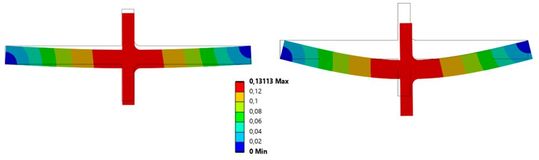
The visual representation of deformations is often greatly exaggerated to make effects visible. Figure 1 shows two representations of the same calculation—but which one is “correct”?
Figure 1: Which deformation is correct?
(Image: Weber Simulation Engineer)
The key factor is not the visual differences, but the actual values:
How much is the deformation scaled?
Where is the zero point (clamping)?
Do the absolute values meet the physical expectations?
Color scales: Red is not always "bad"
A particularly common pitfall is the choice of the color scale when red is intuitively considered critical, as shown in Figure 2. The reason for this is often the automatic scaling, which is based on the minimum and maximum—even if this maximum lies outside the displayed range.
Figure 2: The stresses apparently increase in the images from left to right.
(Image: Weber Simulation Engineer)
Was the color scale manually adjusted? If so, why?
Are contour bands missing that make the transition between different stress regions visible?
Tip: For variation calculations, the same color scale should always be used to make changes directly comparable.
Types of stress: Which is relevant for your component?
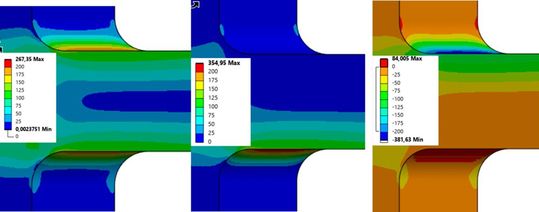
Figure 3 shows three different stress distributions of the same calculation: the von Mises equivalent stress, the maximum principal normal stress, and the minimum principal normal stress.
Figure 3: Different types of stress.
(Image: Weber Simulation Engineer)
Which one is relevant may depend on the material and the type of load:
For ductile materials, the von Mises stress is often the first choice.
Principal normal stresses are crucial for brittle materials or to distinguish between tensile and compressive areas.
Therefore, ask:
Which type of stress is being displayed—and why?
Is this stress actually meaningful for evaluating my component?
Meshing: The Invisible Framework of the Simulation
Meshing is often just a "black box." Yet, it plays a crucial role in determining the quality of the results.
Element types: Hexahedron vs. Tetrahedron
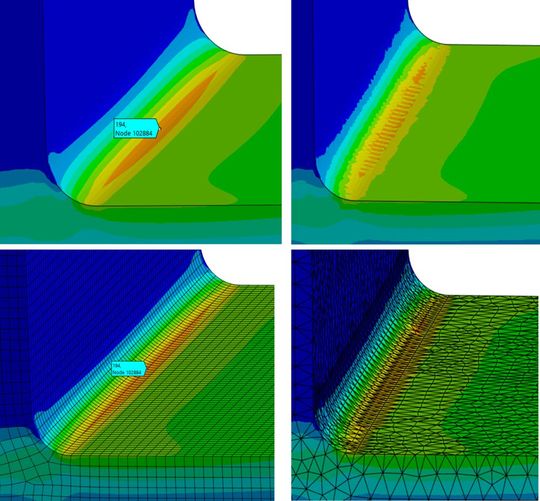
Figure 4 illustrates how different element types (hexahedron vs. tetrahedron) can lead to varying stress distributions. Both element types have their advantages and disadvantages:
Hexahedrons often provide more accurate results for regular geometries with faster computation times.
Tetrahedrons are more flexible for complex shapes but can produce local stress peaks with coarse meshing.
Figure 4: Different meshing – different stresses?
(Image: Weber Simulation Engineer)
Questions for the simulation engineer:
Which elements were used—and why?
Are stress peaks caused by the element quality?
How was mesh refinement ensured in critical areas?
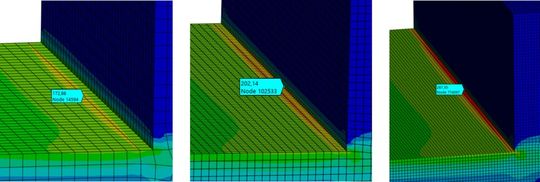
Mesh density: When is the mesh fine enough?
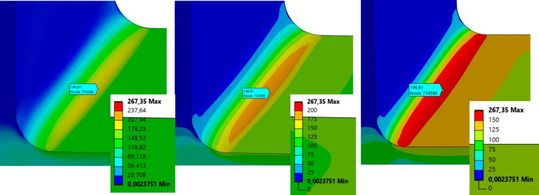
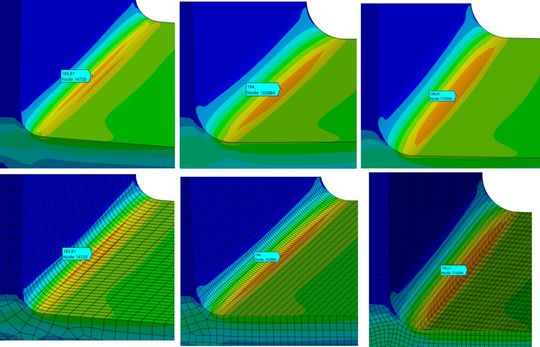
The maximum stress increases in Figure 5 with increasing mesh refinement (from 183 MPa to 196 MPa). This highlights the consideration of stress convergence. However, not every analysis relies on complete convergence. For structural stress concepts for weld seams or investigations of deformations, coarser meshes are often sufficient. The key is that the mesh refinement matches the specific question at hand.
Figure 5: The maximum stress increases from left to right: 183.81 MPa -> 194 MPa -> 196.81 MPa.
(Image: Weber Simulation Engineer)
In general, mesh quality plays a significant role in nonlinear simulations, such as contacts.
Verify Modeling
As a customer, it is important to understand the basics of modeling.
Boundary conditions: Realistic or deliberately conservative?
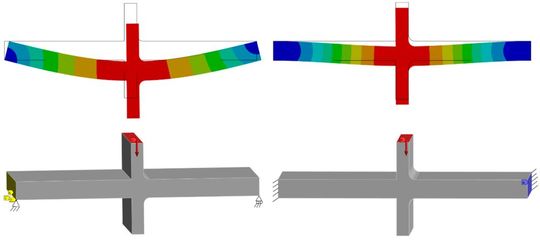
The choice of boundary conditions is one of the most common sources of error in simulations. Figure 6 shows how different constraints lead to completely different stress distributions.
Figure 6: Influence of different boundary conditions.
(Image: Weber Simulation Engineer)
Since the differences are not always so obvious, you should ask the following questions:
How realistic are the chosen boundary conditions? Do they correspond to the actual installation situation?
Do overly rigid constraints lead to excessive or insufficient stresses?
Would a more flexible support—for example, by including adjacent components—be more realistic?
Contacts: When components meet
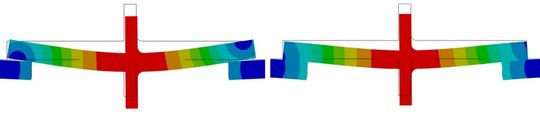
Contacts can be modeled differently, as shown in Figure 7: On the left, a gap opens between the components, while on the right, the contact remains closed. Which variant is realistic?
Figure 7: Influence of different contact conditions.
(Image: Weber Simulation Engineer)
How were the contacts modeled (bonded, frictional, with clearance)?
Was friction considered—and if so, with which coefficient of friction?
What influence do the contact definitions have on the overall result?
When we look at the deformation pattern of the fixed-free bearing, the deformation appears similar to that of the open contact. Is a contact even necessary here?
Geometry: Why details matter
Figure 8 shows a classic singularity: a sharp edge leading to non-convergent stresses. If a radius is modeled instead—as usually present in reality—the stress converges with increasing mesh density.
Figure 8: Geometric singularity.
(Image: Weber Simulation Engineer)
How detailed was the geometry modeled?
Were geometric simplifications made? If so, what are their effects?
How do details like holes or radii affect the result?
Evaluate Results Holistically
Plausibility: Does the result match the expectation?
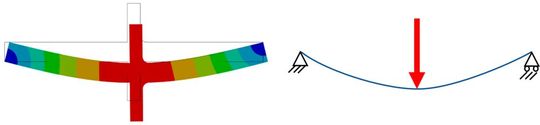
A first step in evaluating simulation results is to compare them with physical intuition. Figure 9 shows the comparison of an FEM calculation with an analytical hand calculation for a simple beam. If the results agree, this is a good sign. If there are discrepancies, either the model or one's own understanding must be questioned.
Figure 9: Verification through comparison with analytical calculation.
(Image: Weber Simulation Engineer)
What physical principles underlie the results?
Do the results align with your intuition and experience?
For which conditions is the FEM model valid? Where are its limitations? What was not captured?
Are the limitations of the simulation clear to all involved?
Result evaluation: The art of simulation
The critical evaluation of simulation results is crucial for the reliability and significance of the FEM analysis. Result evaluation means determining whether safety margins or specified limits are met, or whether optimizations are necessary.
According to which methods, guidelines, or experiences do you want or need to evaluate?
Critically question occurring stress peaks and singularities.
Which evaluation criteria are being applied?
Validation: The reality check
The gold standard of simulation is the comparison with experimental data.
Are there measurement data or tests? Is it necessary and possible to conduct experiments to verify the results?
How well do simulation and reality align?
How are deviations explained?
Conclusion: With Critical Questions to Well-Informed Decisions
FEM simulations are a powerful tool—but their significance depends on the quality of modeling, meshing, result representation, and evaluation. Engineers can assess the reliability of the results and make well-informed technical decisions by asking targeted questions. By understanding result representation, meshing, modeling, and the limitations of simulations, engineers are able to pose deeper and more focused questions. This enables them to better evaluate the quality and reliability of FEM analyses and make sound technical decisions.
Date: 08.12.2025
Naturally, we always handle your personal data responsibly. Any personal data we receive from you is processed in accordance with applicable data protection legislation. For detailed information please see our privacy policy.
Consent to the use of data for promotional purposes
I hereby consent to Vogel Communications Group GmbH & Co. KG, Max-Planck-Str. 7-9, 97082 Würzburg including any affiliated companies according to §§ 15 et seq. AktG (hereafter: Vogel Communications Group) using my e-mail address to send editorial newsletters. A list of all affiliated companies can be found here
Newsletter content may include all products and services of any companies mentioned above, including for example specialist journals and books, events and fairs as well as event-related products and services, print and digital media offers and services such as additional (editorial) newsletters, raffles, lead campaigns, market research both online and offline, specialist webportals and e-learning offers. In case my personal telephone number has also been collected, it may be used for offers of aforementioned products, for services of the companies mentioned above, and market research purposes.
Additionally, my consent also includes the processing of my email address and telephone number for data matching for marketing purposes with select advertising partners such as LinkedIn, Google, and Meta. For this, Vogel Communications Group may transmit said data in hashed form to the advertising partners who then use said data to determine whether I am also a member of the mentioned advertising partner portals. Vogel Communications Group uses this feature for the purposes of re-targeting (up-selling, cross-selling, and customer loyalty), generating so-called look-alike audiences for acquisition of new customers, and as basis for exclusion for on-going advertising campaigns. Further information can be found in section “data matching for marketing purposes”.
In case I access protected data on Internet portals of Vogel Communications Group including any affiliated companies according to §§ 15 et seq. AktG, I need to provide further data in order to register for the access to such content. In return for this free access to editorial content, my data may be used in accordance with this consent for the purposes stated here. This does not apply to data matching for marketing purposes.
Right of revocation
I understand that I can revoke my consent at will. My revocation does not change the lawfulness of data processing that was conducted based on my consent leading up to my revocation. One option to declare my revocation is to use the contact form found at https://contact.vogel.de. In case I no longer wish to receive certain newsletters, I have subscribed to, I can also click on the unsubscribe link included at the end of a newsletter. Further information regarding my right of revocation and the implementation of it as well as the consequences of my revocation can be found in the data protection declaration, section editorial newsletter.
About the author
Elmar Weber is a freelance simulation engineer with over 30 years of experience in mechanical engineering and drive technology. As a service provider "Weber Simulation Engineer," he offers the execution and evaluation of FEM simulations and calculations, automation of calculation processes, and programming of calculation tools.



:quality(80)/p7i.vogel.de/wcms/53/f7/53f7dadbe4d656a3fd4f4077445f29f6/0129828707v1.jpeg "Thanks to its compact design and drilling/unscrewing function, the Fire Birdie is suitable for applications with limited installation space and frequent tool changes. (Image:Marcel Kraibühler)")
:quality(80)/p7i.vogel.de/wcms/da/4d/da4da8d34671dc6bce80e496212de877/0129850788v1.jpeg "Mate-XT Go supports the arms and shoulders during overhead work and repetitive tasks and is designed to significantly reduce muscle strain in everyday working life. (Image:Comau)")
:quality(80)/p7i.vogel.de/wcms/95/97/95976dbaac68b249eb65e74c5aad5300/0129651893v1.jpeg "The C2.0 centric clamps, the S2 fixed jaw clamps and the \"gredoc\" zero-point clamping systems are used for machining the raw parts. Fastening is carried out with width across flats 27. (Image:Gressel)")
:quality(80)/p7i.vogel.de/wcms/57/1b/571b8895efb299d70846bbdbd7af2338/0130043886v1.jpeg "Servo hydraulics independent of the control system: The servo hydraulics software module is integrated directly into the b Maxx 5500 servo drive (pictured: Mehmet Sari, Export Sales Manager at Hürsan Pres (left), Özgür Deniz Demirbaş, Country Manager at Baumüller Turkey) (Image:Baumüller)")
:quality(80)/p7i.vogel.de/wcms/3b/27/3b27f6c5848be73acecb04054bf0a146/0130115209v1.jpeg "Spectroscopic glucose measurement with infrared spectroscopy enables more regular measurements without physical strain. (Image:Endrich)")
:quality(80)/p7i.vogel.de/wcms/3f/cc/3fccb748b0fe16f1f61249d94c72f126/0130149439v1.jpeg "Requirements for integrated power supply systems: Precise AC and DC power supply systems that not only provide energy, but also reliably combine measurement, analysis and system integration. (Image:Schulz Electronic)")
:quality(80)/p7i.vogel.de/wcms/fd/93/fd93e01c16f5a4709278499d981a459c/0130061090v1.jpeg "Revealed: These servo drives are assembled at Aerotech in Fürth. (Image:Aerotech)")
:quality(80)/p7i.vogel.de/wcms/cb/8a/cb8ae7f5205365efce3e7285154fc3cf/0130132198v1.jpeg "Markus Huber (left) and Nicolai Friis from TU Wien know how to make quantum computers multidimensional in order to perform computing operations even better. (Image:TU Vienna / A. Rommel)")
:quality(80)/p7i.vogel.de/wcms/63/21/6321beb732bf7d92640df46d7aa77573/0130125122v1.jpeg "As part of the Carbon Lab Factory Lausitz, a pilot plant for the production of sustainable, cost-effective and competitive carbon fibers will be built at the Guben site. (Image:Fraunhofer IAP / Kristin Stein)")
:quality(80)/p7i.vogel.de/wcms/53/4f/534fe0f168f6ee070ded4a48faca4cef/business-wire-main-image-1103x620v1.jpeg "The new UR AI Trainer, developed by Universal Robots and Scale AI, is the first direct lab-to-factory solution for AI model training.
(Source: Universal Robots)")
:quality(80)/p7i.vogel.de/wcms/08/70/087062e2e1a9b9add5777410dd746ee9/adobestock-1923991605-5607x3156v1v1.jpeg "A new type of tactile sensor, inspired by human skin, even recognizes grains of sand. (Image:Curioso.Photography - stock.adobe.com)")
:quality(80)/p7i.vogel.de/wcms/7f/08/7f087d7013424d123ab7275cd2e3fe55/adobestock-809456218--c2-a9-20degimages-20-e2-80-93-20stock-adobe-com-ki-generiert-4179x2351v1v1.jpeg "The digital upgrading of existing machines conserves resources, saves energy and reduces the need for new production. (Image:Degimages - stock.adobe.com/AI-generated)")
:quality(80)/p7i.vogel.de/wcms/90/db/90db3087d3af0560fcdb4dbc42443ce1/0130157448v1.jpeg "The switch to SDV is the most complex transformation the industry has ever had to master. The end consumer gets a vehicle that gains rather than loses value over its lifetime. (Image:Sonatus)")
:quality(80)/p7i.vogel.de/wcms/73/f0/73f00bb99a23197db05bb584fe78f20f/0130080581v1.jpeg "The \"China Speed\" analysis by Roland Berger shows that the speed of development has only a limited connection with labor costs. (Image:freely licensed at Pexels)")
:quality(80)/p7i.vogel.de/wcms/2f/5b/2f5ba6a150b52c2b8efada560c5cdafe/0130143442v1.jpeg "Automotive suppliers are facing a severe crisis, which is primarily due to a combination of structural change and economic problems. (Image:freely licensed at Pexels)")
:quality(80)/p7i.vogel.de/wcms/22/d0/22d03cd48e992435338b59464c428d41/0129739814v1.jpeg "More electric vehicles on the roads mean a higher demand for electricity - which should ideally be covered by renewable energies. (Image:BMW)")
:quality(80)/p7i.vogel.de/wcms/94/7a/947ac066b98cbcd3470e83ff9da3e25f/0130096114v1.jpeg "The use of amorphous steels in the stator enables a significant reduction in losses and increases the efficiency of modern electric motors in vehicle drives. (Image:Horse Powertrain)")
:quality(80)/p7i.vogel.de/wcms/e5/f1/e5f171d3d7ae021332cc0aeae4d6e299/0130127049v1.jpeg "In collaboration with Shanghai Jiao Tong University, Lenovo has presented a silicon anode battery under the name \"ED1000\" as a proof of concept for mobile workstations. (Image:Lenovo)")
:quality(80)/p7i.vogel.de/wcms/fa/69/fa696e59706b96fff02283dd74cc2398/0130129635v1.jpeg "Samsung Co-CEO Jun Young-hyun wants to respond to the AI-driven boom in demand in the memory market with contracts for up to five years. This should provide more planning security in the traditionally volatile storage business. At the same time, however, this is likely to increase the pressure on customers to secure precise long-term requirements, prices and supply chains. (Image:Samsung)")
:quality(80)/p7i.vogel.de/wcms/31/a8/31a883a47b86634c382923e78fd9a4c9/0130133225v1.jpeg "Figure 1: GMSL-capable point-to-point connection. (Image:ADI)")
:quality(80):fill(efefef,0)/p7i.vogel.de/wcms/67/ad/67adf92d254d2/elatec-wp-smart-factory.png "Elatec WP Smart Factory")
:quality(80)/p7i.vogel.de/wcms/5c/0f/5c0fee074c4b6c8e8c0993f3217c2f5a/0129773718v1.jpeg "The General Fusion demonstration reactor. (Image:General Fusion)")
:quality(80)/p7i.vogel.de/wcms/d2/67/d267ba3af7c247551ff9b551a56aa070/0127356572v1.jpeg "In focus: the new version of the FVA-Workbench (pictured) and optimized solutions from Kisssoft and GWJ Technology. (Image:FVA)")