Anyone like Frank Verzahnungstechnik, who as a highly specialized contract manufacturer decides several times within a few years for a robot cell from Halter CNC Automation, must have good reasons for this. A case study on a well-thought-out strategy.
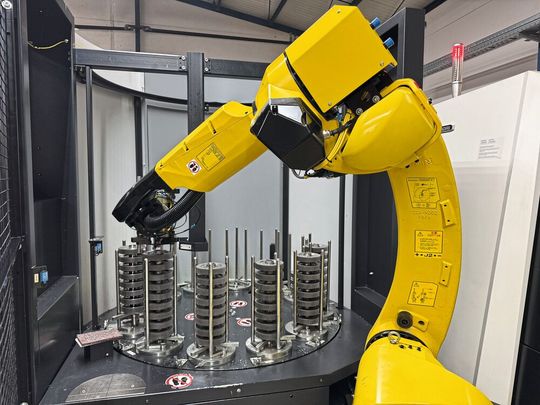
The TurnStacker Premium offers an extremely compact robot cell with particularly high workpiece capacity on a small footprint and is designed for parts with a diameter of up to 230 mm (approx. 9,1 inches).
(Image: Frank Verzahnungstechnik e. K.)
Frank Verzahnungstechnik, based in Wehr (Germany), is an expert in the production of high-precision gears for complex drive technology. "With 20 employees, we manufacture gearbox components such as gears, pinion shafts, or worms for general mechanical engineering," explains owner Martin Frank. Accordingly, the range of industries for which the company produces is diverse. These include the packaging industry, hydraulics industry, robotics and handling technology, cleanroom and vacuum technology, medical technology, and the food industry, among others.
Extremely high manufacturing depth
The products are manufactured exclusively based on customer specifications. According to Martin Frank, the depth of production is therefore extremely high: "Our services range from raw material procurement through all work processes, including the most complex grinding processes, to the finished product. These can be single parts, but also batches of 5, for example, up to larger series of 5,000 pieces. Since we essentially always produce customer- or product-specific special designs, we are anything but a classic mass production. That is why we have a very complex production in which you will find few identical machines."
Gallery
Given the batch sizes to be produced, the high degree of automation is a particular strength of Frank Verzahnungstechnik. "From a quantity of 50, production is certainly already automated. This allows us to react very flexibly and quickly even with comparatively small batches and to manufacture extremely economically. Compared to other contract manufacturers, this is undoubtedly a significant competitive advantage," says Martin Frank.
Automated manufacturing of larger workpieces
This was also one of the decisive reasons why the company invested in a TurnStacker Premium robot cell from Halter CNC Automation for the automated loading and unloading of a lathe for the first time in 2017. Frank Verzahnungstechnik already had solutions for partial automation, for example with bar feeders on lathes. However, the dimensions of the workpieces to be machined sometimes far exceed the classic bar automation, which usually only covers diameters of around 60 to 65 millimeters (approx. 2,4 to 2,6 inches). Therefore, series with larger quantities and part diameters of up to 210 millimeters (approx. 8,2 inches) were manufactured on vertical lathes.
Convincing robotics concept
To automate the process, rotary tables were used, for example, which, however, have a limited workpiece capacity. "In this configuration, only one-sided machining is possible. However, we primarily wanted to promote automated two-sided machining in the turning shop. For larger components, this can be realized either with a turning station and two machines or with a robot that loads a horizontal lathe. In our case, this was a CTX beta 800 from DMG Mori, which has a main and counter spindle with identical performance data. Therefore, we can perform relatively strong turning operations on both sides of the workpiece, which is essential for machining our larger components," explains Martin Frank, who first saw the TurnStacker Premium at a trade fair. The concept of the robot cell was convincing. "In particular, the stacking stations for rotationally symmetrical parts seemed to me at the time to be the most flexible and sensible for our components, which subsequently proved to be absolutely correct."
High workpiece capacity in a small footprint
The TurnStacker Premium offers an exceptionally high workpiece capacity on a small footprint as a highly compact robot cell and is designed for parts with a diameter of up to 230 millimeters (approx. 9,1 inches). The automation concept is very simple, especially with regard to the operators of the cell, and is therefore immediately comprehensible. The rotating workpiece buffer has a total of twelve adjustable stacking stations. At the start of production, eleven of these stations are equipped with raw parts, while the last station is reserved for depositing the first finished parts.
A special feature of the robot cell is the two lift devices monitored by laser sensors at a specific pick-up and placement position of the workpiece buffer. At the pick-up position, the lift device positions the raw parts so that the robot can take the first top workpiece with its gripper. For placing the machined parts in the designated stacking station, the lift device at the placement position lowers the finished parts accordingly until the station is completely filled with components.
For workpiece handling, the robot uses a double gripper, allowing it to remove a finished part from the machine and immediately supply the machine with a raw part. While the robot continuously loads and unloads the machine, an operator can simultaneously remove finished parts from the secured back of the cell and supply the workpiece buffer with new raw parts.
Process reliability is the top priority
Frank Verzahnungstechnik processes workpieces with diameters of up to 200 millimeters(approx. 7,9 inches) and heights of up to 40 millimeters (approx. 1,6 inches) using automation. For smaller diameters, the workpiece height can be 80 to 90 millimeters (approx. 3,1 to 3,5 inches). According to Martin Frank, the dimensions of the workpieces change every two to three days, so the cell must be adjusted accordingly, which generally takes only a short amount of time.
Date: 08.12.2025
Naturally, we always handle your personal data responsibly. Any personal data we receive from you is processed in accordance with applicable data protection legislation. For detailed information please see our privacy policy.
Consent to the use of data for promotional purposes
I hereby consent to Vogel Communications Group GmbH & Co. KG, Max-Planck-Str. 7-9, 97082 Würzburg including any affiliated companies according to §§ 15 et seq. AktG (hereafter: Vogel Communications Group) using my e-mail address to send editorial newsletters. A list of all affiliated companies can be found here
Newsletter content may include all products and services of any companies mentioned above, including for example specialist journals and books, events and fairs as well as event-related products and services, print and digital media offers and services such as additional (editorial) newsletters, raffles, lead campaigns, market research both online and offline, specialist webportals and e-learning offers. In case my personal telephone number has also been collected, it may be used for offers of aforementioned products, for services of the companies mentioned above, and market research purposes.
Additionally, my consent also includes the processing of my email address and telephone number for data matching for marketing purposes with select advertising partners such as LinkedIn, Google, and Meta. For this, Vogel Communications Group may transmit said data in hashed form to the advertising partners who then use said data to determine whether I am also a member of the mentioned advertising partner portals. Vogel Communications Group uses this feature for the purposes of re-targeting (up-selling, cross-selling, and customer loyalty), generating so-called look-alike audiences for acquisition of new customers, and as basis for exclusion for on-going advertising campaigns. Further information can be found in section “data matching for marketing purposes”.
In case I access protected data on Internet portals of Vogel Communications Group including any affiliated companies according to §§ 15 et seq. AktG, I need to provide further data in order to register for the access to such content. In return for this free access to editorial content, my data may be used in accordance with this consent for the purposes stated here. This does not apply to data matching for marketing purposes.
Right of revocation
I understand that I can revoke my consent at will. My revocation does not change the lawfulness of data processing that was conducted based on my consent leading up to my revocation. One option to declare my revocation is to use the contact form found at https://contact.vogel.de. In case I no longer wish to receive certain newsletters, I have subscribed to, I can also click on the unsubscribe link included at the end of a newsletter. Further information regarding my right of revocation and the implementation of it as well as the consequences of my revocation can be found in the data protection declaration, section editorial newsletter.
Work is done in two shifts. The day shifts are mainly reserved for the production of more complex components. The robot loads and unloads the lathe autonomously for up to two hours, depending on the workpiece and batch size, which ranges from hundreds to several thousand pieces. "The materials of our gear parts are usually very abrasive. Therefore, the manufacturing process needs to be cyclically monitored by an employee, for example, to replace a cutting insert or adjust a dimension in time. Certainly, every machine manufacturer has their own monitoring concepts, including for tool life or tool breakage. These are standard processes that, of course, run in our operations as well. However, we operate specifically in a quality environment with very high demands, where mere monitoring of wear limits is not sufficient, and this is exactly where our employees come into play for process control."
The production of simpler components is deliberately shifted by Frank Verzahnungstechnik to a third unmanned shift. For this, the machine and the TurnStacker Premium are prepared for fully automated production throughout the night before the end of the second shift.
Repeated decision for proven solution
Around a year ago, Frank Verzahnungstechnik further expanded production capacities in the turning shop, including modernization with a CLX 450 V6 turning center from DMG Mori, also with a main and counter spindle. Due to the extremely positive experiences with the first robot cell from Halter CNC Automation, it was already decided in advance to automate this machine with a TurnStacker Premium as well.
"The new machine, together with the robot cell, gives us the same possibilities as the system that has been in place since 2017. We thus achieve a certain redundancy on various levels, as we pursue the same manufacturing concept with both solutions and can therefore produce the same components. This has significantly increased our flexibility in turning parts production, enabling us to make the best possible use of production resources for our customers and respond even faster," concludes Martin Frank. (st)



:quality(80)/p7i.vogel.de/wcms/af/1e/af1ec4fca4636f521f780ba0ae009c8e/bild3-werkst-c3-bcck-20und-20werkzeug-5204x2928v1v1.jpeg "The main area of application for the new axial gear cutting machine is the production of rotor shafts for electric vehicles. (Image:Profiroll Technologies)")
:quality(80)/p7i.vogel.de/wcms/d1/ab/d1ab452217529e5c29a81add9aca7c22/0128871322v1.jpeg "Only one year to go: the new EU Machinery Regulation makes cybersecurity mandatory. Companies should act now. (Picture: ©Pisit - stock.adobe.com)")
:quality(80)/p7i.vogel.de/wcms/88/53/8853f7df2fe47a3d2c6f1879f6ac38e6/newsimage417073-1500x843v1v1.jpeg "Measuring setup for friction stir welding: Modular acoustic measuring system with flexibly positioned microphones for recording tool wear and process deviations in real time. (Image:Fraunhofer IDMT)")
:quality(80)/p7i.vogel.de/wcms/28/75/28751a17e2bcca46e53a1e7b8a84c433/schmersal-tiepner-029-6749x3796v1v1.jpeg "Tiepner's compact system produces ID cards made of laminated plastic, which are used as customer cards, ID cards or cheque cards, among other things. Left in the picture: Christian Höltge, Managing Director of Tiepner GmbH. (Image:Tiepner GmbH)")
:quality(80)/p7i.vogel.de/wcms/cd/fe/cdfe212a3b3206e2ff09dcdf71c11240/0129219561v1.jpeg "Extended S-series: The new Cobot models from Omron lift up to 30 kilograms and are now also protected against dust and water thanks to protection class IP65. (Image:Omron)")
:quality(80)/p7i.vogel.de/wcms/c3/6d/c36d161e7709095fd1de4cb9de27d927/0129133682v1.jpeg "Nanjing is Siemens' largest research and production center for CNC systems, drives and electric motors outside Germany. (Image:Siemens)")
:quality(80)/p7i.vogel.de/wcms/70/dc/70dc2fbc09e6958a72c63bd15e986e14/0129206156v1.jpeg "The global shoe machine manufacturer Desma relies on automation and has been revolutionizing shoe production—together with ABB Robotics for over 40 years. (Image:ABB Robotics)")
:quality(80)/p7i.vogel.de/wcms/60/fd/60fd12ddfe1fb623568736f27d1cfe61/0128606899v1.jpeg "The future of supply chains: AI and dashboards to ensure optimal OTIF values (Picture: ©immimagery - stock.adobe.com)")
:quality(80)/p7i.vogel.de/wcms/39/38/393873c2ed943bb715a6419d94049b63/geralt-entrepreneur-1340649-1280-1280x720v1v1.jpeg "Visual Components presents its forecast for production simulation in 2026. (Image:Pixabay)")
:quality(80)/p7i.vogel.de/wcms/60/4e/604e2a1ce26f177c5f28c2bff94c2f7d/der-20rotor-20mit-20aktiv-20verwindbaren-20rotorbl-c3-a4ttern-20im-20windkanal-1920x1079v1v1.jpeg "The rotor with actively twistable rotor blades in the wind tunnel: The open measuring section and sound-absorbing wall and model fuselage cladding enable high-quality acoustic measurements. (Image:DLR)")
:quality(80)/p7i.vogel.de/wcms/a8/9a/a89aef1cba3843fa06a1ec1f07cf659b/adobestock-95634179--c2-a9-20crazyforanimeart-20-e2-80-93-20stock-adobe-com-4762x2678v1v1.jpeg "Copied from the octopus: Researchers have developed a film-like thin-film platform that can dynamically change not only its color but also its surface structure. (Image:AdobeStock_95634179_ CrazyForAnimeArt)")
:quality(80)/p7i.vogel.de/wcms/2b/fb/2bfbb9fa26274cb8f6e8979c24a3d08e/0129243542v1.jpeg "In some cases, the new additively manufactured lightweight bearings only reach
11 percent of the weight of comparable steel bearings. (Image:Rosswag Engineering)")
:quality(80)/p7i.vogel.de/wcms/25/11/25111828d56b46dc0dc3b717ac2dfcfa/0129276081v1.jpeg "According to media reports, Ford is negotiating with Geely about cooperation in production and technology. (Image:Ford)")
:quality(80)/p7i.vogel.de/wcms/b7/2d/b72dfd1458e86652491018914478cb00/0129259253v1.jpeg "The green belt of VW Palmela - including two geothermal fields and a new paint shop. (Image:VW Group)")
:quality(80)/p7i.vogel.de/wcms/cb/76/cb76d0c686e8dbc8b0e0b6961e3849c7/0129249515v1.jpeg "The Chinese Ministry of Industry and Information Technology has developed binding standards for retractable vehicle door handles. (Image:BYD)")
:quality(80)/p7i.vogel.de/wcms/42/0a/420a796e6b9d9e3bf27d89d4fe425d84/0129264331v1.jpeg "Polestar presented the new Model 5 live. (Image:Polestar)")
:quality(80)/p7i.vogel.de/wcms/6f/8f/6f8ff5bf9b81829ef22736bc790cecca/0129224894v1.jpeg "View of the quantum optics laboratory at the University of Stuttgart: here, researchers are experimenting with new photon sources for quantum computing and quantum networks. (Image:Barz Group, University of Stuttgart)")
:quality(80)/p7i.vogel.de/wcms/52/3a/523ac3157ae4b4f596c7241c89127061/0129260553v1.jpeg "This artistic illustration shows a thermal analog calculator that performs calculations using excess heat and is embedded in a microelectronic system. (Image:Jose-Luis Olivares, MIT)")
:quality(80)/p7i.vogel.de/wcms/d1/f4/d1f4508c6b79ec2f0432b34a6fa33a98/0114966184v1.jpeg "The Infineon headquarters Campeon in Neubiberg, Munich. (Image:Infineon)")
:quality(80)/p7i.vogel.de/wcms/fa/d3/fad3872cf3f110f43411f2dce9e8f23a/0129265762v1.jpeg "Siemens Energy has discovered the USA as a prosperous growth market for network technology and gas turbines! In order to be able to meet demand at some point, the company is already digging deeper into its pockets ... (Image:Siemens Energy)")
:fill(fff,0)/images.vogel.de/vogelonline/companyimg/76800/76895/65.jpg "FAULHABER_120mm.jpg ()")
:fill(fff,0)/p7i.vogel.de/companies/67/eb/67eba621ef6ea/logo2.png "logo2 (Wuxi InfiMotion)")
:quality(80)/p7i.vogel.de/wcms/61/a8/61a8dc971c9b011eb052f33a0c7aa4d1/0122489051v1.jpeg "Martin Frank, owner of Frank Verzahnungstechnik: \"We shift the production of simpler components primarily to a third unmanned shift. For this purpose, before the end of the second shift, the machine and the TurnStacker Premium are prepared for fully automated production throughout the night.\"(Image: Frank Verzahnungstechnik e. K.)")
:quality(80)/p7i.vogel.de/wcms/bf/8e/bf8e3662835da157e9388d6c0d41025e/0122489040v1.jpeg "For workpiece handling, the robot uses a double gripper, allowing it to remove a finished part from the machine and immediately supply the machine with a raw part.(Image: Frank Verzahnungstechnik e. K.)")
:quality(80)/p7i.vogel.de/wcms/81/07/810724d73b9d7eef3e1f0507466e6b54/0122489048v1.jpeg "The second TurnStacker Premium from Halter CNC Automation has been used for about a year for the automated loading and unloading of a new CLX 450 V6 turning center from DMG Mori.(Image: Frank Verzahnungstechnik e. K.)")
:quality(80)/p7i.vogel.de/wcms/8d/5c/8d5c9309711fc4fe54b7ffc774788579/0122489036v1.jpeg "While the robot continuously loads and unloads the machine, an operator can simultaneously remove finished parts from the secured back of the cell and replenish the workpiece buffer with new raw parts.(Image: Frank Verzahnungstechnik e. K.)")
:quality(80):fill(efefef,0)/p7i.vogel.de/wcms/67/ad/67adf4a647532/elatec-wp-machine-authentication.png "Elatec WP Machine Authentication")
:quality(80)/p7i.vogel.de/wcms/ac/ad/acadb99a337f96d31b740d7dd0ea7bbe/0123218707v1.jpeg "Martin Frank, owner of Frank Verzahnungstechnik: \"The production of simpler components will be shifted primarily to a third unmanned shift. For this, before the end of the second shift, the machine and the Turnstacker Premium are prepared for fully automated production throughout the night.\" (Image:Frank Verzahnungstechnik e. K.)")
:quality(80)/p7i.vogel.de/wcms/8b/c7/8bc7380a7e8dc5dcb9d7337383e93e46/0127912129v1.jpeg "For the second machining step, the thin-walled component is moved into the gap between the inner and outer tool. (Image:Mapal)")