Siemens has used chemically recycled polyamide 6 in a safety-relevant housing of an RCD circuit breaker for the first time. Material-specific characteristics, recycling technology, and industrial validation must be considered in this process.
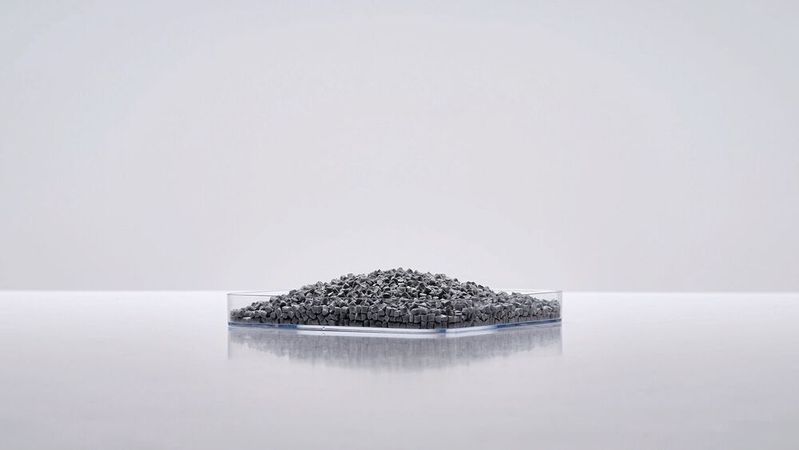
For the housing of the Sentron 5SV3 RCD circuit breaker, Siemens is using a UL-certified PA6 compound made from chemically recycled industrial waste for the first time. The Technyl-4-Earth developed by DOMO offers the performance of a primary polyamide—with approximately 20% lower CO₂ footprint.
(Image: Domo)
The requirements for housing materials for residual current circuit breakers are clearly defined—they include thermal and mechanical durability, flame resistance without halogen-based additives, reliable electrical insulation, and dimensional stability under temperature influence. In the case of the Sentron 5SV3, an FI switch of type A or AC, additional requirements such as high switching cycle durability (over 10,000 cycles according to IEC 61008-1) and permanent marking capability come into play. Siemens has broken new ground by using Technyl-4-Earth in exactly this application—for the first time, a compound with 50 percent recycled content has been used in a UL-certified safety-critical plastic housing at a serial scale.
Lower CO2 Footprint With Full Functionality
The material, developed in collaboration with Domo, is based on chemically recycled polyamide 6, which is recovered from industrial textile waste and fibers. The unique aspect lies in the processing method: the PA6 is depolymerized into caprolactam, purified, and then repolymerized. This produces a PA6 with the technical properties of a primary polyamide—but with significantly lower environmental impact. According to Domo, the material's carbon footprint is reduced by approximately 20 percent (cradle-to-gate) compared to the fossil-based reference, while maintaining the same functionality.
Gallery
The compound used, Technyl-4-Earth C52G1 V25 CR GY 2747, combines a halogen-free flame retardant system with a 25 percent glass fiber reinforcement. The formulation was adjusted to ensure that neither demolding nor dimensional stability causes issues under serial production conditions—a crucial point, as the components are manufactured in existing injection molding tools. Siemens confirmed in internal tests that the mechanical, thermal, and electrical properties meet the requirements. Additionally, both laser markability and the desired color stability in the specific gray tone RAL 7035, which is frequently used in the electrical market, were achieved. The UL certification for use in flame-retardant applications is available and also valid for variants with chemically recycled content, as confirmed by Domo.
Processing takes place in Siemens' own manufacturing facilities, including the Regensburg site. Only green electricity is used there—a criterion necessary to meet the internal Siemens Eco-Tech label. This label evaluates new products across three dimensions:
sustainable material selection
optimal use and
circularity
The use of Technyl-4-Earth in the 5SV3 Type A/AC not only formally meets these requirements but has also been validated by TÜV Rheinland as part of the Siemens governance model.
Eco-Design As Part of Product Development
At Siemens, during the conceptual phase, the so-called eco-design process is used to examine how a product can be improved from an environmental perspective—whether through alternative materials, more resource-efficient designs, or more efficient use. The evaluation is carried out according to an internal framework that takes into account the manufacturing phase, the operating phase, and disposal.
Special attention is placed on material usage. Therefore, in the early phase of the project, the housing material was analyzed for its environmental impact—including through a life cycle assessment (LCA) that Siemens conducts for all relevant product lines. Combined with an EPD (Environmental Product Declaration), this creates a high degree of transparency for customers and regulatory authorities.
The project clearly demonstrated that using a recycled polyamide does not automatically result in performance losses. The material enabled a double-digit percentage reduction in CO₂ emissions without compromising safety-critical properties.
Joint path to series production
The close cooperation between Domo and Siemens' manufacturing and development teams was crucial in enabling critical material issues such as dimensional stability, aging behavior, and flame resistance to be assessed and adjusted at an early stage. Despite its high recycled content, Technyl-4-Earth, unlike traditional mechanical recyclates, meets the flame retardant properties required for UL certification.
Overall, the project demonstrates that recycling technologies can now also be implemented in safety-critical applications—provided material selection is coordinated early and the requirements are clearly defined. The 5SV3 switch not only meets technical standards but also shows that a robust sustainability approach in industrial production is feasible without compromising material quality.
By using Technyl-4-Earth, Siemens sends a clear signal to the industry: chemically recycled engineering plastics are no longer a research topic but an industrially scalable reality—even in highly regulated application fields. The key to this success lies in the combination of recyclable material technology, transparent life cycle assessment, and industrial partnerships on equal footing.
Date: 08.12.2025
Naturally, we always handle your personal data responsibly. Any personal data we receive from you is processed in accordance with applicable data protection legislation. For detailed information please see our privacy policy.
Consent to the use of data for promotional purposes
I hereby consent to Vogel Communications Group GmbH & Co. KG, Max-Planck-Str. 7-9, 97082 Würzburg including any affiliated companies according to §§ 15 et seq. AktG (hereafter: Vogel Communications Group) using my e-mail address to send editorial newsletters. A list of all affiliated companies can be found here
Newsletter content may include all products and services of any companies mentioned above, including for example specialist journals and books, events and fairs as well as event-related products and services, print and digital media offers and services such as additional (editorial) newsletters, raffles, lead campaigns, market research both online and offline, specialist webportals and e-learning offers. In case my personal telephone number has also been collected, it may be used for offers of aforementioned products, for services of the companies mentioned above, and market research purposes.
Additionally, my consent also includes the processing of my email address and telephone number for data matching for marketing purposes with select advertising partners such as LinkedIn, Google, and Meta. For this, Vogel Communications Group may transmit said data in hashed form to the advertising partners who then use said data to determine whether I am also a member of the mentioned advertising partner portals. Vogel Communications Group uses this feature for the purposes of re-targeting (up-selling, cross-selling, and customer loyalty), generating so-called look-alike audiences for acquisition of new customers, and as basis for exclusion for on-going advertising campaigns. Further information can be found in section “data matching for marketing purposes”.
In case I access protected data on Internet portals of Vogel Communications Group including any affiliated companies according to §§ 15 et seq. AktG, I need to provide further data in order to register for the access to such content. In return for this free access to editorial content, my data may be used in accordance with this consent for the purposes stated here. This does not apply to data matching for marketing purposes.
Right of revocation
I understand that I can revoke my consent at will. My revocation does not change the lawfulness of data processing that was conducted based on my consent leading up to my revocation. One option to declare my revocation is to use the contact form found at https://contact.vogel.de. In case I no longer wish to receive certain newsletters, I have subscribed to, I can also click on the unsubscribe link included at the end of a newsletter. Further information regarding my right of revocation and the implementation of it as well as the consequences of my revocation can be found in the data protection declaration, section editorial newsletter.
Domo is already planning to further expand its sustainable material portfolio and provide both PA6 and PA66 compounds based on various recycling technologies for applications requiring flame retardancy.
Future-Proof Authentication with Universal RFID Readers



:quality(80)/p7i.vogel.de/wcms/dd/08/dd086510d9ae7b50181f6070e4463b44/0129363730v1.jpeg "Typical application for ionizing devices: Wrapping films. (Picture: ©Adobe Stock/SMC)")
:quality(80)/p7i.vogel.de/wcms/35/57/3557c819943c53acec41a0ccba87da4f/0130049064v1.jpeg "Researchers at the Fraunhofer IWU in Chemnitz have long known that many typical sheet metal parts can be manufactured more cost-effectively using hollow embossing rollers. Now there is news to report ... (Image:Fraunhofer IWU)")
:quality(80)/p7i.vogel.de/wcms/59/02/590246e3b3f415c65edbee377c14ca77/26-06-pi-fraunhofer-iws-41450-direktplattieren-pic-01-7771x4369v1v1.jpeg "The Fraunhofer IWS has developed the new \"direct laser cladding\" process, which creates a functional layer directly on the base body by applying a strip-shaped metal to rotationally symmetrical components in a spiral and bonding it locally by laser. (Image:Christoph Wilsnack/Fraunhofer IWS)")
:quality(80)/p7i.vogel.de/wcms/73/60/73608418789b1d9c393f5e2fa974eda2/0130209906v1.jpeg "The robots of the X6 generation from b+m enable very high painting quality and are also particularly compact and easy to maintain. (Image:Beckhoff)")
:quality(80)/p7i.vogel.de/wcms/78/e9/78e9188c25a8a94e67c34c9bf8ffe495/visual-agile-20robots-20and-20google-20deepmind-20partner-20to-20bring-20intelligence-20to-20robotics-2500x1406v1v1.jpeg "Together, the partners are developing adaptable, intelligent robots for a wide range of applications (Image:Agile Robots SE)")
:quality(80)/p7i.vogel.de/wcms/e7/66/e7669ecf0260ae8fc54c214e34e4902a/0130316817v1.jpeg "Siemens and Palo Alto Networks offer tested cybersecurity solution for industrial 5G. (Image:Siemens)")
:quality(80)/p7i.vogel.de/wcms/9f/55/9f55324832c4f426958031375124d9de/siemens-20ubtech-20hmnd-1920x1079v1v1.png "Ready for the factory floor: While Ubtech is planning mass production, Siemens is already testing humanoids in real factory applications in Erlangen. (Image:Siemens)")
:quality(80)/p7i.vogel.de/wcms/11/36/113695ed260e29c8c2d9d39dc5f9d869/0130213768v1.jpeg "AI can work cheaply in China and deliver the results rapidly all over the world. (Image:Dall-E / AI-generated)")
:quality(80)/p7i.vogel.de/wcms/62/5f/625f41e87ebfef156a98c8e6393e32fd/0130211654v1.jpeg "Axial flux motors have some advantages over radial flux motor—but their production is currently still expensive. (Image:RWTH Aachen University)")
:quality(80)/p7i.vogel.de/wcms/77/9b/779b0685d010dfe45c9c2cb1cfecd467/0128886425v1.jpeg "The BlueEye is the first \"real\" hyperspectral camera for the UV range and covers the wavelength range from 220 to 380nm. (Image:Inno-spec GmbH)")
:quality(80)/p7i.vogel.de/wcms/e4/51/e451d52ce0182fb0aaa46a5774f832ef/26-04-pi-fraunhofer-iws-21160-bioslide-pic-01-4128x2321v1v1.jpeg "With the BioSlide research project, the Fraunhofer IWS is investigating how sliding systems can be designed to be more sustainable and energy-efficient. New materials can be tested in a particularly application-oriented manner on this plain bearing test stand. (Image:Fraunhofer IWS)")
![Thanks to advanced 3D printing technology, a more efficient use of resources should contribute to lower-emission aviation—this is the goal of ['skai]-lab. (Image:Oleksandr Pashchenko - stock.adobe.com / AI-generated)](https://cdn1.vogel.de/nghHNSbySccfOjG3n1qCA-FVOjQ=/288x162/smart/filters:format(jpg):quality(80)/p7i.vogel.de/wcms/62/64/626424c97a16e69f871bf216c9629c2a/adobestock-1927043193--c2-a9-20oleksandr-20pashchenko-20-e2-80-93-20stock-adobe-com-ki-generiertv1v1.jpeg "Thanks to advanced 3D printing technology, a more efficient use of resources should contribute to lower-emission aviation—this is the goal of ['skai]-lab. (Image:Oleksandr Pashchenko - stock.adobe.com / AI-generated)")
:quality(80)/p7i.vogel.de/wcms/c3/c4/c3c4ce270b083eeac55654148611f064/0130237945v1.jpeg "China is not giving up on hydrogen, but is intensifying its efforts. (Image:freely licensed from Pixabay)")
:quality(80)/p7i.vogel.de/wcms/4e/c0/4ec0bd19390b169edfa23677373dcdf1/0130260089v1.jpeg "Renewable fuels can supply European road traffic, according to a study. (Image:Aral)")
:quality(80)/p7i.vogel.de/wcms/6f/c9/6fc9050301d745cad25585c6780f8f51/0130197341v1.jpeg "Production facilities are a worthwhile target and are therefore at risk. (Image:ABB Robotics)")
:quality(80)/p7i.vogel.de/wcms/b6/62/b662adc2cec8227d8172509bbfb6ee42/25c0207-107-4961x2789v1v1.jpeg "The GLB is the second model based on Mercedes' new MMA platform. Apparently, Geely's platform is better and cheaper, which is why the two companies are negotiating a partnership. (Image:Mercedes-Benz)")
:quality(80)/p7i.vogel.de/wcms/4d/dd/4dddf438e91f394c04a095dbfd109d1c/0130236430v1.jpeg "Measurement modules: The 720301 module in combination with the SL2000 enables RMS and power calculations, among other things. (Image:Yokogawa)")
:quality(80)/p7i.vogel.de/wcms/61/fc/61fcf95f5cca15494ad18343901ae585/0130317237v1.jpeg "With the AGI CPU, Arm says it is taking a \"historic step\": With the processor aimed at AI in data centers, the company is presenting itself for the first time as a provider of its own chips, not just as a pure IP licensor. (Image:Arm)")
:quality(80)/p7i.vogel.de/wcms/82/90/8290dfe3595b6c6b33726ae8b76172c7/0130319587v1.jpeg "The concept image illustrates how the pattern of tiny protrusions and depressions created on the substrate (MgO, bottom) controls the arrangement of atoms in the superconducting material (YBCO, top). At the interface between the two layers, an electronic structure enables superconductivity to occur at higher temperatures than previously possible. (Image:Chalmers University of Technology / Riccardo Arpaia)")
:fill(fff,0)/images.vogel.de/vogelonline/companyimg/76800/76895/65.jpg "FAULHABER_120mm.jpg ()")
:fill(fff,0)/p7i.vogel.de/companies/69/88/69882c428938e/tmts2026-ticec-banner-en-2000px.png "tmts2026-ticec-banner-en-2000px (https://www.tmts.tw/en)")
:quality(80)/p7i.vogel.de/wcms/19/7c/197c60d957224013316dc09edf203ec0/0126627893v1.jpeg "The Sentron 5SV3 RCD circuit breaker meets requirements for thermal and mechanical load capacity, flame retardancy, and dimensional stability – designed for over 10,000 switching cycles according to IEC 61008-1.(Image: Siemens)")
:quality(80)/p7i.vogel.de/wcms/27/44/274495d6e6c4c47b96c5a83220115adf/0126627897v1.jpeg "The circuit breakers are assembled at the Siemens site in Regensburg.(Image: Siemens)")
:quality(80)/p7i.vogel.de/wcms/86/78/86789fb70dd1ce692c31eca7af460a2f/0126627889v1.jpeg "For the housing of the Sentron 5SV3 RCD circuit breaker, Siemens is using a UL-certified PA6 compound made from chemically recycled industrial waste for the first time. The Technyl-4-Earth, developed by DOMO, offers the performance of a primary polyamide – with approximately 20% lower CO₂ footprint.(Image: Domo)")
:quality(80):fill(efefef,0)/p7i.vogel.de/wcms/67/ae/67ae0b9ac31f8/elatec-wp-universal-reader.png "Elatec WP Universal Reader")
:quality(80)/p7i.vogel.de/wcms/82/15/8215f9f8990daed00c6cf93765559baa/0127161770v1.jpeg "BASF has developed two new recycling processes for polyamide. The company and its partners have produced and tested prototypes. Pictured: a chain guide rail from Pöppelmann for Mercedes-Benz. (Image:BASF)")
:quality(80)/p7i.vogel.de/wcms/61/7a/617ae764407c0819b0b649af5fbbdf55/0128163548v1.jpeg "At the end of their lifecycle, Soluboard PCBs can be dissolved in hot water, causing their copper traces and integrated circuit chips to detach and subsequently be recycled. (Image:University of Glasgow James Watt School of Engineering)")