A few years ago, Siemens Mobility received a major order from Egypt for the construction of 2000 km (approx. 124 miles) of high-speed track and the delivery of a total of 131 multiple units and locomotives. The first vehicles are now ready.
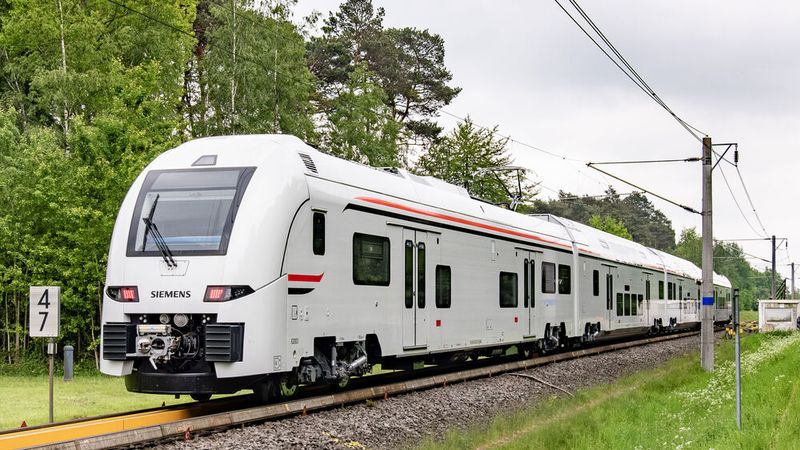
Egypt has ordered 94 desert-proof Desiro HC trains for its new high-speed network.
(Image: Richard Oed)
* Richard Oed is a freelance contributor to ELEKTRONIKPRAXIS.
In September 2021 and May 2022, Siemens Mobility and the Egyptian National Authority for Tunnels (NAT), which is subordinate to the local Ministry of Transport, signed two contracts for a turnkey high-speed rail system. These agreements include the construction of three routes, including the delivery of 41 eight-part and 230 km/h (approx. 143 mph) fast Velaro high-speed trains, 94 four-part Desiro High Capacity (HC) multiple units for regional traffic, and 41 Vectron locomotives for freight traffic. Siemens Mobility estimates the total value of this order at around 8.1 billion euros (approx. 8.82 billion USD) .
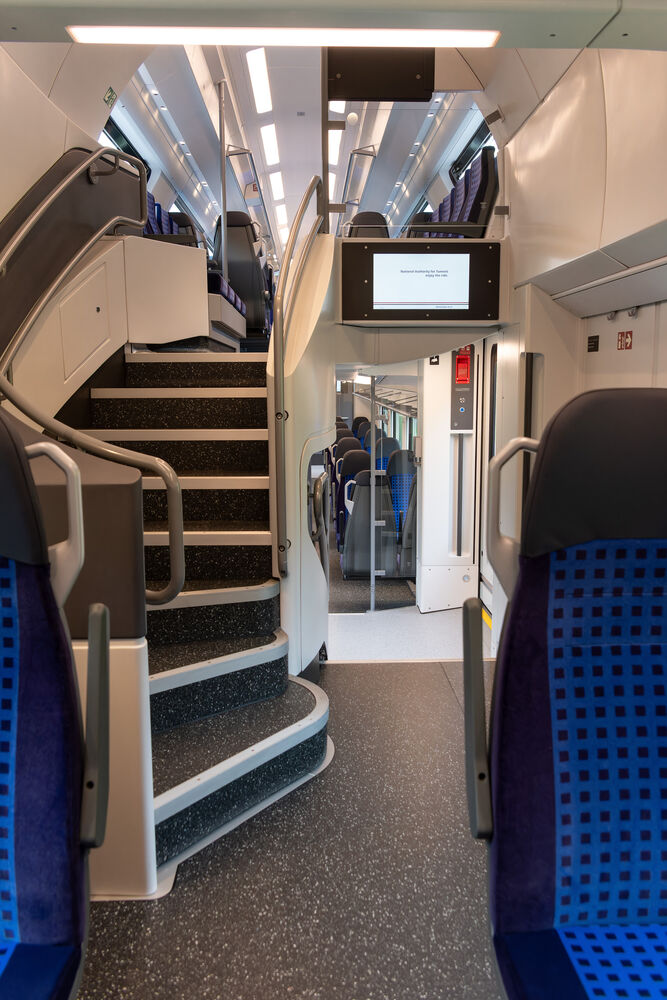
In early May, Siemens presented the local traffic train as the first completed type to the European press in its Test and Validation Center Wegberg-Wildenrath. The vehicle concept is based on the in-house platform Desiro HC, whose trains are in use, for example, in the Augsburg network of Arverio (formerly Go Ahead), in the Elbe-Spree network of ODEG, at the RRX or also in Israel. These single-car trains consist of two single-deck powered end cars—and, depending on customer preference, two to four double-deck unpowered middle cars. The large components of the electrical equipment are completely housed on the roofs of the end cars, which means a larger usable area inside. Both the end cars and the middle cars were designed with accessibility in mind. Thus, the end cars have step-free and ramp-free entrances and barrier-free access to the low-floor area is possible in the double-deck middle cars. The receiving areas (crush spaces) at the entrances are generously sized at 6 m².
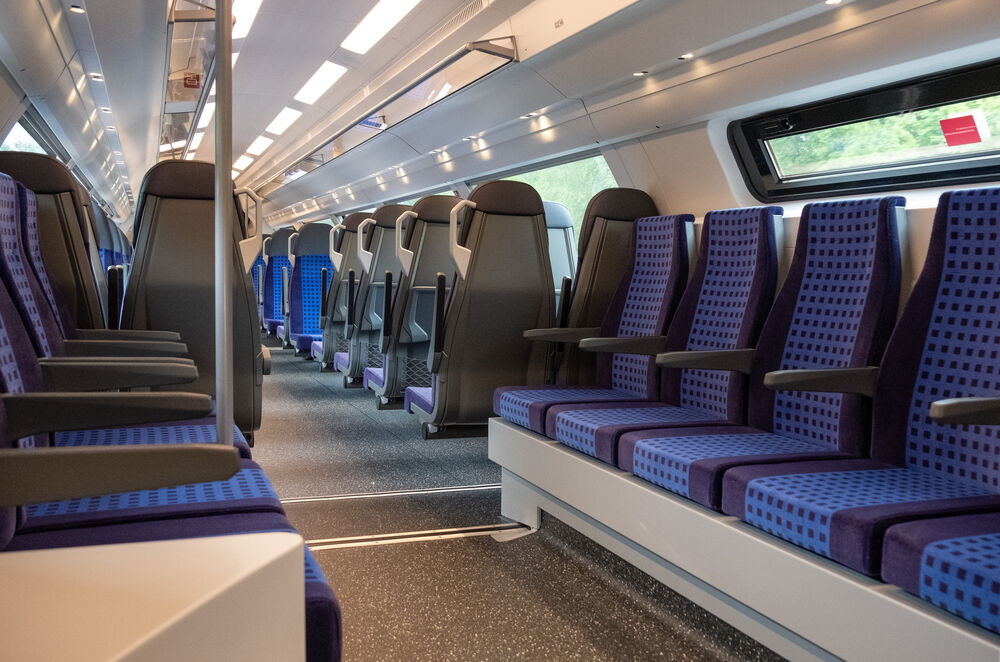
The upper deck of the middle car is bright and friendly.
(Image:Richard Oed)
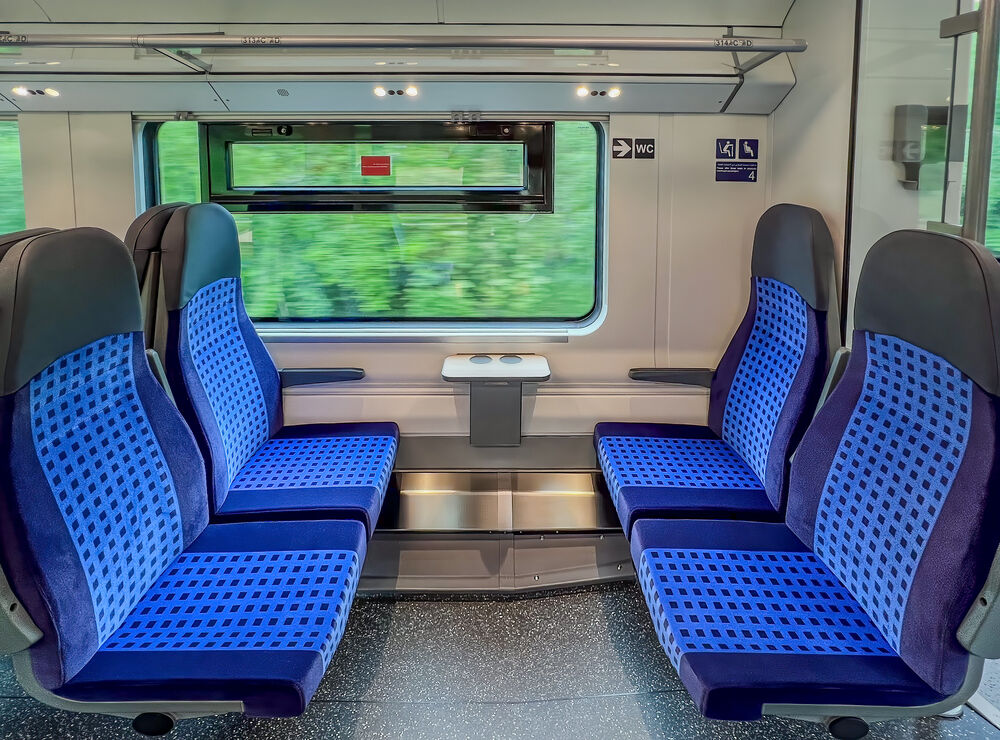
The biggest difference to the German variants of the Desiro HC is the desert resistance. This means that the vehicles are protected from sand, dust, and the high temperatures prevalent in Egypt. In addition, the "Desert Desiros" have a larger output of 4800 kW instead of the 4000 kW of the trains used in Germany. Their top speed is 160 km/h (approx. 100 miles) and they weigh just under 200 tons at a length of 105.25 m. They offer 389 seats with a total capacity of 849 passengers. The multiple units are painted white with black and red trim lines, the national colors of Egypt. The interior design of the Egyptian Desiro resembles the design of the Deutsche Bahn at the customer's request. .
From the intermediate floor, the lower floor can be reached barrier-free, the upper floor via stairs.
(Image:Richard Oed)
First line connects the Red Sea and the Mediterranean Sea
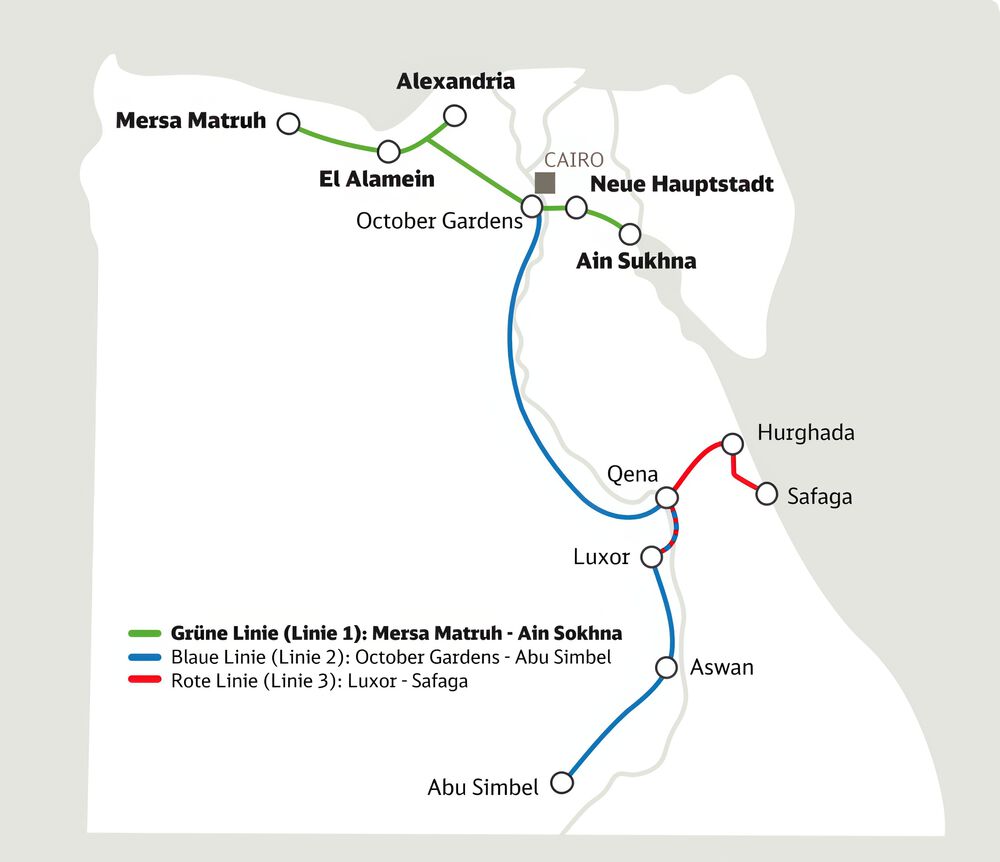
In Egypt, these trains are expected to be used primarily on the so-called "Green Line". This is the first of the three routes commissioned with Siemens and its local partners Orascom Construction and The Arab Contractors. For this, the consortium is taking on the construction, construction, and commissioning of the rail line as well as the maintenance services for 15 years. The 660 km (410 miles) long route connects the port cities of Ain Sukhna on the Red Sea with Alexandria and Mersa Matruh on the Mediterranean Sea via the "New Capital". For this, the consortium partners are not only constructing the double-track route, but also 21 railway stations and around 58 bridges and underpasses. In addition, Siemens is installing the European Train Control System (ETCS) Level 2 and a computer-based signaling system there. Siemens is also supplying the railway power system and the communication and security systems. In November 2022, the NAT initially commissioned Deutsche Bahn International Operations (DB IO), together with Elsewedy Electric, to operate the line for 15 years.
The upper deck of the middle car is bright and friendly.
(Image:Richard Oed)
The first routes are under construction
The second route is the 1,100 km (approx. 683 miles) long "Blue Line", which runs from October Gardens near Cairo via Qena, Luxor, and Aswan to Abu Simbel. It links Cairo with the economic centers in the south and mostly runs along the Nile. The third railway line is more tourist-oriented and connects the world heritage site Luxor with Hurghada and Safage on the Red Sea over 225 km (approx. 140 miles). In addition, it serves freight traffic between the port of Sagada and the interior of the country during the night hours. For the three lines, Siemens Mobility and its partners are building a total of eight operating and freight stations and 60 stations in addition to the tracks. Once completed, Egypt will have the sixth-largest high-speed network in the world.
The planned high-speed network in Egypt covers 200 kilometers on three lines.
(Image:German Railways)
According to Siemens, the Green and Blue Lines are currently under construction, with the Green Line being the furthest advanced. The first two transformer stations for supplying the railway network with 25 kV / 50 Hz from the public power grid have already been installed there, and there are already tracks in the Cairo area. The biggest challenge is the construction of three bridges over the Nile. Two of these are on the Blue Line and one on the Green Line.
In the meantime, the first high-speed trains of the Velaro type and the first Vectron locomotives have been completed. These will be put into operation and tested in Germany. Siemens Mobility plans to display one of the Velaros at this year's InnoTrans show in Berlin. (se)
Date: 08.12.2025
Naturally, we always handle your personal data responsibly. Any personal data we receive from you is processed in accordance with applicable data protection legislation. For detailed information please see our privacy policy.
Consent to the use of data for promotional purposes
I hereby consent to Vogel Communications Group GmbH & Co. KG, Max-Planck-Str. 7-9, 97082 Würzburg including any affiliated companies according to §§ 15 et seq. AktG (hereafter: Vogel Communications Group) using my e-mail address to send editorial newsletters. A list of all affiliated companies can be found here
Newsletter content may include all products and services of any companies mentioned above, including for example specialist journals and books, events and fairs as well as event-related products and services, print and digital media offers and services such as additional (editorial) newsletters, raffles, lead campaigns, market research both online and offline, specialist webportals and e-learning offers. In case my personal telephone number has also been collected, it may be used for offers of aforementioned products, for services of the companies mentioned above, and market research purposes.
Additionally, my consent also includes the processing of my email address and telephone number for data matching for marketing purposes with select advertising partners such as LinkedIn, Google, and Meta. For this, Vogel Communications Group may transmit said data in hashed form to the advertising partners who then use said data to determine whether I am also a member of the mentioned advertising partner portals. Vogel Communications Group uses this feature for the purposes of re-targeting (up-selling, cross-selling, and customer loyalty), generating so-called look-alike audiences for acquisition of new customers, and as basis for exclusion for on-going advertising campaigns. Further information can be found in section “data matching for marketing purposes”.
In case I access protected data on Internet portals of Vogel Communications Group including any affiliated companies according to §§ 15 et seq. AktG, I need to provide further data in order to register for the access to such content. In return for this free access to editorial content, my data may be used in accordance with this consent for the purposes stated here. This does not apply to data matching for marketing purposes.
Right of revocation
I understand that I can revoke my consent at will. My revocation does not change the lawfulness of data processing that was conducted based on my consent leading up to my revocation. One option to declare my revocation is to use the contact form found at https://contact.vogel.de. In case I no longer wish to receive certain newsletters, I have subscribed to, I can also click on the unsubscribe link included at the end of a newsletter. Further information regarding my right of revocation and the implementation of it as well as the consequences of my revocation can be found in the data protection declaration, section editorial newsletter.



:quality(80)/p7i.vogel.de/wcms/31/1f/311fb5b8aa1683b31cca284c8d33f443/0130073373v1.jpeg "Ceratizit has forged a very stable supply chain through a sophisticated and comprehensive recycling concept as well as through its holdings in tungsten mines. Here are some details ... (Image:Ceratite)")
:quality(80)/p7i.vogel.de/wcms/4c/49/4c49ab206af08de47d42c35bacc89c1d/0129539746v1.jpeg "With CPQ software, sales staff can create quotes for complex heavy-duty vehicles in minutes. (Image:TII Scheuerle)")
:quality(80)/p7i.vogel.de/wcms/bc/29/bc29ee18ce776b1915e10e07c1525f3a/0129766196v1.jpeg "The control cabinet is integrated into the rear of the press frame and offers accessibility with a small overhang thanks to the variable door opening. (Image:Tox)")
:quality(80)/p7i.vogel.de/wcms/fe/8a/fe8af1b829b085210fef4c1fa8abddb5/0129784389v1.jpeg "As an integral part of Koch Pac-Systeme's Predictive Pack digital service product, the gearboxes with Cynapse and Wittenstein's Smart Services make it possible to detect damage risks in the packaging specialist's machines at an early stage. (Image:Koch Pac systems)")
:quality(80)/p7i.vogel.de/wcms/b5/34/b534e64b2db218cdb5ad938898cbed56/0130044810v1.jpeg "The magnet of the torus-shaped tokamak reactor will generate magnetic pulses lasting up to 500 seconds and heat the enclosed plasma to a temperature of 150 million degrees. (Image:Iter)")
:quality(80)/p7i.vogel.de/wcms/97/28/9728e560d751dd54acd8b88a82ff7330/0129610882v1.jpeg "Temperature measuring devices are essential for monitoring industrial processes and thus ensuring high product quality. (Image:Micro-Epsilon)")
:quality(80)/p7i.vogel.de/wcms/6b/0d/6b0d694b060190016a4db18401fa55eb/0129937458v1.jpeg "(Picture: ©AI-generated)")
:quality(80)/p7i.vogel.de/wcms/db/68/db689490e348201603dd30447711ea2b/0129578734v1.jpeg "With three-axis vibration measurement (X, Y and Z axes) and temperature detection, the CMSVT38 condition monitoring sensor provides detailed status information that helps to detect machine damage at an early stage. (Image:Kübler)")
:quality(80)/p7i.vogel.de/wcms/48/8a/488afa7c9416394023a5ea1095f4ee4b/rfc4800-1-787x443v1v1.jpeg "Precise, intelligent and robust sensors will play a key role in an increasingly automated and data-driven world. (Image:Novotechnology)")
:quality(80)/p7i.vogel.de/wcms/08/70/087062e2e1a9b9add5777410dd746ee9/adobestock-1923991605-5607x3156v1v1.jpeg "A new type of tactile sensor, inspired by human skin, even recognizes grains of sand. (Image:Curioso.Photography - stock.adobe.com)")
:quality(80)/p7i.vogel.de/wcms/7f/08/7f087d7013424d123ab7275cd2e3fe55/adobestock-809456218--c2-a9-20degimages-20-e2-80-93-20stock-adobe-com-ki-generiert-4179x2351v1v1.jpeg "The digital upgrading of existing machines conserves resources, saves energy and reduces the need for new production. (Image:Degimages - stock.adobe.com/AI-generated)")
:quality(80)/p7i.vogel.de/wcms/dd/ce/ddcef80b290218276bf857cdb64a45e1/finkel-stephan-4162x2341v1.jpeg "Stephan Finkel, Partner and Industry Lead Defence & Security at 3DSE (Source: 3DSE)")
:quality(80)/p7i.vogel.de/wcms/34/e2/34e2a9e46e59eb28f09f9a5fdf41ff9a/0130091813v1.jpeg "Electrical drive trains require a multidimensional concept of performance characterization. Rohde & Schwarz has developed the MXO 3 oscilloscope series for this purpose. (Image:Rohde & Schwarz)")
:quality(80)/p7i.vogel.de/wcms/c9/2a/c92af18e41b077a518994a2ba60eb09f/0130037726v1.jpeg "The Renault subsidiary has presented a new brand strategy (Image:Alpine)")
:quality(80)/p7i.vogel.de/wcms/d8/fc/d8fc13ba0ae6e2180b3954cb1f1bd34c/0130060162v1.jpeg "Volkswagen has started series production of the ID Unyx 08. The model was developed in collaboration with Xpeng. (Image:Volkswagen)")
:quality(80)/p7i.vogel.de/wcms/f5/80/f5809e877017e40b413b48fcd8452246/cefmof-hydrogen-station-29-2048x1366-2048x1152v1v1.jpeg "The hydrogen filling station in Jyväskylä. The electrolyzer is installed in the fenced area at the top right. (Image:Cefmof Hydrogen)")
:quality(80)/p7i.vogel.de/wcms/3d/f2/3df286b8c62e72218e4ea42dcd959ee1/0130050208v1.jpeg "The Heracles chip from Intel calculates fully encrypted data without decrypting it. According to the company, the chip is 1,074 to 1,547 times faster than an Intel Xeon with 24 cores in FHE (Fully Homomorphic Encryption) computing operations. (Image:Intel)")
:quality(80)/p7i.vogel.de/wcms/f6/a5/f6a587801c676040f1e6413a7d305e33/0130062380v1.jpeg "Nvidia is investing 4 billion US dollars in silicon photonics. The aim is to avoid an impending bottleneck in the AI infrastructure. (Image:freely licensed)")
:quality(80)/p7i.vogel.de/wcms/02/36/02364f083b3023cee3b3f0893ea3f859/0129857003v1.jpeg "AI will continue to drive growth in the semiconductor market in 2026. (Image:Dall-E / AI-generated)")
:quality(80)/p7i.vogel.de/wcms/61/8f/618f16f8fa95ec6cc838ca9bfb5dbaf1/0130027046v1.jpeg "The Belgian Research Institute has set up a European university consortium on the subject of CMOS 2.0. It brings together 26 university groups to research chip technologies that go beyond conventional transistor scaling. (Image:Imec)")
:fill(fff,0)/images.vogel.de/vogelonline/companyimg/76800/76895/65.jpg "FAULHABER_120mm.jpg ()")
:fill(fff,0)/p7i.vogel.de/companies/67/eb/67eba621ef6ea/logo2.png "logo2 (Wuxi InfiMotion)")
:quality(80)/p7i.vogel.de/wcms/8e/53/8e5358dd39fc96fa818510ed988a8d38/0125875212v1.jpeg "From the end of 2026, running on the west route in Austria: The new double-decker Railjets of ÖBB. (Image:Marek Knopp)")
:quality(80)/p7i.vogel.de/wcms/69/f5/69f516f07a0ba999c5ba8763891853f1/0130030553v1.jpeg "Can be reloaded in 210 seconds for a return trip on the Greenford branch line: the GWR's 230001. (Image:Jack Boskett Media | GWR)")