A driveshaft is the extreme athlete in the drivetrain of a vehicle because it is responsible for transmitting engine power to the drive wheels. What has changed with the advent of electric mobility, and how do these components manage to deal with the enormous torques of current electric vehicles? It is worth taking a look behind the scenes, as drivetrain and driveshafts must withstand ever-increasing forces.
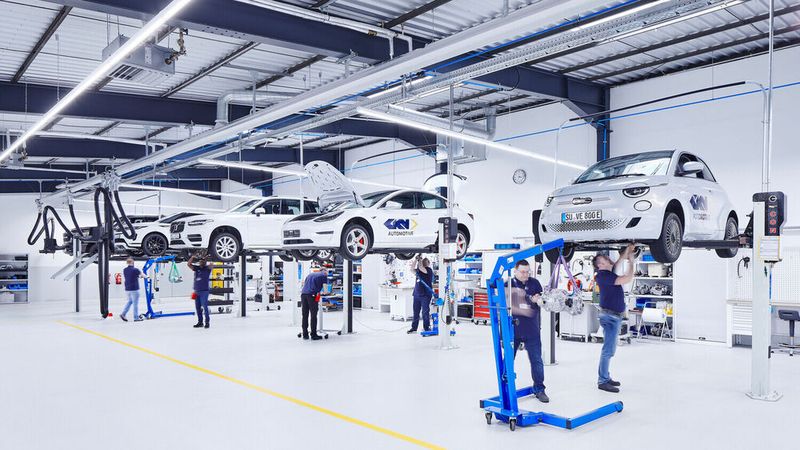
In an electric vehicle, every component must be put to the test. Automotive supplier GKN Automotive must pay particular attention to finding the perfect balance between durability, efficiency, and material use.
(Image: GKN Automotive)
Dr. Bernd Falk is Principal Technical Specialist at GKN Automotive.
In a vehicle with an internal combustion engine, the driveshaft was protected from excessively strong negative driving forces by a clutch unit. The situation is decidedly different in a vehicle with an electric drive. The elasticity in power transmission is eliminated, as there is no intermediate buffer in the form of a clutch gearbox. The inherent inertia ensures the famous "shift second" in combustion engine vehicles, only then does the engine power reach the drive wheel, and the force transmission is established.
The human factor also plays a significant role in vehicles with combustion engines: In the manual shifting of a combustion engine vehicle, the gear change is still performed by the driver, i.e., press the clutch, engage the gear, release the clutch, and thus ensure the force transmission between the gearbox and engine. The increasing prevalence of DSG automatic transmissions in combustion engine vehicles reduces the fully automatic shifting process to a time window of about 0.2 seconds: There is still enough time for the driveshaft to get used to these torque peaks through these traction interruptions. The situation is quite different in the drivetrain of an electric vehicle (Battery Electric Vehicle, BEV): With the elimination of the clutch unit, the enormous torque peaks act on the driveshafts immediately and without any time loss. At the same time, this also multiplies the forces generated by alternating loads.
Regeneration process: Standard in electric cars, not possible in combustion engines
Another factor contributing to the need for the classic combustion engine driveshaft to adapt is the regenerative braking process in electric vehicles. A comparison with the combustion engine world is helpful again here. When a combustion engine vehicle driver releases the gas, the load demand on the driveshaft decreases, allowing it a moment to recover, and the vehicle rolls out or goes into coasting mode. The situation is quite different with the driveshaft in an electric vehicle: Regeneration triggers a negative torque on the driveshaft, similar to the braking process, where positive torque is converted into negative torque. As a result, the driveshaft is almost constantly under load because in an electric vehicle, braking is very often replaced by a high level of regeneration. Controlling acceleration and braking exclusively with the accelerator pedal is also known as One-Pedal Driving. Another important point in the comparison between combustion engine vehicles and electric vehicles is the much higher torque in a BEV. For example, the current Fiat 500 electric offers torque of 220 Nm with a maximum of 118 HP. A Golf II GTI G60 from the 90s achieves similar values and was at the time one of the most powerful vehicles in its class. Driveshafts in electric vehicles must be adapted to these new performance values, which are standard even in small cars.
Electric cars are heavier than combustion engine vehicles
But what does this adaptation process look like, and how does the driveshaft or driveshaft manage to keep up with the ever-increasing performance values of modern electric vehicles? The enormous torques in electric drives could be managed with more material use. However, this would mean accepting a constantly increasing weight, which in turn would reduce the range. What this creates is a classic conflict of objectives between efficiency, weight, and durability. Christian Carlando, Director of Customer Engineering Europe at GKN Automotive explains: "Every component must literally be put to the test on a BEV platform, and we must pay more and more attention to finding the perfect balance between durability, efficiency, and material use. Often, it's a very fine line, but through our test rigs, we can simulate the complete life of an electric vehicle in just a few days. All our customers demand an efficient and stable shaft design. This can minimize heat losses and thus increase the range, even a fraction of a percent increase in range counts here." For this purpose, so-called load spectra are provided by the vehicle manufacturer, which are "replicated" on the test rigs – but in fast-forward. The test criteria here are significantly higher than for vehicles with combustion engines.
Automated vehicles
Even though the fully autonomous Level 5 vehicle may still be a few years away, one thing is certain: It will not be a vehicle with an internal combustion engine, but an electric one. Today, model solutions in public transport with autonomous vehicles for testing purposes already exist. A look at the driveshafts in automated vehicles reveals a new dimension of continuous stress, as the components must cope with multiples of the usual operating time. In extreme cases, this means: continuous operation of the driveshaft in a demanding BEV application scenario with running times of up to 100,000 kilometers per year. And that for ten years. But does the driving behavior of an autonomously driving vehicle match that of a human behind the wheel? "Fortunately not, one might argue," says Christian Carlando. "A self-driving vehicle can of course be optimized for the lowest possible wear level. This means that in normal operation, the vehicle will decelerate and accelerate much more gently than a human driver could. This creates very effective life-extending measures for all vehicle components, whether brakes, tires, or the driveshafts. And of course, the braking and acceleration processes can be exactly reproduced infinitely often - virtually impossible for a human driver."
Human versus machine
The wear limits and life expectancy of vehicle components can be precisely predicted for electric vehicles in autonomous continuous operation. Using test rigs, the life cycles are completely run through and can thus be reproduced again and again. Wear limits can therefore be determined extremely accurately, as the sensor technology of the electric drivetrain constantly compares all vehicle data. The situation becomes more difficult, however, with an electric vehicle that is driven by a human. "A human behind the wheel is naturally unpredictable, personal driving style, and thus also the wear of the components, depends on many factors," emphasizes Carlando. "With combustion engine vehicles, we have been able to gather experience over the decades and with each new vehicle generation, we were able to draw on this knowledge when designing the driveshafts. With the many new vehicle types, automotive manufacturers, and platforms in the BEV sector, we are very often entering uncharted territory, there often are no empirical values. But that's exactly what makes it so exciting, and meanwhile, we have to test much more on real roads again, even though we have expanded our test rig capacities." A continuing trend in BEVs is the still enormous spread of performance values compared to top speed, as even relatively light cars have very high torque. However, the top speed is often much lower than that of comparable models with a combustion engine. "With an electric car, I have an incredible punch in acceleration behavior, and of course, you use that. At the same time, I don't have such a high top speed because my battery capacity is limited. Especially for the driveshaft, this is a huge re-adjustment from the combustion engine vehicle and we have to align our product design accordingly."
Date: 08.12.2025
Naturally, we always handle your personal data responsibly. Any personal data we receive from you is processed in accordance with applicable data protection legislation. For detailed information please see our privacy policy.
Consent to the use of data for promotional purposes
I hereby consent to Vogel Communications Group GmbH & Co. KG, Max-Planck-Str. 7-9, 97082 Würzburg including any affiliated companies according to §§ 15 et seq. AktG (hereafter: Vogel Communications Group) using my e-mail address to send editorial newsletters. A list of all affiliated companies can be found here
Newsletter content may include all products and services of any companies mentioned above, including for example specialist journals and books, events and fairs as well as event-related products and services, print and digital media offers and services such as additional (editorial) newsletters, raffles, lead campaigns, market research both online and offline, specialist webportals and e-learning offers. In case my personal telephone number has also been collected, it may be used for offers of aforementioned products, for services of the companies mentioned above, and market research purposes.
Additionally, my consent also includes the processing of my email address and telephone number for data matching for marketing purposes with select advertising partners such as LinkedIn, Google, and Meta. For this, Vogel Communications Group may transmit said data in hashed form to the advertising partners who then use said data to determine whether I am also a member of the mentioned advertising partner portals. Vogel Communications Group uses this feature for the purposes of re-targeting (up-selling, cross-selling, and customer loyalty), generating so-called look-alike audiences for acquisition of new customers, and as basis for exclusion for on-going advertising campaigns. Further information can be found in section “data matching for marketing purposes”.
In case I access protected data on Internet portals of Vogel Communications Group including any affiliated companies according to §§ 15 et seq. AktG, I need to provide further data in order to register for the access to such content. In return for this free access to editorial content, my data may be used in accordance with this consent for the purposes stated here. This does not apply to data matching for marketing purposes.
Right of revocation
I understand that I can revoke my consent at will. My revocation does not change the lawfulness of data processing that was conducted based on my consent leading up to my revocation. One option to declare my revocation is to use the contact form found at https://contact.vogel.de. In case I no longer wish to receive certain newsletters, I have subscribed to, I can also click on the unsubscribe link included at the end of a newsletter. Further information regarding my right of revocation and the implementation of it as well as the consequences of my revocation can be found in the data protection declaration, section editorial newsletter.
Increasing torque?
The future of autonomous driving and whether the trend towards ever-increasing torque and vehicle weight will continue over the next few years is uncertain. Probably not, as it can already be observed on German highways that drivers of electric cars mostly travel at speeds of up to 140 kilometers per hour. On one hand, this is due to the limited battery range, which significantly decreases at higher speeds. On the other hand, it may already be a part of the rethinking process towards electromobility.



:quality(80)/p7i.vogel.de/wcms/a0/47/a04725ef9bd09fb6c9341a1bea1b5d93/0130443083v1.jpeg "Here, a type of plastic pallet is produced by thermoforming (vacuum forming or deep drawing) at the corresponding division of New England Plastics in the USA. This division, which specializes in so-called liners, is now part of Ringmetall ... (Image:New England Plastics)")
:quality(80)/p7i.vogel.de/wcms/e3/42/e342b3c593ea92d56604d3be969e9c9a/0130437231v1.jpeg "Daimler Truck will be building even more trucks at its Czech plant in Cheb in the future. This is because it is now being expanded for strategic cost-saving reasons ... (Image:Daimler Truck)")
:quality(80)/p7i.vogel.de/wcms/23/99/23992bf2dcdc432c9b7209c34a4a7c48/0129733089v1.jpeg "Stork relies on the modular Neoswiss turning system from Iscar to shorten the set-up times for its sliding headstock lathes and work more productively. (Image:Iscar)")
:quality(80)/p7i.vogel.de/wcms/7d/e2/7de2923434b2f1a78ba5482d8d335269/0113143253v1.jpeg "In our China Market Insider we regularly provide you with relevant information directly from China. (Image:© Eisenhans - stock.adobe.com)")
:quality(80)/p7i.vogel.de/wcms/b7/36/b736dfebc16c42d6901d0d0e1f390493/3d-druck-20factory-20--20ki-20generiert-1920x1079v1.png "(Source: AI-generated)")
:quality(80)/p7i.vogel.de/wcms/79/b2/79b21aad663f4a7bd4472afc1c1afc62/0130433994v1.jpeg "Mission Joyride: The free-flying robot (shown here in the rendering) will relieve the ISS crew of logistics tasks from 2027 with its two mechanical arms. (Image:Icarus Robotics)")
:quality(80)/p7i.vogel.de/wcms/6b/45/6b4546fa6ebf305c3660326909363f32/0130437089v1.jpeg "Industrial AI in action: Rockwell Automation presents practical solutions for self-controlling production systems at the Hannover Messe. (Image:Rainer Jensen, Deutsche Messe)")
:quality(80)/p7i.vogel.de/wcms/78/e9/78e9188c25a8a94e67c34c9bf8ffe495/visual-agile-20robots-20and-20google-20deepmind-20partner-20to-20bring-20intelligence-20to-20robotics-2500x1406v1v1.jpeg "Together, the partners are developing adaptable, intelligent robots for a wide range of applications (Image:Agile Robots SE)")
:quality(80)/p7i.vogel.de/wcms/59/a2/59a2b11f0aa1b700eff02addd5de8703/adobestock-1788280853--c2-a9-20satria-20-e2-80-93-20stock-adobe-com-5081x2860v1v1.jpeg "Quantum computers require extreme cooling to temperatures close to absolute zero in order to keep qubits stable. (Image:satria - stock.adobe.com)")
:quality(80)/p7i.vogel.de/wcms/62/5f/625f41e87ebfef156a98c8e6393e32fd/0130211654v1.jpeg "Axial flux motors have some advantages over radial flux motor—but their production is currently still expensive. (Image:RWTH Aachen University)")
:quality(80)/p7i.vogel.de/wcms/f6/ae/f6aec4f6241b36ed5e3a990ac9176b42/0130429460v1.jpeg "Verne, Pony.ai and Uber want to launch a robotaxi service in Europe. (Image:Verne)")
:quality(80)/p7i.vogel.de/wcms/d7/88/d788699f2974708a332baa4e7a62fa9e/0130438967v1.jpeg "Skoda is withdrawing from China. The brand has produced well over three million vehicles there. (Image:Skoda car)")
:quality(80)/p7i.vogel.de/wcms/b0/43/b043b86899837532aad62d63368a917a/0130371361v1.jpeg "Skoda leaves the chinese market.
(Image:Skoda)")
:quality(80)/p7i.vogel.de/wcms/c3/c4/c3c4ce270b083eeac55654148611f064/0130237945v1.jpeg "China is not giving up on hydrogen, but is intensifying its efforts. (Image:freely licensed from Pixabay)")
:quality(80)/p7i.vogel.de/wcms/ee/09/ee09acbd6dc896df25affaa9e871e6e5/0130440053v1.jpeg "IMS chip module for simple system integration into an ion mobility spectrometer. (Image:Fraunhofer IPMS)")
:quality(80)/p7i.vogel.de/wcms/10/6c/106cd22de5f68a0f74639d654827228c/0130345302v1.jpeg "Made in India: According to the India Electronics and Semiconductor Association (IESA), the country should be able to produce between 75 and 80 million chips by the beginning of 2027, once the plants currently under construction become operational. (Image:Pixabay (Montage: Sebastian Gerstl))")
:quality(80)/p7i.vogel.de/wcms/a5/ed/a5ed6fda029d362732a293d6b19d74c4/0130444216v1.jpeg "Thirteen executives from the Chinese chip industry have drawn up a plan to achieve an 80% self-sufficiency rate for semiconductors by 2030. (Image:Maxim_Kazmin - stock.adobe.com)")
:quality(80)/p7i.vogel.de/wcms/31/a6/31a646018b34d8e0a44bfc8bf17837f6/0130361632v1.jpeg "For many companies, PFAS are considered indispensable in electronics production. (Image:freely licensed)")
:fill(fff,0)/images.vogel.de/vogelonline/companyimg/76800/76895/65.jpg "FAULHABER_120mm.jpg ()")
:quality(80)/p7i.vogel.de/wcms/60/f3/60f35149eac191b5be618aef55279e9e/0128479306v1.jpeg "The new drives make their debut in the CLA. (Image:Mercedes-Benz)")
:quality(80)/p7i.vogel.de/wcms/02/64/02644a307170638c7df2897e869e815a/0127827991v1.jpeg "Toyota has renewed the Hilux. (Image:Toyota)")