Whether measuring displacement or inclination, measuring vibrations or rotational speeds, and much more: We present seven new sensors for different applications.
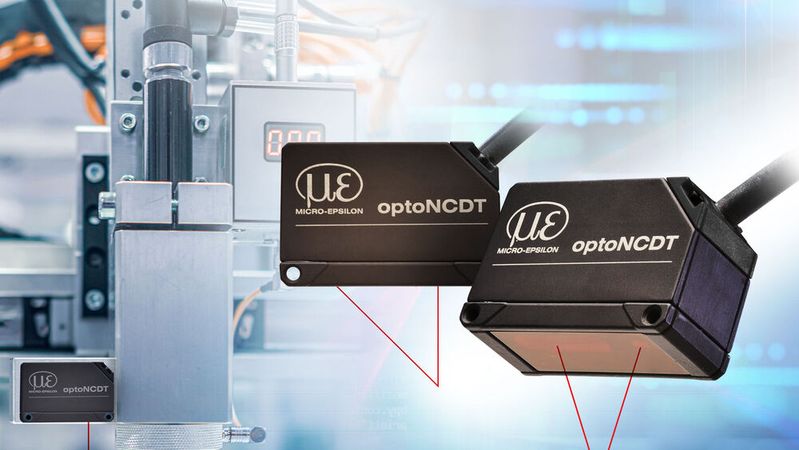
The laser triangulation sensors of the OptoNCDT 1220 series from Micro-Epsilon now have an interface for IO-Link.
(Image: Micro-Epsilon)
Distance and displacement sensor: Now with IO-Link interface
Laser triangulation sensors of the OptoNCDT 1220 series by sensor specialist Micro-Epsilon measure paths and distances with an extremely small light spot, even on the smallest components. Micro-Epsilon has now equipped the sensors with an interface for IO-Link.
The IO-Link communication standard simplifies data communication and reduces the sensor's commissioning time for industrial production environments. Additionally, troubleshooting can be simplified with consistent diagnostic information down to the sensor level.
Sensors of the OptoNCDT 1220 series offer high measurement accuracy. They are particularly suitable for displacement, distance, and position measurements in OEM and series applications in automation technology. They deliver precise measurement results at a measurement rate of up to 2 kHz. Thanks to Active-Surface-Compensation (ASC), the distance signal is stably regulated regardless of the color and brightness of the measurement object.
Vibration sensor: Monitor vibrations in three axes
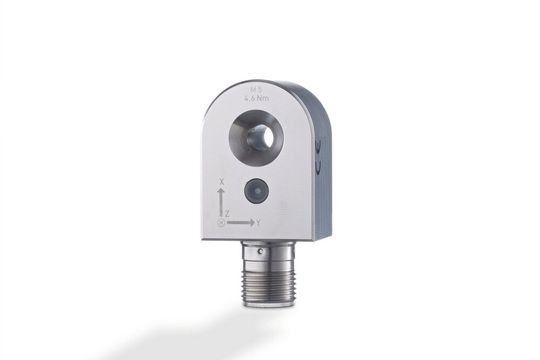
The new VVB30x provides vibration monitoring in all three spatial directions.
(Image: IFM Electronic)
The new condition monitoring sensor VVB30x from IFM continuously captures vibrations in all three spatial directions. From the recorded measurements, the sensor calculates proven condition indicators for assessing the machine condition: information on fatigue (v-RMS), mechanical friction (a-RMS), shocks (a-Peak), and bearing wear (Crest factor). Additionally, the surface temperature is transmitted as an additional wear indicator. The sensor also offers a wide range of smart additional features: In the Basic Condition Monitoring version, the sensor can continuously analyze emerging machine imbalance and communicate securely if necessary; it also records machine operating hours based on the machine-related vibration level, an additional parameter of modern maintenance. In the Data Science Condition Monitoring version, the device also offers a smart bearing demodulation process for secure and continuous bearing analysis, known as BearingScout.
For data transmission, device diagnosis, and parameterization, the new vibration sensor relies on IO-Link. This allows users to implement vibration monitoring and analysis independently of the manufacturer in any SCADA system via common fieldbus protocols or simultaneously via a standardized MQTT or HTTPS interface in any IT system.
Incremental encoder: high precision speed measurement
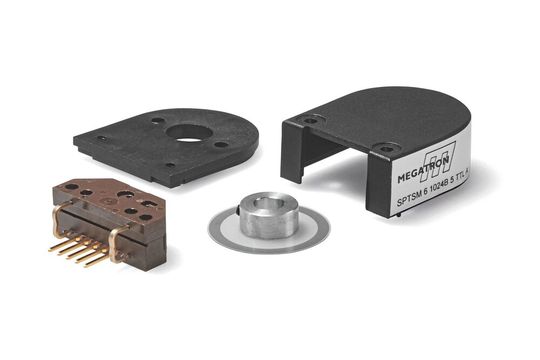
The optoelectronic incremental encoder SPTSM from Megatron enables standardized analysis procedures in the pharmaceutical industry.
(Image: Megatron Elektronik)
Pharmaceutical companies periodically examine product batches to ensure high-quality medication. Encoders from Megatron capture the rotational speed in the drives of the testing equipment, enabling standardized analysis procedures. A renowned laboratory technology manufacturer has been using optoelectronic incremental encoders of the SPTSM series from Megatron in the drive of its tablet testing equipment for more than two decades. In the dissolution testers, so-called paddles rotate in a glass container filled with a liquid medium. The pH value of the liquid is adjusted to the environment found in the human digestive tract. The paddles keep the medium in motion until all the active ingredients of the tablet are released.
The encoders from Megatron continuously capture the rotational speed of the electric motor and monitor the stirring process of the device with 360 pulses/360°. This ensures that the stirrer always operates at the same speed and the test results are comparable. The SPTSM significantly exceeds the test equipment manufacturer's requirements in terms of rotational speed measurement accuracy: the deviation in speed detection should be a maximum of ±2%. However, the encoder measures the stirring drive speed with a deviation of only 0.2%.
Inductive sensors: Heat-resistant with large switching distance
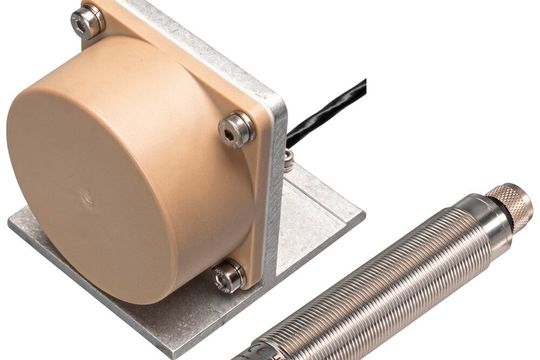
The inductive sensors of the NBN...-F135 series with separate amplifier can be used at temperatures up to 250 °C.
(Image: Pepperl+Fuchs)
The new high-temperature resistant inductive sensors from Pepperl+Fuchs offer a large switching distance of up to 1.97 inches. The IO-Link interface integrated into the amplifier enables integration into Industry 4.0 applications. The sensors are available with variable cable lengths, and each component can be replaced individually. The new inductive sensor sets of the NBN...-F135 series can be used at temperatures up to 482 °F. The temperature drift of the switching distance typically lies below 5 percent, ensuring consistently high detection reliability. At the same time, the devices achieve particularly long service life. The sensor heads can be replaced without re-parameterizing the amplifier, and setting the switching distance via a potentiometer is not necessary.
The IO-Link interface enables seamless communication between control and field level, including the transmission of sensor head status and limit warnings for predictive maintenance. Additionally, a switching cycle and operating hours counter is integrated. Multiple sensor heads can be synchronized in sequence—both in SIO and IO-Link modes.
Date: 08.12.2025
Naturally, we always handle your personal data responsibly. Any personal data we receive from you is processed in accordance with applicable data protection legislation. For detailed information please see our privacy policy.
Consent to the use of data for promotional purposes
I hereby consent to Vogel Communications Group GmbH & Co. KG, Max-Planck-Str. 7-9, 97082 Würzburg including any affiliated companies according to §§ 15 et seq. AktG (hereafter: Vogel Communications Group) using my e-mail address to send editorial newsletters. A list of all affiliated companies can be found here
Newsletter content may include all products and services of any companies mentioned above, including for example specialist journals and books, events and fairs as well as event-related products and services, print and digital media offers and services such as additional (editorial) newsletters, raffles, lead campaigns, market research both online and offline, specialist webportals and e-learning offers. In case my personal telephone number has also been collected, it may be used for offers of aforementioned products, for services of the companies mentioned above, and market research purposes.
Additionally, my consent also includes the processing of my email address and telephone number for data matching for marketing purposes with select advertising partners such as LinkedIn, Google, and Meta. For this, Vogel Communications Group may transmit said data in hashed form to the advertising partners who then use said data to determine whether I am also a member of the mentioned advertising partner portals. Vogel Communications Group uses this feature for the purposes of re-targeting (up-selling, cross-selling, and customer loyalty), generating so-called look-alike audiences for acquisition of new customers, and as basis for exclusion for on-going advertising campaigns. Further information can be found in section “data matching for marketing purposes”.
In case I access protected data on Internet portals of Vogel Communications Group including any affiliated companies according to §§ 15 et seq. AktG, I need to provide further data in order to register for the access to such content. In return for this free access to editorial content, my data may be used in accordance with this consent for the purposes stated here. This does not apply to data matching for marketing purposes.
Right of revocation
I understand that I can revoke my consent at will. My revocation does not change the lawfulness of data processing that was conducted based on my consent leading up to my revocation. One option to declare my revocation is to use the contact form found at https://contact.vogel.de. In case I no longer wish to receive certain newsletters, I have subscribed to, I can also click on the unsubscribe link included at the end of a newsletter. Further information regarding my right of revocation and the implementation of it as well as the consequences of my revocation can be found in the data protection declaration, section editorial newsletter.
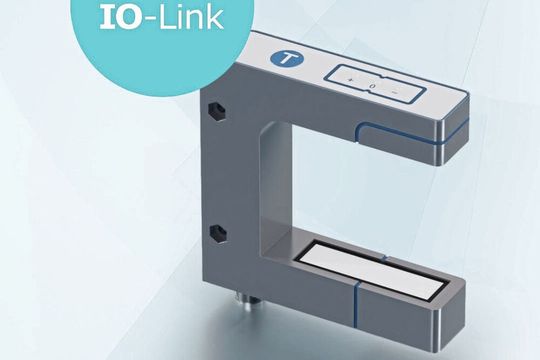
Edge sensors: Smart sensors with IO-Link interface
The new edge sensors bks+ are equipped with the latest IO-Link version 1.1.3.
(Image: Microsonic)
The new edge sensors bks+ from Microsonic are equipped with the latest IO-Link version 1.1.3. This enables seamless integration into modern production environments and optimizes the monitoring of material position. The edge sensors offer a wide working range of 0.47 inches or 1.57 inches. They allow contactless web guiding of highly transparent films, paper, and other sound-impervious materials such as corrugated cardboard, textiles, or rubber. The ultrasonic edge sensors monitor the material position with the highest precision, enabling real-time adjustments, for example, in battery foils.
With the IO-Link interface, the foundation for seamless exchange of process and service data between the system control and the bks+ has been established. Commissioning, operation, and maintenance of the machine or plant are simplified; performance and availability are increased. The ultrasonic edge sensors are preset and ready for immediate use.
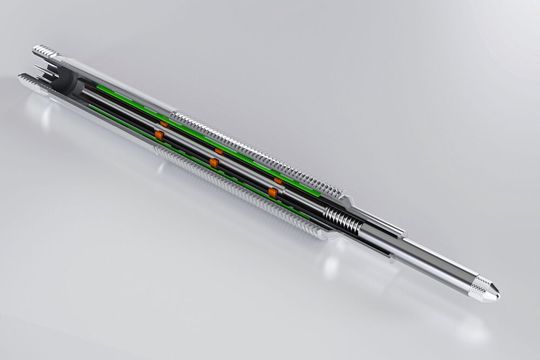
Limit stop: Mechanical sensor for displacement measurements
With the mechanical sensor YM120020, IPF offers a high-precision stop for displacement measurements for the first time.
(Image: IPF Electronic GmbH)
With the mechanical stops as metal attachment adapters for inductive sensors from IPF, robust small queries can be solved in a very simple and reliable way. For applications where the requirements go beyond mere presence control, IPF now offers the mechanical sensor YM120020, the first plunger for displacement measurements. The YM120020, in M12x1 form factor, has a travel range of -0.20 to 0.20 inches with a maximum linearity deviation of ±0.5% over the entire measurement range. The respective position of the plunger with hardened probe tip is output as an analog signal (0 to 10 V) via an M12 connector.
The new sensor from IPF operates on the principle of a differential transformer, a special form of transformer. A spring-mounted measuring rod serves simultaneously as the movable core of the excitation coil, with a passive coil positioned on each side. As soon as the rod is no longer in its central position (0 inches), a voltage is induced in one of the two adjacent coils, which enables displacement measurement through the output of an analog signal via the downstream electronics. Due to its high-resolution, wear-free design, the solution is very precise and mechanically extremely robust (shock resistance up to 0.44 pounds). The functional principle of the YM120020 also ensures that the measurement value is retained even after a power interruption.
Application areas for the new mechanical sensor are found across industries in automation as well as process and quality assurance, where predominantly harsh environmental conditions prevail, such as moisture, aggressive chemicals, or elevated temperatures.
Stainless steel sensors: clean solution
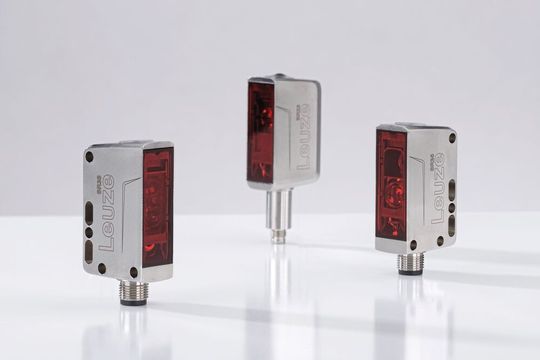
Leuze is launching two new series with sensors in stainless steel housings: Series 33C in hygiene design and Series 35C in robust wash-down design. They are suitable for hygiene-sensitive production and packaging processes.
(Image: Leuze)
New stainless steel sensors from Leuze: Series 33C in hygiene design and Series 35C in robust wash-down design. The Series 33C is particularly suitable for applications in the food, beverage, or pharmaceutical industries—also in plant areas with unpackaged products—thanks to its smooth housing contours without mounting holes. The Series 35C is designed for robustness. It is suitable for high mechanical stress and intensive cleaning processes. The sensors of the 35C series can also be used in the food industry. They are also suitable for the automotive industry or toolmaking.
Both series include light sensors, through-beam, and retro-reflective photoelectric sensors. The range of the 33C and 35C series also includes special solutions for packaging processes: These include retro-reflective sensors for glass and PET detection, sensors with background suppression for detecting small objects, as well as dynamic reference sensors and through-beam sensors for film penetration. In the "small" housing size, the new 33C and 35C series complement the stainless steel miniature sensors of the 53C and 55C series.
With the new Series 33C and 35C, Leuze offers sensors with Power-Pin-Point-LED for the first time. This lighting technology allows the sensors to be aligned and commissioned particularly quickly and easily.



:quality(80)/p7i.vogel.de/wcms/dd/08/dd086510d9ae7b50181f6070e4463b44/0129363730v1.jpeg "Typical application for ionizing devices: Wrapping films. (Picture: ©Adobe Stock/SMC)")
:quality(80)/p7i.vogel.de/wcms/35/57/3557c819943c53acec41a0ccba87da4f/0130049064v1.jpeg "Researchers at the Fraunhofer IWU in Chemnitz have long known that many typical sheet metal parts can be manufactured more cost-effectively using hollow embossing rollers. Now there is news to report ... (Image:Fraunhofer IWU)")
:quality(80)/p7i.vogel.de/wcms/59/02/590246e3b3f415c65edbee377c14ca77/26-06-pi-fraunhofer-iws-41450-direktplattieren-pic-01-7771x4369v1v1.jpeg "The Fraunhofer IWS has developed the new \"direct laser cladding\" process, which creates a functional layer directly on the base body by applying a strip-shaped metal to rotationally symmetrical components in a spiral and bonding it locally by laser. (Image:Christoph Wilsnack/Fraunhofer IWS)")
:quality(80)/p7i.vogel.de/wcms/73/60/73608418789b1d9c393f5e2fa974eda2/0130209906v1.jpeg "The robots of the X6 generation from b+m enable very high painting quality and are also particularly compact and easy to maintain. (Image:Beckhoff)")
:quality(80)/p7i.vogel.de/wcms/78/e9/78e9188c25a8a94e67c34c9bf8ffe495/visual-agile-20robots-20and-20google-20deepmind-20partner-20to-20bring-20intelligence-20to-20robotics-2500x1406v1v1.jpeg "Together, the partners are developing adaptable, intelligent robots for a wide range of applications (Image:Agile Robots SE)")
:quality(80)/p7i.vogel.de/wcms/e7/66/e7669ecf0260ae8fc54c214e34e4902a/0130316817v1.jpeg "Siemens and Palo Alto Networks offer tested cybersecurity solution for industrial 5G. (Image:Siemens)")
:quality(80)/p7i.vogel.de/wcms/9f/55/9f55324832c4f426958031375124d9de/siemens-20ubtech-20hmnd-1920x1079v1v1.png "Ready for the factory floor: While Ubtech is planning mass production, Siemens is already testing humanoids in real factory applications in Erlangen. (Image:Siemens)")
:quality(80)/p7i.vogel.de/wcms/11/36/113695ed260e29c8c2d9d39dc5f9d869/0130213768v1.jpeg "AI can work cheaply in China and deliver the results rapidly all over the world. (Image:Dall-E / AI-generated)")
:quality(80)/p7i.vogel.de/wcms/62/5f/625f41e87ebfef156a98c8e6393e32fd/0130211654v1.jpeg "Axial flux motors have some advantages over radial flux motor—but their production is currently still expensive. (Image:RWTH Aachen University)")
:quality(80)/p7i.vogel.de/wcms/77/9b/779b0685d010dfe45c9c2cb1cfecd467/0128886425v1.jpeg "The BlueEye is the first \"real\" hyperspectral camera for the UV range and covers the wavelength range from 220 to 380nm. (Image:Inno-spec GmbH)")
:quality(80)/p7i.vogel.de/wcms/e4/51/e451d52ce0182fb0aaa46a5774f832ef/26-04-pi-fraunhofer-iws-21160-bioslide-pic-01-4128x2321v1v1.jpeg "With the BioSlide research project, the Fraunhofer IWS is investigating how sliding systems can be designed to be more sustainable and energy-efficient. New materials can be tested in a particularly application-oriented manner on this plain bearing test stand. (Image:Fraunhofer IWS)")
![Thanks to advanced 3D printing technology, a more efficient use of resources should contribute to lower-emission aviation—this is the goal of ['skai]-lab. (Image:Oleksandr Pashchenko - stock.adobe.com / AI-generated)](https://cdn1.vogel.de/nghHNSbySccfOjG3n1qCA-FVOjQ=/288x162/smart/filters:format(jpg):quality(80)/p7i.vogel.de/wcms/62/64/626424c97a16e69f871bf216c9629c2a/adobestock-1927043193--c2-a9-20oleksandr-20pashchenko-20-e2-80-93-20stock-adobe-com-ki-generiertv1v1.jpeg "Thanks to advanced 3D printing technology, a more efficient use of resources should contribute to lower-emission aviation—this is the goal of ['skai]-lab. (Image:Oleksandr Pashchenko - stock.adobe.com / AI-generated)")
:quality(80)/p7i.vogel.de/wcms/b6/62/b662adc2cec8227d8172509bbfb6ee42/25c0207-107-4961x2789v1v1.jpeg "The GLB is the second model based on Mercedes' new MMA platform. Apparently, Geely's platform is better and cheaper, which is why the two companies are negotiating a partnership. (Image:Mercedes-Benz)")
:quality(80)/p7i.vogel.de/wcms/c1/79/c179ce9acd000e7cf48318e03e3fe4da/0130333964v1.jpeg "Magna is expanding its hybrid portfolio with the DHD REX, a dedicated hybrid drive for REEVs. (Image:Magna)")
:quality(80)/p7i.vogel.de/wcms/80/c2/80c2ea3fbe2df808a263d99adad93f66/0130160344v1.jpeg "Francois Provost has been CEO of Renault since summer 2025. (Image:Renault)")
:quality(80)/p7i.vogel.de/wcms/8d/f8/8df87aa10e28419e1869acb641b4c4dd/0130324805v1.jpeg "With the Affela 1 in the Signature Edition, the Sony Honda Mobility joint project was to be launched in a few months' time. (Image:SHM)")
:quality(80)/p7i.vogel.de/wcms/4d/dd/4dddf438e91f394c04a095dbfd109d1c/0130236430v1.jpeg "Measurement modules: The 720301 module in combination with the SL2000 enables RMS and power calculations, among other things. (Image:Yokogawa)")
:quality(80)/p7i.vogel.de/wcms/61/fc/61fcf95f5cca15494ad18343901ae585/0130317237v1.jpeg "With the AGI CPU, Arm says it is taking a \"historic step\": With the processor aimed at AI in data centers, the company is presenting itself for the first time as a provider of its own chips, not just as a pure IP licensor. (Image:Arm)")
:quality(80)/p7i.vogel.de/wcms/82/90/8290dfe3595b6c6b33726ae8b76172c7/0130319587v1.jpeg "The concept image illustrates how the pattern of tiny protrusions and depressions created on the substrate (MgO, bottom) controls the arrangement of atoms in the superconducting material (YBCO, top). At the interface between the two layers, an electronic structure enables superconductivity to occur at higher temperatures than previously possible. (Image:Chalmers University of Technology / Riccardo Arpaia)")
:fill(fff,0)/images.vogel.de/vogelonline/companyimg/76800/76895/65.jpg "FAULHABER_120mm.jpg ()")
:fill(fff,0)/p7i.vogel.de/companies/67/eb/67eba621ef6ea/logo2.png "logo2 (Wuxi InfiMotion)")
:quality(80)/p7i.vogel.de/wcms/df/ae/dfae1e7f351e631952d5aebc1a01efb8/0122336144v1.jpeg "The new VVB30x provides vibration monitoring in all three spatial directions.(Image: IFM Electronic)")
:quality(80)/p7i.vogel.de/wcms/4b/9a/4b9ab3e9f27d665d60fc65a42533b7f4/0122353451v1.jpeg "The optoelectronic incremental encoder SPTSM from Megatron enables standardized analysis procedures in the pharmaceutical industry.(Image: Megatron Elektronik)")
:quality(80)/p7i.vogel.de/wcms/c6/bf/c6bf45f08087fa10985aec3e4534d7d2/0121837883v1.jpeg "The inductive sensors of the NBN...-F135 series with separate amplifier can be used at temperatures up to 250 °C.(Image: Pepperl+Fuchs)")
:quality(80)/p7i.vogel.de/wcms/c5/3a/c53a3cd678c1ef3d14a6b8a4fec26f1d/0122364348v1.jpeg "The new edge sensors bks+ are equipped with the latest IO-Link version 1.1.3.(Image: Microsonic)")
:quality(80)/p7i.vogel.de/wcms/6b/13/6b13416a7bde25cee8f238a685d10677/0125363149v1.jpeg "The laser triangulation sensors are ideal for numerous applications, including factory automation, electronics manufacturing, and robotics. (Image:Micro-Epsilon Messtechnik GmbH & Co. KG)")
:quality(80)/p7i.vogel.de/wcms/24/0b/240b0b955b85b67a3018b7184d3dc620/0126934153v1.jpeg "The Opto NCDT 1220 laser triangulation sensor from Micro-Epsilon is used for measuring board contours. (Image:Micro-Epsilon Messtechnik GmbH & Co. KG)")