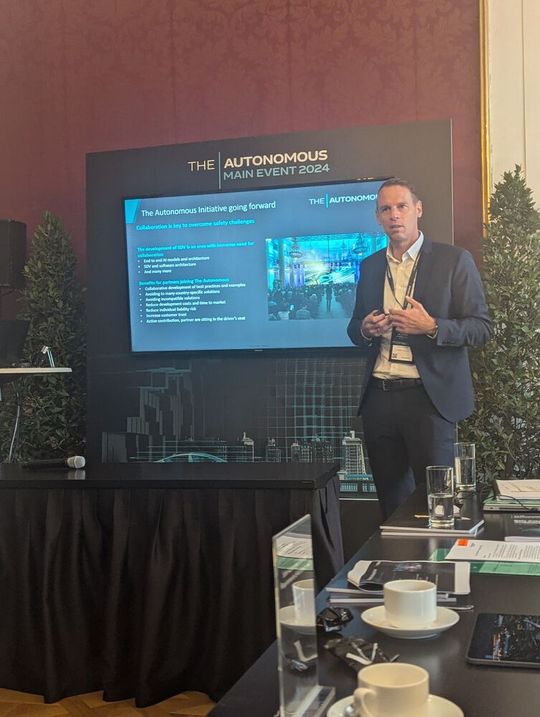
In the fall of this year, the industry event "The Autonomous Main Event" celebrated its five-year anniversary. Why TTTech Auto, as a founding member, is proud of the progress made by the event since 2019 and why "Collaboration is the key" should not be seen as a phrase but as a necessity is explained by CEO Dr. Dirk Linzmeier in conversation with our sisterbrand 'Next Mobility'.
To bring safe autonomous vehicles to the road, close collaboration across company and technology boundaries is an important key factor.
(Image: freely licensed on Pixabay)
More than 1,100 employees worldwide, ten locations across the globe, over 60 technology partners in the automotive industry, and 44 patent families in automotive safety—that is a brief overview of TTTech Auto, the Austrian company founded in 2018 by Audi, Infineon, Samsung, and TTTech Computertechnik. However, the technological history of TTTech Auto goes back a bit further, to 1998 when the parent company TTTech was established. Based in Vienna, the company focuses on improving vehicle safety and supporting the development of safe, highly automated driving functions.
Dr. Linzmeier, you have been CEO of TTTech Auto for more than two years. Which positive events have been particularly important to you during this time?
Dr. Dirk Linzmeier: It feels much longer than two years. What was particularly nice for me was that we were able to achieve great growth in 2023—in all areas. We have specialized in safety-critical applications in the driver vehicle, with the main domain being driver assistance and autonomous driving. And safety, so to speak, as the icing on the cake. In 2023, we started with safety consultancy. At TTTech Auto, there are specialists in the field of safety—that's where we come from. With the consultancy, we have the opportunity to review designs early in the process with automobile manufacturers. This is a good entry point to generate new business.
Also in 2023, we focused on the topic of the software-defined vehicle. We were previously seen as an automated-driving company—even though we never wrote a line of code for AD, but developed the middleware for safety-critical applications. Therefore, we have positioned ourselves towards software-defined vehicles, although in our view, software-defined is too limited. We must avoid the impression that it is only about writing software. Therefore, we have developed the 4SDV approach: System, Safety, Security, and Software-defined Vehicle.
In 2024, we changed our organization. Moving away from a classic board model to a core management team, more like the American model. This means more people at the top management level and fewer management levels overall. We lead as an eight-member team—with all important competencies without a classic board model. From my perspective, this change has brought about a complete cultural shift. It is no longer about needing a decision from the board, but rather discussing within the core management team what the right solution for a particular problem is.
With Mobileye, we were able to gain a major customer. We have collaborations with QNX and NXP. And certainly, a highlight in the middle of the year is our completely new brand identity. We had already done a lot of preliminary work, but then everything was implemented cohesively—a new logo, new colors, new tagline, new vision, and new mission—with the software-defined vehicle at the center.
"There is no one company that can do everything," explains Dr. Dirk Linzmeier, CEO of TTTech Auto, the necessity to collaborate within and beyond the automotive industry. Before TTTech Auto, Dr. Linzmeier worked at ams Osram, Bosch, and Daimler.
(Image: Stefanie Eckardt)
The automotive industry is undergoing change, business models and processes are evolving. What challenges do you see in the transformation and how do you address them in your own company?
Above all, one must not underestimate the cultural component. We are a company with more than 1,000 employees. This is large for a software company—however, it is still a size where transformation is manageable. But one thing is especially important: speed. It is essential to be fast. We can no longer afford to be slow in our processes and developments, because our environment is not stable and it seems it will remain this way for the next two years. It can always happen that everything, whether with customers or at the technological level, changes as early as next month. As a company, I must be able to react quickly and adapt. To be fast, however, I need a culture where people are not afraid to make suggestions and a culture where intermediate results are shown. This is not only more cooperative but also more time-efficient. Leadership culture must then be to accept receiving incomplete things. We experiment with things, and if they do not work as desired, this can be identified relatively quickly and counteracted.
What challenges do automakers face and what factors are crucial for the realization of software-defined vehicles?
Ultimately, it's about functions that the driver can experience. The core is to create the most appealing driving experience possible—and to allow for these to be changed, improved, or upgraded. This requires abstraction between the functions the driver experiences and all the hardware, the complete computing power. The middleware separates hardware and software and is responsible for ensuring everything can be updated. In a vehicle, there are many different systems that all communicate with each other. This makes it complex, and that is the challenge: to develop an E/E architecture that allows functions to be tested quickly. This means that if automobile manufacturers want to quickly try out functions from Bosch, Valeo, Mobileye, etc., it must be quick. Ideally, upload the functions today and test them the next day. That is where we need to get to, especially from a cost perspective.
Date: 08.12.2025
Naturally, we always handle your personal data responsibly. Any personal data we receive from you is processed in accordance with applicable data protection legislation. For detailed information please see our privacy policy.
Consent to the use of data for promotional purposes
I hereby consent to Vogel Communications Group GmbH & Co. KG, Max-Planck-Str. 7-9, 97082 Würzburg including any affiliated companies according to §§ 15 et seq. AktG (hereafter: Vogel Communications Group) using my e-mail address to send editorial newsletters. A list of all affiliated companies can be found here
Newsletter content may include all products and services of any companies mentioned above, including for example specialist journals and books, events and fairs as well as event-related products and services, print and digital media offers and services such as additional (editorial) newsletters, raffles, lead campaigns, market research both online and offline, specialist webportals and e-learning offers. In case my personal telephone number has also been collected, it may be used for offers of aforementioned products, for services of the companies mentioned above, and market research purposes.
Additionally, my consent also includes the processing of my email address and telephone number for data matching for marketing purposes with select advertising partners such as LinkedIn, Google, and Meta. For this, Vogel Communications Group may transmit said data in hashed form to the advertising partners who then use said data to determine whether I am also a member of the mentioned advertising partner portals. Vogel Communications Group uses this feature for the purposes of re-targeting (up-selling, cross-selling, and customer loyalty), generating so-called look-alike audiences for acquisition of new customers, and as basis for exclusion for on-going advertising campaigns. Further information can be found in section “data matching for marketing purposes”.
In case I access protected data on Internet portals of Vogel Communications Group including any affiliated companies according to §§ 15 et seq. AktG, I need to provide further data in order to register for the access to such content. In return for this free access to editorial content, my data may be used in accordance with this consent for the purposes stated here. This does not apply to data matching for marketing purposes.
Right of revocation
I understand that I can revoke my consent at will. My revocation does not change the lawfulness of data processing that was conducted based on my consent leading up to my revocation. One option to declare my revocation is to use the contact form found at https://contact.vogel.de. In case I no longer wish to receive certain newsletters, I have subscribed to, I can also click on the unsubscribe link included at the end of a newsletter. Further information regarding my right of revocation and the implementation of it as well as the consequences of my revocation can be found in the data protection declaration, section editorial newsletter.
What exactly is behind your new 4SDV strategy?
4SDV stands for System, Safety, Security, and Software-defined Vehicle. This means the system must come first, followed by safety and security considerations. Only then does software come into play. We always talk about software-defined vehicles, but software only runs on hardware. This hardware must be utilized; it changes and becomes increasingly complex. Certain software levels are built on the chips, and those who want to use them no longer have to deal with the entire complexity underneath. Thus, the customer receives a standardized interface they can build upon. Developing in this direction is our strategy—namely, to reduce complexity.
At the center of the new strategy is MotionWise, a middleware —what is special about your solution?
The special feature is that MotionWise supports the Correct-by-Design approach. This ensures that the software receives sufficient computing power and communication bandwidth. For example: I am sitting behind the wheel and driving. Suddenly, I have to brake urgently because a pedestrian unexpectedly ran onto the road. This must happen within a defined time budget. With MotionWise, there is middleware that specifies exactly these time slots. Each task has a certain time budget that is defined. With Correct-by-Design, it cannot happen that, if something else is running randomly on the computer, the system is overloaded and works slower, as sometimes happens on a company laptop. That is the first special feature. In addition, there are billions of possibilities for how these time slots can be distributed. We once calculated that, if there are no constraints or side conditions, there are more possibilities than atoms in the universe—as I said, without constraints. Now, there are, of course, constraints, but still, you need an optimization algorithm that finds the perfect schedule. We have invested a lot of IP and knowledge into this.
Collaboration is the key—a phrase that is currently more important than ever. What role do partnerships play for your company and what criteria do you use to select your cooperation partners?
For us, partnerships are particularly important because with MotionWise, we have middleware, and as the name suggests, it is in the middle between hardware and software. All signals in the vehicle pass through our middleware. Therefore, we are involved with everyone: This means we must also understand how, for example, the NXP chip works, but also the operating system from QNX, for instance. We need to understand how a Vector AUTOSAR communication component works. That's why collaboration is particularly important for us because without it, our product wouldn't even exist. We naturally see that there isn't one company that can do everything. Everyone occupies their niche, and no one can do everything alone. So, we are "forced" to cooperate with each other even today. Together, simply put, we do it better.
That raises the question of how to balance between a partnership interaction and what's best for your own company, especially when dealing with competitors.
This is where I see the exact difficulty. The companies mentioned are not competitors, but occupy different niches in an ecosystem. It becomes challenging when companies that do similar things have to work closely together. For example, placing middleware in the market. We find this difficult because everyone wants the best for their own company. Of course, from a technical perspective, it's often said that one approach is better than another. Many approaches have their justification. Currently, all automakers have different approaches to implementation. Even if we all sat together to develop middleware, it couldn't be placed with all automakers because OEMs have different solutions. The effort to develop an all-encompassing middleware would be too great. It wouldn't work. Just attempting to map today's complexity would take too long and be too expensive. The OEMs would also need to take a step forward and want a standard solution, accepting the need for adjustments. I don't see that yet. I am in many working groups at present and see in none how that could be achieved. We'd all like that, but we have no solution on how to get there. From scratch to complete collaboration—that won't happen. Perhaps individual modules will be developed that can be put together later, and one by one, each module is developed to industry standards until the layer is complete. I believe such an approach is more promising. At TTTech Auto, we've now started to design parts of our middleware in a modular way—offering individual modules. This includes collaboration with NXP or QNX—practically middleware that grows together from modules. It won't work otherwise. It's not due to a lack of motivation or unwillingness to collaborate, but the smallest common denominator is currently too small.
The Autonomous Main Event took place for the fifth time in September, marking its anniversary. What is TTTech Auto proud of as a founding member? What topics will be included in the future?
The conference initially thrived on the network of organizers. A tremendous effort was made to ensure relevant industry leaders were present. It was worth it. By now, we've reached a point where potential participants from the industry are reaching out themselves. With The Autonomous—not just the main event but also the working groups—we have established ourselves in the industry and are a fixed component. What stands out for me is the combination of experts and decision-makers.
Yet even as a conference, we must constantly evolve. For example, we have included the topic of artificial intelligence. We must also consider mobility as a whole, beyond automotive—mobility as the entirety of what moves. Consequently, we also have the topic of robotics on our radar. However, step by step—we don’t want to lose focus by including too many topics too quickly.
More and more Chinese manufacturers are currently entering the European market. What role does China play for you?
China has changed significantly in recent years, not only culturally but especially economically. While there used to be good margins and large revenue growth in China, this has changed over the past three years. Currently, it's hardly possible to make money in China because of such high competition. Even Chinese companies say this—very few of them are profitable at the moment. We are in a phase in China of extreme competition, and although consolidation is already happening, the market will need to stabilize over the next two years. We must expect that the market shares of Western automakers will decline and, in my view, will never reach the usual level again. We might slow down this process, but we need to prepare for the fact that in China, 70 percent of the cars sold and produced are Chinese brands. From my perspective, China is also an important market because we can learn a lot there, and completely different things are developing there—we need to be present in the Chinese market for that reason alone, to follow the developments. The Chinese market is faster, it is different—different functions play a role here. And, of course, we also want to do good business there again in the medium term.
One point where China scores compared to Germany is speed. And Austria?
There are no fundamental differences between Germany and Austria in this regard. Austria is, of course, a bit smaller, meaning that as a tech company, we have a high standing here. We have good connections in the industry—certain things get through much faster here, such as support from official entities. From my perspective, speed must be ingrained in the mentality of every company. At TTTech Auto, I can personally influence us to no longer have processes that slow us down and to make decisions quickly. We have that in our own hands.
Can you give a brief outlook—what does the near future hold for TTTech Auto?
We have a lot planned. Especially next year, we want to launch and establish our modular products that we developed this year. At CES 2025, we will announce exciting news, and from a business perspective, we aim to grow by over 20 percent for the third consecutive year.



:quality(80)/p7i.vogel.de/wcms/dd/08/dd086510d9ae7b50181f6070e4463b44/0129363730v1.jpeg "Typical application for ionizing devices: Wrapping films. (Picture: ©Adobe Stock/SMC)")
:quality(80)/p7i.vogel.de/wcms/35/57/3557c819943c53acec41a0ccba87da4f/0130049064v1.jpeg "Researchers at the Fraunhofer IWU in Chemnitz have long known that many typical sheet metal parts can be manufactured more cost-effectively using hollow embossing rollers. Now there is news to report ... (Image:Fraunhofer IWU)")
:quality(80)/p7i.vogel.de/wcms/59/02/590246e3b3f415c65edbee377c14ca77/26-06-pi-fraunhofer-iws-41450-direktplattieren-pic-01-7771x4369v1v1.jpeg "The Fraunhofer IWS has developed the new \"direct laser cladding\" process, which creates a functional layer directly on the base body by applying a strip-shaped metal to rotationally symmetrical components in a spiral and bonding it locally by laser. (Image:Christoph Wilsnack/Fraunhofer IWS)")
:quality(80)/p7i.vogel.de/wcms/73/60/73608418789b1d9c393f5e2fa974eda2/0130209906v1.jpeg "The robots of the X6 generation from b+m enable very high painting quality and are also particularly compact and easy to maintain. (Image:Beckhoff)")
:quality(80)/p7i.vogel.de/wcms/78/e9/78e9188c25a8a94e67c34c9bf8ffe495/visual-agile-20robots-20and-20google-20deepmind-20partner-20to-20bring-20intelligence-20to-20robotics-2500x1406v1v1.jpeg "Together, the partners are developing adaptable, intelligent robots for a wide range of applications (Image:Agile Robots SE)")
:quality(80)/p7i.vogel.de/wcms/e7/66/e7669ecf0260ae8fc54c214e34e4902a/0130316817v1.jpeg "Siemens and Palo Alto Networks offer tested cybersecurity solution for industrial 5G. (Image:Siemens)")
:quality(80)/p7i.vogel.de/wcms/9f/55/9f55324832c4f426958031375124d9de/siemens-20ubtech-20hmnd-1920x1079v1v1.png "Ready for the factory floor: While Ubtech is planning mass production, Siemens is already testing humanoids in real factory applications in Erlangen. (Image:Siemens)")
:quality(80)/p7i.vogel.de/wcms/11/36/113695ed260e29c8c2d9d39dc5f9d869/0130213768v1.jpeg "AI can work cheaply in China and deliver the results rapidly all over the world. (Image:Dall-E / AI-generated)")
:quality(80)/p7i.vogel.de/wcms/62/5f/625f41e87ebfef156a98c8e6393e32fd/0130211654v1.jpeg "Axial flux motors have some advantages over radial flux motor—but their production is currently still expensive. (Image:RWTH Aachen University)")
:quality(80)/p7i.vogel.de/wcms/77/9b/779b0685d010dfe45c9c2cb1cfecd467/0128886425v1.jpeg "The BlueEye is the first \"real\" hyperspectral camera for the UV range and covers the wavelength range from 220 to 380nm. (Image:Inno-spec GmbH)")
:quality(80)/p7i.vogel.de/wcms/e4/51/e451d52ce0182fb0aaa46a5774f832ef/26-04-pi-fraunhofer-iws-21160-bioslide-pic-01-4128x2321v1v1.jpeg "With the BioSlide research project, the Fraunhofer IWS is investigating how sliding systems can be designed to be more sustainable and energy-efficient. New materials can be tested in a particularly application-oriented manner on this plain bearing test stand. (Image:Fraunhofer IWS)")
![Thanks to advanced 3D printing technology, a more efficient use of resources should contribute to lower-emission aviation—this is the goal of ['skai]-lab. (Image:Oleksandr Pashchenko - stock.adobe.com / AI-generated)](https://cdn1.vogel.de/nghHNSbySccfOjG3n1qCA-FVOjQ=/288x162/smart/filters:format(jpg):quality(80)/p7i.vogel.de/wcms/62/64/626424c97a16e69f871bf216c9629c2a/adobestock-1927043193--c2-a9-20oleksandr-20pashchenko-20-e2-80-93-20stock-adobe-com-ki-generiertv1v1.jpeg "Thanks to advanced 3D printing technology, a more efficient use of resources should contribute to lower-emission aviation—this is the goal of ['skai]-lab. (Image:Oleksandr Pashchenko - stock.adobe.com / AI-generated)")
:quality(80)/p7i.vogel.de/wcms/c3/c4/c3c4ce270b083eeac55654148611f064/0130237945v1.jpeg "China is not giving up on hydrogen, but is intensifying its efforts. (Image:freely licensed from Pixabay)")
:quality(80)/p7i.vogel.de/wcms/4e/c0/4ec0bd19390b169edfa23677373dcdf1/0130260089v1.jpeg "Renewable fuels can supply European road traffic, according to a study. (Image:Aral)")
:quality(80)/p7i.vogel.de/wcms/6f/c9/6fc9050301d745cad25585c6780f8f51/0130197341v1.jpeg "Production facilities are a worthwhile target and are therefore at risk. (Image:ABB Robotics)")
:quality(80)/p7i.vogel.de/wcms/b6/62/b662adc2cec8227d8172509bbfb6ee42/25c0207-107-4961x2789v1v1.jpeg "The GLB is the second model based on Mercedes' new MMA platform. Apparently, Geely's platform is better and cheaper, which is why the two companies are negotiating a partnership. (Image:Mercedes-Benz)")
:quality(80)/p7i.vogel.de/wcms/4d/dd/4dddf438e91f394c04a095dbfd109d1c/0130236430v1.jpeg "Measurement modules: The 720301 module in combination with the SL2000 enables RMS and power calculations, among other things. (Image:Yokogawa)")
:quality(80)/p7i.vogel.de/wcms/61/fc/61fcf95f5cca15494ad18343901ae585/0130317237v1.jpeg "With the AGI CPU, Arm says it is taking a \"historic step\": With the processor aimed at AI in data centers, the company is presenting itself for the first time as a provider of its own chips, not just as a pure IP licensor. (Image:Arm)")
:quality(80)/p7i.vogel.de/wcms/82/90/8290dfe3595b6c6b33726ae8b76172c7/0130319587v1.jpeg "The concept image illustrates how the pattern of tiny protrusions and depressions created on the substrate (MgO, bottom) controls the arrangement of atoms in the superconducting material (YBCO, top). At the interface between the two layers, an electronic structure enables superconductivity to occur at higher temperatures than previously possible. (Image:Chalmers University of Technology / Riccardo Arpaia)")
:fill(fff,0)/p7i.vogel.de/companies/67/eb/67eba621ef6ea/logo2.png "logo2 (Wuxi InfiMotion)")

:quality(80)/p7i.vogel.de/wcms/43/83/43837501e21d5e1077ff861308360f14/0127068583v1.jpeg "On September 17 and 18, 2025, the industry event The Autonomous took place at the Vienna Hofburg. (Image:Stefanie Eckardt)")
:quality(80)/p7i.vogel.de/wcms/0a/43/0a436a696528c4a9675af94c2e79d960/0126825714v1.jpeg "RISC-V is no longer a niche technology but has also arrived in the automotive industry. (Image:Tasking)")