With its Edge Apps, but especially with the underlying deployment concept, Schneider Electric aims to smooth the path for its customers into digital transformation and the world of artificial intelligence.
Edge Apps—software applications that process data not in the cloud, but directly on the local hardware—offer an easy entry into digital data analysis.
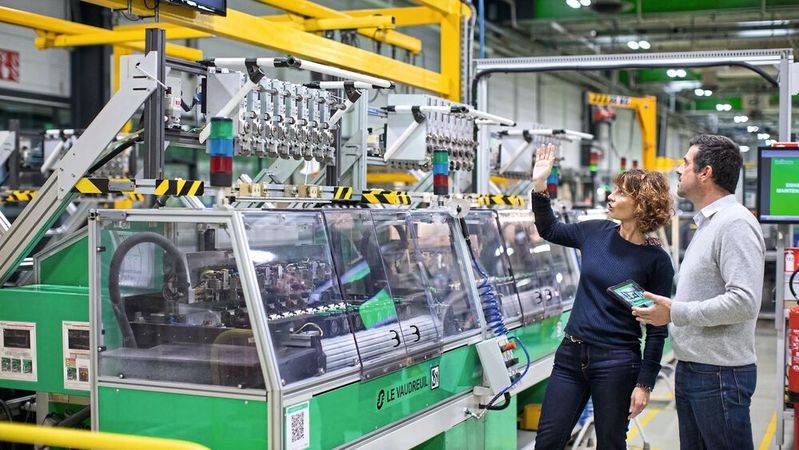
(Image: Schneider Electric)
The question of why digitization is faltering in Germany's factories has long been answered. After all, the facts—at least as suggested by consistent study results—are clear: Economic uncertainty slows investment willingness, everywhere there is a lack of skilled workers or know-how. And: With all the technological advancements and the many different but incompatible systems, maintaining an overview is a challenge. This is how the most common responses from German entrepreneurs sound when they are asked about the obstacles in digital transformation. But, what does this insight bring?
The digital transformation currently always requires a case-by-case perspective.
Silke Rohm, Schneider Electric
Upon closer examination, given the highly heterogeneous culture of medium-sized enterprises in this region, it seems inappropriate to limit digitization problems to just a few generalizing categories. "What currently makes digital transformation so complicated is that it always requires an individual case perspective," explains Silke Rohm, who professionally gains diverse insights into the daily realities of countless German companies every day. "Of course, digital modernization is always a matter of money," admits Rohm. However, how exactly economic or technical aspects impact is very individual. "Each digitization project is a success or failure in its own way," says Silke Rohm.
Being close: With consulting and apps
At Silke Rohm's employer, Schneider Electric, which has about 5,000 employees in Germany, there has been considerable thought for some time about how to simplify and accelerate the entry into digital transformation. In addition to an open IIoT architecture (keyword: Ecostruxure) and a manufacturer-independent automation concept (keyword: Universal Automation), measures taken in this regard also include the introduction of specialized digitalization consulting. Here, in a manner akin to qualitative field research, all aspects and dimensions of a company related to digitalization are examined in advance and then integrated into a holistic transformation process.
Silke Rohm heads this consulting department in the DACH region and knows from experience: "It is often underestimated that digital transformation is about more than just the introduction of new technologies." For many companies, it is incredibly valuable to be accompanied by experienced experts. "But we can only provide this if we are always very close to our customers," says Rohm.
"Being close" is a claim that is not limited to consulting alone. To provide the digitalization consultants with the necessary technical empowerment, the tech company has launched new solutions that are also very close to what they optimize: production. This approach is a holistic solution. The so-called Edge Apps—software applications that process data not in a cloud, but directly on the hardware on-site—are part of this approach.
According to Dr. Rainer Beudert, Marketing Director of IIoT at Schneider Electric, the Edge Apps developed at the global industrial development center in Marktheidenfeld, Lower Franconia, are a deliberately low-threshold entry into digitization: "Many of our customers now feel immense pressure to digitize." The goals are diverse: energy efficiency, quality control, reporting obligations, or creating the prerequisites for the use of artificial intelligence. However, there is often a lack of a coherent plan to deploy software solutions for factory-wide data analysis in a scalable and practical manner. "This is exactly where we start with our Edge-App concept," explains Beudert.
Platform manages apps and edge devices
Anyone wanting to understand what Dr. Rainer Beudert means should know that the new Edge Apps from Schneider Electric are not just individual software applications for specific tasks, such as condition-based maintenance. Instead, the tech giant has launched a comprehensive apps platform through which apps and edge devices for individual machines and production lines can be centrally managed, deployed, secured, and updated.
Various "ready to use" base apps, data models, additional features, and even third-party applications can be combined for the specific business case. Furthermore, all of this can be directly installed on the local hardware and, if necessary, rolled out across many different machines, lines, and locations.
The Edge Apps Manager can be operated either in a cloud environment or locally on the company's own IT infrastructure (on-premise). In both cases, it is used not for data processing but for the structured deployment and management of the Edge-App network. Updates, licensing, backups, and mass deployments can also be carried out via the Edge Apps Manager. Data collection occurs locally, while the analysis of all production data can also take place in the app or cloud.
Ready to use without programming effort
Since the Edge Apps support various communication protocols, such as Modbus TCP and OPC UA, they can be retrofitted practically anywhere and used for data analysis even in manufacturer-diverse machine landscapes. They are ready to use immediately without any programming effort and can be seamlessly integrated into the existing IT architecture without compromising it.
Date: 08.12.2025
Naturally, we always handle your personal data responsibly. Any personal data we receive from you is processed in accordance with applicable data protection legislation. For detailed information please see our privacy policy.
Consent to the use of data for promotional purposes
I hereby consent to Vogel Communications Group GmbH & Co. KG, Max-Planck-Str. 7-9, 97082 Würzburg including any affiliated companies according to §§ 15 et seq. AktG (hereafter: Vogel Communications Group) using my e-mail address to send editorial newsletters. A list of all affiliated companies can be found here
Newsletter content may include all products and services of any companies mentioned above, including for example specialist journals and books, events and fairs as well as event-related products and services, print and digital media offers and services such as additional (editorial) newsletters, raffles, lead campaigns, market research both online and offline, specialist webportals and e-learning offers. In case my personal telephone number has also been collected, it may be used for offers of aforementioned products, for services of the companies mentioned above, and market research purposes.
Additionally, my consent also includes the processing of my email address and telephone number for data matching for marketing purposes with select advertising partners such as LinkedIn, Google, and Meta. For this, Vogel Communications Group may transmit said data in hashed form to the advertising partners who then use said data to determine whether I am also a member of the mentioned advertising partner portals. Vogel Communications Group uses this feature for the purposes of re-targeting (up-selling, cross-selling, and customer loyalty), generating so-called look-alike audiences for acquisition of new customers, and as basis for exclusion for on-going advertising campaigns. Further information can be found in section “data matching for marketing purposes”.
In case I access protected data on Internet portals of Vogel Communications Group including any affiliated companies according to §§ 15 et seq. AktG, I need to provide further data in order to register for the access to such content. In return for this free access to editorial content, my data may be used in accordance with this consent for the purposes stated here. This does not apply to data matching for marketing purposes.
Right of revocation
I understand that I can revoke my consent at will. My revocation does not change the lawfulness of data processing that was conducted based on my consent leading up to my revocation. One option to declare my revocation is to use the contact form found at https://contact.vogel.de. In case I no longer wish to receive certain newsletters, I have subscribed to, I can also click on the unsubscribe link included at the end of a newsletter. Further information regarding my right of revocation and the implementation of it as well as the consequences of my revocation can be found in the data protection declaration, section editorial newsletter.
In addition to features for condition-based maintenance, the Edge Apps Manager also contains applications in the area of Asset Performance for condition-based maintenance or apps in the area of Quality Analytics for autonomous yield optimization or image-based process optimization using AI. "The clever thing about our new Edge Apps is that they can really be individually adapted to the respective suitable business logic," says Dr. Rainer Beudert, referring to potential use cases. "Accordingly, our Edge Apps are not fixed to specific industries. We have already seen initial use cases in the water management sector as well as in the food industry."
When you know how, it is often possible to massively increase the efficiency of systems with simple digital tools.
Dr. Rainer Beudert, Schneider Electric
Digitalization happens from the ground up
Schneider Electric aims to provide an easy entry into digital data analysis with its Edge Apps and the underlying deployment and ecosystem concept. Without necessarily having to deal with the risks of a cloud-based solution, the data is captured, structured, processed, and analyzed directly at the OT level. "And in many use cases, this already provides insights that can practically immediately make production processes more energy-efficient, reliable, and cyber-secure," knows software expert Dr. Beudert. "If you know how, it is often possible to significantly increase the efficiency of facilities using simple digital means." For this, it is important to know one's own goals and conditions well and to tailor every step individually to them.
However, this is only possible if the technical solutions meet this demand. Flexibility and customizability are needed to meet the diverse requirements and circumstances with great practical relevance. And this is something that not only the large, cloud-based platforms for big data analysis are capable of achieving. There are quite a few use cases where using customized Edge Apps is the better first step.
“This article was first published on our sister portal "elektrotechnik" (German Edition), Vogel Communications Group.“



:quality(80)/p7i.vogel.de/wcms/31/84/3184f9ac736d8df7c2e934593684bc74/0130024314v1.jpeg "Here, the Bavarian car manufacturer BMW looks ahead to 2025: business was sluggish due to US tariffs and weakening sales in China ... (Image:BMW)")
:quality(80)/p7i.vogel.de/wcms/49/09/49095c6192a6c46d47b567e1def31ea6/0130024626v1.jpeg "The new TUM \"RoboGym\" (powered by Neura) is Europe's largest training center for next-generation humanoid robots. It focuses on the implementation of artificial intelligence in robotic systems. At the same time, it is a forge for AI experts ... (Image:Neura Robotics)")
:quality(80)/p7i.vogel.de/wcms/fe/8a/fe8af1b829b085210fef4c1fa8abddb5/0129784389v1.jpeg "As an integral part of Koch Pac-Systeme's Predictive Pack digital service product, the gearboxes with Cynapse and Wittenstein's Smart Services make it possible to detect damage risks in the packaging specialist's machines at an early stage. (Image:Koch Pac systems)")
:quality(80)/p7i.vogel.de/wcms/9f/7b/9f7be35880605811e045acd3af8b571b/0129558586v1.jpeg "An example of the V210 processing machine, which, according to Voortman, supplements the laser cutting of the V353 with drilling, thread cutting and milling. (Image:Voortman)")
:quality(80)/p7i.vogel.de/wcms/db/68/db689490e348201603dd30447711ea2b/0129578734v1.jpeg "With three-axis vibration measurement (X, Y and Z axes) and temperature detection, the CMSVT38 condition monitoring sensor provides detailed status information that helps to detect machine damage at an early stage. (Image:Kübler)")
:quality(80)/p7i.vogel.de/wcms/92/5e/925ee98ea36ad9bd574fa1cea11d0e53/0129964352v1.jpeg "The production of hardware components for humanoid robots offers great market potential. (Image:Fraunhofer IPA)")
:quality(80)/p7i.vogel.de/wcms/08/72/0872dd2dd119a54824c41e0e580e45a8/0129576591v1.jpeg "The Rose enclosure systems can be customized on request. (Image:Rose Systemtechnik GmbH)")
:quality(80)/p7i.vogel.de/wcms/73/17/7317794432521bf911711b91287cfc28/0129961259v1.jpeg "ABB Robotics and Nvidia are enabling the widespread use of physical AI in the world of robotics. This means that systems can be created virtually and with high precision and optimized much more cost-effectively. In the large image the virtual system, next to it the real robot cell ... (Image:ABB)")
:quality(80)/p7i.vogel.de/wcms/dd/ce/ddcef80b290218276bf857cdb64a45e1/finkel-stephan-4162x2341v1.jpeg "Stephan Finkel, Partner and Industry Lead Defence & Security at 3DSE (Source: 3DSE)")
:quality(80)/p7i.vogel.de/wcms/cb/fe/cbfe2741917274bbbf93d5b93e47a4f5/contact-software-launcht-fourier-20aiv1v1.png "Fourier AI combines AI models with AI applications developed for demanding engineering tasks. (Image:Contact Software)")
:quality(80)/p7i.vogel.de/wcms/bc/f7/bcf7a56980850be13ed37d220cd514bc/elchinator-security-5042249-1280-1280x720v1v1.jpeg "The HP Wolf Security Report shows: Attackers use AI for speed, modularity and automation, while the quality of campaigns is low. (Image:Picture: Pixabay)")
:quality(80)/p7i.vogel.de/wcms/68/89/688937087188b77da95b2079399ca862/0130009534v1.jpeg "Here you can see the Dualis layout configurator in use at Montratec. (Picture: ©Gorodenkoff - stock.adobe.com)")
:quality(80)/p7i.vogel.de/wcms/69/f5/69f516f07a0ba999c5ba8763891853f1/0130030553v1.jpeg "Can be reloaded in 210 seconds for a return trip on the Greenford branch line: the GWR's 230001. (Image:Jack Boskett Media | GWR)")
:quality(80)/p7i.vogel.de/wcms/f0/5e/f05e720c52f757660ddbf7c410074f64/adobestock-222131875-5616x3157v1.jpeg "(Source: © jeson - stock.adobe.com)")
:quality(80)/p7i.vogel.de/wcms/b2/64/b2641254fef5afa15645cefc37089c88/0130021093v1.jpeg "Daimler Truck and Quantum Systems are jointly developing unmanned military vehicles. (Image:Quantum Systems)")
:quality(80)/p7i.vogel.de/wcms/30/7e/307e71ec64f7c52c29458544ca29adf1/org-blobs-user-response-file-output-799034cb-2ad7-4031-859a-15013f5b78e3-plugin-output-toolu-01vwfuenhw3cadvud7pddgyq-1536x864v1v1.png "China's government is debating the contents of the 15th five-year plan. The focus will change for the automotive industry. (Image:AI-generated)")
:quality(80)/p7i.vogel.de/wcms/61/8f/618f16f8fa95ec6cc838ca9bfb5dbaf1/0130027046v1.jpeg "The Belgian Research Institute has set up a European university consortium on the subject of CMOS 2.0. It brings together 26 university groups to research chip technologies that go beyond conventional transistor scaling. (Image:Imec)")
:quality(80)/p7i.vogel.de/wcms/db/a2/dba29322d0934dea1bbc4b31df80e392/0129953760v1.jpeg "SEM image: High-density electrode array with 128 nm dots. (Image:imec)")
:quality(80)/p7i.vogel.de/wcms/c2/a8/c2a8a93f306c1475489dff074ad59731/0129967672v1.jpeg "Figure 1: Imec's logic technology roadmap showing the extension of the nanosheet era from 2nm to the A10 node with the outer-wall forksheet, before the transition to CFET for A7 and beyond. (Image:imec)")
:quality(80)/p7i.vogel.de/wcms/07/79/0779a3ba2b38d583fc9b515900be2add/0129957428v1.jpeg "If the Chinese government has its way, domestic data centers full of Nvidia hardware will be a thing of the past. (Image:Nvidia)")
:fill(fff,0)/images.vogel.de/vogelonline/companyimg/76800/76895/65.jpg "FAULHABER_120mm.jpg ()")
:fill(fff,0)/p7i.vogel.de/companies/67/eb/67eba621ef6ea/logo2.png "logo2 (Wuxi InfiMotion)")
:quality(80)/p7i.vogel.de/wcms/75/13/75139f428ba57205c692b17d742281f7/0124874362v1.jpeg "Digitalization with Weidmüller: machine operation via HMI or via cloud. (Image:M. Christa)")
:quality(80)/p7i.vogel.de/wcms/41/58/41584767d691fecc48b6489f371cba28/0126543851v1.jpeg "By connecting Siemens Industrial Edge with the Snowflake AI Data Cloud, manufacturers gain access to plug-and-play Industrial Edge applications that contextualize OT data and transfer it into IT systems. (Image:Siemens)")