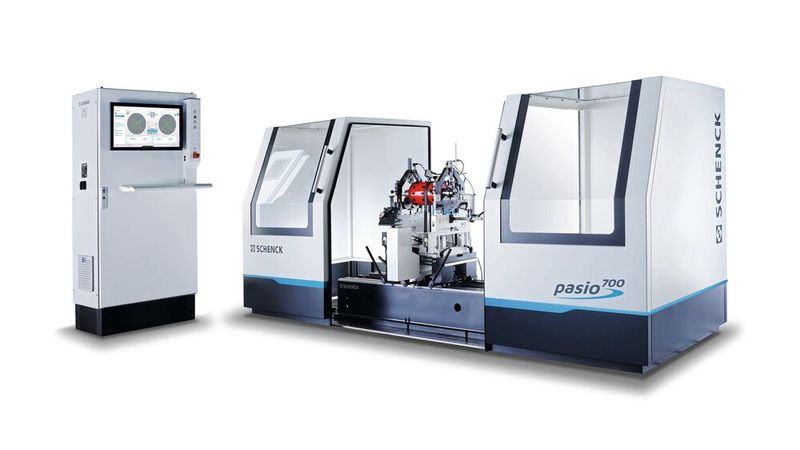
With the Pasio 700, Schenck Rotec has not only introduced a new balancing machine, but also determined the Product Carbon Footprint according to ISO 14067 for the first time. This has led to valuable insights.
With the Pasio balancing machine, Schenck Rotec offers smaller businesses and workshops as well as manufacturers and OEMs a suitable machine for horizontal balancing that is not aligned to a specific rotor type.
(Image: Schenck Rotec)
Fans, spindles, armatures, compressors—in many industrial applications, rotors need to be measured, balanced and checked. With the Pasio balancing machine, Schenck Rotoc offers smaller businesses and workshops, as well as manufacturers and OEMs, a machine for horizontal balancing that is not aligned to a specific rotor type. Instead, the machine covers the entire spectrum: from cylindrical rotors with their own journal to disc-shaped rotors with auxiliary shaft. It is suitable for individual rotors as well as for series, to measure unbalances, determine their position, support the operator in balancing and perform a control measurement. And the new Pasio, with its three size gradations, can accommodate rotor weights from 1 to 700 kilograms. The design as a modular construction kit system thus offers flexibility to all users.
In addition to the criteria of form and function as well as global usability, the developers at Schenck Rotec particularly focused on sustainability in the design of the machine: In cooperation with the Fraunhofer IBP, a Product Carbon Footprint (according to ISO 14067) of six to 16 tons of CO2 equivalents was determined over the entire life cycle of 15 years.
Our customers can use the Carbon Footprint for their own emission assessments.
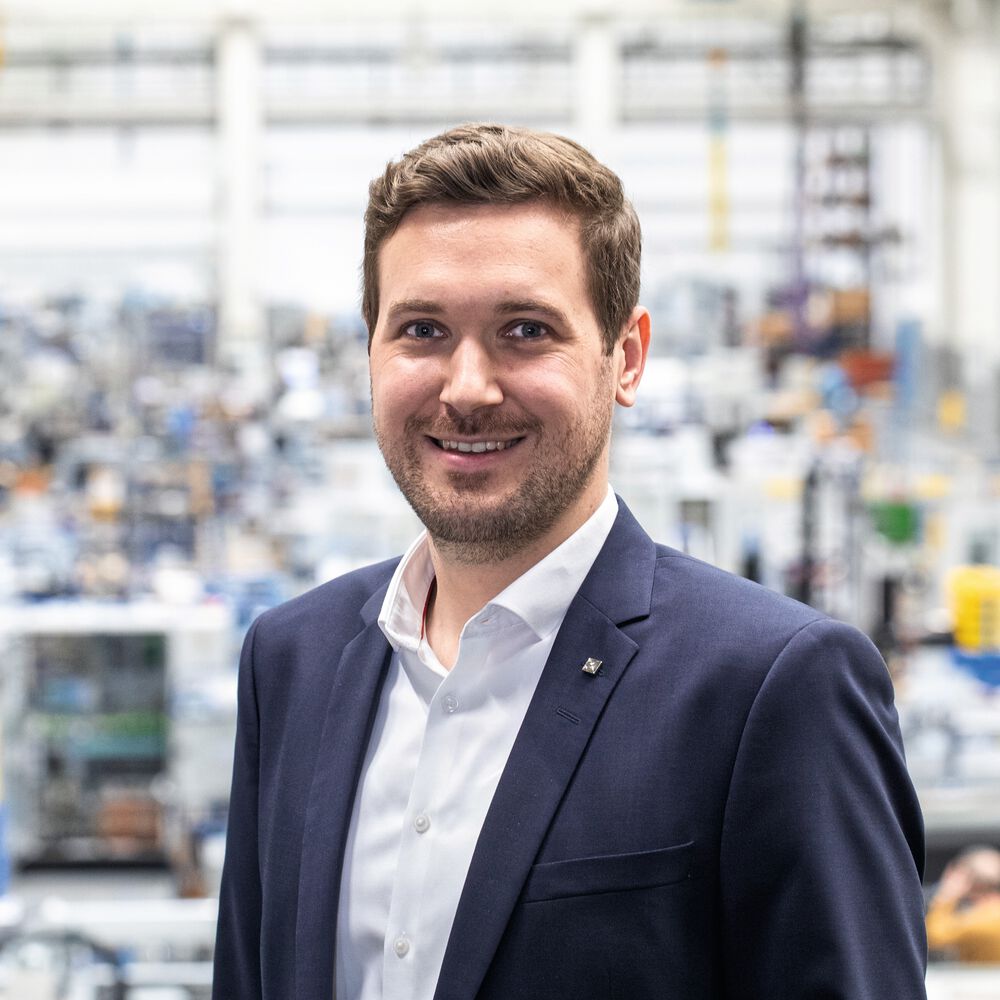
Jonas Schuch, Manager Sustainability at Schenck Rotec
"The disclosure of the Carbon Footprint provides customers with an important decision-making aid when choosing sustainable machines," explains Jonas Schuch, Manager of Sustainability at Schenck Rotec.
(Image:Schenck Rotec)
"Determining the Product Carbon Footprint of the Pasio 700 was an important step in making the ecological footprint of our new balancing machine more transparent," explains Jonas Schuch, Sustainability Manager at Schenck Rotec. "This allows us to offer our customers the opportunity to use this parameter for their own emission assessments." In addition, the ecological footprint provides the company with the basis to make future developments even more sustainable.
Quantification of the Carbon Footprint together with the Fraunhofer IBP
The quantification of the Carbon Footprint for the Pasio 700 horizontal balancing machine was implemented together with Fraunhofer IBP in a joint research project. The calculations were carried out using the principles of Life Cycle Assessment based on the DIN EN ISO 14067 standard. This process determines the greenhouse gas emissions from the procurement of raw materials to the end of the product's life.
The Carbon Footprint for the Pasio 700, for the scenarios considered and the entire life cycle with a usage duration of 15 years, lies between 6,563 and 16,002 kg CO2 equivalents. The value for the average reference machine is 9,516 kg CO2 equivalents. For classification: Four business class flights between Frankfurt and New York correspond to about 9,000 kg CO2 equivalents (Source: Federal Environmental Agency CO2 Calculator My CO2 Balance: Air Travel, CO2 Calculator of the Federal Environmental Agency)
To ensure that scientifically sound methods are used for the analysis, Jonas Schuch and his colleagues have chosen the Fraunhofer IBP as an experienced partner. The parent company of Schenck Rotec, Dürr AG, has also carried out similar projects with the Fraunhofer IBP on ecological balance in the past—with good experiences, as Schuch knows.
Greenhouse gas emissions from production and use captured
In addition to comprehensive advice, Fraunhofer IBP supported the purchasing, product development and product management departments in data collection, fed missing emission data from a scientific database, developed a calculation model and summarized the results in a report. Included in the determination are the climate gas emissions attributable to production (materials, processing steps, transports) and the usage phase (including twelve usage scenarios and two energy mixes). An emission credit was calculated for the end of the machine's life, based on the recyclability of the various components.
An example illustrates this: According to the analysis, a Pasio 700 balancing machine has the smallest environmental impact when operated with a 50 kg rotor in batch size 1 (i.e., ten percent machine utilization) in single-shift operation (eight hours per day). With a usage time of 15 years and the reference electricity mix, this results in around 8,400 kg CO2e. Using renewable energies emits only 6,563 kg CO2e in this period. The use of pure green electricity thus reduces greenhouse gas emissions in this case by approximately 22 percent.
As usual for such a project, Schuh and his colleagues had to overcome some obstacles. The project was scheduled for two months. "In retrospect, this turned out to be tight," Schuch explains. Since the colleagues from the departments implemented the topic in addition to their other tasks, capacity conflicts arose. "Therefore, in total, just under three months were needed until we held the result report including the Product Carbon Footprint in our hands," the Sustainability Manager reports. In addition, the experts checked the entire machine parts list for the consistency of the material master data to ensure a clean database for modeling. This parts list comprises about 1000 lines, "a time expenditure that we initially underestimated," says Schuch.
Date: 08.12.2025
Naturally, we always handle your personal data responsibly. Any personal data we receive from you is processed in accordance with applicable data protection legislation. For detailed information please see our privacy policy.
Consent to the use of data for promotional purposes
I hereby consent to Vogel Communications Group GmbH & Co. KG, Max-Planck-Str. 7-9, 97082 Würzburg including any affiliated companies according to §§ 15 et seq. AktG (hereafter: Vogel Communications Group) using my e-mail address to send editorial newsletters. A list of all affiliated companies can be found here
Newsletter content may include all products and services of any companies mentioned above, including for example specialist journals and books, events and fairs as well as event-related products and services, print and digital media offers and services such as additional (editorial) newsletters, raffles, lead campaigns, market research both online and offline, specialist webportals and e-learning offers. In case my personal telephone number has also been collected, it may be used for offers of aforementioned products, for services of the companies mentioned above, and market research purposes.
Additionally, my consent also includes the processing of my email address and telephone number for data matching for marketing purposes with select advertising partners such as LinkedIn, Google, and Meta. For this, Vogel Communications Group may transmit said data in hashed form to the advertising partners who then use said data to determine whether I am also a member of the mentioned advertising partner portals. Vogel Communications Group uses this feature for the purposes of re-targeting (up-selling, cross-selling, and customer loyalty), generating so-called look-alike audiences for acquisition of new customers, and as basis for exclusion for on-going advertising campaigns. Further information can be found in section “data matching for marketing purposes”.
In case I access protected data on Internet portals of Vogel Communications Group including any affiliated companies according to §§ 15 et seq. AktG, I need to provide further data in order to register for the access to such content. In return for this free access to editorial content, my data may be used in accordance with this consent for the purposes stated here. This does not apply to data matching for marketing purposes.
Right of revocation
I understand that I can revoke my consent at will. My revocation does not change the lawfulness of data processing that was conducted based on my consent leading up to my revocation. One option to declare my revocation is to use the contact form found at https://contact.vogel.de. In case I no longer wish to receive certain newsletters, I have subscribed to, I can also click on the unsubscribe link included at the end of a newsletter. Further information regarding my right of revocation and the implementation of it as well as the consequences of my revocation can be found in the data protection declaration, section editorial newsletter.
A large part of the emissions are caused before delivery
The fact that the machine already causes a large part of the emissions by the time it is delivered to the customer was one of the insights Schuch and colleagues gained over the course of the project. In the usage phase, on the other hand, emissions are relatively low, especially when electricity from renewable energy sources is used for machine operation. The drive technology used also contributes to this; it enables energy recovery. Schenck Rotec uses the knowledge gained for the continuous improvement and further development of sustainable products. Thus, the acquired knowledge about material with a relatively high CO2 footprint flows into future product developments; it is replaced by components produced sustainably.
The response to the CO2 footprint of the Pasio 700 at EMO 2023 in Hanover was positive, reports Jonas Schuch. The fact that Scheck Rotec was the only balancing machine manufacturer at the trade fair to have shown such a value for a machine reinforces Schuch in the knowledge that he is playing a pioneering role here. "I strongly suspect that interest in the Product Carbon Footprint will increase significantly in the future," predicts Jonas Schuch. "Providing this value offers customers an important decision-making aid when choosing sustainable machines for their business activity."



:quality(80)/p7i.vogel.de/wcms/dd/08/dd086510d9ae7b50181f6070e4463b44/0129363730v1.jpeg "Typical application for ionizing devices: Wrapping films. (Picture: ©Adobe Stock/SMC)")
:quality(80)/p7i.vogel.de/wcms/35/57/3557c819943c53acec41a0ccba87da4f/0130049064v1.jpeg "Researchers at the Fraunhofer IWU in Chemnitz have long known that many typical sheet metal parts can be manufactured more cost-effectively using hollow embossing rollers. Now there is news to report ... (Image:Fraunhofer IWU)")
:quality(80)/p7i.vogel.de/wcms/59/02/590246e3b3f415c65edbee377c14ca77/26-06-pi-fraunhofer-iws-41450-direktplattieren-pic-01-7771x4369v1v1.jpeg "The Fraunhofer IWS has developed the new \"direct laser cladding\" process, which creates a functional layer directly on the base body by applying a strip-shaped metal to rotationally symmetrical components in a spiral and bonding it locally by laser. (Image:Christoph Wilsnack/Fraunhofer IWS)")
:quality(80)/p7i.vogel.de/wcms/73/60/73608418789b1d9c393f5e2fa974eda2/0130209906v1.jpeg "The robots of the X6 generation from b+m enable very high painting quality and are also particularly compact and easy to maintain. (Image:Beckhoff)")
:quality(80)/p7i.vogel.de/wcms/78/e9/78e9188c25a8a94e67c34c9bf8ffe495/visual-agile-20robots-20and-20google-20deepmind-20partner-20to-20bring-20intelligence-20to-20robotics-2500x1406v1v1.jpeg "Together, the partners are developing adaptable, intelligent robots for a wide range of applications (Image:Agile Robots SE)")
:quality(80)/p7i.vogel.de/wcms/e7/66/e7669ecf0260ae8fc54c214e34e4902a/0130316817v1.jpeg "Siemens and Palo Alto Networks offer tested cybersecurity solution for industrial 5G. (Image:Siemens)")
:quality(80)/p7i.vogel.de/wcms/9f/55/9f55324832c4f426958031375124d9de/siemens-20ubtech-20hmnd-1920x1079v1v1.png "Ready for the factory floor: While Ubtech is planning mass production, Siemens is already testing humanoids in real factory applications in Erlangen. (Image:Siemens)")
:quality(80)/p7i.vogel.de/wcms/11/36/113695ed260e29c8c2d9d39dc5f9d869/0130213768v1.jpeg "AI can work cheaply in China and deliver the results rapidly all over the world. (Image:Dall-E / AI-generated)")
:quality(80)/p7i.vogel.de/wcms/62/5f/625f41e87ebfef156a98c8e6393e32fd/0130211654v1.jpeg "Axial flux motors have some advantages over radial flux motor—but their production is currently still expensive. (Image:RWTH Aachen University)")
:quality(80)/p7i.vogel.de/wcms/77/9b/779b0685d010dfe45c9c2cb1cfecd467/0128886425v1.jpeg "The BlueEye is the first \"real\" hyperspectral camera for the UV range and covers the wavelength range from 220 to 380nm. (Image:Inno-spec GmbH)")
:quality(80)/p7i.vogel.de/wcms/e4/51/e451d52ce0182fb0aaa46a5774f832ef/26-04-pi-fraunhofer-iws-21160-bioslide-pic-01-4128x2321v1v1.jpeg "With the BioSlide research project, the Fraunhofer IWS is investigating how sliding systems can be designed to be more sustainable and energy-efficient. New materials can be tested in a particularly application-oriented manner on this plain bearing test stand. (Image:Fraunhofer IWS)")
![Thanks to advanced 3D printing technology, a more efficient use of resources should contribute to lower-emission aviation—this is the goal of ['skai]-lab. (Image:Oleksandr Pashchenko - stock.adobe.com / AI-generated)](https://cdn1.vogel.de/nghHNSbySccfOjG3n1qCA-FVOjQ=/288x162/smart/filters:format(jpg):quality(80)/p7i.vogel.de/wcms/62/64/626424c97a16e69f871bf216c9629c2a/adobestock-1927043193--c2-a9-20oleksandr-20pashchenko-20-e2-80-93-20stock-adobe-com-ki-generiertv1v1.jpeg "Thanks to advanced 3D printing technology, a more efficient use of resources should contribute to lower-emission aviation—this is the goal of ['skai]-lab. (Image:Oleksandr Pashchenko - stock.adobe.com / AI-generated)")
:quality(80)/p7i.vogel.de/wcms/c3/c4/c3c4ce270b083eeac55654148611f064/0130237945v1.jpeg "China is not giving up on hydrogen, but is intensifying its efforts. (Image:freely licensed from Pixabay)")
:quality(80)/p7i.vogel.de/wcms/4e/c0/4ec0bd19390b169edfa23677373dcdf1/0130260089v1.jpeg "Renewable fuels can supply European road traffic, according to a study. (Image:Aral)")
:quality(80)/p7i.vogel.de/wcms/6f/c9/6fc9050301d745cad25585c6780f8f51/0130197341v1.jpeg "Production facilities are a worthwhile target and are therefore at risk. (Image:ABB Robotics)")
:quality(80)/p7i.vogel.de/wcms/b6/62/b662adc2cec8227d8172509bbfb6ee42/25c0207-107-4961x2789v1v1.jpeg "The GLB is the second model based on Mercedes' new MMA platform. Apparently, Geely's platform is better and cheaper, which is why the two companies are negotiating a partnership. (Image:Mercedes-Benz)")
:quality(80)/p7i.vogel.de/wcms/4d/dd/4dddf438e91f394c04a095dbfd109d1c/0130236430v1.jpeg "Measurement modules: The 720301 module in combination with the SL2000 enables RMS and power calculations, among other things. (Image:Yokogawa)")
:quality(80)/p7i.vogel.de/wcms/61/fc/61fcf95f5cca15494ad18343901ae585/0130317237v1.jpeg "With the AGI CPU, Arm says it is taking a \"historic step\": With the processor aimed at AI in data centers, the company is presenting itself for the first time as a provider of its own chips, not just as a pure IP licensor. (Image:Arm)")
:quality(80)/p7i.vogel.de/wcms/82/90/8290dfe3595b6c6b33726ae8b76172c7/0130319587v1.jpeg "The concept image illustrates how the pattern of tiny protrusions and depressions created on the substrate (MgO, bottom) controls the arrangement of atoms in the superconducting material (YBCO, top). At the interface between the two layers, an electronic structure enables superconductivity to occur at higher temperatures than previously possible. (Image:Chalmers University of Technology / Riccardo Arpaia)")
:fill(fff,0)/images.vogel.de/vogelonline/companyimg/76800/76895/65.jpg "FAULHABER_120mm.jpg ()")
:fill(fff,0)/p7i.vogel.de/companies/69/88/69882c428938e/tmts2026-ticec-banner-en-2000px.png "tmts2026-ticec-banner-en-2000px (https://www.tmts.tw/en)")
:fill(fff,0)/p7i.vogel.de/companies/67/eb/67eba621ef6ea/logo2.png "logo2 (Wuxi InfiMotion)")
:quality(80)/p7i.vogel.de/wcms/c9/7d/c97d07383bdc830da93cbc62fc32e5dc/0126044130v1.jpeg "Thinner cables generate more heat due to their higher electrical resistance, resulting in greater power loss. The thicker a cable is, the lower the resistance – allowing the current to flow freely without a significant portion of the energy being converted into heat. (Image:Lapp)")
:quality(80)/p7i.vogel.de/wcms/3d/d2/3dd22afbcf44a70668c1d9ec913b39db/0125327451v1.jpeg "EMO Hannover 2025 offers three focus topics, one of which is sustainability. Here are some examples from exhibitors on how they achieve this in their companies. Ceratizit, for instance, focuses on recycling milling cutters (pictured) & more. (Image:Ceratizit)")