February 11 was the European Emergency Number Day. A good occasion to consider: What can companies do to make calls to 112 unnecessary in the first place? With the right protective measures, the risk of occupational accidents can be significantly reduced.
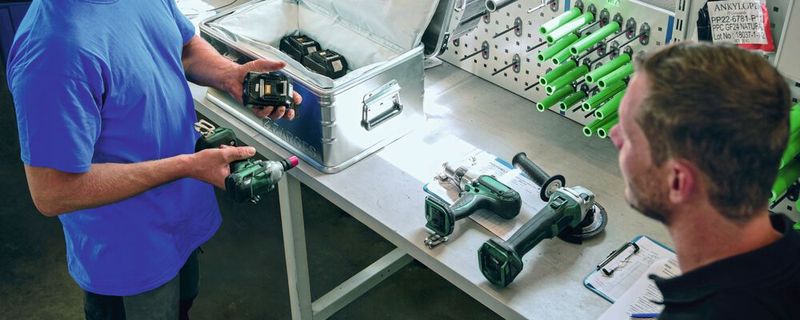
With the Zarges Battery Storage Box, tool batteries can be stored properly.
(Image: Zarges)
An average of 84,000 emergency calls are received daily by the control centers of fire departments and emergency services in Germany, which equates to one per second. In total, there were over 30 million in 2023, according to the latest figures from Deutsche Telekom, through whose network all calls to 112 are routed. Although not every emergency call results in a response, rescue workers have more than enough to do. In Bavaria alone, the Bavarian Red Cross (BRK) had to deploy 648,000 times. A significant portion of the emergency calls nationwide relates to the work environment. According to the German Social Accident Insurance (DGUV), 10,283 serious occupational accidents were reported in 2023, 381 of which were fatal. It's high time to review one's own occupational safety concept.
High risk from fall accidents and suspension trauma
The likelihood of accidents is particularly high in the construction industry, where 76 of the fatal occupational accidents occurred. No wonder, as employees often work with heavy equipment or at great heights. Fall accidents, in particular, are dangerous. According to the DGUV, they accounted for 16 percent of the fatal and 30,000 reportable occupational accidents. Often, a fall from less than two meters is enough to cause serious injuries. The severity increases with height. To protect themselves, construction workers are increasingly wearing safety harnesses. While these do protect against impact, they do not prevent suspension trauma. When a person hangs motionlessly in an upright position in the harness, the cutting straps cause the blood to pool in the legs. The brain and other vital organs are no longer adequately supplied with oxygen, leading to dizziness, nausea, or confusion. Almost all affected individuals develop symptoms within ten minutes, and after 15 minutes, the chances of survival decrease rapidly. Even if the rescue is successful in time, damage can remain, as the pooled blood may release toxic substances into the body.
What can rescue workers actually accomplish?
When it comes to saving lives, every second often counts. However, many companies overestimate how quickly emergency services can be on site. Some technical managers think, "We have a deal with the fire department – they come immediately when something happens here."
However, in the event of a fall, the arriving rescuers often can only cut the fallen employee out of the harness dead. Without a doubt, the rescue workers provide an enormous service and do their best every day. But they, too, often work at the limits of their capacity and are understaffed. When many operations occur simultaneously, bottlenecks are inevitable. A nationwide investigative report by SWR shows that in the event of a sudden cardiac arrest, more than 80 percent of the emergency services in Germany arrive too late. A resuscitation attempt should be made after no more than eight minutes in such cases. However, only a few paramedics manage to reach the scene that quickly. What are the chances of a safe rescue in the event of a fall accident, then?
Integrated fall protection solution can save lives
All the more important is to ensure optimal prevention and the best possible occupational safety. For fall protection, a "Chair in the Air" system is recommended, allowing the worker to quickly and easily bring themselves into a sitting position. This reduces the pressure on the legs and keeps blood circulation flowing. Since the system is integrated into the safety harness, the fallen individual only needs to pull up their legs to sit. They can rescue themselves intuitively and do not need experience in handling protective equipment. This makes the solution safer than trauma straps, which are commonly used. These must not only be carried separately and be quickly accessible in a stressful situation, but their application also requires regular training to ensure everything works correctly in an emergency.
Underestimated danger: Battery fire
In addition to fall accidents and suspension trauma, there are many other risks in the construction and industrial sectors that occupational safety officers must address. Often underestimated is the danger posed by lithium-ion batteries, which are found in many power tools. When these energy carriers age, are defective, or improperly stored, they can ignite. This is partly due to the increased risk of short circuits through the natural aging process. High temperatures or impacts during storage can also damage the internal components. Once ignited, they are difficult to extinguish as lithium-ion batteries burn at temperatures sometimes exceeding 1000 degrees. Conventional extinguishing agents are not sufficient, and there is even a risk of explosion upon contact with water. In many cases, the fire department cannot extinguish the fire but only bring it under control. To mitigate risks, it is important to store and transport batteries safely. Special safety boxes with a fire-resistant inner lining are recommended for this purpose.
Regulation is increasing
Due to the increasing prevalence of e-bikes and electronic devices, it is expected that legislators will enact stricter regulations for the handling and storage of lithium-ion batteries in the coming years. Insurers are also likely to address this risk and adjust their policies accordingly. Even today, the implementation of appropriate protective measures for batteries falls under §5 of the Occupational Health and Safety Act. According to this, employers are obliged to assess working conditions and associated hazards. In the future, companies will need to consider more and more regulations in occupational and product safety. Since December 2024, for example, the new EU regulation for general product safety has been in effect, replacing Directive 2002/95/EC. Manufacturers are now required to perform an internal risk analysis for each product. For safety officers, it is becoming increasingly difficult to keep track of and know all the regulatory requirements in detail. Therefore, it is advisable to seek advice from external specialists.
Date: 08.12.2025
Naturally, we always handle your personal data responsibly. Any personal data we receive from you is processed in accordance with applicable data protection legislation. For detailed information please see our privacy policy.
Consent to the use of data for promotional purposes
I hereby consent to Vogel Communications Group GmbH & Co. KG, Max-Planck-Str. 7-9, 97082 Würzburg including any affiliated companies according to §§ 15 et seq. AktG (hereafter: Vogel Communications Group) using my e-mail address to send editorial newsletters. A list of all affiliated companies can be found here
Newsletter content may include all products and services of any companies mentioned above, including for example specialist journals and books, events and fairs as well as event-related products and services, print and digital media offers and services such as additional (editorial) newsletters, raffles, lead campaigns, market research both online and offline, specialist webportals and e-learning offers. In case my personal telephone number has also been collected, it may be used for offers of aforementioned products, for services of the companies mentioned above, and market research purposes.
Additionally, my consent also includes the processing of my email address and telephone number for data matching for marketing purposes with select advertising partners such as LinkedIn, Google, and Meta. For this, Vogel Communications Group may transmit said data in hashed form to the advertising partners who then use said data to determine whether I am also a member of the mentioned advertising partner portals. Vogel Communications Group uses this feature for the purposes of re-targeting (up-selling, cross-selling, and customer loyalty), generating so-called look-alike audiences for acquisition of new customers, and as basis for exclusion for on-going advertising campaigns. Further information can be found in section “data matching for marketing purposes”.
In case I access protected data on Internet portals of Vogel Communications Group including any affiliated companies according to §§ 15 et seq. AktG, I need to provide further data in order to register for the access to such content. In return for this free access to editorial content, my data may be used in accordance with this consent for the purposes stated here. This does not apply to data matching for marketing purposes.
Right of revocation
I understand that I can revoke my consent at will. My revocation does not change the lawfulness of data processing that was conducted based on my consent leading up to my revocation. One option to declare my revocation is to use the contact form found at https://contact.vogel.de. In case I no longer wish to receive certain newsletters, I have subscribed to, I can also click on the unsubscribe link included at the end of a newsletter. Further information regarding my right of revocation and the implementation of it as well as the consequences of my revocation can be found in the data protection declaration, section editorial newsletter.
Conclusion
Occupational safety is an employer's duty. Of course, accidents can occur despite the best prevention. We are then relieved and grateful when the fire department and paramedics quickly arrive at the scene. However, companies should do everything possible to prevent rescue operations and mitigate risks. Therefore, it is important to prioritize occupational safety and review existing protective measures. External specialists can provide consulting support to find optimal solutions. Ultimately, it is also about social responsibility, and every emergency call that can be avoided counts.
Secure and Compliant Authentication in Laboratories



:quality(80)/p7i.vogel.de/wcms/a0/47/a04725ef9bd09fb6c9341a1bea1b5d93/0130443083v1.jpeg "Here, a type of plastic pallet is produced by thermoforming (vacuum forming or deep drawing) at the corresponding division of New England Plastics in the USA. This division, which specializes in so-called liners, is now part of Ringmetall ... (Image:New England Plastics)")
:quality(80)/p7i.vogel.de/wcms/23/99/23992bf2dcdc432c9b7209c34a4a7c48/0129733089v1.jpeg "Stork relies on the modular Neoswiss turning system from Iscar to shorten the set-up times for its sliding headstock lathes and work more productively. (Image:Iscar)")
:quality(80)/p7i.vogel.de/wcms/7d/e2/7de2923434b2f1a78ba5482d8d335269/0113143253v1.jpeg "In our China Market Insider we regularly provide you with relevant information directly from China. (Image:© Eisenhans - stock.adobe.com)")
:quality(80)/p7i.vogel.de/wcms/9d/2b/9d2b802f800e5caf17b2831e74228cd3/screenshot-202026-03-03-20103822-609x343v1v1.png "Visual comparison: on the left, a clean, burr-free cut edge; on the right, typical burr formation with oxidation discoloration. This illustrates how strongly parameter control and gas management influence the quality of the result. (CO₂ laser, oxygen cutting gas, sheet thickness approx. 15 mm). (Image:Picture: Rime)")
:quality(80)/p7i.vogel.de/wcms/b7/36/b736dfebc16c42d6901d0d0e1f390493/3d-druck-20factory-20--20ki-20generiert-1920x1079v1.png "(Source: AI-generated)")
:quality(80)/p7i.vogel.de/wcms/79/b2/79b21aad663f4a7bd4472afc1c1afc62/0130433994v1.jpeg "Mission Joyride: The free-flying robot (shown here in the rendering) will relieve the ISS crew of logistics tasks from 2027 with its two mechanical arms. (Image:Icarus Robotics)")
:quality(80)/p7i.vogel.de/wcms/6b/45/6b4546fa6ebf305c3660326909363f32/0130437089v1.jpeg "Industrial AI in action: Rockwell Automation presents practical solutions for self-controlling production systems at the Hannover Messe. (Image:Rainer Jensen, Deutsche Messe)")
:quality(80)/p7i.vogel.de/wcms/78/e9/78e9188c25a8a94e67c34c9bf8ffe495/visual-agile-20robots-20and-20google-20deepmind-20partner-20to-20bring-20intelligence-20to-20robotics-2500x1406v1v1.jpeg "Together, the partners are developing adaptable, intelligent robots for a wide range of applications (Image:Agile Robots SE)")
:quality(80)/p7i.vogel.de/wcms/59/a2/59a2b11f0aa1b700eff02addd5de8703/adobestock-1788280853--c2-a9-20satria-20-e2-80-93-20stock-adobe-com-5081x2860v1v1.jpeg "Quantum computers require extreme cooling to temperatures close to absolute zero in order to keep qubits stable. (Image:satria - stock.adobe.com)")
:quality(80)/p7i.vogel.de/wcms/49/38/493876a248943456b7e4a6db6edfc454/0130230765v1.jpeg "Safe and reliable in aircraft construction: light-curing adhesive bond combined with universal fastening elements. (Source: Delo)")
:quality(80)/p7i.vogel.de/wcms/b5/c7/b5c749d16c8a2e789c1469c2c8c1c387/0130452780v1.jpeg "Volvo Trucks completes road tests with its new hydrogen-powered trucks. (Image:Volvo Trucks)")
:quality(80)/p7i.vogel.de/wcms/ba/69/ba6975f417a85147084f38dc2cd209e2/0130451386v1.jpeg "Together with Nvidia, Hyundai wants to develop an architecture that will be used for level 4 robotaxis (image) as well as for level 2 customer vehicles. (Image:Hyundai)")
:quality(80)/p7i.vogel.de/wcms/93/4d/934de334b47abaa526c78cba1417d7af/0130343495v1.jpeg "The new SU7 is available in three price categories, \"Standard\", \"Pro\" and \"Max\" (Image:Xiaomi)")
:quality(80)/p7i.vogel.de/wcms/df/a0/dfa048434bb94f1b7d030e346b25b3ae/0130373541v1.jpeg "From August, BMW will be producing the i3 at its main plant in Munich - which the car manufacturer has extensively rebuilt for this purpose. (Image:Rainer Haeckl)")
:quality(80)/p7i.vogel.de/wcms/ee/09/ee09acbd6dc896df25affaa9e871e6e5/0130440053v1.jpeg "IMS chip module for simple system integration into an ion mobility spectrometer. (Image:Fraunhofer IPMS)")
:quality(80)/p7i.vogel.de/wcms/10/6c/106cd22de5f68a0f74639d654827228c/0130345302v1.jpeg "Made in India: According to the India Electronics and Semiconductor Association (IESA), the country should be able to produce between 75 and 80 million chips by the beginning of 2027, once the plants currently under construction become operational. (Image:Pixabay (Montage: Sebastian Gerstl))")
:quality(80)/p7i.vogel.de/wcms/a5/ed/a5ed6fda029d362732a293d6b19d74c4/0130444216v1.jpeg "Thirteen executives from the Chinese chip industry have drawn up a plan to achieve an 80% self-sufficiency rate for semiconductors by 2030. (Image:Maxim_Kazmin - stock.adobe.com)")
:quality(80)/p7i.vogel.de/wcms/31/a6/31a646018b34d8e0a44bfc8bf17837f6/0130361632v1.jpeg "For many companies, PFAS are considered indispensable in electronics production. (Image:freely licensed)")
:fill(fff,0)/images.vogel.de/vogelonline/companyimg/76800/76895/65.jpg "FAULHABER_120mm.jpg ()")
:quality(80):fill(efefef,0)/p7i.vogel.de/wcms/67/ac/67acb931a438c/elatec-wp-gmp.png "Elatec WP GMP")
:quality(80)/p7i.vogel.de/wcms/a3/b1/a3b1fc7017077329db7f36638c443293/org-blobs-user-response-file-output-3464bb0e-cba5-499e-b2d1-f0550dad2b2c-plugin-output-call-98wgfin4vwuwdk4rk2mcggg2-1536x864v1v1.png "The safety of electric cars is currently the subject of much debate in China. (Image:Image: AI-generated)")
:quality(80)/p7i.vogel.de/wcms/d9/41/d941e1b8998814d001561be0a4977974/0125616599v1.jpeg "Researcher Carolin Müller from TUM Klinikum showcases a new robotic module developed for the case of a tension pneumothorax. (Image:TUM)")