The Dekra Traffic Safety Report 2025 "Mobility in Changing Times" addresses, among other things, the integration of artificial intelligence (AI) in road vehicles. These technologies hold significant potential for increased road safety but also carry high risks. Read what Dekra (Global leader in vehicle inspections) experts are calling for here.
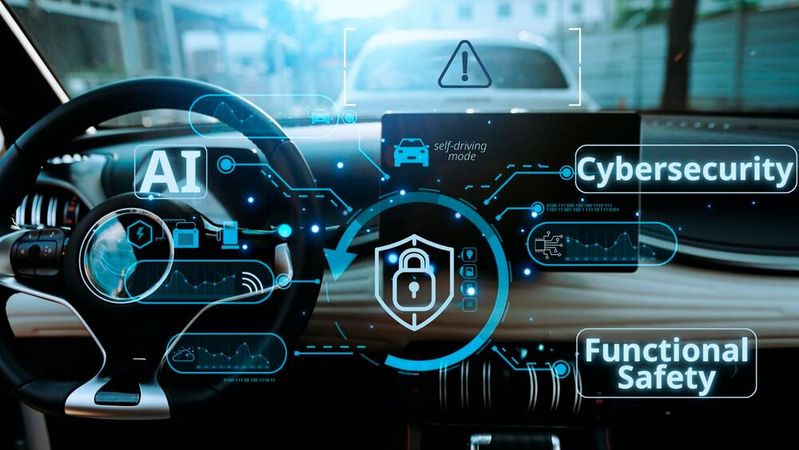
In the future, Advanced Driver Assistance Systems (ADAS) will take on important tasks in an increasing number of vehicles.
(Image: DEKRA)
Artificial Intelligence (AI) is increasingly being integrated into road vehicles. This inherently holds significant potential for improved traffic safety. However, "the high risks associated with the—never entirely avoidable—failure of AI systems must not be overlooked," warns Xavier Valero, Director Artificial Intelligence & Advanced Analytics at Dekra. Therefore, regulations and standards, such as the EU AI Act as a legal framework for the development of such systems, are all the more important. The topic is one of many covered in the current Dekra Road Safety Report 2025 "Mobility Through the Ages."
Driver Assistance Systems Classified As High-Risk Systems
In the future, Advanced Driver Assistance Systems (ADAS) will take on important tasks in an increasing number of vehicles:
For the detection of traffic signs, pedestrians, cyclists, or vehicles,
for monitoring tire pressure or engine temperature, or
for initiating automated braking or lane-changing maneuvers
However, since a malfunction could endanger human health and life, the EU classified such ADAS as high-risk systems in its AI Act passed in 2024. "These systems, which are crucial for driving safety, must therefore be subject to strict oversight and validation to ensure their reliability and avoid risks," emphasizes Xavier Valero.
A comprehensive quality management system throughout the entire AI lifecycle is required for full compliance, as it ensures that all activities remain traceable and verifiable.
Xavier Valero, Director Artificial Intelligence & Advanced Analytics at Dekra
AI Law Allows Exceptions
The AI Act also allows exceptions if AI systems have already been evaluated in accordance with existing regulations, such as vehicle type approval (Regulation EU 2018/858). This means that safety features like ADAS, while indirectly regulated by the AI Act, can be validated through existing type approval procedures without requiring additional third-party assessments.
"Aside from ensuring that their systems meet the requirements of the AI Act, system providers must also establish a comprehensive AI management system with clear guidelines and workflows within their organization," adds the Dekra expert. Additionally, all parties involved—upstream technology suppliers, downstream integrators, and manufacturers—must contribute to ensuring system safety, data security, and transparency. "A comprehensive quality management system throughout the entire AI lifecycle is required for full compliance, as this ensures that all activities remain traceable and verifiable," says Xavier Valero.
Continuous Monitoring During Operation
Guidelines for the safety of AI systems in the automotive industry are provided by ISO/PAS 8800. This standard covers the entire AI lifecycle, from design to deployment, ensuring that systems are both safe and reliable at every stage. It complements ISO 26262 (functional safety) and ISO 21448 (SOTIF—Safety of the Intended Functionality) to address potential risks associated with AI-powered systems. It also emphasizes the importance of controlling data quality, system validation, and continuous monitoring during operation.
Dekra plays a key role in promoting safe and reliable AI applications in road vehicles. The independent expert organization participates in regulatory discussions, possesses expertise in shaping best practices, and offers training, evaluation, and certification according to ISO 8800. This enables manufacturers to ensure that their AI systems meet the highest safety standards.
The higher the degree of automation, the more the causes of accidents shift from human error within the vehicle itself to human error in IT design behind the human-machine interface.
Dr. Thomas Wagner, Traffic psychologist at Dekra
Ethical Questions About AI Systems in Vehicles
The use of AI systems in vehicles also brings challenges, such as ethical issues and the need to ensure fundamental protection requirements. "The higher the degree of automation, the more the causes of accidents shift from human error within the vehicle itself to human error in IT design behind the human-machine interface," explains Dekra traffic psychologist Dr. Thomas Wagner. This is because those developing the software for vehicle AI must make a multitude of decisions, such as determining the behavior of fully automated vehicles in the event of an unavoidable accident and addressing the question of who should potentially be harmed.
"At its core, this involves programmed decision routines to distribute the risk of occurring damages among the various parties involved in an accident," the Dekra expert continues. Automakers and policymakers alike face these moral dilemmas. After all, reaching a consensus on the principles of such decisions is particularly important for the public, as fully automated vehicles would otherwise be socially less accepted and used.
Moral Dilemmas Experimentally Investigated
To quantify societal expectations regarding the ethical principles of conflict behavior in fully automated vehicles, a group of scientists led by Briton Edmond Awad developed the "Moral Machine" experiment a few years ago. Participants had to choose their preferred option in unavoidable accident scenarios with two possible outcomes:
Date: 08.12.2025
Naturally, we always handle your personal data responsibly. Any personal data we receive from you is processed in accordance with applicable data protection legislation. For detailed information please see our privacy policy.
Consent to the use of data for promotional purposes
I hereby consent to Vogel Communications Group GmbH & Co. KG, Max-Planck-Str. 7-9, 97082 Würzburg including any affiliated companies according to §§ 15 et seq. AktG (hereafter: Vogel Communications Group) using my e-mail address to send editorial newsletters. A list of all affiliated companies can be found here
Newsletter content may include all products and services of any companies mentioned above, including for example specialist journals and books, events and fairs as well as event-related products and services, print and digital media offers and services such as additional (editorial) newsletters, raffles, lead campaigns, market research both online and offline, specialist webportals and e-learning offers. In case my personal telephone number has also been collected, it may be used for offers of aforementioned products, for services of the companies mentioned above, and market research purposes.
Additionally, my consent also includes the processing of my email address and telephone number for data matching for marketing purposes with select advertising partners such as LinkedIn, Google, and Meta. For this, Vogel Communications Group may transmit said data in hashed form to the advertising partners who then use said data to determine whether I am also a member of the mentioned advertising partner portals. Vogel Communications Group uses this feature for the purposes of re-targeting (up-selling, cross-selling, and customer loyalty), generating so-called look-alike audiences for acquisition of new customers, and as basis for exclusion for on-going advertising campaigns. Further information can be found in section “data matching for marketing purposes”.
In case I access protected data on Internet portals of Vogel Communications Group including any affiliated companies according to §§ 15 et seq. AktG, I need to provide further data in order to register for the access to such content. In return for this free access to editorial content, my data may be used in accordance with this consent for the purposes stated here. This does not apply to data matching for marketing purposes.
Right of revocation
I understand that I can revoke my consent at will. My revocation does not change the lawfulness of data processing that was conducted based on my consent leading up to my revocation. One option to declare my revocation is to use the contact form found at https://contact.vogel.de. In case I no longer wish to receive certain newsletters, I have subscribed to, I can also click on the unsubscribe link included at the end of a newsletter. Further information regarding my right of revocation and the implementation of it as well as the consequences of my revocation can be found in the data protection declaration, section editorial newsletter.
The fully automated vehicle evades or
the vehicle stays on its course.
The "Moral Machine" collection ultimately included nearly 40 million decisions from millions of people in 233 countries or regions. A total of 130 countries were grouped into three broad clusters: the Western cluster (North America and many European countries), the Eastern cluster (e.g., Japan and Islamic countries), and the Southern cluster (countries in Central and South America).
An intensive societal discussion and as much international consensus as possible will be indispensable in the future.
Dr. Thomas Wagner, Traffic psychologist at Dekra
Between the three clusters, significant differences were observed in some preferences. For example, the preference to spare younger individuals over older ones and individuals of higher status over those of lower status was significantly less pronounced in countries of the Eastern cluster compared to the Western cluster. Countries in the Southern cluster showed a noticeably weaker preference for sparing humans over pets compared to the other two clusters. Only the preference for sparing pedestrians over vehicle occupants and the preference for sparing lawful traffic participants over those displaying unlawful behavior appeared to be equally present across all clusters.
"The results of this experiment show how multifaceted and complex the questions are that need to be decided during programming," says Dr. Wagner. "An intensive societal discussion and as much international consensus as possible will be indispensable in the future."
Dekra Road Safety Report
Further background on the topic of AI in vehicles, as well as many other aspects of "Mobility in Changing Times," can be found in the Dekra Traffic Safety Report 2025.
Secure and Compliant Authentication in Laboratories



:quality(80)/p7i.vogel.de/wcms/53/f7/53f7dadbe4d656a3fd4f4077445f29f6/0129828707v1.jpeg "Thanks to its compact design and drilling/unscrewing function, the Fire Birdie is suitable for applications with limited installation space and frequent tool changes. (Image:Marcel Kraibühler)")
:quality(80)/p7i.vogel.de/wcms/da/4d/da4da8d34671dc6bce80e496212de877/0129850788v1.jpeg "Mate-XT Go supports the arms and shoulders during overhead work and repetitive tasks and is designed to significantly reduce muscle strain in everyday working life. (Image:Comau)")
:quality(80)/p7i.vogel.de/wcms/95/97/95976dbaac68b249eb65e74c5aad5300/0129651893v1.jpeg "The C2.0 centric clamps, the S2 fixed jaw clamps and the \"gredoc\" zero-point clamping systems are used for machining the raw parts. Fastening is carried out with width across flats 27. (Image:Gressel)")
:quality(80)/p7i.vogel.de/wcms/57/1b/571b8895efb299d70846bbdbd7af2338/0130043886v1.jpeg "Servo hydraulics independent of the control system: The servo hydraulics software module is integrated directly into the b Maxx 5500 servo drive (pictured: Mehmet Sari, Export Sales Manager at Hürsan Pres (left), Özgür Deniz Demirbaş, Country Manager at Baumüller Turkey) (Image:Baumüller)")
:quality(80)/p7i.vogel.de/wcms/3b/27/3b27f6c5848be73acecb04054bf0a146/0130115209v1.jpeg "Spectroscopic glucose measurement with infrared spectroscopy enables more regular measurements without physical strain. (Image:Endrich)")
:quality(80)/p7i.vogel.de/wcms/3f/cc/3fccb748b0fe16f1f61249d94c72f126/0130149439v1.jpeg "Requirements for integrated power supply systems: Precise AC and DC power supply systems that not only provide energy, but also reliably combine measurement, analysis and system integration. (Image:Schulz Electronic)")
:quality(80)/p7i.vogel.de/wcms/fd/93/fd93e01c16f5a4709278499d981a459c/0130061090v1.jpeg "Revealed: These servo drives are assembled at Aerotech in Fürth. (Image:Aerotech)")
:quality(80)/p7i.vogel.de/wcms/cb/8a/cb8ae7f5205365efce3e7285154fc3cf/0130132198v1.jpeg "Markus Huber (left) and Nicolai Friis from TU Wien know how to make quantum computers multidimensional in order to perform computing operations even better. (Image:TU Vienna / A. Rommel)")
:quality(80)/p7i.vogel.de/wcms/63/21/6321beb732bf7d92640df46d7aa77573/0130125122v1.jpeg "As part of the Carbon Lab Factory Lausitz, a pilot plant for the production of sustainable, cost-effective and competitive carbon fibers will be built at the Guben site. (Image:Fraunhofer IAP / Kristin Stein)")
:quality(80)/p7i.vogel.de/wcms/53/4f/534fe0f168f6ee070ded4a48faca4cef/business-wire-main-image-1103x620v1.jpeg "The new UR AI Trainer, developed by Universal Robots and Scale AI, is the first direct lab-to-factory solution for AI model training.
(Source: Universal Robots)")
:quality(80)/p7i.vogel.de/wcms/08/70/087062e2e1a9b9add5777410dd746ee9/adobestock-1923991605-5607x3156v1v1.jpeg "A new type of tactile sensor, inspired by human skin, even recognizes grains of sand. (Image:Curioso.Photography - stock.adobe.com)")
:quality(80)/p7i.vogel.de/wcms/7f/08/7f087d7013424d123ab7275cd2e3fe55/adobestock-809456218--c2-a9-20degimages-20-e2-80-93-20stock-adobe-com-ki-generiert-4179x2351v1v1.jpeg "The digital upgrading of existing machines conserves resources, saves energy and reduces the need for new production. (Image:Degimages - stock.adobe.com/AI-generated)")
:quality(80)/p7i.vogel.de/wcms/90/db/90db3087d3af0560fcdb4dbc42443ce1/0130157448v1.jpeg "The switch to SDV is the most complex transformation the industry has ever had to master. The end consumer gets a vehicle that gains rather than loses value over its lifetime. (Image:Sonatus)")
:quality(80)/p7i.vogel.de/wcms/73/f0/73f00bb99a23197db05bb584fe78f20f/0130080581v1.jpeg "The \"China Speed\" analysis by Roland Berger shows that the speed of development has only a limited connection with labor costs. (Image:freely licensed at Pexels)")
:quality(80)/p7i.vogel.de/wcms/2f/5b/2f5ba6a150b52c2b8efada560c5cdafe/0130143442v1.jpeg "Automotive suppliers are facing a severe crisis, which is primarily due to a combination of structural change and economic problems. (Image:freely licensed at Pexels)")
:quality(80)/p7i.vogel.de/wcms/22/d0/22d03cd48e992435338b59464c428d41/0129739814v1.jpeg "More electric vehicles on the roads mean a higher demand for electricity - which should ideally be covered by renewable energies. (Image:BMW)")
:quality(80)/p7i.vogel.de/wcms/94/7a/947ac066b98cbcd3470e83ff9da3e25f/0130096114v1.jpeg "The use of amorphous steels in the stator enables a significant reduction in losses and increases the efficiency of modern electric motors in vehicle drives. (Image:Horse Powertrain)")
:quality(80)/p7i.vogel.de/wcms/e5/f1/e5f171d3d7ae021332cc0aeae4d6e299/0130127049v1.jpeg "In collaboration with Shanghai Jiao Tong University, Lenovo has presented a silicon anode battery under the name \"ED1000\" as a proof of concept for mobile workstations. (Image:Lenovo)")
:quality(80)/p7i.vogel.de/wcms/fa/69/fa696e59706b96fff02283dd74cc2398/0130129635v1.jpeg "Samsung Co-CEO Jun Young-hyun wants to respond to the AI-driven boom in demand in the memory market with contracts for up to five years. This should provide more planning security in the traditionally volatile storage business. At the same time, however, this is likely to increase the pressure on customers to secure precise long-term requirements, prices and supply chains. (Image:Samsung)")
:quality(80)/p7i.vogel.de/wcms/31/a8/31a883a47b86634c382923e78fd9a4c9/0130133225v1.jpeg "Figure 1: GMSL-capable point-to-point connection. (Image:ADI)")
:fill(fff,0)/images.vogel.de/vogelonline/companyimg/76800/76895/65.jpg "FAULHABER_120mm.jpg ()")
:fill(fff,0)/p7i.vogel.de/companies/69/88/69882c428938e/tmts2026-ticec-banner-en-2000px.png "tmts2026-ticec-banner-en-2000px (https://www.tmts.tw/en)")
:fill(fff,0)/p7i.vogel.de/companies/67/eb/67eba621ef6ea/logo2.png "logo2 (Wuxi InfiMotion)")
:quality(80):fill(efefef,0)/p7i.vogel.de/wcms/67/ac/67acb931a438c/elatec-wp-gmp.png "Elatec WP GMP")
:quality(80)/p7i.vogel.de/wcms/fc/bd/fcbdbf5c6fdf969dc3e005b3ae512915/can-ai-5000x2812v1v1.jpeg "Anyone who allows themselves to be distracted in China when the assistance system is switched on is responsible. The \"Supreme People's Court\" came to this conclusion. (Image:Togg)")
:quality(80)/p7i.vogel.de/wcms/bb/6e/bb6e230f8c1580fb1843b0de7d5abcf1/0124522783v1.jpeg "The AI Assurance in Mobility Conference Europe, which took place on April 1st and 2nd, 2025, in Berlin, focused on one question: How can we build trust in AI-based driving systems? (Image:AI Assurance in Mobility)")