Long tool life even in the very high HRC range—that’s why Witte Niederberg relies on OSG in toolmaking. There are reasons why the solid carbide torus milling cutter, whose geometry is easily 15 years old, is still in use.
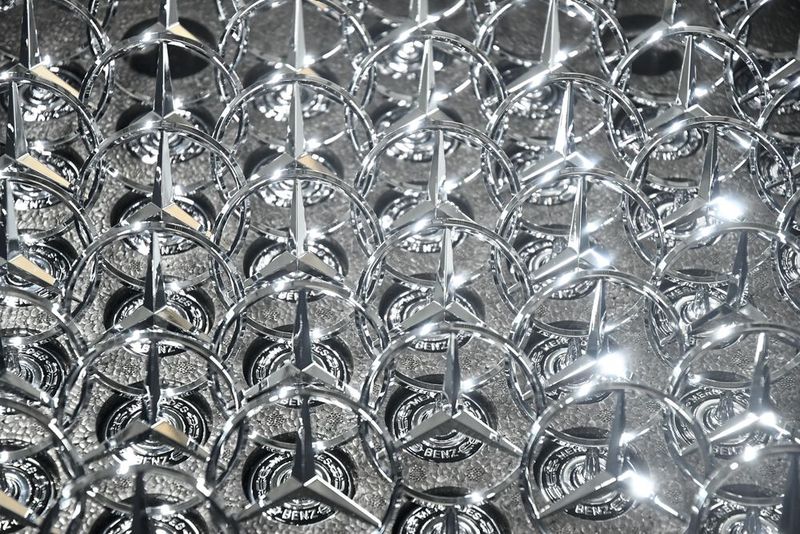
The Mercedes star: Witte Niederberg manufactures one of the world's most valuable trademarks using the zinc die-casting process.
(Image: OSG)
Since the merger of Daimler-Motoren-Gesellschaft with Benz & Cie. in 1926, the Mercedes star has been the trademark of all Mercedes-Benz vehicles. With a brand value in the upper double-digit billion range, it is one of the most valuable trademarks in the world. Previously, the star prominently adorned the hood of most Mercedes models, and today it still does on the sedans and wagons of the C-Class (in China), optionally on the E-Class, the S-Class, and the Maybach version of the SUV GLS. The star is manufactured by Witte Niederberg in Wülfrath, North Rhine-Westphalia (Germany), using zinc die-casting. For other models, it is now integrated into the grille.
Witte Automotive operates as a global corporate group for automotive customers, encompassing everything from product vision to coherent concepts and the production of large series. The product range of locking, latching, and security systems is extensive and includes mechatronic as well as mechanical solutions for doors, hatches, locks, lock and handle sets, and interiors like car seats. The company offers system solutions where control, electronics, and mechanics are closely aligned. As a system supplier, Witte also relies on standardized module constructions, thereby ensuring consistently high quality.
Since 2008, Witte Niederberg has been the specialist for locking and latching systems with high-quality surfaces within the corporate group. The product range includes seat adjustments, tailgate systems, hood locking systems—and the Mercedes star. The company is also the competence center for stamping and die-cast parts within the group, offering full capabilities from designing and constructing tools to manufacturing complete assemblies. Approximately 370 employees process around 12,000 tons of steel and 2,300 tons of zinc die-cast annually into stamping and die-cast products as well as components for locking and latching systems. These are subsequently further processed by internal assembly and/or the plants in Nejdek, Ostrov, Ruse, or Bitburg.
Molds and dies for zinc die-cast products are built in Wülfrath. For the production of stamped parts, components of progressive dies are used—such as filigree parts made of brass or larger tools up to 3.5 meters made of steel. For the subsequent parts production, presses with forces from 200 to 500 tons are employed, achieving batch sizes from a few thousand to several million parts. The construction of dies, molds, and tools begins for Witte with development and design. As with subsequent manufacturing, external partners are sometimes utilized. Additionally, numerous spare parts for stamping tools are manufactured in Wülfrath. Furthermore, tool modifications are made to meet customer requirements. For this range, five machining centers with 12,000 to 16,000 revolutions per minute are used, a Makino with a 20,000-rpm spindle, and an HSC machine for the graphite area, operating up to 41,000 revolutions per minute. All are 3-axis machines.
Tool life of 80 threads at once
"I got to know OSG 14 years ago when I started at Witte," says Luca Stieber, who works as a CNC miller in Wülfrath. "Over the years, the collaboration has become more and more intense, even friendly." In this atmosphere, for example, OSG tools are regularly tested in the field before they hit the market.
An example is the thread mill WHO-EM-PNC, for which we had no practical data for working in solid materials until now. Threading with an M3 in 62 HRC, which can be quite problematic in tool and mold making, was an instant success.
Jürgen Roesler, Application technology sales at OSG
While with M6 or M8, tool life often only reaches ten threads, the OSG thread mill immediately achieved 80. "So we both benefit from the constant give and take," emphasizes Stieber. A prime example is the conversion of the WXS series to the solid carbide mills "AE-H," which was done for certain applications. "I always keep Luca up to date," stresses Roesler. "We try out everything new that fits the local production. This, of course, also speaks for Luca, who is always open to new things." In the case of the AE-H, simply changing the tool showed a significant effect: the tool life was extended by up to 20 percent.
15-year-old tool geometry still impresses
The WXS torus cutter has been in use at Witte for no less than twelve years. It is not unusual for certain machining steps to be transferred to a new tool, namely the AE-H. The fact is: "The WXS is a great tool that we can absolutely rely on for its tool life. We are very satisfied," says Stieber. Conversely, for a tool with a geometry roughly 15 years old to still be in use, there must be reasons. And it's not just the new dimensions that OSG is currently launching for the "WXS-HS-CRE." "Rather, the cutter has a geometry that is unique to OSG and makes its application so attractive," emphasizes Magnus Hoyer, head of the OSG Academy in Göppingen.
Date: 08.12.2025
Naturally, we always handle your personal data responsibly. Any personal data we receive from you is processed in accordance with applicable data protection legislation. For detailed information please see our privacy policy.
Consent to the use of data for promotional purposes
I hereby consent to Vogel Communications Group GmbH & Co. KG, Max-Planck-Str. 7-9, 97082 Würzburg including any affiliated companies according to §§ 15 et seq. AktG (hereafter: Vogel Communications Group) using my e-mail address to send editorial newsletters. A list of all affiliated companies can be found here
Newsletter content may include all products and services of any companies mentioned above, including for example specialist journals and books, events and fairs as well as event-related products and services, print and digital media offers and services such as additional (editorial) newsletters, raffles, lead campaigns, market research both online and offline, specialist webportals and e-learning offers. In case my personal telephone number has also been collected, it may be used for offers of aforementioned products, for services of the companies mentioned above, and market research purposes.
Additionally, my consent also includes the processing of my email address and telephone number for data matching for marketing purposes with select advertising partners such as LinkedIn, Google, and Meta. For this, Vogel Communications Group may transmit said data in hashed form to the advertising partners who then use said data to determine whether I am also a member of the mentioned advertising partner portals. Vogel Communications Group uses this feature for the purposes of re-targeting (up-selling, cross-selling, and customer loyalty), generating so-called look-alike audiences for acquisition of new customers, and as basis for exclusion for on-going advertising campaigns. Further information can be found in section “data matching for marketing purposes”.
In case I access protected data on Internet portals of Vogel Communications Group including any affiliated companies according to §§ 15 et seq. AktG, I need to provide further data in order to register for the access to such content. In return for this free access to editorial content, my data may be used in accordance with this consent for the purposes stated here. This does not apply to data matching for marketing purposes.
Right of revocation
I understand that I can revoke my consent at will. My revocation does not change the lawfulness of data processing that was conducted based on my consent leading up to my revocation. One option to declare my revocation is to use the contact form found at https://contact.vogel.de. In case I no longer wish to receive certain newsletters, I have subscribed to, I can also click on the unsubscribe link included at the end of a newsletter. Further information regarding my right of revocation and the implementation of it as well as the consequences of my revocation can be found in the data protection declaration, section editorial newsletter.
The four- or five-flute solid carbide tool not only has a corner radius but is also smoothly ground from the center outward where the cutting edge transitions into the chip. It doesn't go straight up into the groove but is ground with a convex curve. This means the cutting edge doesn't act abruptly but continuously.
Magnus Hoyer, Head of the OSG Academy
The effect for the user is that the tool does not chatter, as is often the case with cutters featuring standard geometry. The quality is very consistent. Especially with hard materials, there is always a smooth cut. "Additionally, the 'WXS' coating provides a powerful protection at very high processing temperatures," says Hoyer. "This coating is very hard, does not flake off, and has excellent sliding properties, ensuring safe chip evacuation. A game changer for this tool is that there is no geometric differentiation in cutting values: steels up to 65 HRC can be machined just as effortlessly as soft materials with 35 HRC."
We use the WXS-(HS)-CRE for materials from 54 to 62 HRC. It also happens that we mill an HSS punch with 65 HRC. The key is always that we need to know the strategy precisely.
Luca Stieber, CNC-Fräser, Witte Niederberg
In use are both versions WXS-HS-CRE and WXS-CRE, with and without neck, diameters from 2 to 12 millimeters. "With this program, we are super covered, can mill almost anything and go deep down," Stieber evaluates. Depending on the component, roughing and semi-roughing are done. Sometimes, Stieber also pre-finishes with the roughing tool.
For the final finishing with the AE-H series, I achieve the same allowance contour-accurately everywhere, and I now aim for a five hundredths allowance. With the program using different diameters and radii, we get superb results.
Luca Stieber, CNC-Fräser, Witte Niederberg
That he sometimes also uses the WXE-CRE for finishing has efficiency reasons: "In some cases, it's faster than with the ball end mill," he says. "Moreover, we only use the WXS-CRE when the surface isn't required to be perfect. However, we already produce excellent surfaces with the cutter." With at least two more cutting edges than a ball end mill, machines with the necessary dynamics and precision are required. "But with the Makino F5, my favorite machine, that's a given," he chuckles.
For OSG, Witte is the prime example of building long-term partnerships with customers and growing together. "This is only possible through a competent field service," emphasizes Hoyer. "The foundation is the tool, which we provide with consistently high quality and precision, backed by our own standards and the underlying production chain."
Regrinding concept for greater sustainability
How OSG responds to customer wishes is further demonstrated by the topic of sustainability. "Together, we developed a regrinding concept where the WXS-CRE is shortened and brought to the next smaller size, for example from a 12R3 to a 10R2," reports Rösler. And Stieber adds: "In parallel, I developed a method to shorten a 12 WXS-HS-CRE once and create a WXS-CRE from it. The tool is cut down from the long shank with a short neck and ground to a 12." For OSG, this is a solution that, in times when sustainability is a hot topic, they are more than happy to pass on to other customers.
Hard machining up to 70 HRC
Just like with the WXS-CRE torus cutter, Witte has achieved very good results with the "AE-MS-H" end mill on critical parts. A gear contour was precision-milled with a 5-millimeter depth of cut using increasingly smaller tools, starting from a 6 down to a 3. "In the end, we were ultra-precise with a superb surface," says Stieber. The AE-MS-H is an extremely stable tool designed with six cutting edges and small chip chambers for hard machining up to 70 HRC. The roughing tool is used, for example, for trochoidal pocket milling, but it can also be excellently used for finishing. Even when removing a hundredth of a millimeter, the stable tool maintains the integrity of the surface. The result is top-quality surfaces. Having already used the AE-MS-H, Stieber plans to deploy the tool more frequently. "I handle many tasks very well with it, and it has a long tool life even in the very high HRC range." For Hoyer, this once again closes the loop, especially in tool and mold making: "We not only deliver tools but also programming strategies, even those that address a problem in a completely different way."



:quality(80)/p7i.vogel.de/wcms/60/eb/60ebe43de41f833157b476b2e1641811/0130090160v1.jpeg "The Surface Control Automotive measuring system from Micro-Epsilon automatically detects dents, scratches and other surface defects on body shells. (Image:Micro-Epsilon)")
:quality(80)/p7i.vogel.de/wcms/26/8a/268aba929d72bd089234bd512aab9b08/0130487474v1.jpeg "The works meeting at Volkswagen is over! Here is a brief overview of the most important aspects ... (Image:VW)")
:quality(80)/p7i.vogel.de/wcms/50/63/5063e5b91e7897c13b882440c7f106d4/0128575929v1.jpeg "How is Edge AI changing the industry? Local data processing meets distributed intelligence to promote sustainability and efficiency. (Picture: ©tippapatt - stock.adobe.com)")
:quality(80)/p7i.vogel.de/wcms/a0/47/a04725ef9bd09fb6c9341a1bea1b5d93/0130443083v1.jpeg "Here, a type of plastic pallet is produced by thermoforming (vacuum forming or deep drawing) at the corresponding division of New England Plastics in the USA. This division, which specializes in so-called liners, is now part of Ringmetall ... (Image:New England Plastics)")
:quality(80)/p7i.vogel.de/wcms/29/d8/29d83fa92093c7f247429e060be46c7b/0130378625v1.jpeg "Secures and monitors circuits directly in the field: Turck's IP67 TBIF fuse with IO-Link (Image:Turck GmbH)")
:quality(80)/p7i.vogel.de/wcms/d3/3d/d33d26b35aa1e64f5c41d19d22c5c5dc/0130496518v1.jpeg "(Image:Speedbot)")
:quality(80)/p7i.vogel.de/wcms/f0/ca/f0caaaa9fc2347a5221760a94f92e831/0129880873v1.jpeg "Human-machine collaboration takes on a new quality. This is because the automation task is formulated in natural language and the AI takes over its implementation directly in the project. This allows users to implement Codesys projects more quickly. (Image:Codesys)")
:quality(80)/p7i.vogel.de/wcms/b7/36/b736dfebc16c42d6901d0d0e1f390493/3d-druck-20factory-20--20ki-20generiert-1920x1079v1.png "(Source: AI-generated)")
:quality(80)/p7i.vogel.de/wcms/79/b2/79b21aad663f4a7bd4472afc1c1afc62/0130433994v1.jpeg "Mission Joyride: The free-flying robot (shown here in the rendering) will relieve the ISS crew of logistics tasks from 2027 with its two mechanical arms. (Image:Icarus Robotics)")
:quality(80)/p7i.vogel.de/wcms/59/a2/59a2b11f0aa1b700eff02addd5de8703/adobestock-1788280853--c2-a9-20satria-20-e2-80-93-20stock-adobe-com-5081x2860v1v1.jpeg "Quantum computers require extreme cooling to temperatures close to absolute zero in order to keep qubits stable. (Image:satria - stock.adobe.com)")
:quality(80)/p7i.vogel.de/wcms/49/38/493876a248943456b7e4a6db6edfc454/0130230765v1.jpeg "Safe and reliable in aircraft construction: light-curing adhesive bond combined with universal fastening elements. (Source: Delo)")
:quality(80)/p7i.vogel.de/wcms/26/e1/26e1c8d1f56a588b078196508a069155/0130500702v1.jpeg "Hyundai plans a large truck for North America (Image:Hyundai)")
:quality(80)/p7i.vogel.de/wcms/61/eb/61eb2c9fe2ec3295593bd63ebc610f59/0130504331v1.jpeg "Headquarters of the Chinese truck start-up Zeron. (Image:Jiangsu 01 Automobile Technology/Screen shot)")
:quality(80)/p7i.vogel.de/wcms/c2/57/c257d627beec10e94252cde72830adf6/0130472803v1.jpeg "With the Twingo E-Tech, Renault is now launching a purely electrically powered new edition of the Twingo small car (Image:Renault)")
:quality(80)/p7i.vogel.de/wcms/c1/43/c143c24b62e51b848b2586b52bcd20e2/0130468443v1.jpeg "Jörg Burzer, Head of Development at Mercedes Benz Group AG (Image:Mercedes)")
:quality(80)/p7i.vogel.de/wcms/89/f2/89f2b2de703956abfb30ea456d77a463/0130471595v1.jpeg "The joint venture between TDK and Nippon Chemical Industrial focuses on the development of ceramic materials for electronic components. (Image:TDK Corporation)")
:quality(80)/p7i.vogel.de/wcms/e4/a0/e4a0da27805e96aa8976f04add4b3bec/0130458429v1.jpeg "Fit for extreme conditions: This illustration shows a photonic chip whose components have been bonded with high stability using the new connection technology. (Image:NIST)")
:quality(80)/p7i.vogel.de/wcms/9b/84/9b845ee38e4fb3c8ea07d1735d9e36fd/0130451629v1.jpeg "The windshield as a projection screen: a high-precision and low-latency system architecture is required for implementation. This requires the seamless integration of different technologies. (Image:Harman)")
:quality(80)/p7i.vogel.de/wcms/86/e0/86e09ea9c278d112c55b995b843abfee/0130494578v1.jpeg "PV system on the roof of the Elbfabrik, a Fraunhofer IFF research factory. A sensor system can detect faults in large-scale PV systems at an early stage. (Image:Fraunhofer IFF/Anne Bornkessel)")
:fill(fff,0)/images.vogel.de/vogelonline/companyimg/76800/76895/65.jpg "FAULHABER_120mm.jpg ()")
:quality(80)/p7i.vogel.de/wcms/97/39/9739f46487c7ce3dcf86c8465be36aa0/0121665023v1.jpeg "The Mercedes star: Witte Niederberg manufactures one of the world's most valuable trademarks using the zinc die-casting process.(Image: OSG)")
:quality(80)/p7i.vogel.de/wcms/35/bd/35bd1812f1ecc34ee059ff40620470ba/0121665562v1.jpeg "Witte Niederberg is the competence center of the Witte Group for stamped and die-cast parts. The production uses presses that operate with forces ranging from 200 to 500 tons.(Image: OSG)")
:quality(80)/p7i.vogel.de/wcms/85/b5/85b5563a51cd6b25db9d55f222c5c2f6/0121665570v1.jpeg "In mold and toolmaking in Wülfrath, dies, molds, and progressive compound tools are designed, built, optimized, and repaired.(Image: OSG)")
:quality(80)/p7i.vogel.de/wcms/8b/03/8b031de0765da80bb040ece28cff4516/0121665573v1.jpeg "Witte Niederberg uses the solid carbide torus milling cutter series \"WXS-(HS)-CRE\" for roughing, semi-roughing, and semi-finishing, as well as finishing in materials up to 62 HRC.(Image: OSG)")
:quality(80)/p7i.vogel.de/wcms/c7/0b/c70b7c455cff09d32b4d94c71ceab1ab/0128553595v1.jpeg "Perfectionist machining of the upper knee joint component at the Mikron Tool development center with one of the newly developed milling tools. (Image:Thomas Entzeroth)")
:quality(80)/p7i.vogel.de/wcms/c2/57/c257474faf6095a24bacfd98524bc7f8/0130090188v1.jpeg "With the Coromill MR20 milling system, the cutting tool specialist Sandvik Coromant is bringing a product that should make a name for itself in tool and mold making, as well as in aerospace components, to what the manufacturer claims it can do ... (Image:Sandvik Coromant)")