The IFL at the Karlsruhe Institute of Technology and the IAS at the University of Stuttgart are jointly developing a robot that learns human skills through imitation. For this purpose, they have established the ICM Future Lab Hapt-X-Deep, a research infrastructure unique in Germany.
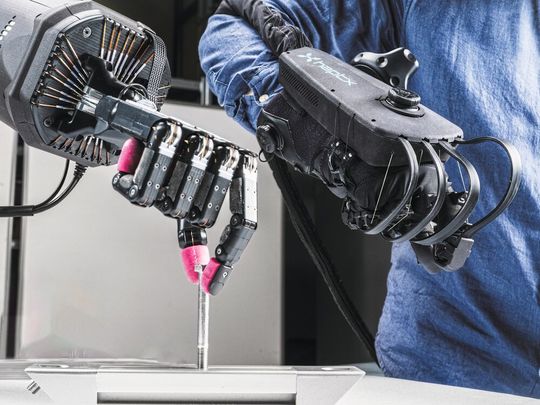
Precise imitation: The humanoid Shadow Dexterous Hand in the Hapt-X-Deep Future Lab mimics the movements of a human hand – a crucial step for the intuitive learning of robots.
(Image: Amadeus Bramsiepe, KIT)
Edgar Welte snaps his fingers in the air and brings the robot one step closer to being human. At least that's how it should be in the near future. For now, the researcher only remotely controls the robot and the humanoid Shadow Dexterous Hand with the Hapt-X virtual reality glove, which is grasping a tool right next to it.
Doctoral student and junior professor Rania Rayyes have established the ICM Future Laboratory Hapt-X-Deep at the Institute for Conveying Technology and Logistics Systems (IFL) of the KIT to develop a robotic gripping system that learns human tasks through imitation. Germany's first laboratory with the complete system from the company Shadow Robot is located in Karlsruhe (Germany), but the Institute for Automation Technology and Software Systems (IAS) at the University of Stuttgart is also involved in the research work.
The institutes are jointly developing a learning robot with a gripping system that can quickly, flexibly, reliably, and safely respond to changing requirements, product designs, or materials. Their research infrastructure, costing 212,000 US dollars, was funded by the ICM.
Imitation learning: Robots learn like apprentices
Programming robots for industrial tasks is currently a lengthy process. Writing the code is followed by testing and then rewriting until the machine performs a process reliably. These learning phases are too long for future production technologies, which rely on rapid adaptability. "Getting a robot ready for use should not take longer than training a new employee in the future," says Edgar Welte.
To achieve this goal, the team aims to teach robots to learn from humans. Just as apprentices learn from their mentors, their robotic gripping system should eventually learn from an operator how to use new tools, handle different materials, perform entire tasks, or respond to changes in production processes. "We employ autonomous imitation learning and deep reinforcement learning for our system. The robot intuitively and immediately learns skills through interaction with humans," explains Rania Rayyes. This approach shortens not only the initial programming process but also retooling times.
Hapt-X-Deep advances human-machine communication
Human learning is an exchange of information. The participants communicate with each other, interpret visual information, and ask follow-up questions. In the Hapt-X-Deep Future Lab, the researchers communicate with the robot via data. Edgar Welte generates data through his movements with the Hapt-X-Glove and instructs the six-axis cobot on how to rotate and grasp tools or workpieces. With its 20 actuators, the Shadow Dexterous Hand can almost exactly replicate human grasping movements, better than any other gripper on the market. The pressure sensors in the mechanical fingers provide direct feedback to the operator. Edgar Welte feels small air cushions in the Hapt-X-Glove when the weight increases or the tool is incorrectly positioned in the hand. He immediately adjusts his grip, and the gripper mimics his actions.
The researcher corrects the robot's error in real time. This will also be an important function when the machine can later learn independently, relying on its artificial intelligence. "Through immediate corrections, we can quickly expand the capabilities of our system and save months of work on reprogramming," explains Rania Rayyes.
About the Innovation Campus Future Mobility
The mobility and production of the future are sustainable, efficient, and originate from Baden-Württemberg. The prerequisites for this are groundbreaking new technologies—from innovative vehicle drives to adaptable production methods. The goal of the Innovation Campus Mobility of the Future (ICM) is to shape this transformation. At ICM, the University of Stuttgart and the Karlsruhe Institute of Technology (KIT) pool their research and innovation expertise to develop new technologies quickly and flexibly, test new approaches, and lay the foundation for disruptive innovations. The ICM is one of the largest initiatives for the mobility and production of the future in Germany.
The Hapt-X-Deep Future Lab has a dual function. It serves as the hardware for researching and developing software-supported technologies, while also acting as a demonstrator for their functionality. "For me, it's a unique opportunity to work with such a high-quality lab for my research," says Edgar Welte. With his dissertation on "Interactive Imitation Learning for Dexterous Manipulation," he will make a decisive contribution to the development of the overall system. Additionally, Hapt-X-Deep is expected to host projects on sensor technology, alternative teleoperation methods like gesture recognition via motion tracking, or the control of individual fingers.
This also includes collaborations with companies like Bosch AI or other academic institutes. "Hapt-X-Deep is intended to open as many doors as possible in research," explains Rania Rayyes. One of these leads to the IAS at the University of Stuttgart to the group of junior professor Andrey Morozov. As part of collaborative projects, the researchers in Stuttgart will develop methods to ensure the safety and reliability of the adaptable robot.
Robots optimize themselves through error detection
Fault injection via digital twins will be used as a testing procedure for the system, with deep learning systems helping the robot to recognize anomalies independently and thus predict errors. Eventually, it should also be able to autonomously correct these errors based on what it has learned. This part of the software is being developed in Stuttgart and tested in the real-world lab of the IFL at KIT. Hapt-X-Deep is a state-of-the-art research infrastructure and simultaneously an interface through which the ICM brings together the best researchers in the country to jointly develop groundbreaking solutions for human-robot learning.
Date: 08.12.2025
Naturally, we always handle your personal data responsibly. Any personal data we receive from you is processed in accordance with applicable data protection legislation. For detailed information please see our privacy policy.
Consent to the use of data for promotional purposes
I hereby consent to Vogel Communications Group GmbH & Co. KG, Max-Planck-Str. 7-9, 97082 Würzburg including any affiliated companies according to §§ 15 et seq. AktG (hereafter: Vogel Communications Group) using my e-mail address to send editorial newsletters. A list of all affiliated companies can be found here
Newsletter content may include all products and services of any companies mentioned above, including for example specialist journals and books, events and fairs as well as event-related products and services, print and digital media offers and services such as additional (editorial) newsletters, raffles, lead campaigns, market research both online and offline, specialist webportals and e-learning offers. In case my personal telephone number has also been collected, it may be used for offers of aforementioned products, for services of the companies mentioned above, and market research purposes.
Additionally, my consent also includes the processing of my email address and telephone number for data matching for marketing purposes with select advertising partners such as LinkedIn, Google, and Meta. For this, Vogel Communications Group may transmit said data in hashed form to the advertising partners who then use said data to determine whether I am also a member of the mentioned advertising partner portals. Vogel Communications Group uses this feature for the purposes of re-targeting (up-selling, cross-selling, and customer loyalty), generating so-called look-alike audiences for acquisition of new customers, and as basis for exclusion for on-going advertising campaigns. Further information can be found in section “data matching for marketing purposes”.
In case I access protected data on Internet portals of Vogel Communications Group including any affiliated companies according to §§ 15 et seq. AktG, I need to provide further data in order to register for the access to such content. In return for this free access to editorial content, my data may be used in accordance with this consent for the purposes stated here. This does not apply to data matching for marketing purposes.
Right of revocation
I understand that I can revoke my consent at will. My revocation does not change the lawfulness of data processing that was conducted based on my consent leading up to my revocation. One option to declare my revocation is to use the contact form found at https://contact.vogel.de. In case I no longer wish to receive certain newsletters, I have subscribed to, I can also click on the unsubscribe link included at the end of a newsletter. Further information regarding my right of revocation and the implementation of it as well as the consequences of my revocation can be found in the data protection declaration, section editorial newsletter.



:quality(80)/p7i.vogel.de/wcms/dd/08/dd086510d9ae7b50181f6070e4463b44/0129363730v1.jpeg "Typical application for ionizing devices: Wrapping films. (Picture: ©Adobe Stock/SMC)")
:quality(80)/p7i.vogel.de/wcms/35/57/3557c819943c53acec41a0ccba87da4f/0130049064v1.jpeg "Researchers at the Fraunhofer IWU in Chemnitz have long known that many typical sheet metal parts can be manufactured more cost-effectively using hollow embossing rollers. Now there is news to report ... (Image:Fraunhofer IWU)")
:quality(80)/p7i.vogel.de/wcms/59/02/590246e3b3f415c65edbee377c14ca77/26-06-pi-fraunhofer-iws-41450-direktplattieren-pic-01-7771x4369v1v1.jpeg "The Fraunhofer IWS has developed the new \"direct laser cladding\" process, which creates a functional layer directly on the base body by applying a strip-shaped metal to rotationally symmetrical components in a spiral and bonding it locally by laser. (Image:Christoph Wilsnack/Fraunhofer IWS)")
:quality(80)/p7i.vogel.de/wcms/73/60/73608418789b1d9c393f5e2fa974eda2/0130209906v1.jpeg "The robots of the X6 generation from b+m enable very high painting quality and are also particularly compact and easy to maintain. (Image:Beckhoff)")
:quality(80)/p7i.vogel.de/wcms/78/e9/78e9188c25a8a94e67c34c9bf8ffe495/visual-agile-20robots-20and-20google-20deepmind-20partner-20to-20bring-20intelligence-20to-20robotics-2500x1406v1v1.jpeg "Together, the partners are developing adaptable, intelligent robots for a wide range of applications (Image:Agile Robots SE)")
:quality(80)/p7i.vogel.de/wcms/e7/66/e7669ecf0260ae8fc54c214e34e4902a/0130316817v1.jpeg "Siemens and Palo Alto Networks offer tested cybersecurity solution for industrial 5G. (Image:Siemens)")
:quality(80)/p7i.vogel.de/wcms/9f/55/9f55324832c4f426958031375124d9de/siemens-20ubtech-20hmnd-1920x1079v1v1.png "Ready for the factory floor: While Ubtech is planning mass production, Siemens is already testing humanoids in real factory applications in Erlangen. (Image:Siemens)")
:quality(80)/p7i.vogel.de/wcms/11/36/113695ed260e29c8c2d9d39dc5f9d869/0130213768v1.jpeg "AI can work cheaply in China and deliver the results rapidly all over the world. (Image:Dall-E / AI-generated)")
:quality(80)/p7i.vogel.de/wcms/62/5f/625f41e87ebfef156a98c8e6393e32fd/0130211654v1.jpeg "Axial flux motors have some advantages over radial flux motor—but their production is currently still expensive. (Image:RWTH Aachen University)")
:quality(80)/p7i.vogel.de/wcms/77/9b/779b0685d010dfe45c9c2cb1cfecd467/0128886425v1.jpeg "The BlueEye is the first \"real\" hyperspectral camera for the UV range and covers the wavelength range from 220 to 380nm. (Image:Inno-spec GmbH)")
:quality(80)/p7i.vogel.de/wcms/e4/51/e451d52ce0182fb0aaa46a5774f832ef/26-04-pi-fraunhofer-iws-21160-bioslide-pic-01-4128x2321v1v1.jpeg "With the BioSlide research project, the Fraunhofer IWS is investigating how sliding systems can be designed to be more sustainable and energy-efficient. New materials can be tested in a particularly application-oriented manner on this plain bearing test stand. (Image:Fraunhofer IWS)")
![Thanks to advanced 3D printing technology, a more efficient use of resources should contribute to lower-emission aviation—this is the goal of ['skai]-lab. (Image:Oleksandr Pashchenko - stock.adobe.com / AI-generated)](https://cdn1.vogel.de/nghHNSbySccfOjG3n1qCA-FVOjQ=/288x162/smart/filters:format(jpg):quality(80)/p7i.vogel.de/wcms/62/64/626424c97a16e69f871bf216c9629c2a/adobestock-1927043193--c2-a9-20oleksandr-20pashchenko-20-e2-80-93-20stock-adobe-com-ki-generiertv1v1.jpeg "Thanks to advanced 3D printing technology, a more efficient use of resources should contribute to lower-emission aviation—this is the goal of ['skai]-lab. (Image:Oleksandr Pashchenko - stock.adobe.com / AI-generated)")
:quality(80)/p7i.vogel.de/wcms/c3/c4/c3c4ce270b083eeac55654148611f064/0130237945v1.jpeg "China is not giving up on hydrogen, but is intensifying its efforts. (Image:freely licensed from Pixabay)")
:quality(80)/p7i.vogel.de/wcms/4e/c0/4ec0bd19390b169edfa23677373dcdf1/0130260089v1.jpeg "Renewable fuels can supply European road traffic, according to a study. (Image:Aral)")
:quality(80)/p7i.vogel.de/wcms/6f/c9/6fc9050301d745cad25585c6780f8f51/0130197341v1.jpeg "Production facilities are a worthwhile target and are therefore at risk. (Image:ABB Robotics)")
:quality(80)/p7i.vogel.de/wcms/b6/62/b662adc2cec8227d8172509bbfb6ee42/25c0207-107-4961x2789v1v1.jpeg "The GLB is the second model based on Mercedes' new MMA platform. Apparently, Geely's platform is better and cheaper, which is why the two companies are negotiating a partnership. (Image:Mercedes-Benz)")
:quality(80)/p7i.vogel.de/wcms/4d/dd/4dddf438e91f394c04a095dbfd109d1c/0130236430v1.jpeg "Measurement modules: The 720301 module in combination with the SL2000 enables RMS and power calculations, among other things. (Image:Yokogawa)")
:quality(80)/p7i.vogel.de/wcms/61/fc/61fcf95f5cca15494ad18343901ae585/0130317237v1.jpeg "With the AGI CPU, Arm says it is taking a \"historic step\": With the processor aimed at AI in data centers, the company is presenting itself for the first time as a provider of its own chips, not just as a pure IP licensor. (Image:Arm)")
:quality(80)/p7i.vogel.de/wcms/82/90/8290dfe3595b6c6b33726ae8b76172c7/0130319587v1.jpeg "The concept image illustrates how the pattern of tiny protrusions and depressions created on the substrate (MgO, bottom) controls the arrangement of atoms in the superconducting material (YBCO, top). At the interface between the two layers, an electronic structure enables superconductivity to occur at higher temperatures than previously possible. (Image:Chalmers University of Technology / Riccardo Arpaia)")
:fill(fff,0)/images.vogel.de/vogelonline/companyimg/76800/76895/65.jpg "FAULHABER_120mm.jpg ()")
:fill(fff,0)/p7i.vogel.de/companies/69/88/69882c428938e/tmts2026-ticec-banner-en-2000px.png "tmts2026-ticec-banner-en-2000px (https://www.tmts.tw/en)")
:fill(fff,0)/p7i.vogel.de/companies/67/eb/67eba621ef6ea/logo2.png "logo2 (Wuxi InfiMotion)")
:quality(80)/p7i.vogel.de/wcms/05/b7/05b7c58dcf5a7fc900348d1c30f7c116/0129540459v1.jpeg "Researchers from Stuttgart have investigated whether the \"technology\" behind hairy elephant trunks, which function as a sensitive gripping system, can also be used in robotics. (Image:Zoo Magic)")
:quality(80)/p7i.vogel.de/wcms/53/4f/534fe0f168f6ee070ded4a48faca4cef/business-wire-main-image-1103x620v1.jpeg "The new UR AI Trainer, developed by Universal Robots and Scale AI, is the first direct lab-to-factory solution for AI model training.
(Source: Universal Robots)")