Complaints about driverless taxis are on the rise in China. However, that's not likely to stop their progress. Learn about what these robot taxis are already good at and what still needs to be improved.
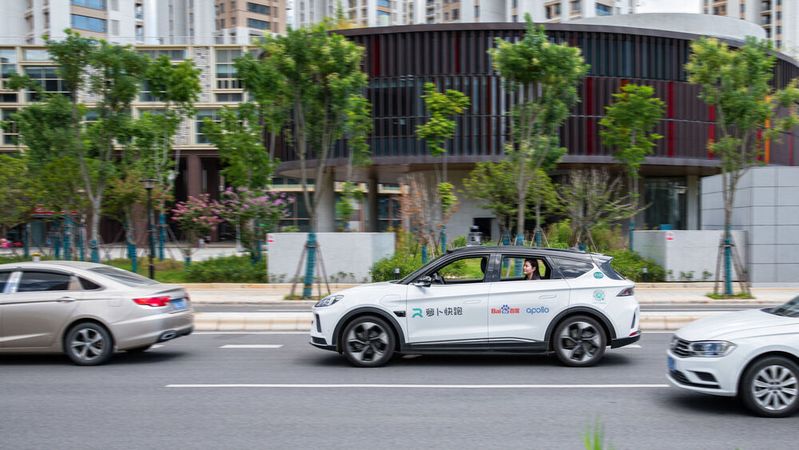
Apollo Go's robot taxis are driving too cautiously for many Chinese motorists.
(Image: Baidu Inc.)
These slow robot taxis! In Wuhan and other Chinese cities, complaints are increasing about the driverless taxis from "Baidu Apollo Go". While most Chinese people are well-disposed towards the new technology, autonomous driving in real traffic appears to still have a number of "teething troubles".
"Driving too slowly!", "Suddenly braking abruptly!" or "Wobbling around the corner at snail's pace!" are some of the comments on the country's social media, since Apollo Go introduced the sixth generation of its robot taxis in the city of Wuhan, with millions of inhabitants. Complaints are also reportedly coming from more than ten other cities where the company's driverless taxi fleet now operates, including Beijing, Shanghai, Guangzhou, Shenzhen, Chengdu, and Dalian, reports the Chinese automotive newspaper Zhongguo Qiche Bao. However, it seems that drivers in Wuhan are particularly dissatisfied.
Criticism of excessive caution
A large part of the criticism revolves around the "excessive caution" of the robot taxis in traffic as perceived by other road users. They generally drive too slowly everywhere, never exceeding 60 km/h on valley bridges, thus causing sluggish traffic and traffic jams where this was not the case before. The robot taxis apparently turn so slowly that some drivers behind them are almost raging with impatience. They are "too polite" and always give way to pedestrians, it is said. And they often brake so hard that they themselves become a safety risk for following vehicles, are some of the accusations against the robot taxis.
Fairly, in favor of the developers of robot taxis, it must be mentioned at this point that the drivers in Wuhan are known nationwide for their tempestuous driving style. The bustling pedestrians with often questionable traffic behavior in the center of the 13-million-city presents a special challenge for the programming of algorithms for autonomous driving. Baidu Apollo had only introduced the latest generation of its Apollo-Go fleet in May of this year. In addition to new hardware components, they are equipped on the software side with a new "Large Model", the ADFM or "Autonomous Driving Foundation Model".
More than ten times superior to human drivers
The company claims that the new system is "more than ten times superior to human drivers in terms of driving safety" and can also cover "complex urban scenarios". The accumulating complaints from drivers in China have sparked a new debate about autonomous driving, its safety, and the feasibility of rapid commercialization at today's level of technology.
"These issues not only interfere with the normal traffic participation of citizens, but also trigger extensive discussions about the safety and practicability of autonomous vehicles," writes the Chinese car newspaper. How the debate will develop further is not yet clear—however, for the moment, supporters of autonomous driving in China clearly seem to be in the majority. A survey by the Capgemini Research Institute shows that consumers in China have a more positive attitude towards driverless driving than consumers in most other countries in the world. According to press reports, more than half of the Chinese would like to give up their own driving as soon as they can switch to autonomous cars. Drivers in western countries have a "much more conservative attitude" towards the new technology in comparison, according to articles about the Capgemini survey.
Road tests for rapid development
China's government is promoting the development of autonomous driving by quickly approving road tests for individual, private vehicles. The autonomous taxi fleets all over the country also provide valuable test kilometers and experiences for car manufacturers—the current complaints in Wuhan and elsewhere can certainly be taken into account.
In recent years, the service that allows you to easily call a driverless taxi from your smartphone app and safely ride to your desired location has quietly spread to more and more cities in the People's Republic. In Wuhan, you can conveniently travel from the airport to a hotel in the city center without having to communicate with a taxi driver and worry about the amount of tip.
Date: 08.12.2025
Naturally, we always handle your personal data responsibly. Any personal data we receive from you is processed in accordance with applicable data protection legislation. For detailed information please see our privacy policy.
Consent to the use of data for promotional purposes
I hereby consent to Vogel Communications Group GmbH & Co. KG, Max-Planck-Str. 7-9, 97082 Würzburg including any affiliated companies according to §§ 15 et seq. AktG (hereafter: Vogel Communications Group) using my e-mail address to send editorial newsletters. A list of all affiliated companies can be found here
Newsletter content may include all products and services of any companies mentioned above, including for example specialist journals and books, events and fairs as well as event-related products and services, print and digital media offers and services such as additional (editorial) newsletters, raffles, lead campaigns, market research both online and offline, specialist webportals and e-learning offers. In case my personal telephone number has also been collected, it may be used for offers of aforementioned products, for services of the companies mentioned above, and market research purposes.
Additionally, my consent also includes the processing of my email address and telephone number for data matching for marketing purposes with select advertising partners such as LinkedIn, Google, and Meta. For this, Vogel Communications Group may transmit said data in hashed form to the advertising partners who then use said data to determine whether I am also a member of the mentioned advertising partner portals. Vogel Communications Group uses this feature for the purposes of re-targeting (up-selling, cross-selling, and customer loyalty), generating so-called look-alike audiences for acquisition of new customers, and as basis for exclusion for on-going advertising campaigns. Further information can be found in section “data matching for marketing purposes”.
In case I access protected data on Internet portals of Vogel Communications Group including any affiliated companies according to §§ 15 et seq. AktG, I need to provide further data in order to register for the access to such content. In return for this free access to editorial content, my data may be used in accordance with this consent for the purposes stated here. This does not apply to data matching for marketing purposes.
Right of revocation
I understand that I can revoke my consent at will. My revocation does not change the lawfulness of data processing that was conducted based on my consent leading up to my revocation. One option to declare my revocation is to use the contact form found at https://contact.vogel.de. In case I no longer wish to receive certain newsletters, I have subscribed to, I can also click on the unsubscribe link included at the end of a newsletter. Further information regarding my right of revocation and the implementation of it as well as the consequences of my revocation can be found in the data protection declaration, section editorial newsletter.
Reports of accidents removed
So far, there have been no significant accidents in millions of autonomous kilometers driven. However, foreign critics complain that sometimes reports of accidents involving autonomous vehicles in China are removed from the internet by censorship—apparently because the government wants to promote the development of the industry.
In Wuhan, 70 percent of all Apollo Go robotaxis are completely without a safety driver. Only in a minority of the robotaxis there is a human "supervisor" who can intervene in case of emergency. However, for every three robotaxis without human crew, a supervisor must monitor the rides from a safety center screen.
Experts agree that safety is a major argument for the introduction of autonomous driving. Even though the robot taxis are not perfect and they apparently overly cautious according to the opinion of other drivers - so far, they cause significantly fewer accidents in practice than Chinese taxi drivers. Also, autonomous vehicles reduce operating costs for transport operators. The recently unveiled 6th generation Baidu Apollo robot taxi costs only 200,000 yuan (about 25,800 euros) to manufacture—which is only about half the cost of the previous generation.
Rapid amortization of acquisition costs
However, the most significant saving for taxi or mobility companies is in wage costs. There is no need to pay and insure drivers anymore, and no income tax is due. Now that the prices for robot taxis are dropping so drastically, the purchase of an autonomous taxi will pay off very quickly. This allows cheaper fares to be offered to end customers. Baidu's and its technology partners' ability to build a "nice electric car complete with computer and sensor suite for less than 28,000 dollars is a great step and will gradually be replicated worldwide," comments US magazine Forbes.
To produce its robot taxis, Apollo Go is working with several established car manufacturers, including Geely, Great Wall, and GAC. There have also been projects with Toyota and Ford. Together with Geely, Baidu has also founded an electric car brand called Jidu, which specializes in automated driving cars.
Transport needs of the aging population
Baidu, sometimes referred to as "China's Google," and its partners in the auto industry are hoping for a lucrative business once autonomous driving spreads globally from China. They argue that the world's rapidly aging population will not be able to meet its future transportation needs without such solutions. In the emerging "Smart Cities", they say that managing traffic flows with autonomous cars is easier than with traditional vehicles. Moreover, they argue that advances in connected and intelligent driving are rapidly increasing their safety year by year.
The most important argument for investors who are pumping a lot of money into the development of autonomous cars in China is still the cost advantages for mobility and logistics providers. The use of robot taxis not only saves driver's wages, but also significantly simplifies and thus makes cheaper the work of the taxi dispatch centers. According to Apollo Go, the activation, the dispatch to the customer, the return to the parking spot and the cleaning of the vehicles after the ride are all carried out completely automatically, so without any human interaction.
Apollo Go aims to reach break-even point in Wuhan this year, and the company wants to be profitable by 2025. This would make Apollo Go the world's first commercially successful mobility provider to rely on autonomous driving. In the opinion of many analysts in China, the current complaints from some road users who think the taxis are driving too slowly will not be able to stop this.



:quality(80)/p7i.vogel.de/wcms/dd/08/dd086510d9ae7b50181f6070e4463b44/0129363730v1.jpeg "Typical application for ionizing devices: Wrapping films. (Picture: ©Adobe Stock/SMC)")
:quality(80)/p7i.vogel.de/wcms/35/57/3557c819943c53acec41a0ccba87da4f/0130049064v1.jpeg "Researchers at the Fraunhofer IWU in Chemnitz have long known that many typical sheet metal parts can be manufactured more cost-effectively using hollow embossing rollers. Now there is news to report ... (Image:Fraunhofer IWU)")
:quality(80)/p7i.vogel.de/wcms/59/02/590246e3b3f415c65edbee377c14ca77/26-06-pi-fraunhofer-iws-41450-direktplattieren-pic-01-7771x4369v1v1.jpeg "The Fraunhofer IWS has developed the new \"direct laser cladding\" process, which creates a functional layer directly on the base body by applying a strip-shaped metal to rotationally symmetrical components in a spiral and bonding it locally by laser. (Image:Christoph Wilsnack/Fraunhofer IWS)")
:quality(80)/p7i.vogel.de/wcms/73/60/73608418789b1d9c393f5e2fa974eda2/0130209906v1.jpeg "The robots of the X6 generation from b+m enable very high painting quality and are also particularly compact and easy to maintain. (Image:Beckhoff)")
:quality(80)/p7i.vogel.de/wcms/78/e9/78e9188c25a8a94e67c34c9bf8ffe495/visual-agile-20robots-20and-20google-20deepmind-20partner-20to-20bring-20intelligence-20to-20robotics-2500x1406v1v1.jpeg "Together, the partners are developing adaptable, intelligent robots for a wide range of applications (Image:Agile Robots SE)")
:quality(80)/p7i.vogel.de/wcms/e7/66/e7669ecf0260ae8fc54c214e34e4902a/0130316817v1.jpeg "Siemens and Palo Alto Networks offer tested cybersecurity solution for industrial 5G. (Image:Siemens)")
:quality(80)/p7i.vogel.de/wcms/9f/55/9f55324832c4f426958031375124d9de/siemens-20ubtech-20hmnd-1920x1079v1v1.png "Ready for the factory floor: While Ubtech is planning mass production, Siemens is already testing humanoids in real factory applications in Erlangen. (Image:Siemens)")
:quality(80)/p7i.vogel.de/wcms/11/36/113695ed260e29c8c2d9d39dc5f9d869/0130213768v1.jpeg "AI can work cheaply in China and deliver the results rapidly all over the world. (Image:Dall-E / AI-generated)")
:quality(80)/p7i.vogel.de/wcms/62/5f/625f41e87ebfef156a98c8e6393e32fd/0130211654v1.jpeg "Axial flux motors have some advantages over radial flux motor—but their production is currently still expensive. (Image:RWTH Aachen University)")
:quality(80)/p7i.vogel.de/wcms/77/9b/779b0685d010dfe45c9c2cb1cfecd467/0128886425v1.jpeg "The BlueEye is the first \"real\" hyperspectral camera for the UV range and covers the wavelength range from 220 to 380nm. (Image:Inno-spec GmbH)")
:quality(80)/p7i.vogel.de/wcms/e4/51/e451d52ce0182fb0aaa46a5774f832ef/26-04-pi-fraunhofer-iws-21160-bioslide-pic-01-4128x2321v1v1.jpeg "With the BioSlide research project, the Fraunhofer IWS is investigating how sliding systems can be designed to be more sustainable and energy-efficient. New materials can be tested in a particularly application-oriented manner on this plain bearing test stand. (Image:Fraunhofer IWS)")
![Thanks to advanced 3D printing technology, a more efficient use of resources should contribute to lower-emission aviation—this is the goal of ['skai]-lab. (Image:Oleksandr Pashchenko - stock.adobe.com / AI-generated)](https://cdn1.vogel.de/nghHNSbySccfOjG3n1qCA-FVOjQ=/288x162/smart/filters:format(jpg):quality(80)/p7i.vogel.de/wcms/62/64/626424c97a16e69f871bf216c9629c2a/adobestock-1927043193--c2-a9-20oleksandr-20pashchenko-20-e2-80-93-20stock-adobe-com-ki-generiertv1v1.jpeg "Thanks to advanced 3D printing technology, a more efficient use of resources should contribute to lower-emission aviation—this is the goal of ['skai]-lab. (Image:Oleksandr Pashchenko - stock.adobe.com / AI-generated)")
:quality(80)/p7i.vogel.de/wcms/c3/c4/c3c4ce270b083eeac55654148611f064/0130237945v1.jpeg "China is not giving up on hydrogen, but is intensifying its efforts. (Image:freely licensed from Pixabay)")
:quality(80)/p7i.vogel.de/wcms/4e/c0/4ec0bd19390b169edfa23677373dcdf1/0130260089v1.jpeg "Renewable fuels can supply European road traffic, according to a study. (Image:Aral)")
:quality(80)/p7i.vogel.de/wcms/6f/c9/6fc9050301d745cad25585c6780f8f51/0130197341v1.jpeg "Production facilities are a worthwhile target and are therefore at risk. (Image:ABB Robotics)")
:quality(80)/p7i.vogel.de/wcms/b6/62/b662adc2cec8227d8172509bbfb6ee42/25c0207-107-4961x2789v1v1.jpeg "The GLB is the second model based on Mercedes' new MMA platform. Apparently, Geely's platform is better and cheaper, which is why the two companies are negotiating a partnership. (Image:Mercedes-Benz)")
:quality(80)/p7i.vogel.de/wcms/4d/dd/4dddf438e91f394c04a095dbfd109d1c/0130236430v1.jpeg "Measurement modules: The 720301 module in combination with the SL2000 enables RMS and power calculations, among other things. (Image:Yokogawa)")
:quality(80)/p7i.vogel.de/wcms/61/fc/61fcf95f5cca15494ad18343901ae585/0130317237v1.jpeg "With the AGI CPU, Arm says it is taking a \"historic step\": With the processor aimed at AI in data centers, the company is presenting itself for the first time as a provider of its own chips, not just as a pure IP licensor. (Image:Arm)")
:quality(80)/p7i.vogel.de/wcms/82/90/8290dfe3595b6c6b33726ae8b76172c7/0130319587v1.jpeg "The concept image illustrates how the pattern of tiny protrusions and depressions created on the substrate (MgO, bottom) controls the arrangement of atoms in the superconducting material (YBCO, top). At the interface between the two layers, an electronic structure enables superconductivity to occur at higher temperatures than previously possible. (Image:Chalmers University of Technology / Riccardo Arpaia)")
:fill(fff,0)/p7i.vogel.de/companies/67/eb/67eba621ef6ea/logo2.png "logo2 (Wuxi InfiMotion)")
:quality(80)/p7i.vogel.de/wcms/05/d3/05d39704bff2ef7463349e208c095fa9/0128367551v1.jpeg "At the beginning of December, a robotaxi from the mobility service provider Hello hit two pedestrians in Zhuzhou, China. (Image:Hello)")
:quality(80)/p7i.vogel.de/wcms/0a/c0/0ac043c3b7601e24e922dde437028fb8/0127955040v1.jpeg "The self-driving shuttle from Holon is starting in downtown Hamburg. (Image:Holon)")