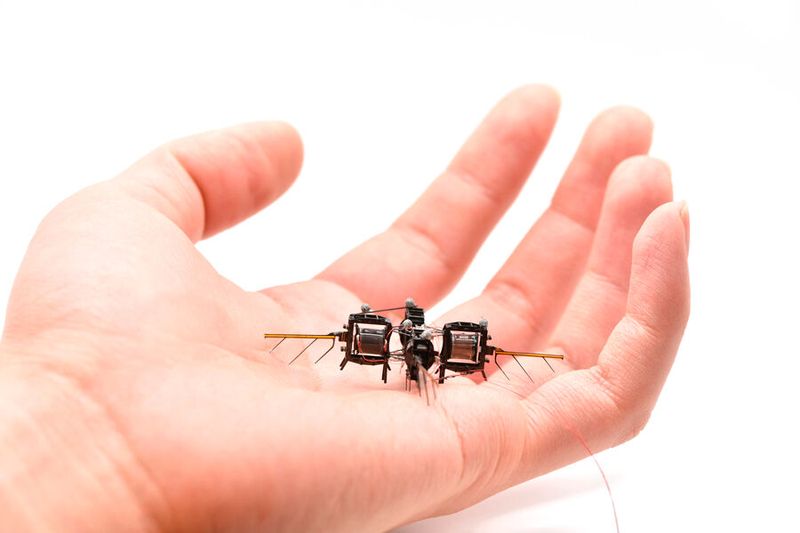
Researchers have long been working on various robots inspired by insects. Researchers at MIT have now optimized an existing robot insect to weigh less than a paperclip while being able to fly significantly faster and longer.
The new robots from MIT weigh less than a paperclip and can hover for about 1000 seconds—more than 100 times longer than before.
(Image: MIT)
With a more efficient method of artificial pollination, farmers could grow fruits and vegetables in multi-story warehouses in the future, increasing yields while mitigating some of the harmful environmental impacts of agriculture.
To make this idea a reality, MIT researchers are developing robot insects that could one day swarm from mechanical beehives to quickly perform precise pollination. However, even the best bug-sized robots can't match natural pollinators like bees in terms of endurance, speed, and maneuverability.
Flying robots are more agile, faster and more precise
Now, researchers at MIT, inspired by the anatomy of these natural pollinators, have revised their previous design to develop tiny flying robots that are much more agile than previous versions: The new robots can hover for about 1,000 seconds, which is more than 100 times longer than previously demonstrated, it is reported. The robotic insect, which weighs less than a paperclip, can fly significantly faster than similar robots and perform acrobatic maneuvers like double jumps in the air.
The revised robot was designed to improve flight precision and agility while minimizing the mechanical stress on the artificial wings, allowing for faster maneuvers, higher endurance, and a longer lifespan. The new design also provides enough space to carry tiny batteries or sensors, enabling the robot to fly independently outside the lab.
Gallery
"The flight duration we demonstrated in this work is likely longer than the entire flight duration our field has been able to accumulate so far with these robotic insects. With the improved lifespan and precision of this robot, we are getting closer to some very exciting applications, such as assisted pollination," says Kevin Chen, assistant professor in the Department of Electrical Engineering and Computer Science (EECS), head of the Soft and Micro Robotics Laboratory within the Research Laboratory of Electronics (RLE), and lead author of an open-access paper on the new design.
Chen worked together with co-authors Suhan Kim and Yi-Hsuan Hsiao, who are studying in the EECS department, as well as EECS student Zhijian Ren and summer visiting student Jiashu Huang on the publication. The research findings were published in Science Robotics.
New design enables more power and more space
Earlier versions of the robot insect consisted of four identical units, each with two wings, assembled into a rectangular device the size of a microcassette. "But there is no insect with eight wings. In our old design, the performance of each individual unit was always better than that of the entire robot," says Chen.
This drop in performance was partly caused by the arrangement of the wings, which blew air into each other when flapping, reducing the lift forces they could generate.
With the new design, the robot is split into two halves. Each of the four identical units now has a flapping wing that points away from the center of the robot, stabilizing the wings and increasing their lift forces. With only half as many wings, this design also provides space for the robot to carry electronics.
Less effort, more power
The movement of the robot's wings is powered by artificial muscles. These tiny, soft actuators can quickly compress and expand, generating a mechanical force that causes the wings to flap. In previous designs, when the actuator's movements reached the extremely high frequencies required for flight, the devices often buckled. This reduced the robot's performance and efficiency. To address this, the researchers developed transmissions that connect the wings with the artificial muscles. These transmissions reduce the mechanical stress that limited the lifespan of previous versions. The new transmissions prevent this buckling motion, allowing the artificial muscles to endure less stress and exert more force for the wingbeat.
Compared to the old robots, we can now generate three times the torque as before, which is why we can perform very demanding and very precise trajectory flights.
Chen
Another innovation is a long wing hinge that reduces torsional stress during the flapping motion. Manufacturing the hinge, which is about 0.79 inches long but only has a diameter of 0.0079 inches, was one of the biggest challenges for the researchers.
Robot insect follows letters
When all four units are in place, the new robotic insect can hover for more than 1,000 seconds, which is almost 17 minutes, without any loss of flight precision. The new robot also achieved an average speed of 13.78 inches per second—the fastest flight researchers have recorded so far—while performing body rolls and double flips. It can even accurately trace a flight path that spells MIT.
Date: 08.12.2025
Naturally, we always handle your personal data responsibly. Any personal data we receive from you is processed in accordance with applicable data protection legislation. For detailed information please see our privacy policy.
Consent to the use of data for promotional purposes
I hereby consent to Vogel Communications Group GmbH & Co. KG, Max-Planck-Str. 7-9, 97082 Würzburg including any affiliated companies according to §§ 15 et seq. AktG (hereafter: Vogel Communications Group) using my e-mail address to send editorial newsletters. A list of all affiliated companies can be found here
Newsletter content may include all products and services of any companies mentioned above, including for example specialist journals and books, events and fairs as well as event-related products and services, print and digital media offers and services such as additional (editorial) newsletters, raffles, lead campaigns, market research both online and offline, specialist webportals and e-learning offers. In case my personal telephone number has also been collected, it may be used for offers of aforementioned products, for services of the companies mentioned above, and market research purposes.
Additionally, my consent also includes the processing of my email address and telephone number for data matching for marketing purposes with select advertising partners such as LinkedIn, Google, and Meta. For this, Vogel Communications Group may transmit said data in hashed form to the advertising partners who then use said data to determine whether I am also a member of the mentioned advertising partner portals. Vogel Communications Group uses this feature for the purposes of re-targeting (up-selling, cross-selling, and customer loyalty), generating so-called look-alike audiences for acquisition of new customers, and as basis for exclusion for on-going advertising campaigns. Further information can be found in section “data matching for marketing purposes”.
In case I access protected data on Internet portals of Vogel Communications Group including any affiliated companies according to §§ 15 et seq. AktG, I need to provide further data in order to register for the access to such content. In return for this free access to editorial content, my data may be used in accordance with this consent for the purposes stated here. This does not apply to data matching for marketing purposes.
Right of revocation
I understand that I can revoke my consent at will. My revocation does not change the lawfulness of data processing that was conducted based on my consent leading up to my revocation. One option to declare my revocation is to use the contact form found at https://contact.vogel.de. In case I no longer wish to receive certain newsletters, I have subscribed to, I can also click on the unsubscribe link included at the end of a newsletter. Further information regarding my right of revocation and the implementation of it as well as the consequences of my revocation can be found in the data protection declaration, section editorial newsletter.
Yet even with these design innovations, there remains a gap between the best robot insects and real animals. A bee, for example, has only two wings but can still perform fast and very controlled movements.
.
The wings of bees are finely controlled by very sophisticated muscles. This level of fine-tuning is something that really fascinates us but that we have not yet been able to replicate.



:quality(80)/p7i.vogel.de/wcms/eb/2b/eb2bd1b8487afe577b37363cd02f16ff/0113143253v1.jpeg "In our China Market Insider, we regularly provide you with relevant information straight from China. (Image:© Eisenhans - stock.adobe.com)")
:quality(80)/p7i.vogel.de/wcms/dd/b8/ddb8edc98c49b384734ab2432b297eb5/adobestock-1913662309--irene-stock-adobe-com-ki-generiertv1.jpeg "Rotary joints are used in grippers and swivel mechanisms to allow assemblies to rotate or swivel smoothly relative to one another, even under very high loads (illustrative image). (Source: Irene - stock.adobe.com / KI-generiert)")
:quality(80)/p7i.vogel.de/wcms/d1/ef/d1ef6b6f7d4543f7999980bacccaf22b/0133499261v1.jpeg "As the growing imbalance in trade relations with China continues to widen, the EU Chamber of Commerce foresees a day when trade with China will have to be seriously reevaluated ... (Image: AI-generated)")
:quality(80)/p7i.vogel.de/wcms/fe/1f/fe1fa5ee713f94deaba963dc24c3abc5/0133299273v1.jpeg "The Flexistar enables highly flexible production of laser-welded tubes thanks to its tool-free clamping system. (Image:Because Technology, LLC)")
:quality(80)/p7i.vogel.de/wcms/60/ef/60ef4f07e4829b2c2929befc0f353c58/0133511729v1.jpeg "Humanoid robots can match human performance in certain tasks. (Image:Gemini / AI-generated)")
:quality(80)/p7i.vogel.de/wcms/2e/99/2e99726b522e4b35b690e25eb6a42643/0133463991v1.jpeg "Robotics: In AMR applications, connection technology must reliably transmit power, signals, and data despite vibration and shock loads—in very confined spaces and in a way that allows for regular maintenance. (Image:Hyperever)")
:quality(80)/p7i.vogel.de/wcms/d0/18/d01801e3d5dbd7bc9d0b4f60408b630c/0133468429v1.jpeg "Quality requirements for film packaging are on the rise. At the same time, many companies are turning to recyclable film materials, which, however, have their own challenges. Fraunhofer researchers have therefore developed a fast system that detects problems in real time. (Image:Fraunhofer IKTS)")
:quality(80)/p7i.vogel.de/wcms/b1/06/b106cf44923ce39565c3264982fd20eb/0133414574v1.jpeg "Robots Build Robots: At the new Ubtech factory, automated systems even handle parts of the material supply and logistics for the production of humanoid robots. (Image:Ubtech)")
:quality(80)/p7i.vogel.de/wcms/c0/52/c052f405eb55fc3d08c4837e77206fc0/adobestock-2021845957--aucartstudio-stock-adobe-com-ki-generiertv1.jpeg "An innovation from China to combat extreme summer heat: A novel coating lowers temperatures. (Source: © AucArtStudio – stock.adobe.com_AI-generated)")
:quality(80)/p7i.vogel.de/wcms/66/a7/66a7b78159caeacce57136529688799f/0133503398v1.jpeg "Sunlight Makes Stone! These stone blocks weren't made the traditional way. Instead, they were additively manufactured from sand using a laser. In the future, however, the laser is set to be replaced by concentrated sunlight—if the startup Addisol is successful... (Image:Addisol / F. Fiedler)")
:quality(80)/p7i.vogel.de/wcms/72/b9/72b995c2c8d812c5e2115cbef31e035a/0133462727v1.jpeg "Eggl manufactures center hoods that are precisely tailored to each cooking island—whether standard size or custom shape. They are made entirely of stainless steel and are individually customized in terms of size and filter arrangement. (Image:SPI)")
:quality(80)/p7i.vogel.de/wcms/13/5d/135dfae6229ceaf5c55467a43e8f7257/adobestock-1879961393--ardi-stock-adobe-com-ki-generiertv1.jpeg "Annoying chatterboxes or awkward silences in response to questions—a moderator should specifically prepare for difficult situations in order to navigate them effectively. (Image:ardi - stock.adobe.com_AI-generated)")
:quality(80)/p7i.vogel.de/wcms/aa/a2/aaa2c6dd2daa24b485cddbf9297590c0/0133467318v1.jpeg "Battery Monitoring: Battery monitoring using electrochemical impedance spectroscopy offers several advantages. (Image:TI)")
:quality(80)/p7i.vogel.de/wcms/39/b2/39b21bf03be1683831862239a369987c/0133469638v1.jpeg "Data from autonomous vehicles and robots operating autonomously is in high demand, and Ruqi wants to capitalize on this. (Image:Ruqi Mobility)")
:quality(80)/p7i.vogel.de/wcms/8a/bb/8abbb6217220595edc1549ac9b84f307/0133429906v1.jpeg "The IAA in Hanover showcased the ambitions of Chinese commercial vehicle manufacturers in Europe. (Image:Wehner - VCG)")
:quality(80)/p7i.vogel.de/wcms/0c/53/0c5313ef91c14b6df0d0996efc33c8ad/jpg03568-bearbeitetv1.jpeg "The category winners of the 2027 German Car of the Year award. (Source: GCOTY)")
:quality(80)/p7i.vogel.de/wcms/48/15/4815da27c45973ca629a99b375ac3aef/0133509585v1.jpeg "Ventuno Q RoadTest: Designed to help the Element14 community gain practical insights from real-world tests using the Ventuno Q. (Image:Farnell/Element14)")
:quality(80)/p7i.vogel.de/wcms/17/2b/172bd132f9febdfcbcedba292ad0504d/aufmacherv1.jpeg "Micro-Epsilon offers a wide range of IO-Link-compatible sensors. (Source: Micro-Epsilon Messtechnik GmbH & Co. KG)")
:quality(80)/p7i.vogel.de/wcms/ca/b4/cab46fd26d19d6a2febca032048200b6/0133471827v1.jpeg "Photonics SDK for C and Python: Computational operations are now abstracted as standard mathematical functions. (Image:Q.ANT)")
:quality(80)/p7i.vogel.de/wcms/92/b2/92b2ed5299cde450c0764f4f64468395/0133505895v1.jpeg "The \"Iris 100\" test system for high-precision volume production of microLEDs uses a spectrometer and a high-resolution camera. (Image:Teradyne)")
:fill(fff,0)/images.vogel.de/vogelonline/companyimg/76800/76895/65.jpg "FAULHABER_120mm.jpg ()")
:fill(fff,0)/p7i.vogel.de/companies/69/88/69882c428938e/tmts2026-ticec-banner-en-2000px.png "tmts2026-ticec-banner-en-2000px (https://www.tmts.tw/en)")
:fill(fff,0)/p7i.vogel.de/companies/69/de/69de1b7403b0d/simtos-logo.jpeg "simtos-logo (SIMTOS)")
:quality(80)/p7i.vogel.de/wcms/37/28/3728dff4e4f7d15e250a425a7238f9c7/0122585996v1.jpeg "Powerhouse: The robot insect can now also carry small batteries or sensors.(Image: MIT)")
:quality(80)/p7i.vogel.de/wcms/b0/4b/b04b2435f8ca93fc99b8249b4215f8e1/0122585999v1.jpeg "With the new design, the robot is split into two halves. Each of the four identical units now has a flapping wing that points away from the center of the robot, stabilizing the wings and increasing their lift forces.(Image: MIT)")
:quality(80)/p7i.vogel.de/wcms/d9/4c/d94ce26fcf51b39d597e4d716b1620e4/0122585993v1.jpeg "The new robot also achieved an average speed of 35 centimeters per second - the fastest flight recorded by researchers so far - performing body rolls and double flips. It can even precisely follow a trajectory that spells MIT.(Image: MIT)")
:quality(80)/p7i.vogel.de/wcms/d4/f3/d4f3bbd6e52451bd3f9ad3254b528820/0128361393v1.jpeg "Fast and agile like a bumblebee, a new microrobot by engineers from the Massachusetts Institute of Technology (MIT). (Image:MIT)")
:quality(80)/p7i.vogel.de/wcms/53/6b/536b0bb25290f40453cf286dddc11ef6/3840x2160v1.jpeg "The so-called \"flapping-wing aerial-aquatic vehicle\" (FAAV) weighs less than 300 grams and is designed to help researchers study the mechanics that allow diving birds to move both in the air and in the water. (Source: Raphael Zufferey)")