


:quality(80)/p7i.vogel.de/wcms/8e/fa/8efad6aa006fcf624d07c645b774d8ce/screenshot-202026-01-21-20113324-764x430v1v1.png "The system processes heavy sheets weighing up to 200 kg fully automatically, without programming or teaching. (Image:Teqram)")
:quality(80)/p7i.vogel.de/wcms/0c/58/0c587c8221ae96052b5dcc0f40eb3dcd/0128880879v1.jpeg "A chip surfer with a solid carbide head is used for finishing in the third operation. (Image:Ingersoll)")
:quality(80)/p7i.vogel.de/wcms/a2/9b/a29bb02b3f1e34962e28579dccfbbc49/0129266114v1.jpeg "Bevel gears on workpiece carriers in the rotary indexing conveyor of the VSC 400 DDS - the pick-up spindle removes the workpiece precisely and reproducibly for hard machining at EWS. (Image:Emag)")
:quality(80)/p7i.vogel.de/wcms/c0/2c/c02c6f8c4c079cc5db6a21c00affcecd/0128311235v1.jpeg "Tatra chose a Fastems FPC3000 system as the automation solution, which initially contains twelve pallet spaces, and in a later stage 18 pallet spaces and a linear conveyor. (Image:Starrag/Ralf Baumgarten)")
:quality(80)/p7i.vogel.de/wcms/4d/74/4d745446555110ca9797db1eabb7c9d3/0129551585v1.jpeg "Jochen Gemeinhardt is responsible for NTT Data's AI business in the DACH region as Head of Production & Supply Chain and Head of Industry Line Global Business. (Image:NTT Data)")
:quality(80)/p7i.vogel.de/wcms/7a/c8/7ac81c41bab1cc98fbe7b20c95644c6c/0129575667v1.jpeg "For the live gala show celebrating the New Year festival, Unitree rehearsed an impressive performance with its robots. (Image:Unitree/YouTube)")
:quality(80)/p7i.vogel.de/wcms/a3/0c/a30c4c3a36910e92d6082fde37261730/0129555015v1.jpeg "From command recipient to decision-maker: thanks to Agentic AI, robots no longer just stubbornly execute pre-programmed scripts. Instead, they analyze visual data in real time and decide autonomously on the next process step (Image:Nano Banana / AI-generated)")
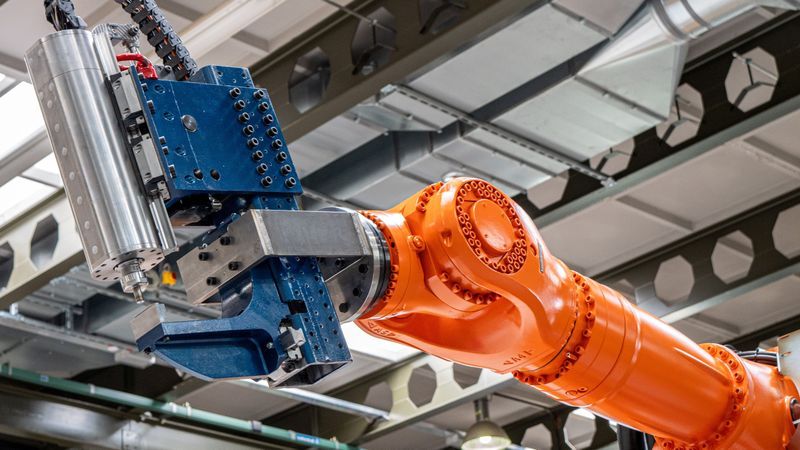
:quality(80)/p7i.vogel.de/wcms/60/00/6000deb595c3e6b2dd0bfe508aa71653/newsimage418166-5084x2861v1v1.jpeg "The robot-guided friction stir welding gun \"Steppwelder\" in use on a conventional 6-axis industrial robot. (Image:Image: Dominik Walz, MPA, University of Stuttgart)")
:quality(80)/p7i.vogel.de/wcms/48/38/4838074eab3f29ec319797fb63881b18/adobestock-693942839--c2-a9-20wirot-20-e2-80-93-20stock-adobe-com-3389x1907v1v1.jpeg "Leaves or bird droppings can cause hotspots on solar modules and reduce performance. (Image:Wirot stock.adobe.com.)")
:quality(80)/p7i.vogel.de/wcms/3f/7f/3f7f9f45ebccd4751d41106866314aea/newsimage418028-2772x1559v1v1.jpeg "Live in the ice channel—detailed recordings in real time make the smallest mistakes and thus time losses in the luge run visible. (Image:Mittweida University of Applied Sciences)")
:quality(80)/p7i.vogel.de/wcms/05/b7/05b7c58dcf5a7fc900348d1c30f7c116/0129540459v1.jpeg "Researchers from Stuttgart have investigated whether the \"technology\" behind hairy elephant trunks, which function as a sensitive gripping system, can also be used in robotics. (Image:Zoo Magic)")
:quality(80)/p7i.vogel.de/wcms/95/00/95009ae2972690e3fdab0dc701e202c3/0129621847v1.jpeg "Last year, Airbus's revenue increased by six percent to 81 billion US dollars. (Image:Airbus SAS 2024)")
:quality(80)/p7i.vogel.de/wcms/ee/66/ee668414d90f1bffbb6e4574ba790d89/0129639616v1.jpeg "Anyone relying on the fuel consumption figures in the description of their \"plug-in\" hybrid might be in for a surprise. Researchers have found in real-world tests that theory and practice differ significantly ... (Image:Koenigsreuther)")
:quality(80)/p7i.vogel.de/wcms/fb/c5/fbc5a1d3151a05241d0b5afc0f017759/0129596854v1.jpeg "The prospects for European cell production have been poor for some time. The reasons for this are high production costs, technical difficulties in ramping up production and overcapacity on the market. (Image:McKinsey)")
:quality(80)/p7i.vogel.de/wcms/69/38/69381399780e10e1bbb446a6a5bfd3e1/0129500927v1.jpeg "Complex design, simple production: With the \"Front-IQ Light\" headlamp, a film is three-dimensionally formed directly in the tool thanks to Colorform technology. (Image:Leonard Kurz)")
:quality(80)/p7i.vogel.de/wcms/41/85/41855b7e5c57936c33039a7e785462c9/0129633555v1.jpeg "A chip processing method developed by MIT could help cryptographic processes keep data secure by allowing two chips within the same system to authenticate each other using a common fingerprint. (Image:freely licensed)")
:quality(80)/p7i.vogel.de/wcms/f3/56/f3568508f969e8560cf1c8d3a3f2885c/0127958464v1.jpeg "According to the manufacturer, Contrinex's photoelectric miniature sensors are the smallest optical sensors with integrated electronics on the market. They are available as diffuse sensors or through-beam sensors. (Image:Contrinex, Shutterstock/asharkyu)")
:quality(80)/p7i.vogel.de/wcms/ab/82/ab82dfd86fd624854af173066cfacea5/0129154593v1.jpeg "The digital Mycelium Lifecycle Platform supports production managers in operating their machines safely, securely, efficiently, and in compliance with standards throughout their entire lifecycle. It combines the management of personnel and machines on a single platform. (Image:Pilz GmbH & Co. KG)")
:quality(80)/p7i.vogel.de/wcms/5c/6b/5c6b52f55eced3f21a82b49b4d29972c/0129641027v1.jpeg "Bytedance has popularized the short video format with the TikTok app, among other things. AI is used in many of the Group's products. (Image:Bytedance)")
Date: 08.12.2025
Naturally, we always handle your personal data responsibly. Any personal data we receive from you is processed in accordance with applicable data protection legislation. For detailed information please see our privacy policy.
Consent to the use of data for promotional purposes
I hereby consent to Vogel Communications Group GmbH & Co. KG, Max-Planck-Str. 7-9, 97082 Würzburg including any affiliated companies according to §§ 15 et seq. AktG (hereafter: Vogel Communications Group) using my e-mail address to send editorial newsletters. A list of all affiliated companies can be found here
Newsletter content may include all products and services of any companies mentioned above, including for example specialist journals and books, events and fairs as well as event-related products and services, print and digital media offers and services such as additional (editorial) newsletters, raffles, lead campaigns, market research both online and offline, specialist webportals and e-learning offers. In case my personal telephone number has also been collected, it may be used for offers of aforementioned products, for services of the companies mentioned above, and market research purposes.
Additionally, my consent also includes the processing of my email address and telephone number for data matching for marketing purposes with select advertising partners such as LinkedIn, Google, and Meta. For this, Vogel Communications Group may transmit said data in hashed form to the advertising partners who then use said data to determine whether I am also a member of the mentioned advertising partner portals. Vogel Communications Group uses this feature for the purposes of re-targeting (up-selling, cross-selling, and customer loyalty), generating so-called look-alike audiences for acquisition of new customers, and as basis for exclusion for on-going advertising campaigns. Further information can be found in section “data matching for marketing purposes”.
In case I access protected data on Internet portals of Vogel Communications Group including any affiliated companies according to §§ 15 et seq. AktG, I need to provide further data in order to register for the access to such content. In return for this free access to editorial content, my data may be used in accordance with this consent for the purposes stated here. This does not apply to data matching for marketing purposes.
Right of revocation
I understand that I can revoke my consent at will. My revocation does not change the lawfulness of data processing that was conducted based on my consent leading up to my revocation. One option to declare my revocation is to use the contact form found at https://contact.vogel.de. In case I no longer wish to receive certain newsletters, I have subscribed to, I can also click on the unsubscribe link included at the end of a newsletter. Further information regarding my right of revocation and the implementation of it as well as the consequences of my revocation can be found in the data protection declaration, section editorial newsletter.
:quality(80)/p7i.vogel.de/wcms/54/99/54993d2d36581f224b437a849dc73fcb/0124586424v1.jpeg "Hand welding with the laser at Kolless in Bremen. (Image:Colless)")
:quality(80)/p7i.vogel.de/wcms/a2/87/a2874fd262b015ade8955729c0fc8399/0126462776v1.jpeg "At the Fraunhofer Institute for Material and Beam Technology (IWS), Dr.-Ing. Axel Jahn and his team are researching several possibilities to optimize welding using laser beam shaping. Here, for example, a battery housing made of aluminum die-cast and aluminum extrusion components. (Image:Fraunhofer IWS / R. Jungnickel)")