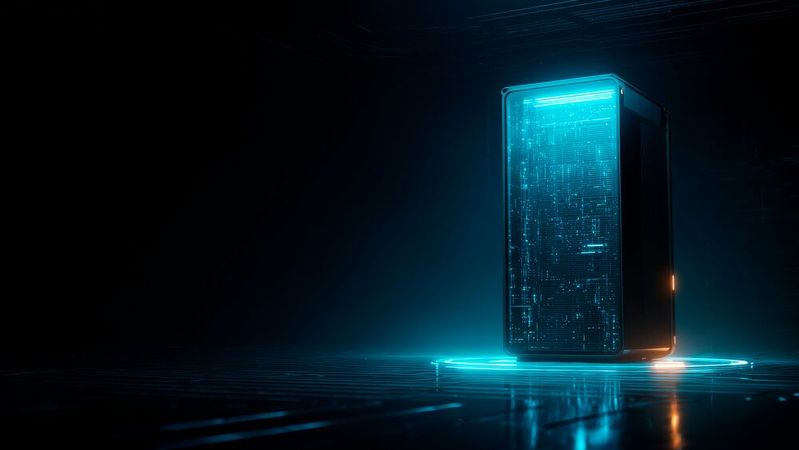
Chinese scientists have developed a neuromorphic supercomputer that is only the size of a small refrigerator. The server, which is of interest for AI applications, is said to consume so little energy that it can be operated from a household power socket.
A refrigerator-sized supercomputer was recently unveiled in China. Among other things, it is intended for use at home and on the move.
The innovation called "BIE-1 (BI Explorer)" is the first "ultra-compact, mobile, brain-inspired computing device on Earth", writes the Chinese science newspaper Zhongguo Kexue Bao. The researchers have succeeded in "compressing a computer with the performance of a supercomputer into the size of a mini fridge", writes the paper.
Suitable for Use at Home, in Small Offices And on the Move
According to the report, the server, which is interesting for AI applications, is so small and consumes so little energy that it can be operated from a household socket. It was developed by two researchers at the Guangdong Institute of Intelligence Science and Technology (GDIIST), who also work for two start-ups incubated there.
BIE-1 can be "easily used at home, in small offices and even in mobile environments", writes GDIIST on its website.
Miniaturization Taken A Step Further
This is reminiscent of the vision of Steve Jobs and his first Macintosh, who wanted to bring the then still huge computers out of closed data centers and into people's everyday lives through miniaturization.
What the Apple founder achieved for the world of computers with Neumann architecture, the Chinese computer scientists now want to repeat in the field of neuromorphic computing. "A traditional data center is like a building: it requires high initial investment and consumes a lot of energy," said Nie Lei, co-director of the Joint Laboratory of Intelligent Computing Systems at GDIIST and one of the two inventors. In contrast, his computer, which is based on a self-developed neural network, can be operated via a normal power socket and consumes "only a tenth of the energy of conventional supercomputers", said Nie Lei.
Together with his partner Cai Jiang, he stood on the stage of a scientific symposium on October 26. Between the two men stood their first BIE-1, which reached up to their hips.
The household-sized supercomputer has 1,152 CPU cores, 4.8 terabytes of DDR5 RAM and a storage capacity of 204 terabytes.
AI Enables Enormous Computing Power
Although the term "supercomputer" is not precisely defined and is therefore elastic, hardware bearing this label is usually not available for less than ten million euros.
According to Nie Lei and Cai Jiang, they have programmed a new AI algorithm that gives the neural network in the BIE-1 a computing power that can compete with "traditional supercomputers".
"On a single CPU node, it completed training with 10 billion tokens in just 30 hours, with training and inference speeds of 100,000 and 500,000 tokens per second respectively," writes the science journal.
For comparison: Nvidia's flagship server Blackwell GB200 NVL72 advertises an inference speed of 1.5 million tokens per second.
The energy efficiency of the new computer is also remarkable: while conventional AI computers consume a lot of power, among other things for cooling, the new BIE-1 is so economical that it never exceeds a CPU temperature of 158 °F, even under full load.
Supercomputer at A Bargain Price
Although the scientists are also pursuing commercial interests and represent two start-ups that emerged from the research institute, they want to make their BIE-1, dubbed the Mini-Fridge Server by the Chinese press, available to other researchers and students free of charge. Above all, they hope that it will be useful for AI applications in medical research, said a GDIIST spokesperson.
According to the scientist and entrepreneur, an "Enterprise" edition will be sold to companies for around 3.5 million yuan (around $493,000). That would be a bargain price and something of a minor sensation in the supercomputer sector if the performance figures given by the inventors of their computer can be independently confirmed.
Experts Are Impressed
Chinese and foreign experts were impressed in their initial reactions. "If the BIE-1 delivers on even half of its performance promises, it would be a significant step forward for neuromorphic computing and Chinese AI hardware," writes Tom's Hardware.
Date: 08.12.2025
Naturally, we always handle your personal data responsibly. Any personal data we receive from you is processed in accordance with applicable data protection legislation. For detailed information please see our privacy policy.
Consent to the use of data for promotional purposes
I hereby consent to Vogel Communications Group GmbH & Co. KG, Max-Planck-Str. 7-9, 97082 Würzburg including any affiliated companies according to §§ 15 et seq. AktG (hereafter: Vogel Communications Group) using my e-mail address to send editorial newsletters. A list of all affiliated companies can be found here
Newsletter content may include all products and services of any companies mentioned above, including for example specialist journals and books, events and fairs as well as event-related products and services, print and digital media offers and services such as additional (editorial) newsletters, raffles, lead campaigns, market research both online and offline, specialist webportals and e-learning offers. In case my personal telephone number has also been collected, it may be used for offers of aforementioned products, for services of the companies mentioned above, and market research purposes.
Additionally, my consent also includes the processing of my email address and telephone number for data matching for marketing purposes with select advertising partners such as LinkedIn, Google, and Meta. For this, Vogel Communications Group may transmit said data in hashed form to the advertising partners who then use said data to determine whether I am also a member of the mentioned advertising partner portals. Vogel Communications Group uses this feature for the purposes of re-targeting (up-selling, cross-selling, and customer loyalty), generating so-called look-alike audiences for acquisition of new customers, and as basis for exclusion for on-going advertising campaigns. Further information can be found in section “data matching for marketing purposes”.
In case I access protected data on Internet portals of Vogel Communications Group including any affiliated companies according to §§ 15 et seq. AktG, I need to provide further data in order to register for the access to such content. In return for this free access to editorial content, my data may be used in accordance with this consent for the purposes stated here. This does not apply to data matching for marketing purposes.
Right of revocation
I understand that I can revoke my consent at will. My revocation does not change the lawfulness of data processing that was conducted based on my consent leading up to my revocation. One option to declare my revocation is to use the contact form found at https://contact.vogel.de. In case I no longer wish to receive certain newsletters, I have subscribed to, I can also click on the unsubscribe link included at the end of a newsletter. Further information regarding my right of revocation and the implementation of it as well as the consequences of my revocation can be found in the data protection declaration, section editorial newsletter.
"The release of the BIE-1 marks the beginning of a new era of mobile personal supercomputing—characterized by miniaturization, energy efficiency, customization, accessibility and widespread use," the Chinese science newspaper quoted Zhang Xu, director of GDIIST and member of the Chinese Academy of Sciences. Steve Jobs sends his regards.
Henrik Bork, long-time China correspondent for Süddeutsche Zeitung and Frankfurter Rundschau, is Managing Director at Asia Waypoint, a consulting agency based in Beijing that specializes in China.
Future-Proof Authentication with Universal RFID Readers



:quality(80)/p7i.vogel.de/wcms/eb/2b/eb2bd1b8487afe577b37363cd02f16ff/0113143253v1.jpeg "In our China Market Insider, we regularly provide you with relevant information straight from China. (Image:© Eisenhans - stock.adobe.com)")
:quality(80)/p7i.vogel.de/wcms/dd/b8/ddb8edc98c49b384734ab2432b297eb5/adobestock-1913662309--irene-stock-adobe-com-ki-generiertv1.jpeg "Rotary joints are used in grippers and swivel mechanisms to allow assemblies to rotate or swivel smoothly relative to one another, even under very high loads (illustrative image). (Source: Irene - stock.adobe.com / KI-generiert)")
:quality(80)/p7i.vogel.de/wcms/d1/ef/d1ef6b6f7d4543f7999980bacccaf22b/0133499261v1.jpeg "As the growing imbalance in trade relations with China continues to widen, the EU Chamber of Commerce foresees a day when trade with China will have to be seriously reevaluated ... (Image: AI-generated)")
:quality(80)/p7i.vogel.de/wcms/fe/1f/fe1fa5ee713f94deaba963dc24c3abc5/0133299273v1.jpeg "The Flexistar enables highly flexible production of laser-welded tubes thanks to its tool-free clamping system. (Image:Because Technology, LLC)")
:quality(80)/p7i.vogel.de/wcms/60/ef/60ef4f07e4829b2c2929befc0f353c58/0133511729v1.jpeg "Humanoid robots can match human performance in certain tasks. (Image:Gemini / AI-generated)")
:quality(80)/p7i.vogel.de/wcms/2e/99/2e99726b522e4b35b690e25eb6a42643/0133463991v1.jpeg "Robotics: In AMR applications, connection technology must reliably transmit power, signals, and data despite vibration and shock loads—in very confined spaces and in a way that allows for regular maintenance. (Image:Hyperever)")
:quality(80)/p7i.vogel.de/wcms/d0/18/d01801e3d5dbd7bc9d0b4f60408b630c/0133468429v1.jpeg "Quality requirements for film packaging are on the rise. At the same time, many companies are turning to recyclable film materials, which, however, have their own challenges. Fraunhofer researchers have therefore developed a fast system that detects problems in real time. (Image:Fraunhofer IKTS)")
:quality(80)/p7i.vogel.de/wcms/b1/06/b106cf44923ce39565c3264982fd20eb/0133414574v1.jpeg "Robots Build Robots: At the new Ubtech factory, automated systems even handle parts of the material supply and logistics for the production of humanoid robots. (Image:Ubtech)")
:quality(80)/p7i.vogel.de/wcms/c0/52/c052f405eb55fc3d08c4837e77206fc0/adobestock-2021845957--aucartstudio-stock-adobe-com-ki-generiertv1.jpeg "An innovation from China to combat extreme summer heat: A novel coating lowers temperatures. (Source: © AucArtStudio – stock.adobe.com_AI-generated)")
:quality(80)/p7i.vogel.de/wcms/66/a7/66a7b78159caeacce57136529688799f/0133503398v1.jpeg "Sunlight Makes Stone! These stone blocks weren't made the traditional way. Instead, they were additively manufactured from sand using a laser. In the future, however, the laser is set to be replaced by concentrated sunlight—if the startup Addisol is successful... (Image:Addisol / F. Fiedler)")
:quality(80)/p7i.vogel.de/wcms/72/b9/72b995c2c8d812c5e2115cbef31e035a/0133462727v1.jpeg "Eggl manufactures center hoods that are precisely tailored to each cooking island—whether standard size or custom shape. They are made entirely of stainless steel and are individually customized in terms of size and filter arrangement. (Image:SPI)")
:quality(80)/p7i.vogel.de/wcms/13/5d/135dfae6229ceaf5c55467a43e8f7257/adobestock-1879961393--ardi-stock-adobe-com-ki-generiertv1.jpeg "Annoying chatterboxes or awkward silences in response to questions—a moderator should specifically prepare for difficult situations in order to navigate them effectively. (Image:ardi - stock.adobe.com_AI-generated)")
:quality(80)/p7i.vogel.de/wcms/3e/2f/3e2f1ec6c4e1a24eac32957acebd0901/0133601693v1.jpeg "From the boule (bottom) to the wafer to the chip (on top of the boule). Transistors are used as switches in power electronics. (Image:Bosch)")
:quality(80)/p7i.vogel.de/wcms/8f/99/8f9956e7dce99d1b28c27fb1c30ea236/04-dsc-2230v1.jpeg "Bosch is cutting jobs in Nuremberg. (Source: Bosch)")
:quality(80)/p7i.vogel.de/wcms/aa/a2/aaa2c6dd2daa24b485cddbf9297590c0/0133467318v1.jpeg "Battery Monitoring: Battery monitoring using electrochemical impedance spectroscopy offers several advantages. (Image:TI)")
:quality(80)/p7i.vogel.de/wcms/39/b2/39b21bf03be1683831862239a369987c/0133469638v1.jpeg "Data from autonomous vehicles and robots operating autonomously is in high demand, and Ruqi wants to capitalize on this. (Image:Ruqi Mobility)")
:quality(80)/p7i.vogel.de/wcms/28/28/2828c5261714321afb0bab67bf771823/0133353387v1.jpeg "The 130-meter-long China Zorrilla draws its power from a battery system with a capacity of more than 40 MWh. Eight electric motors drive an equal number of water jets. (Image:Incat Australia Pty Ltd)")
:quality(80)/p7i.vogel.de/wcms/48/15/4815da27c45973ca629a99b375ac3aef/0133509585v1.jpeg "Ventuno Q RoadTest: Designed to help the Element14 community gain practical insights from real-world tests using the Ventuno Q. (Image:Farnell/Element14)")
:quality(80)/p7i.vogel.de/wcms/17/2b/172bd132f9febdfcbcedba292ad0504d/aufmacherv1.jpeg "Micro-Epsilon offers a wide range of IO-Link-compatible sensors. (Source: Micro-Epsilon Messtechnik GmbH & Co. KG)")
:quality(80)/p7i.vogel.de/wcms/ca/b4/cab46fd26d19d6a2febca032048200b6/0133471827v1.jpeg "Photonics SDK for C and Python: Computational operations are now abstracted as standard mathematical functions. (Image:Q.ANT)")
:fill(fff,0)/p7i.vogel.de/companies/69/88/69882c428938e/tmts2026-ticec-banner-en-2000px.png "tmts2026-ticec-banner-en-2000px (https://www.tmts.tw/en)")
:quality(80):fill(efefef,0)/p7i.vogel.de/wcms/67/ae/67ae0b9ac31f8/elatec-wp-universal-reader.png "Elatec WP Universal Reader")
:quality(80)/p7i.vogel.de/wcms/7d/a3/7da3623df87775722e9ba4fda7e16dc7/0133164888v1.jpeg "Z.ai told ChatGPT how it would like to be portrayed. (Image:Dall-E / AI-generated)")
:quality(80)/p7i.vogel.de/wcms/59/a2/59a2b11f0aa1b700eff02addd5de8703/adobestock-1788280853--c2-a9-20satria-20-e2-80-93-20stock-adobe-com-5081x2860v1v1.jpeg "Quantum computers require extreme cooling to temperatures close to absolute zero in order to keep qubits stable. (Image:satria - stock.adobe.com)")