3D Systems has developed a proprietary testing and calibration procedure for its laser-based Direct Metal Printing (DMP) systems. Users and their end customers benefit from parts manufactured with the highest reliability.
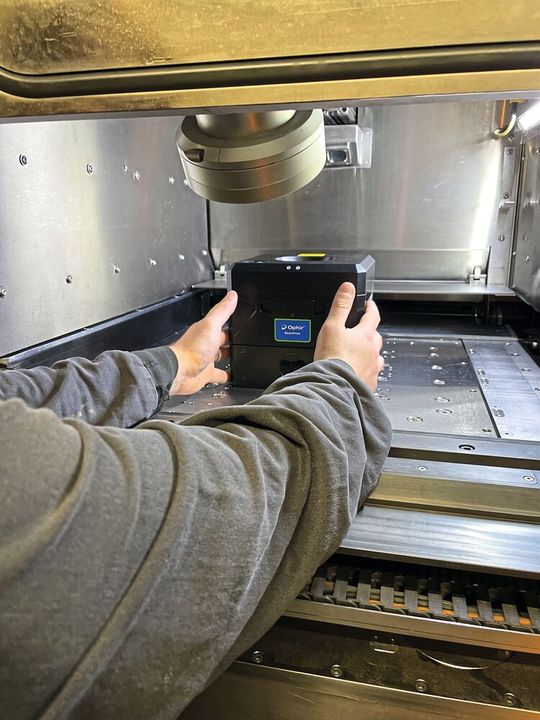
The compact measuring device can be easily placed in the build chamber.
(Image: 3D Systems)
The possibilities of additive manufacturing never cease to amaze: delicate structures, complex custom parts, and components with fascinating properties emerge as if out of nowhere. In 1986, 3D Systems enriched the industry with the innovation of 3D printing. Today, the company is one of the largest players in the field of additive manufacturing and develops AM solutions at locations around the world.
Since 3D Systems' solutions are particularly widespread in highly regulated industries such as healthcare and aerospace, the question often arises as to how repeatable and stable the processes really are. Users, for example, need to demonstrate and document the process stability of the machines they operate over time.
3D Systems aimed to remove this hurdle for users. The goal was to provide advanced measurement and calibration procedures on-site, including dedicated documentation functions, allowing machine users to meet the highest standards.
Demanding Industry Standards
In additive manufacturing, every layer counts. The laser-based optical systems in metallic 3D manufacturing must precisely meet the specifications. This is the only way to ensure that each manufactured part possesses the desired properties. The key optical process parameters are laser power, beam caustics, and the position of the laser beam.
The engineers at 3D Systems monitor these process parameters during the development and production of equipment for metallic 3D manufacturing. At the same time, service technicians should also be able to regularly check the performance and stability of optical systems on-site at the customer's location. Wouter Polspoel, R&D Program Manager at 3D Systems, explains: "Our customers, especially in regulated industries, need to demonstrate that the manufactured parts meet high quality requirements. They must comply with ISO standards such as ISO 52941, which govern control procedures and acceptance criteria for laser powder bed fusion machines for metallic materials in aerospace. Our goal was to create a package of service procedures that takes into account all relevant requirements of the applicable standards and guidelines."
A particular challenge was measuring the caustics at build level for lasers with high power. Just in time, MKS introduced a new solution for this: the Ophir BeamPeek power and beam caustic analysis system. Thanks to innovative measurement technology, the device offers short measurement cycles and versatile application possibilities in service.
Extensive Tests for Best Practices
As part of long-term tests with the Ophir Beam Peek device on the DMP Factory 500, a scalable solution for additive manufacturing of metal parts with a build volume of 19.69 inches × 19.69 inches × 19.69 inches and three fiber lasers, the 3D engineers developed specific measurement routines, defined deviations, and created a comprehensive checklist that is implemented as part of the Advanced Service Package.
"The Ophir Beam Peek system proved its versatility and is very easy to use," says Wouter Polspoel.
The stability of the output power, along with the accuracy of the beam caustics, is crucial for manufacturing high-quality parts. Additionally, with the BeamPeek system, we also measure the beam quality factor M2 of each laser at the center of the build plane.
Wouter Polspoel, R&D Program Manager at 3D Systems
Additionally, as part of the Advanced Service Package routine, a thermal Ophir sensor is used to check the stability of the laser power. The air-cooled FL1100A-BB-65 sensor is paired with a handheld display device to measure the power values during laser setup and after a setup time of 15 minutes at maximum power.
Measurement Technology Builds Trust
With the additional service offering, 3D Systems' customers gain security and flexibility, explains Wouter Polspoel: "We do not expect significant changes in laser parameters, as we use high-quality components and our processes are very stable. Nevertheless, we want to provide users with a way to check their process parameters and document this inspection. Thanks to the Ophir Beam Peek system, we are able to meet the stringent process control and calibration requirements of the ISO standard as part of our Advanced Service Package. All parties gain confidence in the manufactured parts, and that is exactly what the market needs: reliability!" The recommended frequency for performing an Advanced Service Package is every six months.
Date: 08.12.2025
Naturally, we always handle your personal data responsibly. Any personal data we receive from you is processed in accordance with applicable data protection legislation. For detailed information please see our privacy policy.
Consent to the use of data for promotional purposes
I hereby consent to Vogel Communications Group GmbH & Co. KG, Max-Planck-Str. 7-9, 97082 Würzburg including any affiliated companies according to §§ 15 et seq. AktG (hereafter: Vogel Communications Group) using my e-mail address to send editorial newsletters. A list of all affiliated companies can be found here
Newsletter content may include all products and services of any companies mentioned above, including for example specialist journals and books, events and fairs as well as event-related products and services, print and digital media offers and services such as additional (editorial) newsletters, raffles, lead campaigns, market research both online and offline, specialist webportals and e-learning offers. In case my personal telephone number has also been collected, it may be used for offers of aforementioned products, for services of the companies mentioned above, and market research purposes.
Additionally, my consent also includes the processing of my email address and telephone number for data matching for marketing purposes with select advertising partners such as LinkedIn, Google, and Meta. For this, Vogel Communications Group may transmit said data in hashed form to the advertising partners who then use said data to determine whether I am also a member of the mentioned advertising partner portals. Vogel Communications Group uses this feature for the purposes of re-targeting (up-selling, cross-selling, and customer loyalty), generating so-called look-alike audiences for acquisition of new customers, and as basis for exclusion for on-going advertising campaigns. Further information can be found in section “data matching for marketing purposes”.
In case I access protected data on Internet portals of Vogel Communications Group including any affiliated companies according to §§ 15 et seq. AktG, I need to provide further data in order to register for the access to such content. In return for this free access to editorial content, my data may be used in accordance with this consent for the purposes stated here. This does not apply to data matching for marketing purposes.
Right of revocation
I understand that I can revoke my consent at will. My revocation does not change the lawfulness of data processing that was conducted based on my consent leading up to my revocation. One option to declare my revocation is to use the contact form found at https://contact.vogel.de. In case I no longer wish to receive certain newsletters, I have subscribed to, I can also click on the unsubscribe link included at the end of a newsletter. Further information regarding my right of revocation and the implementation of it as well as the consequences of my revocation can be found in the data protection declaration, section editorial newsletter.
Optimized Design
However, Ophir Beam Peek is not only used by service technicians, as Viktor Valckenaers, R&D Project Engineer at 3D Systems, explains: "We conducted intensive tests with the Beam Peek system, particularly during the design phase of our new laser-based system for additive manufacturing. Specifically, the measurements of the beam waist position revealed interesting correlations between gas flow, component contamination, and beam parameters. These insights have been very helpful in optimizing the new system."
The argon flow in the build chamber significantly affects the quality of additively manufactured parts. For this reason, engineers at 3D Systems invest considerable development effort into optimally positioning the gas inlet nozzles. During the design phase, they first use simulation software to explore possible geometries. Once the first tests on the prototype can begin, the Ophir Beam Peek measurement device is used. The beam position is measured before and after each build job under different gas flow scenarios. During the development of the DMP Factory 500, these tests demonstrated the direct correlation between gas flow and the position of the beam waist. The illustration on page 35 shows the change in beam waist position with optimized and non-optimized gas flow. Since any shift in the beam waist directly affects laser performance at the build level, a deterioration in part quality can be expected.
It is well known that the quality of a 3D-printed component strongly depends on the gas flow in the build chamber. However, it is very helpful to be able to precisely quantify how much the minimal beam waist is affected by contamination caused by suboptimal gas flow.
Viktor Valckenaers, R&D Project Engineer at 3D Systems
Once all parameters are defined and the prototype is finalized, each machine undergoes several months of intensive testing. During this phase, the laser beams are regularly checked using the measurement device. These measurements play a central role in verifying the beam caustic and documenting process stability. Another advantage of the device becomes apparent here, as Victor Valckenaers explains: "The Ophir Beam Peek caustic analysis system can be used for both high and low laser powers. This feature is extremely valuable to us as it allows us to use the device for the entire series of measurements."
Success Through Collaboration
Both during the intensive testing phase and integration, questions were clarified directly with the Ophir developers. The result is already a great success: "We were able to significantly improve our on-site services within just a few months. At the same time, the more extensive measurement capabilities shorten the development times for our machines."



:quality(80)/p7i.vogel.de/wcms/d9/43/d943b0ce33bdf921f37f14655bb0c376/cuscinetto-a-sfere-di-leonardo-da-vinci-in-una-mostra-su-leonardo-da-vinci-al-mulino-di-mora-bassa---morabassa-croppedv1.jpeg "Replica of Leonardo da Vinci's ball bearing: The inventor used wooden balls. Spacers prevent the balls from rubbing against each other. (Source: Capricornis crispus)")
:quality(80)/p7i.vogel.de/wcms/17/b8/17b8af0cb725e0e1d3e8d72458bab260/siemens-meet-at-the-machinev1.jpeg "“Meet at the Machine” is Siemens’ new initiative, which aims to bring together machine builders, software, and automation technologies to accelerate innovation in the machine tool industry and help manufacturers become productive more quickly. (Source: Siemens)")
:quality(80)/p7i.vogel.de/wcms/8e/7e/8e7e0cda4c68699bcc48283a38739769/0133316747v1.jpeg "A little-known hidden champion! When people think of laser cutting, the first thing that comes to mind is the power of the laser beam—and it is impressive to see the sparks flying. But Air Liquide—an exhibitor at Euroblech, by the way—wants to make it clear that the process gas is also key to success. (Image:AI-generated)")
:quality(80)/p7i.vogel.de/wcms/20/fa/20fa35e0af203c3464f7e7fdbb57a685/0133281172v1.jpeg "Since 2003, Etzinger AG has been developing and manufacturing high-quality coffee grinders, pepper mills, and grinding mechanisms for professional and home use. (Image:Etzinger)")
:quality(80)/p7i.vogel.de/wcms/b1/06/b106cf44923ce39565c3264982fd20eb/0133414574v1.jpeg "Robots Build Robots: At the new Ubtech factory, automated systems even handle parts of the material supply and logistics for the production of humanoid robots. (Image:Ubtech)")
:quality(80)/p7i.vogel.de/wcms/38/79/38799bfbbccd938b64c67068cfa68780/0133329362v1.jpeg "What exactly enables machines to act on their own? (Image:Shutterstock)")
:quality(80)/p7i.vogel.de/wcms/1b/9f/1b9fc9f113fc66212e2c0e17a3edaf9f/org-blobs-user-response-file-output-f317796f-57b7-483f-9403-5d9ac8a816f5-plugin-output-call-kdigtepb7be7us8xvbota0mh-1672x940v1.png "According to Barclays data, Europe leads the global trade in actuator components. With a 34 percent share, the region ranks ahead of China, which has a 26.3 percent share. (Source: Statista | CC BY-ND 4.0, AI-generated)")
:quality(80)/p7i.vogel.de/wcms/f5/4c/f54c9fc59ccb0604ab9219188469a45f/image1v1.jpeg "Christopher Savoia, Global Head of the UR+ Ecosystem at Universal Robots, presents the new SP7 Smart Panel on a UR17g-1300 robot during the unveiling of Gen 7—UR’s 7th-generation robot platform—at IMTS in Chicago on September 14, 2026. (Image:Image: Teradyne Robotics)")
:quality(80)/p7i.vogel.de/wcms/ca/46/ca462051dfb9a1fb37ca4053762af9df/org-blobs-user-response-file-output-908c701c-3b37-491e-bb5c-35fc3d336575-plugin-output-call-182851v1.png "Through extreme compression, high-energy lasers transform simple plastics into high-purity nanodiamonds. What was once used in planetary physics is now opening up entirely new possibilities for quantum sensors, novel catalysts, and extremely hard materials. (Illustrative image) (Source: VCG / AI-generated)")
:quality(80)/p7i.vogel.de/wcms/7c/7a/7c7a5eada63c7a36a365391c292f76d4/hot-fire-jarvisv1.jpeg "(Developed in record time: A “JARVIS-class” jet engine capable of up to 100 pounds of thrust. It was designed in a four-week sprint using generative AI and established CAD/CAE tools.MIT)")
:quality(80)/p7i.vogel.de/wcms/87/87/87870cf2b30aaef7b8a06212a4ef2c14/0133403885v1.jpeg "A digital twin and a real component demonstrate how closely simulation and manufacturing are converging. Stampack Xpress 2026.1 virtually models forming behavior and supports the validation of process and tool design. (Image:Stampack)")
:quality(80)/p7i.vogel.de/wcms/59/2a/592a7f2d0964e9e6846cae331f5daa3a/0133266065v1.jpeg "Perforated metal sheets are particularly well-suited for balcony railings, as they combine stability, privacy, and design versatility. (Image:Ripo Factory)")
:quality(80)/p7i.vogel.de/wcms/24/d5/24d546b8c00887feaef1cbc207b9e2af/0133433032v1.jpeg "Mahle CEO Arnd Franz was recently asked about his vision for the future of the commercial vehicle business—particularly regarding the industry's transition to electric vehicles... (Image:Kai R. Joachim / Mahle)")
:quality(80)/p7i.vogel.de/wcms/8b/c5/8bc5c0c40b6d706aca4e3f3ddcc99958/0133387335v1.jpeg "At InnoTrans, Stadler is unveiling for the first time its new four-axle EURO DuFour locomotive for freight service, which SBB Cargo has ordered. Compared to the existing fleet, it is expected to be significantly more energy-efficient in operation. (Image:Stadler)")
:quality(80)/p7i.vogel.de/wcms/49/97/49978469e969283ccb68531ebef1f412/klaus-zellmer-1v1.jpeg "Klaus Zellmer will become CEO of Volvo no later than October 2027. (Source: Volvo)")
:quality(80)/p7i.vogel.de/wcms/cf/e1/cfe1f3824102bd030f4fe5e4e13e1e0e/0133433007v1.jpeg "The situation in the German automotive manufacturing industry is not exactly rosy, especially when viewed in the context of global competition. Read here to find out what a recent analysis of the situation reveals ... (Image:AI-generated)")
:quality(80)/p7i.vogel.de/wcms/f3/d9/f3d91ebfd703e24d4065b0ae7898e46b/0133177388v1.jpeg "The Evolution of Coding: In the past, programs were written by hand and fed into the computer using punch cards and switches. Today, in the age of “vibe coding,” computers can largely program themselves. (Image:Dall-E / AI-generated)")
:quality(80)/p7i.vogel.de/wcms/00/cd/00cd7c51cf41652dbb295c14634cd34f/0133438409v1.jpeg "Flash memory from Spansion dating back to 2004, before the company merged with Cypress. Infineon is divesting its NOR flash and FRAM memory business. Winbond, which is acquiring the division for $1.12 billion, plans to continue operating it as a separate company under the Spansion name starting next year. (Image:Raimond Spekking / CC BY-SA 4.0 / Wikimedia Commons)")
:quality(80)/p7i.vogel.de/wcms/09/dc/09dcc37616c3a9d5d7a289c97a352a89/0133428369v1.jpeg "(Image:Gemini / AI-generated)")
:quality(80)/p7i.vogel.de/wcms/4c/53/4c534208d09a9b1ce597938715e7fc19/0133288763v1.jpeg "Logic Folding: In its latest Kirin 9050 Pro, Huawei uses hybrid bonding to distribute the computing units across two silicon layers in order to increase the effective transistor density without resorting to finer manufacturing processes. (Image:Huawei)")
:fill(fff,0)/images.vogel.de/vogelonline/companyimg/76800/76895/65.jpg "FAULHABER_120mm.jpg ()")
:fill(fff,0)/p7i.vogel.de/companies/69/de/69de1b7403b0d/simtos-logo.jpeg "simtos-logo (SIMTOS)")
:quality(80):fill(efefef,0)/p7i.vogel.de/wcms/67/ad/67adf92d254d2/elatec-wp-smart-factory.png "Elatec WP Smart Factory")
:quality(80)/p7i.vogel.de/wcms/9d/2b/9d2b802f800e5caf17b2831e74228cd3/screenshot-202026-03-03-20103822-609x343v1v1.png "Visual comparison: on the left, a clean, burr-free cut edge; on the right, typical burr formation with oxidation discoloration. This illustrates how strongly parameter control and gas management influence the quality of the result. (CO₂ laser, oxygen cutting gas, sheet thickness approx. 15 mm). (Image:Picture: Rime)")
:quality(80)/p7i.vogel.de/wcms/5f/9d/5f9dd59b9f2df54d5c3974ad15fc2276/0130879366v1.jpeg "With a new combination of beam shaping technology, a new generation of fiber lasers and a new cutting nozzle, Trumpf is offering the opportunity to become more efficient in the laser cutting of hot-formed parts. The centerpiece here is the new X-Blast 2.0 cutting nozzle. (Image:Trump)")