VW China CEORalf Brandstätter: "The Play-Off Season Starts Now"
By
Tina Rumpelt
| Translated by AI
6 min Reading Time
In 2022, BYD overtook market leader Volkswagen in China. That same year, Ralf Brandstätter took over VW's China business. He changed course. In the "irrational market," he must now maintain the new direction.
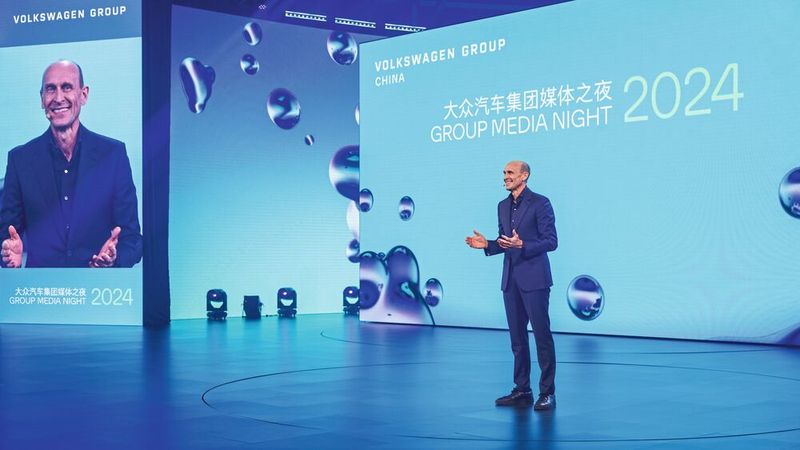
Volkswagen China CEO Ralf Brandstätter: "Our measure of success is profitability, not just market share."
(Image: Volkswagen AG)
It won't be a walk in the park. Volkswagen's China chief, Ralf Brandstätter, aims to have "secured a strong market position" by the end of the decade. "To achieve this, you have to run a smart, sustainable race," he wrote on LinkedIn in 2024. He is planning "for two challenging years" during which VW China will prepare for "a major technological leap and a wave of product launches starting in 2026." "By 2027, our group will have launched a total of 40 new models in China, 20 of which will be New Energy Vehicles," said the 59-year-old top executive with over 30 years of experience at VW.
Brandstätter has also set a monetary goal: 2.1 billion US dollars in operating profit by 2027. For 2025, the Wolfsburg-based company has currently planned a China result of 530 million to 1.1 billion US dollars. By comparison, in 2018 and 2019, VW earned well over four billion euros in China each year. Volkswagen sold 1.3 million cars in China in the first six months of this year—2.4 percent less than in the same period in 2024.
Customized Solutions for Chinese Customers
The VW brand is just getting ready for its product offensive starting in 2026. "We are shifting into delivery mode," says Brandstätter. Sales of the fully electric E5 Sportback will begin in 2025. It is the first production model of the newly created "AUDI" brand for China, developed jointly with SAIC. At this year's Auto Show in Shanghai, VW presented three production-ready concept vehicles of the "new generation of intelligent, fully connected electric vehicles, entirely tailored to the wishes of Chinese customers," Volkswagen wrote.
The VW ID Aura (manufactured by FAW-VW) is the first car built on the new, China-developed "Compact Main Platform (CMP) with the also locally developed E/E architecture" (CEA) for the A-segment. The sedan model aims to capture market share in the highly competitive compact segment, and therefore: it is expected to cost only around 18,000 US dollars. The full-size SUV ID Era (with SAIC) is the brand's first electric vehicle with a range extender, achieving a range of 620 miles according to VW. The third hopeful is the "sporty-progressive" designed SUV ID. Evo, targeting, as VW states, "lifestyle-oriented and tech-savvy" buyer groups.
"China Speed" in Development
Ralf Brandstätter has revamped many things at VW China. He has shortened and accelerated decision-making processes. The China team has already achieved 24 to 34 months "time-to-market" for the new models. In a presentation to Chinese investors in April 2024, Brandstätter quantified the cost advantages of the new CMP compared to the MEB platform at 40 percent.
He has strengthened local software and development expertise in China, also through collaborations with Chinese tech companies, including Horizon Robotics (AI chips and solutions for intelligent vehicles), Thundersoft (software for connectivity and infotainment), and Gotion (solid-state battery technology). Together with Xpeng, the OTA-capable "China Electronic Architecture" (CEA) was developed. "25 percent fewer ECUs, more functionalities, and scalable," Brandstätter says enthusiastically.
Xpeng for the East, Rivian for the West
And he has aligned the development team to consistently implement customer desires—with China-specific products. "While customers in Europe and the US still like to use physical buttons, in China, everything in the car, from the window controls to the air conditioning, is operated entirely via voice control. This has fundamental implications for how you design the electronic architecture and software for the car. We have a clear answer to this: for the West, we solve it with our joint venture with Rivian; for the East and China, with Xpeng," he explained in an interview with FAZ in April 2025. Together with Xpeng, VW China also plans to build a "Super Fast Charging" network with 20,000 charging points in 420 Chinese cities.
Ralf Brandstätter has ...
... many answers ready. He firmly believes in a successful future for Volkswagen in China. At the same time, he is aware of the increasingly challenging conditions that the automotive industry is currently facing in China.
"In China, for China"—the mission: "For us, 'In China, for China' is not just a slogan but our way of working. We always say that this is a marathon, not a sprint, and the playoff season is starting now. We know we need to be faster, more efficient, and more cost-effective, but also better tailored to the needs of Chinese customers."1
Date: 08.12.2025
Naturally, we always handle your personal data responsibly. Any personal data we receive from you is processed in accordance with applicable data protection legislation. For detailed information please see our privacy policy.
Consent to the use of data for promotional purposes
I hereby consent to Vogel Communications Group GmbH & Co. KG, Max-Planck-Str. 7-9, 97082 Würzburg including any affiliated companies according to §§ 15 et seq. AktG (hereafter: Vogel Communications Group) using my e-mail address to send editorial newsletters. A list of all affiliated companies can be found here
Newsletter content may include all products and services of any companies mentioned above, including for example specialist journals and books, events and fairs as well as event-related products and services, print and digital media offers and services such as additional (editorial) newsletters, raffles, lead campaigns, market research both online and offline, specialist webportals and e-learning offers. In case my personal telephone number has also been collected, it may be used for offers of aforementioned products, for services of the companies mentioned above, and market research purposes.
Additionally, my consent also includes the processing of my email address and telephone number for data matching for marketing purposes with select advertising partners such as LinkedIn, Google, and Meta. For this, Vogel Communications Group may transmit said data in hashed form to the advertising partners who then use said data to determine whether I am also a member of the mentioned advertising partner portals. Vogel Communications Group uses this feature for the purposes of re-targeting (up-selling, cross-selling, and customer loyalty), generating so-called look-alike audiences for acquisition of new customers, and as basis for exclusion for on-going advertising campaigns. Further information can be found in section “data matching for marketing purposes”.
In case I access protected data on Internet portals of Vogel Communications Group including any affiliated companies according to §§ 15 et seq. AktG, I need to provide further data in order to register for the access to such content. In return for this free access to editorial content, my data may be used in accordance with this consent for the purposes stated here. This does not apply to data matching for marketing purposes.
Right of revocation
I understand that I can revoke my consent at will. My revocation does not change the lawfulness of data processing that was conducted based on my consent leading up to my revocation. One option to declare my revocation is to use the contact form found at https://contact.vogel.de. In case I no longer wish to receive certain newsletters, I have subscribed to, I can also click on the unsubscribe link included at the end of a newsletter. Further information regarding my right of revocation and the implementation of it as well as the consequences of my revocation can be found in the data protection declaration, section editorial newsletter.
—implementation and opportunities: "As a leading market for electric vehicles, digitalization, and autonomous driving, China offers unique opportunities. While many international companies are withdrawing, we are integrating [...] even more deeply into the local ecosystem. If we are not present here, we would miss out on opportunities. The knowledge we build there benefits the entire group."2
Profitability: "After two years of consistent implementation of the cost strategy 'In China, for China' and the gradual execution of programs to reduce fixed costs, a renewed acceleration in profitability is in sight."3
Strategies in competitive markets: "In this unhealthy environment, we are not striving for growth at any cost. Our measure of success is profitability, not just market share."2 "Those who can only sell their cars through discounts are damaging their brand."4 "Some market participants can catch up, but not all will survive."5
New competitors from the tech scene: "That doesn't make life easier for us."5 "Almost all 'new forces' rely solely on the electric car market and often sell at significant losses or not at all. We can offset our revenue."2
Partnerships with Chinese companies: "The partnerships were a necessity to gain more speed in the short term. The collaboration has helped us adapt to the market faster and better."6
Scaling "made in China" technologies: "Volkswagen's strength has always been in the efficient scaling of its own technologies. [...] With the CEA—the China Electronic Architecture—we have developed a zonal architecture with central computers, the first in the group. [...] We have now decided to roll it out to combustion engine vehicles as well. This creates enormous additional scale. Starting in 2027, we will launch the second generation of the CEA."6
Trade conflict between the USA and China: "Around 95 percent of our components for the China business are manufactured locally. This strengthens our competitiveness and at the same time makes us more resilient to geopolitical risks. Therefore, the escalating tariffs currently have no direct impact on our business in the region."7
New opportunities in the crisis: "The Chinese are pragmatic. Their own economic growth has slowed significantly. That’s why the government is once again focusing more heavily on foreign investments. [...] And of course, crises create opportunities. Many countries in Asia, as well as in South America and the Middle East, have built strong economic relations with China. We can benefit from this by utilizing our production capacities in China and exporting from there to such countries." [...] "When a German company is behind it, opportunities arise to establish ourselves in markets that we have not been able to tap into before."7 "We do not deliver to Europe or North America. For these markets, we have our own production capacities."6
Recording
Our "recordings" consist of quotes from renowned publications. This format allows us to present you with the thoughts, strategies, and goals of top managers in the automotive industry in a timely manner—focused on current topics and as compressed as no traditional interview can manage. Sources:
1 globaltimes.cn, May 2, 2025
2 Ralf Brandstätter, LinkedIn, 2024
3 "China Investor Update," Ralf Brandstätter, April 23, 2024



:quality(80)/p7i.vogel.de/wcms/eb/2b/eb2bd1b8487afe577b37363cd02f16ff/0113143253v1.jpeg "In our China Market Insider, we regularly provide you with relevant information straight from China. (Image:© Eisenhans - stock.adobe.com)")
:quality(80)/p7i.vogel.de/wcms/dd/b8/ddb8edc98c49b384734ab2432b297eb5/adobestock-1913662309--irene-stock-adobe-com-ki-generiertv1.jpeg "Rotary joints are used in grippers and swivel mechanisms to allow assemblies to rotate or swivel smoothly relative to one another, even under very high loads (illustrative image). (Source: Irene - stock.adobe.com / KI-generiert)")
:quality(80)/p7i.vogel.de/wcms/d1/ef/d1ef6b6f7d4543f7999980bacccaf22b/0133499261v1.jpeg "As the growing imbalance in trade relations with China continues to widen, the EU Chamber of Commerce foresees a day when trade with China will have to be seriously reevaluated ... (Image: AI-generated)")
:quality(80)/p7i.vogel.de/wcms/fe/1f/fe1fa5ee713f94deaba963dc24c3abc5/0133299273v1.jpeg "The Flexistar enables highly flexible production of laser-welded tubes thanks to its tool-free clamping system. (Image:Because Technology, LLC)")
:quality(80)/p7i.vogel.de/wcms/60/ef/60ef4f07e4829b2c2929befc0f353c58/0133511729v1.jpeg "Humanoid robots can match human performance in certain tasks. (Image:Gemini / AI-generated)")
:quality(80)/p7i.vogel.de/wcms/2e/99/2e99726b522e4b35b690e25eb6a42643/0133463991v1.jpeg "Robotics: In AMR applications, connection technology must reliably transmit power, signals, and data despite vibration and shock loads—in very confined spaces and in a way that allows for regular maintenance. (Image:Hyperever)")
:quality(80)/p7i.vogel.de/wcms/d0/18/d01801e3d5dbd7bc9d0b4f60408b630c/0133468429v1.jpeg "Quality requirements for film packaging are on the rise. At the same time, many companies are turning to recyclable film materials, which, however, have their own challenges. Fraunhofer researchers have therefore developed a fast system that detects problems in real time. (Image:Fraunhofer IKTS)")
:quality(80)/p7i.vogel.de/wcms/b1/06/b106cf44923ce39565c3264982fd20eb/0133414574v1.jpeg "Robots Build Robots: At the new Ubtech factory, automated systems even handle parts of the material supply and logistics for the production of humanoid robots. (Image:Ubtech)")
:quality(80)/p7i.vogel.de/wcms/c0/52/c052f405eb55fc3d08c4837e77206fc0/adobestock-2021845957--aucartstudio-stock-adobe-com-ki-generiertv1.jpeg "An innovation from China to combat extreme summer heat: A novel coating lowers temperatures. (Source: © AucArtStudio – stock.adobe.com_AI-generated)")
:quality(80)/p7i.vogel.de/wcms/66/a7/66a7b78159caeacce57136529688799f/0133503398v1.jpeg "Sunlight Makes Stone! These stone blocks weren't made the traditional way. Instead, they were additively manufactured from sand using a laser. In the future, however, the laser is set to be replaced by concentrated sunlight—if the startup Addisol is successful... (Image:Addisol / F. Fiedler)")
:quality(80)/p7i.vogel.de/wcms/72/b9/72b995c2c8d812c5e2115cbef31e035a/0133462727v1.jpeg "Eggl manufactures center hoods that are precisely tailored to each cooking island—whether standard size or custom shape. They are made entirely of stainless steel and are individually customized in terms of size and filter arrangement. (Image:SPI)")
:quality(80)/p7i.vogel.de/wcms/13/5d/135dfae6229ceaf5c55467a43e8f7257/adobestock-1879961393--ardi-stock-adobe-com-ki-generiertv1.jpeg "Annoying chatterboxes or awkward silences in response to questions—a moderator should specifically prepare for difficult situations in order to navigate them effectively. (Image:ardi - stock.adobe.com_AI-generated)")
:quality(80)/p7i.vogel.de/wcms/aa/a2/aaa2c6dd2daa24b485cddbf9297590c0/0133467318v1.jpeg "Battery Monitoring: Battery monitoring using electrochemical impedance spectroscopy offers several advantages. (Image:TI)")
:quality(80)/p7i.vogel.de/wcms/39/b2/39b21bf03be1683831862239a369987c/0133469638v1.jpeg "Data from autonomous vehicles and robots operating autonomously is in high demand, and Ruqi wants to capitalize on this. (Image:Ruqi Mobility)")
:quality(80)/p7i.vogel.de/wcms/8a/bb/8abbb6217220595edc1549ac9b84f307/0133429906v1.jpeg "The IAA in Hanover showcased the ambitions of Chinese commercial vehicle manufacturers in Europe. (Image:Wehner - VCG)")
:quality(80)/p7i.vogel.de/wcms/0c/53/0c5313ef91c14b6df0d0996efc33c8ad/jpg03568-bearbeitetv1.jpeg "The category winners of the 2027 German Car of the Year award. (Source: GCOTY)")
:quality(80)/p7i.vogel.de/wcms/48/15/4815da27c45973ca629a99b375ac3aef/0133509585v1.jpeg "Ventuno Q RoadTest: Designed to help the Element14 community gain practical insights from real-world tests using the Ventuno Q. (Image:Farnell/Element14)")
:quality(80)/p7i.vogel.de/wcms/17/2b/172bd132f9febdfcbcedba292ad0504d/aufmacherv1.jpeg "Micro-Epsilon offers a wide range of IO-Link-compatible sensors. (Source: Micro-Epsilon Messtechnik GmbH & Co. KG)")
:quality(80)/p7i.vogel.de/wcms/ca/b4/cab46fd26d19d6a2febca032048200b6/0133471827v1.jpeg "Photonics SDK for C and Python: Computational operations are now abstracted as standard mathematical functions. (Image:Q.ANT)")
:quality(80)/p7i.vogel.de/wcms/92/b2/92b2ed5299cde450c0764f4f64468395/0133505895v1.jpeg "The \"Iris 100\" test system for high-precision volume production of microLEDs uses a spectrometer and a high-resolution camera. (Image:Teradyne)")
:quality(80)/p7i.vogel.de/wcms/f0/46/f04683b47f718749e41eb841b33d4b34/audi-1480x832v1.png "Audi and SAIC have launched the sale of their jointly developed model, the \"AUDI E5 Sportback.\" (Image: Audi)")
:quality(80)/p7i.vogel.de/wcms/7b/ca/7bca80b9835ac5cd1da592ee092825b9/0128162430v1.jpeg "Volkswagen Group China Technology has completed the final expansion phase of its technology and innovation center in Hefei, China. (Image:Volkswagen)")
:quality(80)/p7i.vogel.de/wcms/f4/23/f4237da377044edc41a38afcf6c6d626/b2026cw00152-3840x2158v1v1.jpeg "AI agents in vehicles: this was the big topic for Volkswagen AG at the \"Auto China\" 2026 trade fair. (Image:Volkswagen AG)")