Open source initiatives and AI platforms are set to accelerate the development of software-defined vehicles. What do you need in the race for the best digital car?
The switch to SDV is the most complex transformation the industry has ever had to master. The end consumer gets a vehicle that gains rather than loses value over its lifetime.
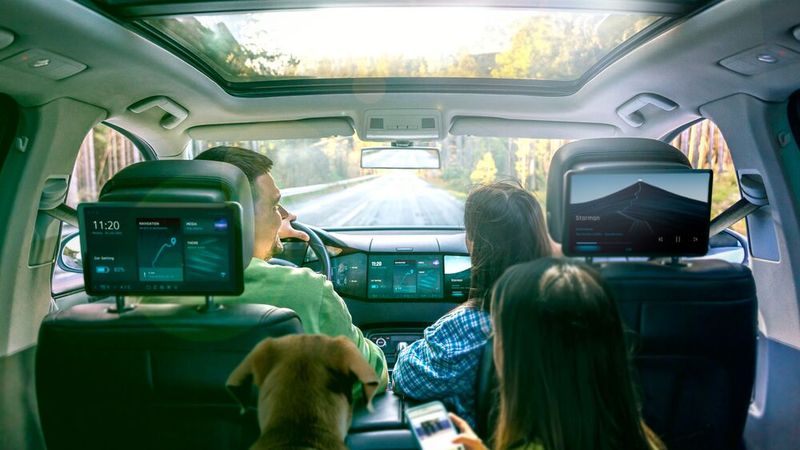
(Image: Sonatus)
When the engineer looks out of his window, he sees green fields. Somewhere in the rolling hills of Bedfordshire, the test vehicle is on the move, constantly sending data to its monitor.
Diagnostic systems as well as sensors and control units in the vehicle provide the development engineer with data in real time. This is made possible by the AI Technician and the Collector AI. Both are components of the software platform from the US company Sonatus. The programs run at the Nissan Technical Centre Europe (NTCS) in Cranfield, around 80 kilometers north of London. The partnership between the two companies is intended to prove that vehicle development can be accelerated with the help of artificial intelligence (AI). Even before a prototype has been built, the software could deliver results from driving simulations.
AI Helps SDV
"The role of AI is clear: it serves as a tool for our engineers and is not a replacement. By working together, we can create an improved customer experience and maintain our competitiveness in a rapidly evolving market," emphasizes David Moss, Senior Vice President Research and Development at Nissan Europe. Upcoming versions of the Nissan Juke and Leaf will thus fall under the category of software-defined vehicles (SDV). This is the big paradigm shift in the automotive industry. It is no longer individual hardware that determines a function in the car, but software that runs on as few high-performance computers as possible in the vehicle. It can network control units and other components with each other so that new functions can be installed over the course of a vehicle's life via over-the-air updates.
Disconnect Software From the Component
The design method is changing the cooperation between car manufacturers and Tier 1 suppliers. Until now, they have developed innovations. To avoid margin pressure on the hardware, they also supplied the software. But in the SDV, not every control unit is allowed to run its own program. Only a networked overall system enables updates across all control units. This allows car manufacturers to integrate functions developed in-house, programs from start-ups and functions from major technology providers such as Google and Amazon, Nvidia and Qualcomm into the vehicle.
From Hardware to Software Logic
Software development is time-consuming and expensive. Every manufacturer develops a pet mode or the Bluetooth drivers for mobile devices themselves. This explains the founding of the open source initiative S-Core. The VDA launched it in cooperation with the Eclipse Foundation. In June 2025, eleven companies signed a memorandum of understanding. At the beginning of 2026, the number of members increased to 32 companies. In addition to car manufacturers such as BMW, Mercedes-Benz, Volkswagen and Stellantis, the entire automotive industry is now represented. The truck manufacturers Traton (MAN, Scania, VW Truck & Bus) and Coretura (Volvo and Daimler Truck) are also involved. Suppliers (including Bosch, Continental, Valeo), software companies (including Elektrobit, Red Hat, T-Systems) and technology groups (including Infineon, LG Electronics, Qualcomm) are also represented at S-Core.
New de Facto Standard
This is exclusively about non-differentiating functions in the competition between brands. "Like Linux in IT, S-Core has the potential to become the de facto standard for high-performance controllers in the automotive sector. Open source promises faster collaboration, shorter time-to-market and reduced total cost of ownership," explains Dr. Moritz Neukirchner, Senior Director of Strategic Product Management at Elektrobit. The Erlangen-based company is a wholly owned subsidiary of Aumovio and also a member of the S-Core initiative. The VDA summarizes the advantages in figures: Up to 40 percent less effort for development, integration and maintenance of the open source software used. Ideally, this means up to 30 percent faster time to market.
Speed is a decisive criterion. The economic pressure from and in China is growing. More and more new brands are entering the German market with their vehicles. Models from BYD, Zeekr and Xpeng focus on technical innovation and digital offerings. Young, tech-savvy customers are rewarding this. However, the switch to SDV is the most complex transformation the industry has ever had to master. It's not just about writing software - it's about restructuring development processes, supply chains and certification logics that have evolved over decades.
Global Trend
"European companies are currently leading the way with S-Core. However, the Americans are interested. In the Japanese market, the JASPAR Vehicle API is an initiative that should be seen as complementary. Here, the organizations are in active exchange in order to intensify collaboration. Nobody in the industry has an interest in creating fragmented ecosystems," says Neukirchner. However, the decisive proof point has yet to be reached: use in series production vehicles. Only when S-Core is running there will it become clear whether the open source strategy is a success. The number of contributing companies is increasing, the momentum is there. Version 1.0 of the software stock should be ready for use by the end of 2026 and integrated into vehicles that will be launched on the market by 2030 at the latest.
Date: 08.12.2025
Naturally, we always handle your personal data responsibly. Any personal data we receive from you is processed in accordance with applicable data protection legislation. For detailed information please see our privacy policy.
Consent to the use of data for promotional purposes
I hereby consent to Vogel Communications Group GmbH & Co. KG, Max-Planck-Str. 7-9, 97082 Würzburg including any affiliated companies according to §§ 15 et seq. AktG (hereafter: Vogel Communications Group) using my e-mail address to send editorial newsletters. A list of all affiliated companies can be found here
Newsletter content may include all products and services of any companies mentioned above, including for example specialist journals and books, events and fairs as well as event-related products and services, print and digital media offers and services such as additional (editorial) newsletters, raffles, lead campaigns, market research both online and offline, specialist webportals and e-learning offers. In case my personal telephone number has also been collected, it may be used for offers of aforementioned products, for services of the companies mentioned above, and market research purposes.
Additionally, my consent also includes the processing of my email address and telephone number for data matching for marketing purposes with select advertising partners such as LinkedIn, Google, and Meta. For this, Vogel Communications Group may transmit said data in hashed form to the advertising partners who then use said data to determine whether I am also a member of the mentioned advertising partner portals. Vogel Communications Group uses this feature for the purposes of re-targeting (up-selling, cross-selling, and customer loyalty), generating so-called look-alike audiences for acquisition of new customers, and as basis for exclusion for on-going advertising campaigns. Further information can be found in section “data matching for marketing purposes”.
In case I access protected data on Internet portals of Vogel Communications Group including any affiliated companies according to §§ 15 et seq. AktG, I need to provide further data in order to register for the access to such content. In return for this free access to editorial content, my data may be used in accordance with this consent for the purposes stated here. This does not apply to data matching for marketing purposes.
Right of revocation
I understand that I can revoke my consent at will. My revocation does not change the lawfulness of data processing that was conducted based on my consent leading up to my revocation. One option to declare my revocation is to use the contact form found at https://contact.vogel.de. In case I no longer wish to receive certain newsletters, I have subscribed to, I can also click on the unsubscribe link included at the end of a newsletter. Further information regarding my right of revocation and the implementation of it as well as the consequences of my revocation can be found in the data protection declaration, section editorial newsletter.
Cooperation with China
While S-Core provides an open infrastructure, OEMs and suppliers also need partners who can deliver specific product solutions. Elektrobit also wants to provide this. In June 2025, the company signed a joint development agreement with the Hon Hai Technology Group, better known as Foxconn. Together, the two companies are developing EV.OS, an AI-centered software platform for electric vehicles that combines hardware and software into a scalable unit. EV.OS comprises an E/E reference architecture with a standardized operating system and a vehicle application layer. The platform is designed to support multiple ECUs and enable service-oriented architectures across all functional domains, including a semantic vehicle API for third-party applications. "By combining Elektrobit's automotive software expertise with Foxconn's manufacturing and hardware innovation, we are creating a scalable platform that reduces complexity, shortens development cycles and supports future mobility business models," summarizes Maria Anhalt, CEO of Elektrobit.
The Elektrobit range is complemented by EB Civion, a suite for digital cockpit development. The cloud-native development environment enables rapid prototyping of human machine interfaces (HMI) and apps in the cockpit infotainment system.
AI Platform for the Entire Vehicle Life Cycle
On the other side of the Atlantic, Sonatus is working on a similar problem. Founded in 2018 in Sunnyvale, California, the company focuses on AI-supported tools. They analyze vehicle data during the development process as well as throughout the vehicle's life cycle. According to the company, the technology is installed in more than six million production vehicles.
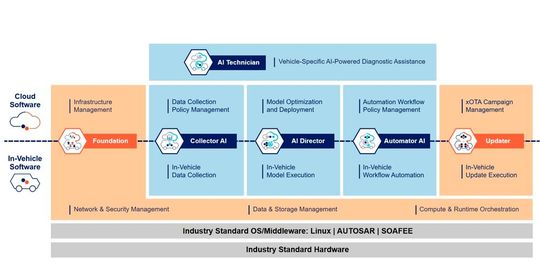
The Sonatus Vehicle Platform has a modular structure and consists of the aforementioned AI Technician, Collector AI and four other modules. Sonatus deliberately does not position itself as a full-service provider. According to the company, no single company can supply all the technologies for an SDV. Instead, the company relies on an open ecosystem with partners such as AWS, Google Cloud, NXP and Broadcom. This makes the platform fundamentally compatible with open source initiatives such as S-Core. "Through more intelligent data acquisition and accelerated development processes, complex systems can be developed faster and more precisely. In the NTCE, Nissan is demonstrating how future-oriented engineering is revolutionizing vehicle development," explains Alexandre Corjon, Senior Vice President and Technical Fellow at Sonatus.
Three Levels of a New Industrial Architecture
"The real SDV challenge is no longer a question of if or when, but how we make SDVs available, scalable and affordable. In view of rising development costs and increasing vehicle complexity, the industry needs a tailored approach," emphasizes Maria Anhalt from Elektrobit.
The SDV transformation is being driven forward on three levels: At the lowest level, a common, non-differentiating infrastructure is being created with open source projects. Similar to Linux in IT, it forms the basis. Above this are commercial platforms. Finally, at the very top, OEMs are working on functions that differentiate them from the competition.
(Image: Sonatus)
S-Core, Elektrobit and Sonatus are driving the SDV transformation on three levels: at the lowest level, a common, non-differentiating infrastructure is being created with open source projects. Similar to Linux in IT, it forms the basis. Above this are commercial platforms such as EV.OS from Elektrobit or the Sonatus Vehicle Platform. They add specific automotive expertise. Finally, at the very top, car manufacturers are working on functions that differentiate themselves from the competition: Driving experience, user interaction and brand-specific features. (se)



:quality(80)/p7i.vogel.de/wcms/53/f7/53f7dadbe4d656a3fd4f4077445f29f6/0129828707v1.jpeg "Thanks to its compact design and drilling/unscrewing function, the Fire Birdie is suitable for applications with limited installation space and frequent tool changes. (Image:Marcel Kraibühler)")
:quality(80)/p7i.vogel.de/wcms/da/4d/da4da8d34671dc6bce80e496212de877/0129850788v1.jpeg "Mate-XT Go supports the arms and shoulders during overhead work and repetitive tasks and is designed to significantly reduce muscle strain in everyday working life. (Image:Comau)")
:quality(80)/p7i.vogel.de/wcms/95/97/95976dbaac68b249eb65e74c5aad5300/0129651893v1.jpeg "The C2.0 centric clamps, the S2 fixed jaw clamps and the \"gredoc\" zero-point clamping systems are used for machining the raw parts. Fastening is carried out with width across flats 27. (Image:Gressel)")
:quality(80)/p7i.vogel.de/wcms/57/1b/571b8895efb299d70846bbdbd7af2338/0130043886v1.jpeg "Servo hydraulics independent of the control system: The servo hydraulics software module is integrated directly into the b Maxx 5500 servo drive (pictured: Mehmet Sari, Export Sales Manager at Hürsan Pres (left), Özgür Deniz Demirbaş, Country Manager at Baumüller Turkey) (Image:Baumüller)")
:quality(80)/p7i.vogel.de/wcms/3b/27/3b27f6c5848be73acecb04054bf0a146/0130115209v1.jpeg "Spectroscopic glucose measurement with infrared spectroscopy enables more regular measurements without physical strain. (Image:Endrich)")
:quality(80)/p7i.vogel.de/wcms/3f/cc/3fccb748b0fe16f1f61249d94c72f126/0130149439v1.jpeg "Requirements for integrated power supply systems: Precise AC and DC power supply systems that not only provide energy, but also reliably combine measurement, analysis and system integration. (Image:Schulz Electronic)")
:quality(80)/p7i.vogel.de/wcms/fd/93/fd93e01c16f5a4709278499d981a459c/0130061090v1.jpeg "Revealed: These servo drives are assembled at Aerotech in Fürth. (Image:Aerotech)")
:quality(80)/p7i.vogel.de/wcms/cb/8a/cb8ae7f5205365efce3e7285154fc3cf/0130132198v1.jpeg "Markus Huber (left) and Nicolai Friis from TU Wien know how to make quantum computers multidimensional in order to perform computing operations even better. (Image:TU Vienna / A. Rommel)")
:quality(80)/p7i.vogel.de/wcms/63/21/6321beb732bf7d92640df46d7aa77573/0130125122v1.jpeg "As part of the Carbon Lab Factory Lausitz, a pilot plant for the production of sustainable, cost-effective and competitive carbon fibers will be built at the Guben site. (Image:Fraunhofer IAP / Kristin Stein)")
:quality(80)/p7i.vogel.de/wcms/53/4f/534fe0f168f6ee070ded4a48faca4cef/business-wire-main-image-1103x620v1.jpeg "The new UR AI Trainer, developed by Universal Robots and Scale AI, is the first direct lab-to-factory solution for AI model training.
(Source: Universal Robots)")
:quality(80)/p7i.vogel.de/wcms/08/70/087062e2e1a9b9add5777410dd746ee9/adobestock-1923991605-5607x3156v1v1.jpeg "A new type of tactile sensor, inspired by human skin, even recognizes grains of sand. (Image:Curioso.Photography - stock.adobe.com)")
:quality(80)/p7i.vogel.de/wcms/7f/08/7f087d7013424d123ab7275cd2e3fe55/adobestock-809456218--c2-a9-20degimages-20-e2-80-93-20stock-adobe-com-ki-generiert-4179x2351v1v1.jpeg "The digital upgrading of existing machines conserves resources, saves energy and reduces the need for new production. (Image:Degimages - stock.adobe.com/AI-generated)")
:quality(80)/p7i.vogel.de/wcms/90/db/90db3087d3af0560fcdb4dbc42443ce1/0130157448v1.jpeg "The switch to SDV is the most complex transformation the industry has ever had to master. The end consumer gets a vehicle that gains rather than loses value over its lifetime. (Image:Sonatus)")
:quality(80)/p7i.vogel.de/wcms/73/f0/73f00bb99a23197db05bb584fe78f20f/0130080581v1.jpeg "The \"China Speed\" analysis by Roland Berger shows that the speed of development has only a limited connection with labor costs. (Image:freely licensed at Pexels)")
:quality(80)/p7i.vogel.de/wcms/2f/5b/2f5ba6a150b52c2b8efada560c5cdafe/0130143442v1.jpeg "Automotive suppliers are facing a severe crisis, which is primarily due to a combination of structural change and economic problems. (Image:freely licensed at Pexels)")
:quality(80)/p7i.vogel.de/wcms/22/d0/22d03cd48e992435338b59464c428d41/0129739814v1.jpeg "More electric vehicles on the roads mean a higher demand for electricity - which should ideally be covered by renewable energies. (Image:BMW)")
:quality(80)/p7i.vogel.de/wcms/94/7a/947ac066b98cbcd3470e83ff9da3e25f/0130096114v1.jpeg "The use of amorphous steels in the stator enables a significant reduction in losses and increases the efficiency of modern electric motors in vehicle drives. (Image:Horse Powertrain)")
:quality(80)/p7i.vogel.de/wcms/e5/f1/e5f171d3d7ae021332cc0aeae4d6e299/0130127049v1.jpeg "In collaboration with Shanghai Jiao Tong University, Lenovo has presented a silicon anode battery under the name \"ED1000\" as a proof of concept for mobile workstations. (Image:Lenovo)")
:quality(80)/p7i.vogel.de/wcms/fa/69/fa696e59706b96fff02283dd74cc2398/0130129635v1.jpeg "Samsung Co-CEO Jun Young-hyun wants to respond to the AI-driven boom in demand in the memory market with contracts for up to five years. This should provide more planning security in the traditionally volatile storage business. At the same time, however, this is likely to increase the pressure on customers to secure precise long-term requirements, prices and supply chains. (Image:Samsung)")
:quality(80)/p7i.vogel.de/wcms/31/a8/31a883a47b86634c382923e78fd9a4c9/0130133225v1.jpeg "Figure 1: GMSL-capable point-to-point connection. (Image:ADI)")
:fill(fff,0)/images.vogel.de/vogelonline/companyimg/76800/76895/65.jpg "FAULHABER_120mm.jpg ()")
:fill(fff,0)/p7i.vogel.de/companies/67/eb/67eba621ef6ea/logo2.png "logo2 (Wuxi InfiMotion)")
:quality(80)/p7i.vogel.de/wcms/a8/d7/a8d748a29612695eec22e0fad4cbf61a/0128735143v1.jpeg "The CES takes place in Las Vegas from January 6 to 9, 2026. (Image:Consumer Technology Association (CTA))")
:quality(80)/p7i.vogel.de/wcms/53/6b/536be1966f279ef2cd99509d00e79fca/0129693994v1.jpeg "Elektrobit is working on a new architecture for cockpit systems. (Image:Electrobit)")