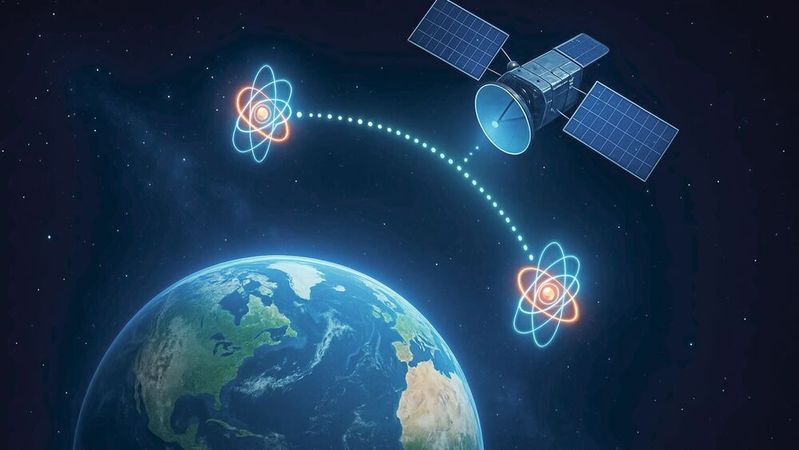
Researchers demonstrate for the first time that entangled quantum states can also be realized via the uplink—from Earth to satellite. Despite atmospheric disturbances and extremely low success rates, this method opens up new avenues for global quantum communication and thus for the quantum internet.
Quantum entanglement is expected to enable a faster and more secure internet in the future.
(Image: AI-generated)
The distribution of quantum state entanglement represents a central component for future quantum-based communication and computing networks. Ground-satellite systems are considered a promising way to establish such connections over long distances. So far, the focus has primarily been on satellites that generate decoupled photon pairs in space and send them to Earth (downlink). This article reverses that approach and systematically investigates the feasibility of the so-called uplink configuration: Two ground stations each generate a photon pair, send one part of each photon pair to orbit, and there a Bell measurement is conducted, entangling the remaining qubits on the ground stations. This procedure theoretically offers advantages – for example, regarding ground power vs. satellite hardware – but has so far been considered practically hardly feasible. The authors now demonstrate through numerical modeling that this uplink variant is, in principle, feasible.
Draft of the Protocol
In the outlined setup, there are two ground stations separated by a distance (DG). A satellite in low Earth orbit (LEO) is equidistant from both ground stations. Each ground station generates a Bell pair (the modeling assumes perfect Bell pairs with fidelity = 1) and encodes one photon of the pair into the polarization of a photon, while retaining the other part as a stationary qubit. Both photons are simultaneously sent into orbit. On the satellite, an optical Bell measurement is carried out using a combination of a polarization beam splitter (PBS), a 45° wave plate (Hadamard), and polarization splitting with detectors. A successful detection occurs when exactly two clicks are registered – one in each of the two spatially resolved modes – at which point the remaining stationary qubits at the two ground stations are entangled.
Modeling of Key Error Sources
The authors consider several physical effects that could impact the success and quality (fidelity) of the protocol:
Mode mismatch: For the Bell measurement to work correctly, the two photons must arrive at the satellite in perfect temporal and spatial overlap. Any deviation increases the distinguishability of the photons and lowers the fidelity. The use of time gating reduces the proportion of unsynchronized photons, albeit at the cost of success probability.
Beam widening and wandering: As the photons ascend to orbit, the radiation leads to an increasing spread of the beam ("beam widening") as well as random shifts of its center ("beam wandering") due to atmospheric turbulence. These effects reduce the coupling to the satellite telescope and thus the overall efficiency.
Atmospheric attenuation: The path through Earth's atmosphere results in absorption and scattering—more significantly at the start of the path in the uplink version, making the impact greater than in the downlink version.
Noise photons and background noise: The receiving area in the satellite is exposed not only to the targeted photons but also to numerous unwanted photons, such as those from reflected sunlight or moonlight as well as the Earth's surface. These can cause erroneous measurements, thereby reducing the effective fidelity and success probability.
Success Probability and Quality
The overall performance of the protocol is characterized by two key metrics: the success probability (ηtot) and the resulting fidelity (F). The success probability is determined by the likelihood of obtaining a correct detection pattern ("signature") that indicates a valid Bell measurement, taking into account all losses and noise sources. Fidelity, in turn, reflects how "close" the generated entangled state is to an ideal Bell state and directly depends on the probability of detecting a legitimate photon event set (relative to error events caused by noise). Simulations reveal a trade-off between a large time-gating window (allowing more photons to be detected) and high fidelity: a larger window increases the success probability but also allows more noise or non-optimally synchronized photons to pass through, reducing fidelity.
Further simulations show that with increasing satellite altitude and growing distance between ground stations, fidelity and success probability decrease significantly – initially, the situation improves with increasing altitude because the photons have to traverse less atmosphere (due to the decreasing zenith angle), but later, beam divergence becomes dominant. As the distance between ground stations increases, the photon path lengthens, amplifying loss and noise.
Date: 08.12.2025
Naturally, we always handle your personal data responsibly. Any personal data we receive from you is processed in accordance with applicable data protection legislation. For detailed information please see our privacy policy.
Consent to the use of data for promotional purposes
I hereby consent to Vogel Communications Group GmbH & Co. KG, Max-Planck-Str. 7-9, 97082 Würzburg including any affiliated companies according to §§ 15 et seq. AktG (hereafter: Vogel Communications Group) using my e-mail address to send editorial newsletters. A list of all affiliated companies can be found here
Newsletter content may include all products and services of any companies mentioned above, including for example specialist journals and books, events and fairs as well as event-related products and services, print and digital media offers and services such as additional (editorial) newsletters, raffles, lead campaigns, market research both online and offline, specialist webportals and e-learning offers. In case my personal telephone number has also been collected, it may be used for offers of aforementioned products, for services of the companies mentioned above, and market research purposes.
Additionally, my consent also includes the processing of my email address and telephone number for data matching for marketing purposes with select advertising partners such as LinkedIn, Google, and Meta. For this, Vogel Communications Group may transmit said data in hashed form to the advertising partners who then use said data to determine whether I am also a member of the mentioned advertising partner portals. Vogel Communications Group uses this feature for the purposes of re-targeting (up-selling, cross-selling, and customer loyalty), generating so-called look-alike audiences for acquisition of new customers, and as basis for exclusion for on-going advertising campaigns. Further information can be found in section “data matching for marketing purposes”.
In case I access protected data on Internet portals of Vogel Communications Group including any affiliated companies according to §§ 15 et seq. AktG, I need to provide further data in order to register for the access to such content. In return for this free access to editorial content, my data may be used in accordance with this consent for the purposes stated here. This does not apply to data matching for marketing purposes.
Right of revocation
I understand that I can revoke my consent at will. My revocation does not change the lawfulness of data processing that was conducted based on my consent leading up to my revocation. One option to declare my revocation is to use the contact form found at https://contact.vogel.de. In case I no longer wish to receive certain newsletters, I have subscribed to, I can also click on the unsubscribe link included at the end of a newsletter. Further information regarding my right of revocation and the implementation of it as well as the consequences of my revocation can be found in the data protection declaration, section editorial newsletter.
Under optimized parameters – e.g., time gating of 40 ns, wave packet width of 10 ns, satellite altitude of 200 km, ground station distance of 300 km – a fidelity of approximately 0.972 can be achieved with a success probability of about 1.5 × 10⁻⁴. For more realistic altitudes (500 km) and distances (1,000 km), acceptable values of fidelity ~ 0.84 with η ≈ 2.4 × 10⁻⁶ can still be achieved.
Discussion and Outlook
The study demonstrates that the uplink variant of entanglement distribution is, in principle, feasible – but under clear conditions: nighttime operation, shorter ground station distances, low orbit altitude, and excellent synchronization and optics are required. During the day, noise levels are so high that fidelity drops to approximately 0.25, making the operation practically inefficient. However, the significant advantage lies in the fact that ground stations can provide significantly higher photon generation capacity than satellites. This opens up prospects for more compact satellite architectures that primarily serve as measurement stations, while high-performance ground stations bear the main workload.
For future work, hardware implementation will be particularly critical: the study assumes on-demand photon sources as a model assumption, but these are not yet experimentally available in sufficient quality. With pulsed sources that generate photons probabilistically, additional synchronization problems arise between the two ground stations. The multiplexing of the protocol – to achieve higher rates – also needs to be thoroughly investigated, as does a synchronization protocol for correctly tagging the photons for entanglement.
Final Remark
In summary, the analysis shows that the use of satellites for uplink methods in quantum optical entanglement distribution is not merely a theoretical variation but a realistic option. While the achieved success probabilities are very low – in the range of 10⁻⁶ – they offer new pathways for the global networking of quantum stations with sufficient fidelity. This adds another building block for the future realization of the "quantum internet." (mr)



:quality(80)/p7i.vogel.de/wcms/dd/08/dd086510d9ae7b50181f6070e4463b44/0129363730v1.jpeg "Typical application for ionizing devices: Wrapping films. (Picture: ©Adobe Stock/SMC)")
:quality(80)/p7i.vogel.de/wcms/35/57/3557c819943c53acec41a0ccba87da4f/0130049064v1.jpeg "Researchers at the Fraunhofer IWU in Chemnitz have long known that many typical sheet metal parts can be manufactured more cost-effectively using hollow embossing rollers. Now there is news to report ... (Image:Fraunhofer IWU)")
:quality(80)/p7i.vogel.de/wcms/59/02/590246e3b3f415c65edbee377c14ca77/26-06-pi-fraunhofer-iws-41450-direktplattieren-pic-01-7771x4369v1v1.jpeg "The Fraunhofer IWS has developed the new \"direct laser cladding\" process, which creates a functional layer directly on the base body by applying a strip-shaped metal to rotationally symmetrical components in a spiral and bonding it locally by laser. (Image:Christoph Wilsnack/Fraunhofer IWS)")
:quality(80)/p7i.vogel.de/wcms/73/60/73608418789b1d9c393f5e2fa974eda2/0130209906v1.jpeg "The robots of the X6 generation from b+m enable very high painting quality and are also particularly compact and easy to maintain. (Image:Beckhoff)")
:quality(80)/p7i.vogel.de/wcms/78/e9/78e9188c25a8a94e67c34c9bf8ffe495/visual-agile-20robots-20and-20google-20deepmind-20partner-20to-20bring-20intelligence-20to-20robotics-2500x1406v1v1.jpeg "Together, the partners are developing adaptable, intelligent robots for a wide range of applications (Image:Agile Robots SE)")
:quality(80)/p7i.vogel.de/wcms/e7/66/e7669ecf0260ae8fc54c214e34e4902a/0130316817v1.jpeg "Siemens and Palo Alto Networks offer tested cybersecurity solution for industrial 5G. (Image:Siemens)")
:quality(80)/p7i.vogel.de/wcms/9f/55/9f55324832c4f426958031375124d9de/siemens-20ubtech-20hmnd-1920x1079v1v1.png "Ready for the factory floor: While Ubtech is planning mass production, Siemens is already testing humanoids in real factory applications in Erlangen. (Image:Siemens)")
:quality(80)/p7i.vogel.de/wcms/11/36/113695ed260e29c8c2d9d39dc5f9d869/0130213768v1.jpeg "AI can work cheaply in China and deliver the results rapidly all over the world. (Image:Dall-E / AI-generated)")
:quality(80)/p7i.vogel.de/wcms/62/5f/625f41e87ebfef156a98c8e6393e32fd/0130211654v1.jpeg "Axial flux motors have some advantages over radial flux motor—but their production is currently still expensive. (Image:RWTH Aachen University)")
:quality(80)/p7i.vogel.de/wcms/77/9b/779b0685d010dfe45c9c2cb1cfecd467/0128886425v1.jpeg "The BlueEye is the first \"real\" hyperspectral camera for the UV range and covers the wavelength range from 220 to 380nm. (Image:Inno-spec GmbH)")
:quality(80)/p7i.vogel.de/wcms/e4/51/e451d52ce0182fb0aaa46a5774f832ef/26-04-pi-fraunhofer-iws-21160-bioslide-pic-01-4128x2321v1v1.jpeg "With the BioSlide research project, the Fraunhofer IWS is investigating how sliding systems can be designed to be more sustainable and energy-efficient. New materials can be tested in a particularly application-oriented manner on this plain bearing test stand. (Image:Fraunhofer IWS)")
![Thanks to advanced 3D printing technology, a more efficient use of resources should contribute to lower-emission aviation—this is the goal of ['skai]-lab. (Image:Oleksandr Pashchenko - stock.adobe.com / AI-generated)](https://cdn1.vogel.de/nghHNSbySccfOjG3n1qCA-FVOjQ=/288x162/smart/filters:format(jpg):quality(80)/p7i.vogel.de/wcms/62/64/626424c97a16e69f871bf216c9629c2a/adobestock-1927043193--c2-a9-20oleksandr-20pashchenko-20-e2-80-93-20stock-adobe-com-ki-generiertv1v1.jpeg "Thanks to advanced 3D printing technology, a more efficient use of resources should contribute to lower-emission aviation—this is the goal of ['skai]-lab. (Image:Oleksandr Pashchenko - stock.adobe.com / AI-generated)")
:quality(80)/p7i.vogel.de/wcms/c3/c4/c3c4ce270b083eeac55654148611f064/0130237945v1.jpeg "China is not giving up on hydrogen, but is intensifying its efforts. (Image:freely licensed from Pixabay)")
:quality(80)/p7i.vogel.de/wcms/4e/c0/4ec0bd19390b169edfa23677373dcdf1/0130260089v1.jpeg "Renewable fuels can supply European road traffic, according to a study. (Image:Aral)")
:quality(80)/p7i.vogel.de/wcms/6f/c9/6fc9050301d745cad25585c6780f8f51/0130197341v1.jpeg "Production facilities are a worthwhile target and are therefore at risk. (Image:ABB Robotics)")
:quality(80)/p7i.vogel.de/wcms/b6/62/b662adc2cec8227d8172509bbfb6ee42/25c0207-107-4961x2789v1v1.jpeg "The GLB is the second model based on Mercedes' new MMA platform. Apparently, Geely's platform is better and cheaper, which is why the two companies are negotiating a partnership. (Image:Mercedes-Benz)")
:quality(80)/p7i.vogel.de/wcms/4d/dd/4dddf438e91f394c04a095dbfd109d1c/0130236430v1.jpeg "Measurement modules: The 720301 module in combination with the SL2000 enables RMS and power calculations, among other things. (Image:Yokogawa)")
:quality(80)/p7i.vogel.de/wcms/61/fc/61fcf95f5cca15494ad18343901ae585/0130317237v1.jpeg "With the AGI CPU, Arm says it is taking a \"historic step\": With the processor aimed at AI in data centers, the company is presenting itself for the first time as a provider of its own chips, not just as a pure IP licensor. (Image:Arm)")
:quality(80)/p7i.vogel.de/wcms/82/90/8290dfe3595b6c6b33726ae8b76172c7/0130319587v1.jpeg "The concept image illustrates how the pattern of tiny protrusions and depressions created on the substrate (MgO, bottom) controls the arrangement of atoms in the superconducting material (YBCO, top). At the interface between the two layers, an electronic structure enables superconductivity to occur at higher temperatures than previously possible. (Image:Chalmers University of Technology / Riccardo Arpaia)")
:fill(fff,0)/p7i.vogel.de/companies/67/eb/67eba621ef6ea/logo2.png "logo2 (Wuxi InfiMotion)")
:quality(80)/p7i.vogel.de/wcms/18/4a/184a4f40eb2c88c7d124f15637e76e63/0125307842v1.jpeg "Existing quantum computers could one day be eclipsed by a new concept. This is because the Spinning project was able to demonstrate the application advantages of so-called \"spin photon\" quantum computers. (Image:IBM)")
:quality(80)/p7i.vogel.de/wcms/cb/8a/cb8ae7f5205365efce3e7285154fc3cf/0130132198v1.jpeg "Markus Huber (left) and Nicolai Friis from TU Wien know how to make quantum computers multidimensional in order to perform computing operations even better. (Image:TU Vienna / A. Rommel)")