New tools such as AI, digital twins and real-time visualization are being used intensively in product design. But what does this do to the work of designers? Lennart Baramsky from BMW Group Designworks provides insights into how processes are changing, but the design identity remains the same.
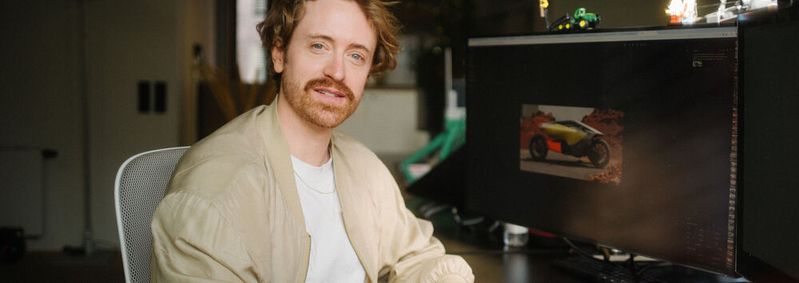
Lennart Baramsky, designer at BMW Group Designworks, shows that design today is created in networked systems—no longer in the classic order of idea, sketch and elaboration.
(Picture: Designworks Munich)
Almost anything is possible. Design has reached a point where artificial intelligence, real-time visualization and three-dimensional processes have long since set the standard. Where sketches used to be created and renderings marked the next step, design is now conceived directly in space. Products are developed, tested and experienced as digital twins before they are built. Materials, proportions and atmospheres can be simulated, compared and further developed. What used to require imagination is now visible. What once took time is now part of an ever faster process. Visual standards have also increased significantly: What used to be considered extraordinary now defines the basics. High precision, rapid iteration and differentiated elaboration are required.
The challenge today is not to confuse feasibility with relevance, but to understand design as a targeted lever for systematic added value. This is precisely where the BMW Group Designworks innovation studio, an independent subsidiary of the BMW Group, comes in. Every day, we experience how artificial intelligence is shaping design today, how the work of designers is shifting— and what new forms of responsibility, attitude and decision-making this entails.
10 impulses for design work with AI
The personal insights of Lennart Baramsky:
Good AI, bad AI: Honestly question your own attitude.
Let loose! Create your own balancing act between control and relinquishing control. This opens up huge scope for the unexpected. Supposed mistakes by the AI can lead to your next flash of inspiration. So celebrate the unexpected!
Design wisdom reloaded: Less is more! Are you wondering how you can recognize your own quality? Quality does not come from those who can mass produce, but from those who understand relevance.
The good ones in the pot...: Your creative achievement lies in the selection. Both in what is taken forward and in what is deliberately discarded. The new currency when designing with AI is "decide and filter".
He who asks, leads. The rules of the game of conversation apply to "dialog with AI": You lead because you define the framework and direction, because you don't let your emotions carry you away and because you are the one asking the questions.
From follower to leader Social media is full of insider knowledge and hidden offers: Research well, take a look, knit in your own knowledge and build up expertise (at your leisure)!
Flex Beats Fixation Change the way you think! Don't look for the one tool. Understanding principles is more important than fixating on the best solution.
From uncomfort zone to growth zone: Be prepared: it gets uncomfortable before it gets comfortable! Trial, error and even failure are part of the game.
For all your love of design: Make sure you train your ability to rethink processes!
Jam it! At Designworks, we hold regular jam sessions as a team to get into a relaxed and free dialog and learning together.
Design Work is Shifting: from "Making" to "Orchestrating"
The classic idea of design as a sequence of fixed steps—idea, sketch, elaboration—is becoming less and less effective. Instead, design today is created in networked systems: from the interlinking of tools, from parallel processes, from conscious decisions along a strategically orchestrated workflow. The focus is not only on the result, but also on the process that leads to it.
In the future, this is precisely the designer's job: to combine the right tools for their benefit in such a way that the best result is achieved in the end.
Lennart Baramsky
Lennart Baramsky, designer at BMW Group Designworks, has long since left the classic disciplinary boundaries of product and UX design behind in his work. He describes this shift as a key skill for the coming years: "In the future, this will be the designer's job: to combine the right tools for their benefit in such a way that the best result is achieved in the end." AI is not seen as an all-in-one solution, but as part of a system. One AI model generates initial visual approaches, another refines them, a third raises the quality and level of detail even further. Design is created in the sequence—and in the decisions in between.
This also changes the requirements profile of the profession: designers have to rethink processes, recognize ideal workflows and control interrelationships. Technical understanding, 3D expertise and the ability to combine digital tools in a meaningful way are becoming the basis of creative work. "Today, the selection of tools alone is almost an artistic achievement in itself," says Baramsky. Design is shifting from the surface to the structure. Or, as he puts it himself: "In my work, I often feel more like an art creative director who decides in which direction the AI should be steered."
The aha moment is right here: Design is not losing importance—it is actually gaining responsibility. The quality of good designers has always been their ability to reduce complexity and make relevance visible. The more that is possible with AI today, the more important it is how possibilities are organized, filtered and brought together.
AI As A Sparring Partner in the Design And Decision-Making Process
Working with AI is a balancing act. Between clear control and deliberate room for the unexpected. Designers set the direction, the mood and the framework—and react to what comes back. "It's often about finding a balance between: I have control—and I relinquish control," says Baramsky. Deviations or supposed mistakes are not seen as a bug, but as an impulse. As a starting point for new ideas.
Baramsky explains: "This process describes a kind of dialog that you have with the AI." The creative achievement lies not in the initial result, but in the selection. In what is taken further—and in what is deliberately discarded. Creativity does not disappear, it shifts. Away from pure generation, towards conscious selection, combination and further thinking. Or, as Baramsky sums it up: "For me, creativity is a combination: a decision made from elements that are reconfigured and brought together."
How Design Identity Remains Visible Despite AI
This decision also touches on the question of creative identity. Anyone who has decided to enter the design profession does so out of a desire to create. The concern about giving up part of this identity is justified. At the same time, practice shows a different picture. "In my case, it tends to inspire creativity," says Baramsky. AI opens up new combination spaces, accelerates iterations without shifting the final creative responsibility.
Date: 08.12.2025
Naturally, we always handle your personal data responsibly. Any personal data we receive from you is processed in accordance with applicable data protection legislation. For detailed information please see our privacy policy.
Consent to the use of data for promotional purposes
I hereby consent to Vogel Communications Group GmbH & Co. KG, Max-Planck-Str. 7-9, 97082 Würzburg including any affiliated companies according to §§ 15 et seq. AktG (hereafter: Vogel Communications Group) using my e-mail address to send editorial newsletters. A list of all affiliated companies can be found here
Newsletter content may include all products and services of any companies mentioned above, including for example specialist journals and books, events and fairs as well as event-related products and services, print and digital media offers and services such as additional (editorial) newsletters, raffles, lead campaigns, market research both online and offline, specialist webportals and e-learning offers. In case my personal telephone number has also been collected, it may be used for offers of aforementioned products, for services of the companies mentioned above, and market research purposes.
Additionally, my consent also includes the processing of my email address and telephone number for data matching for marketing purposes with select advertising partners such as LinkedIn, Google, and Meta. For this, Vogel Communications Group may transmit said data in hashed form to the advertising partners who then use said data to determine whether I am also a member of the mentioned advertising partner portals. Vogel Communications Group uses this feature for the purposes of re-targeting (up-selling, cross-selling, and customer loyalty), generating so-called look-alike audiences for acquisition of new customers, and as basis for exclusion for on-going advertising campaigns. Further information can be found in section “data matching for marketing purposes”.
In case I access protected data on Internet portals of Vogel Communications Group including any affiliated companies according to §§ 15 et seq. AktG, I need to provide further data in order to register for the access to such content. In return for this free access to editorial content, my data may be used in accordance with this consent for the purposes stated here. This does not apply to data matching for marketing purposes.
Right of revocation
I understand that I can revoke my consent at will. My revocation does not change the lawfulness of data processing that was conducted based on my consent leading up to my revocation. One option to declare my revocation is to use the contact form found at https://contact.vogel.de. In case I no longer wish to receive certain newsletters, I have subscribed to, I can also click on the unsubscribe link included at the end of a newsletter. Further information regarding my right of revocation and the implementation of it as well as the consequences of my revocation can be found in the data protection declaration, section editorial newsletter.
For Lennart Baramsky, creative identity is something that takes time to form: "It's not just one picture—it's a mass of decisions." Only through the interplay of many works does it become recognizable what constitutes a signature: Which moods dominate. Which solutions are preferred. Which variants are consistently left out. "You only understand the creative signature once you have a certain number of pictures."
Design thus becomes less a question of individual output and more a question of structural consistency in the process. Those who curate develop a language. Those who make decisions repeatedly shape identity. And this is precisely where design remains distinctive—even, and especially, when working with AI.



:quality(80)/p7i.vogel.de/wcms/22/21/222188d6bb12615d57768ba523fc4462/0129282193v1.jpeg "With the special milling cutter from Iscar's Multi-Master series, Eisele saves almost 200 seconds of machining time per component. (Image:Iscar)")
:quality(80)/p7i.vogel.de/wcms/0e/02/0e02d56de3a46514ab0ee9628082b595/0113143253v1.jpeg "In our China Market Insider, we regularly provide you with relevant information directly from China. (Image:© Eisenhans - stock.adobe.com)")
:quality(80)/p7i.vogel.de/wcms/d3/8b/d38be31e36c76946078dbc27dd06eb3e/0130590945v1.jpeg "From left to right: Cornelius Kiesel, President of Zimmermann Inc., Brian Czapla, Sales Manager at Century Tool, Yousif Sallan, Project Manager at Zimmermann Inc. and Tom Bradford, Production Manager at Century Tool in front of the \"FZU37\" portal milling machine. (Image:Ivette Gersh Photography)")
:quality(80)/p7i.vogel.de/wcms/a4/18/a4183e1d5d818ecdcc7ff3ebd5568838/line-album-325-260408-1-1477x831v1.jpeg "TMTS 2026 (Image: Victoria Sonnenberg)")
:quality(80)/p7i.vogel.de/wcms/57/2e/572eca8289966c32964ef4206d6240ff/0130350923v1.jpeg "Agentic AI refers to systems that not only evaluate information, but can also derive action steps from it and support operational processes. (Picture: ©GamePixel - stock.adobe.com)")
:quality(80)/p7i.vogel.de/wcms/f6/22/f622329f66f3d9330861eaa378abbec4/0130596771v1.jpeg "The newly introduced AI reference design is one of the first to be developed for the Nvidia Vera Rubin NVL72 racks. (symbolic image) (Picture: ©Framestock - stock.adobe.com)")
:quality(80)/p7i.vogel.de/wcms/61/49/6149492927ad0a1c083bed903699e228/0130561240v1.jpeg "With the Humanoid Capabilities Navigator, Fraunhofer IPA offers industry a practical tool for realistically evaluating the potential of humanoid robots. (Image:Fraunhofer IPA/Photo Rainer Bez)")
:quality(80)/p7i.vogel.de/wcms/cb/02/cb02d24324dfacafb2f0a2228065eb39/0130583507v1.jpeg "Lennart Baramsky, designer at BMW Group Designworks, shows that design today is created in networked systems—no longer in the classic order of idea, sketch and elaboration. (Picture:Designworks Munich)")
:quality(80)/p7i.vogel.de/wcms/14/27/142774c1c27785d56d8ab10131fb648d/adobestock-844361487--c2-a9-20jk-kyoto-20-e2-80-93-20stock-adobe-com-ki-generiertv1.jpeg "Large-scale or rapidly growing IoT scenarios in factory automation can often only be implemented using conventional cabling with considerable infrastructure costs. Wireless technologies can offer great added value when used in a complementary and sensible way. (Source: © JK_kyoto - stock.adobe.com / AI-generated)")
:quality(80)/p7i.vogel.de/wcms/3d/bf/3dbfb672adb0446d40669e6403baf3b6/adobestock-1421003638--c2-a9-20tenpixels-20--20stock-adobe-comv1.jpeg "Many processes in design and development are undergoing change. PLM solutions ensure greater efficiency thanks to transparency and data consistency. (Source: © TenPixels - stock.adobe.com)")
:quality(80)/p7i.vogel.de/wcms/b7/36/b736dfebc16c42d6901d0d0e1f390493/3d-druck-20factory-20--20ki-20generiert-1920x1079v1.png "(Source: AI-generated)")
:quality(80)/p7i.vogel.de/wcms/0b/64/0b64fa6f43a1f9c8e6fd60055f9d27ed/0130580085v1.jpeg "Stellantis is negotiating with Leapmotor about an Opel model to be developed in China. (Image:Opel)")
:quality(80)/p7i.vogel.de/wcms/87/f8/87f87cbd3669c82cf8a929f50541f806/0130618626v1.jpeg "Microchip's new hybrid MCU system-in-package SAM9X75 enables MPU computing power with the familiar development environment of MCU-based designs, (Image:Microchip)")
:quality(80)/p7i.vogel.de/wcms/6b/63/6b635ddc12a03c966cc8c6e836dcdcb2/0130616488v1.jpeg "Keep your hands off the wheel, it may soon be said throughout Europe! Because Tesla wants to introduce its \"Full Self Driving\" (FDS) driver assistance system, at least in the \"Monitored\" version ... (Picture:Tesla)")
:quality(80)/p7i.vogel.de/wcms/f0/fd/f0fd3f56baba17d1887d75e3201d0642/0130459769v1.jpeg "Marcus Ekman takes over as Head of Development at Mercedes-Benz Trucks on October 1, 2026 (Image:Daimler Truck AG)")
:quality(80)/p7i.vogel.de/wcms/aa/0d/aa0df5652cc37cfd8b6c3601c92c1f4c/0130519149v1.jpeg "The GQA2W024A050V-007-R converter is available in multiple housing configurations to give developers maximum flexibility for their overall housing design and converter cooling. (Image:TDK Lambda)")
:quality(80)/p7i.vogel.de/wcms/34/b4/34b4fe3e34f655aa3b0e3e6bfb83fde4/0130526171v1.jpeg "Private networks: Siemens expands its private 5G infrastructure to the USA and seven other countries (Image:Siemens AG)")
:quality(80)/p7i.vogel.de/wcms/8d/fe/8dfe4efea68edaaa40058dfea8f3da2f/0130519880v1.jpeg "Chip giant Intel has made gains on the US stock market, according to reports today. This is actually unusual for the current state of affairs. There is also news that Intel wants to get involved in Elon Musk's Terafab project ... (Image:Chipcheck)")
:quality(80)/p7i.vogel.de/wcms/89/f2/89f2b2de703956abfb30ea456d77a463/0130471595v1.jpeg "The joint venture between TDK and Nippon Chemical Industrial focuses on the development of ceramic materials for electronic components. (Image:TDK Corporation)")
:fill(fff,0)/p7i.vogel.de/companies/69/88/69882c428938e/tmts2026-ticec-banner-en-2000px.png "tmts2026-ticec-banner-en-2000px (https://www.tmts.tw/en)")
:quality(80):fill(efefef,0)/p7i.vogel.de/wcms/65/a6/65a678f1a2373/etmm-artificial-intelligence.png "ETMM Artificial Intelligence")
:quality(80)/p7i.vogel.de/wcms/a0/3c/a03cfd21fde8dd98ba9039ec32668954/0128850767v1.jpeg "In engineering, powerful workstations are the be-all and end-all to be well-prepared for the AI era. (Image:Dell Technologies)")
:quality(80)/p7i.vogel.de/wcms/13/84/1384c4aef400712db630fbacc5083585/94048294v1.jpeg "In new product ideas, costs play a decisive role. With design-to-cost methods, it is possible to precisely plan how costs can best be saved. (Image:public domain)")