Battery Manufacturing DayProducing Batteries in Germany—How It Can Succeed
From
Gernot Goppelt / Translated by AI
5 min Reading Time
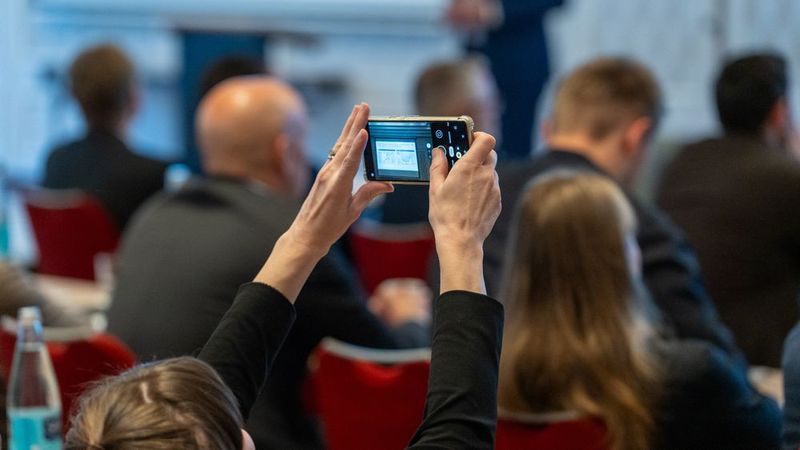
Efficient battery production is essential for the success of e-mobility. At the Battery Manufacturing Day, around 120 participants discussed how this could be achieved in practice. At the end of November, the event in Karlsruhe focused on battery cell and module production in Germany.
At the end of November, the focus in Karlsruhe was on battery cell and module production in Germany.
(Bild: Dominik Böhm - Fotokumpel)
"Electromobility is on a bumpy road," said Thorsten Reichling from consulting firm P3 in his presentation "Challenges in Lithium-Ion Battery Manufacturing" at the 1st Battery Manufacturing Day. As is well known, the sales of electric vehicles are currently subdued. Hermann Uchtner from Schuler Pressen had a more optimistic view—he referred to the indestructible "Gartner Hype Cycle." According to this, dents in technological development after a peak of inflated expectations are not unusual. Typically, a stable productivity plateau follows. It is important to prepare for this because "we are making decisions today for the demands of the next ten years."
A key to affordable electromobility is battery production. Europe is facing significant challenges in this area. There are several reasons for this, such as the heavy dependence on battery raw materials from China, but also higher regulatory hurdles in the European development environment. So, what can Europe and Germany do to compete with the currently dominant China in battery production?
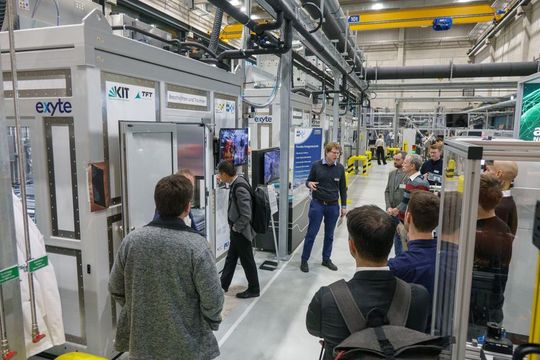
On the eve of Battery Manufacturing Day, there were insights into agile battery cell production at the Karlsruhe Research Factory for AI-integrated manufacturing.
(Bild: Thomas Günnel - 'Automobil Industrie')
Chinese plant manufacturers are getting involved
Hermann Uchtmann from plant manufacturer Schuler Pressen described an interesting phenomenon: The market for battery production plants in China is currently stagnating, which is driving Chinese suppliers to Europe in order to realize their growth there.
However, European plant manufacturers still have the advantage that they are better equipped to meet the extremely high specifications expected in Europe. Nevertheless, operating costs (OPEX) and investment costs (CAPEX) have moved to the forefront as crucial factors for remaining competitive.
There is no shortage of research and practical solutions, as demonstrated the day before with a tour of the "Karlsruhe Research Factory for AI-Integrated Production." The research factory, involving Fraunhofer IOSB and ICT and the wbk Institute for Production Engineering at KIT, is developing concepts for battery production and recycling, among other things.
A fundamental approach is to find agile and adaptable production concepts to quickly make "immature" processes ready for mass production. AI and the data ecosystem Catena-X also play a central role in these developments.
Agile processes in battery production
Katharina Zipse from CatX Service GmbH spoke about this topic. She described Catena-X as an open collaborative data space for the automotive industry that optimizes business processes along the entire value chain. According to Zipse, the European project—which is part of the larger Gaia-X initiative—enables the industry to reduce costs by about 20 percent.
Robert Vollmer from Schuler Group and Bernd Kremer from German Edge Cloud reported on data-driven processes in battery production. Schuler combines two software products: The GEC Onsite Digital Production System from German Edge Cloud includes data collection in the cloud and edge computing, which processes the data.
Edge computing refers to data processing that occurs "on the edge" of the cloud, capturing data to process it outside of the central cloud server. This is intended to make data processing more agile, targeted, and flexible.
The second element is the Track-and-Trace function of the Metris software from plant manufacturer Andritz. A key goal is to reduce scrap in the production of battery cells.
Minimizing scrap is an important cost factor in competing with Chinese suppliers. Hermann Uchtmann from Schuler sees potential in this area— provided European battery manufacturers are better able to consider OPEX and CAPEX within the Total Cost of Ownership when acquiring production equipment.
Lower Costs Through Battery Recycling
In addition to efficient processes, material costs play a crucial role. In the medium term, these costs can indirectly decrease through optimized recycling and, in the long run, a circular economy that minimizes the need for new materials. The Karlsruhe Research Factory is conducting research in this area, and industry players are also exploring new solutions.
Max Rettenmaier from the machinery manufacturer Trumpf, for example, presented a development project where batteries are cut open with lasers before recycling. Thanks to the remarkable speed, the heat input is surprisingly low, ensuring that the inner cells are not endangered. Equally intriguing is a new method for removing active material from anodes and cathodes using lasers. Trumpf is working to make such processes ready for series production.Omron, a provider of automation solutions for battery production with over 20 years of experience, is now increasingly focusing on recycling. According to Henry Claussnitzer, who discussed battery disassembly concepts, recycling is by no means just a reversal of the production process. He mentioned, for instance, the trend toward cell-to-car integration, which is an exciting development from a design perspective but presents challenges when it comes to removing used cells from vehicles. Traditional battery modules make this process significantly simpler.
Moreover, the internal condition of a used battery is often unknown. Over its lifetime, parts of the electrolyte might disappear, and materials can change. There is currently no “battery passport” to provide insight into the state of the battery. Is it suitable for another life in a stationary application? This remains an open question.
Date: 08.12.2025
Naturally, we always handle your personal data responsibly. Any personal data we receive from you is processed in accordance with applicable data protection legislation. For detailed information please see our privacy policy.
Consent to the use of data for promotional purposes
I hereby consent to Vogel Communications Group GmbH & Co. KG, Max-Planck-Str. 7-9, 97082 Würzburg including any affiliated companies according to §§ 15 et seq. AktG (hereafter: Vogel Communications Group) using my e-mail address to send editorial newsletters. A list of all affiliated companies can be found here
Newsletter content may include all products and services of any companies mentioned above, including for example specialist journals and books, events and fairs as well as event-related products and services, print and digital media offers and services such as additional (editorial) newsletters, raffles, lead campaigns, market research both online and offline, specialist webportals and e-learning offers. In case my personal telephone number has also been collected, it may be used for offers of aforementioned products, for services of the companies mentioned above, and market research purposes.
Additionally, my consent also includes the processing of my email address and telephone number for data matching for marketing purposes with select advertising partners such as LinkedIn, Google, and Meta. For this, Vogel Communications Group may transmit said data in hashed form to the advertising partners who then use said data to determine whether I am also a member of the mentioned advertising partner portals. Vogel Communications Group uses this feature for the purposes of re-targeting (up-selling, cross-selling, and customer loyalty), generating so-called look-alike audiences for acquisition of new customers, and as basis for exclusion for on-going advertising campaigns. Further information can be found in section “data matching for marketing purposes”.
In case I access protected data on Internet portals of Vogel Communications Group including any affiliated companies according to §§ 15 et seq. AktG, I need to provide further data in order to register for the access to such content. In return for this free access to editorial content, my data may be used in accordance with this consent for the purposes stated here. This does not apply to data matching for marketing purposes.
Right of revocation
I understand that I can revoke my consent at will. My revocation does not change the lawfulness of data processing that was conducted based on my consent leading up to my revocation. One option to declare my revocation is to use the contact form found at https://contact.vogel.de. In case I no longer wish to receive certain newsletters, I have subscribed to, I can also click on the unsubscribe link included at the end of a newsletter. Further information regarding my right of revocation and the implementation of it as well as the consequences of my revocation can be found in the data protection declaration, section editorial newsletter.
Back to the Start of the Battery Lifecycle
Nicole Neub from Exyte Technology GmbH discussed the "encapsulation" of processes using "energy-efficient micro-environments for battery production." Using the example of manufacturing Li-ion cells, she explained that sometimes the product must be protected from humans.
Specifically, cell production requires an extremely dry environment, but humans naturally produce significant moisture simply through breathing. The solution lies in a mini-environment—small, encapsulated spaces designed to minimize the energy required to maintain dryness.
Collaborating to Develop and Manufacture Batteries
What were the key takeaways from the Battery Manufacturing Day? It’s clear that strong collaboration between industry and research will be essential for Europe to produce batteries competitively.
Equally important are initiatives like the Karlsruhe Research Factory and process-accompanying solutions such as Catena-X. Battery recycling will play a pivotal role in this effort.It may also be necessary to rethink manufacturing processes to better accommodate efficient recycling from the outset. Battery production is still a relatively young field, constantly evolving.
Battery Manufacturing Day Also in 2025
Battery Manufacturing Day will once again serve as a platform May 14/15, 2025 for exchanging insights on new developments in battery production. All information about the event can be found on the Battery Manufacturing Day event page.



:quality(80)/p7i.vogel.de/wcms/a0/47/a04725ef9bd09fb6c9341a1bea1b5d93/0130443083v1.jpeg "Here, a type of plastic pallet is produced by thermoforming (vacuum forming or deep drawing) at the corresponding division of New England Plastics in the USA. This division, which specializes in so-called liners, is now part of Ringmetall ... (Image:New England Plastics)")
:quality(80)/p7i.vogel.de/wcms/23/99/23992bf2dcdc432c9b7209c34a4a7c48/0129733089v1.jpeg "Stork relies on the modular Neoswiss turning system from Iscar to shorten the set-up times for its sliding headstock lathes and work more productively. (Image:Iscar)")
:quality(80)/p7i.vogel.de/wcms/7d/e2/7de2923434b2f1a78ba5482d8d335269/0113143253v1.jpeg "In our China Market Insider we regularly provide you with relevant information directly from China. (Image:© Eisenhans - stock.adobe.com)")
:quality(80)/p7i.vogel.de/wcms/9d/2b/9d2b802f800e5caf17b2831e74228cd3/screenshot-202026-03-03-20103822-609x343v1v1.png "Visual comparison: on the left, a clean, burr-free cut edge; on the right, typical burr formation with oxidation discoloration. This illustrates how strongly parameter control and gas management influence the quality of the result. (CO₂ laser, oxygen cutting gas, sheet thickness approx. 15 mm). (Image:Picture: Rime)")
:quality(80)/p7i.vogel.de/wcms/b7/36/b736dfebc16c42d6901d0d0e1f390493/3d-druck-20factory-20--20ki-20generiert-1920x1079v1.png "(Source: AI-generated)")
:quality(80)/p7i.vogel.de/wcms/79/b2/79b21aad663f4a7bd4472afc1c1afc62/0130433994v1.jpeg "Mission Joyride: The free-flying robot (shown here in the rendering) will relieve the ISS crew of logistics tasks from 2027 with its two mechanical arms. (Image:Icarus Robotics)")
:quality(80)/p7i.vogel.de/wcms/6b/45/6b4546fa6ebf305c3660326909363f32/0130437089v1.jpeg "Industrial AI in action: Rockwell Automation presents practical solutions for self-controlling production systems at the Hannover Messe. (Image:Rainer Jensen, Deutsche Messe)")
:quality(80)/p7i.vogel.de/wcms/78/e9/78e9188c25a8a94e67c34c9bf8ffe495/visual-agile-20robots-20and-20google-20deepmind-20partner-20to-20bring-20intelligence-20to-20robotics-2500x1406v1v1.jpeg "Together, the partners are developing adaptable, intelligent robots for a wide range of applications (Image:Agile Robots SE)")
:quality(80)/p7i.vogel.de/wcms/59/a2/59a2b11f0aa1b700eff02addd5de8703/adobestock-1788280853--c2-a9-20satria-20-e2-80-93-20stock-adobe-com-5081x2860v1v1.jpeg "Quantum computers require extreme cooling to temperatures close to absolute zero in order to keep qubits stable. (Image:satria - stock.adobe.com)")
:quality(80)/p7i.vogel.de/wcms/49/38/493876a248943456b7e4a6db6edfc454/0130230765v1.jpeg "Safe and reliable in aircraft construction: light-curing adhesive bond combined with universal fastening elements. (Source: Delo)")
:quality(80)/p7i.vogel.de/wcms/b5/c7/b5c749d16c8a2e789c1469c2c8c1c387/0130452780v1.jpeg "Volvo Trucks completes road tests with its new hydrogen-powered trucks. (Image:Volvo Trucks)")
:quality(80)/p7i.vogel.de/wcms/ba/69/ba6975f417a85147084f38dc2cd209e2/0130451386v1.jpeg "Together with Nvidia, Hyundai wants to develop an architecture that will be used for level 4 robotaxis (image) as well as for level 2 customer vehicles. (Image:Hyundai)")
:quality(80)/p7i.vogel.de/wcms/93/4d/934de334b47abaa526c78cba1417d7af/0130343495v1.jpeg "The new SU7 is available in three price categories, \"Standard\", \"Pro\" and \"Max\" (Image:Xiaomi)")
:quality(80)/p7i.vogel.de/wcms/df/a0/dfa048434bb94f1b7d030e346b25b3ae/0130373541v1.jpeg "From August, BMW will be producing the i3 at its main plant in Munich - which the car manufacturer has extensively rebuilt for this purpose. (Image:Rainer Haeckl)")
:quality(80)/p7i.vogel.de/wcms/ee/09/ee09acbd6dc896df25affaa9e871e6e5/0130440053v1.jpeg "IMS chip module for simple system integration into an ion mobility spectrometer. (Image:Fraunhofer IPMS)")
:quality(80)/p7i.vogel.de/wcms/10/6c/106cd22de5f68a0f74639d654827228c/0130345302v1.jpeg "Made in India: According to the India Electronics and Semiconductor Association (IESA), the country should be able to produce between 75 and 80 million chips by the beginning of 2027, once the plants currently under construction become operational. (Image:Pixabay (Montage: Sebastian Gerstl))")
:quality(80)/p7i.vogel.de/wcms/a5/ed/a5ed6fda029d362732a293d6b19d74c4/0130444216v1.jpeg "Thirteen executives from the Chinese chip industry have drawn up a plan to achieve an 80% self-sufficiency rate for semiconductors by 2030. (Image:Maxim_Kazmin - stock.adobe.com)")
:quality(80)/p7i.vogel.de/wcms/31/a6/31a646018b34d8e0a44bfc8bf17837f6/0130361632v1.jpeg "For many companies, PFAS are considered indispensable in electronics production. (Image:freely licensed)")
:quality(80)/p7i.vogel.de/wcms/e5/e6/e5e67eccb62ee8a6cb251cddf8794500/0128016296v1.jpeg "Sascha Kleinert, CEO of Accumotive, opened the Battery Manufacturing Day: \"No battery will leave my plant that is not OK,\" he said in his presentation on Mercedes battery production in Kamenz. (Image:Eidens-Holl)")
:quality(80)/p7i.vogel.de/wcms/ae/f9/aef9d63bb12fea9c7dfbcaa15b4318e3/0127312184v1.jpeg "Kia and Hyundai are testing monitoring that collects detailed real-time data on the condition of each battery cell. (Image:Kia)")