The increasing complexity of modern semiconductor manufacturing processes presents system manufacturers with new challenges in terms of precision, process control and quality assurance. Measurement and control concepts are becoming increasingly important, especially in heterogeneous 3D integration.
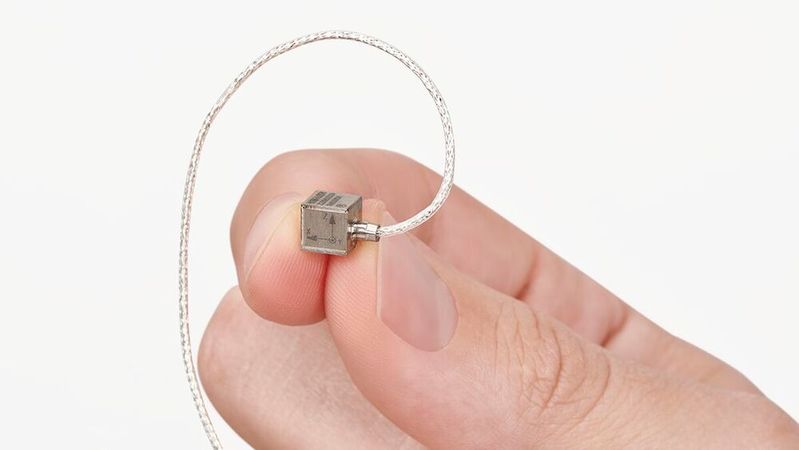
The Z22198 is an extremely compact, three-axis IEPE acceleration sensor for measuring oscillations (vibrations) and shocks in demanding applications. With an edge length of just 0.24 inches and a weight of 0.03 ounces, it is ideal for lightweight structures and confined spaces.
(Image: Copyright 2020 ScROGERS,All Rights Reserved)
In the semiconductor industry, every nanometer counts, every defect costs thousands of euros and process stability is essential. From grinding to CMP and bonding to test procedures, manufacturers of semiconductor equipment are increasingly no longer viewing force, pressure and acceleration sensors as an optional additional function. In many applications, classic MEMS or strain gauge sensors reach their limits in terms of resolution, measuring range or service life. It can make sense to integrate high-precision piezoelectric sensors into semiconductor production systems in order to meet the increasing demands on yield, quality and efficiency.
Heterogeneous 3D integration is revolutionizing semiconductor manufacturing by combining logic, memory, radio frequency (RF) and chiplet components into compact, high-performance systems. This enables technological advances in artificial intelligence (AI), high performance computing (HPC) and 5G/6G. However, the complexity of the wafer bonding, die stacking and through-silicon via (TSV) processes also harbors considerable risks.
As components become ever smaller and contain new materials, the tolerances for force, pressure, vibration and temperature are shrinking to a critical level. Yield is affected by specific risks at every step of the process: from sub-micron alignment during wafer-to-wafer bonding, to avoiding voids during TSV filling, to chip displacement during the die attach process or anomalies during encapsulation. At the same time, the economic consequences of defects are increasing rapidly. Each of these anomalies can multiply costs, often by several thousand euros. Production equipment with integrated monitoring and control can contribute significantly to process stability and yield to protect the substantial value of each wafer.
Semiconductor Suppliers Bear the Burden of Precision
The manufacturers of production systems for the semiconductor industry are at the center of technological change: they play a central role in precision, productivity and quality. This makes them key factors for the entire industry. While speed and mechanical precision used to be the decisive parameters for success, semiconductor manufacturers today have much higher requirements. Among other things, integrated sensor technology, closed-loop process control and traceable quality data that enable predictive maintenance are required. As a result, systems are evolving from purely mechanical precision tools to intelligent systems with integrated monitoring and adaptive control.
Failure Modes Put the Yield at Risk
3D integration is associated with a large number of complex and cost-intensive failure mechanisms. Defects such as cracks or misalignments can be identified by optical inline inspection, but additional risks arise during production that cannot be detected using these methods. Thermomechanical stresses due to different coefficients of thermal expansion (CTE) can lead to deformation or micro-cracking. TSV processes are prone to incomplete filling and voids, which compromises electrical integrity. Even minimal lateral displacements or tilts in the micrometer range during the die attach process can disrupt alignment and prevent precise contacting of the interconnect structures. Furthermore, a faulty print profile during encapsulation can cause mechanical damage to sensitive chips.
Precise Sensor Technology: the Foundation for Quality And Yield
High-resolution piezoelectric force sensors integrated directly into the bond heads monitor all bonding processes in real time and can reduce the risk of quality deviations. Suppliers such as Kistler offer sensor solutions that enable semiconductor equipment manufacturers to implement closed-loop control and support end-to-end process transparency. Thanks to their high resolution, signal stability and low drift, the sensors provide reliable measurement data for process optimization, quality assurance and complete traceability. Stable measurement results can also be achieved under demanding conditions such as high-temperature bonding and encapsulation. The sensors are also optimized for clean room and vacuum applications.
The compact, highly sensitive sensors detect forces from nanonewtons to kilonewtons and thus cover a wide measuring range and application spectrum—from precise grinding and chemical mechanical planarization (CMP) to bonding, chiplet placement and encapsulation. Thanks to the high-resolution real-time detection of even the smallest forces, they enable more precise process control and help to achieve stable quality even at high throughput rates.
During the acceleration and deceleration of linear drives, integrated acceleration sensors monitor micro-vibrations and shock events that can lead to micrometer displacements. In the subsequent process steps such as encapsulation, underfill or TSV filling, the latest generation of pressure sensors enable continuous real-time monitoring of the cavities. This allows errors to be reliably detected, homogeneous encapsulation to be ensured and stable process conditions to be supported.
Date: 08.12.2025
Naturally, we always handle your personal data responsibly. Any personal data we receive from you is processed in accordance with applicable data protection legislation. For detailed information please see our privacy policy.
Consent to the use of data for promotional purposes
I hereby consent to Vogel Communications Group GmbH & Co. KG, Max-Planck-Str. 7-9, 97082 Würzburg including any affiliated companies according to §§ 15 et seq. AktG (hereafter: Vogel Communications Group) using my e-mail address to send editorial newsletters. A list of all affiliated companies can be found here
Newsletter content may include all products and services of any companies mentioned above, including for example specialist journals and books, events and fairs as well as event-related products and services, print and digital media offers and services such as additional (editorial) newsletters, raffles, lead campaigns, market research both online and offline, specialist webportals and e-learning offers. In case my personal telephone number has also been collected, it may be used for offers of aforementioned products, for services of the companies mentioned above, and market research purposes.
Additionally, my consent also includes the processing of my email address and telephone number for data matching for marketing purposes with select advertising partners such as LinkedIn, Google, and Meta. For this, Vogel Communications Group may transmit said data in hashed form to the advertising partners who then use said data to determine whether I am also a member of the mentioned advertising partner portals. Vogel Communications Group uses this feature for the purposes of re-targeting (up-selling, cross-selling, and customer loyalty), generating so-called look-alike audiences for acquisition of new customers, and as basis for exclusion for on-going advertising campaigns. Further information can be found in section “data matching for marketing purposes”.
In case I access protected data on Internet portals of Vogel Communications Group including any affiliated companies according to §§ 15 et seq. AktG, I need to provide further data in order to register for the access to such content. In return for this free access to editorial content, my data may be used in accordance with this consent for the purposes stated here. This does not apply to data matching for marketing purposes.
Right of revocation
I understand that I can revoke my consent at will. My revocation does not change the lawfulness of data processing that was conducted based on my consent leading up to my revocation. One option to declare my revocation is to use the contact form found at https://contact.vogel.de. In case I no longer wish to receive certain newsletters, I have subscribed to, I can also click on the unsubscribe link included at the end of a newsletter. Further information regarding my right of revocation and the implementation of it as well as the consequences of my revocation can be found in the data protection declaration, section editorial newsletter.
In conjunction with industrial charge amplifiers, the sensors provide the control system of the semiconductor equipment with real-time data for force monitoring, which then enables precise control and monitoring. Furthermore, mobile diagnostic tools with integrated charge amplifiers are available for location-independent, in-process verification of relevant process parameters and quality-critical measured variables.
Sensor Placement Requires Individual Solutions
When developing devices for heterogeneous 3D integration, it is important to do more than just select the right sensor technology. It is also crucial that the sensors are placed exactly where they deliver meaningful measurement results. Kistler works with semiconductor manufacturing equipment manufacturers to optimize application and installation to ensure that force, pressure and acceleration sensors are optimally applied to capture important measurement data. Additional services such as calibration and system validation contribute to long-term accuracy and reliability.
Acting Innovatively to Realize Higher Performance And Competitive Advantages
As Industry Lead Semiconductor at Kistler, Robert Hillinger shapes the further development of innovative sensor solutions for the semiconductor industry. He supports the sales team with technical expertise and helps customers worldwide to make their processes more efficient, safer and more profitable.
(Image: Kistler)
The use of advanced sensor systems can provide an important basis for stable production processes, high efficiency and reproducible quality. At the same time, new product requirements such as miniaturization pose complex challenges and open up new opportunities for differentiation.
Retrofits in existing machines are often technically demanding and rarely achieve the performance of solutions that have already been integrated in the design phase. This is why forward-looking planning and early integration can pay off.
Looking to the future, the requirements continue to increase: new and innovative materials as well as more complex manufacturing processes require precise and sophisticated monitoring strategies. High-resolution sensors play an important role in ensuring quality, efficiency and competitiveness in the long term. Early investment in sensor technologies can create competitive advantages. (sb)
Robert Hillinger is Industry Lead Semiconductor at Kistler.



:quality(80)/p7i.vogel.de/wcms/f9/7d/f97deef8fde21c8630d76411b18a20a7/0129803665v1.jpeg "Skoda has invested well over 220 million US dollars in the high-tech battery plant that has now opened in Mlada Boleslav. It has now started its work, which is highly automated ... (Image:Skoda)")
:quality(80)/p7i.vogel.de/wcms/f5/61/f561ad7c72ed41fd7a67ad9c481cb15d/0129799343v1.jpeg "Engine-generator units (MGU) from Steyr Motors are at work in the Leopard 2 main battle tank and the Leguan bridge vehicle (pictured). An extended contract is now to secure at least 500 more systems of this type for the Bundeswehr ... (Image:German Armed Forces)")
:quality(80)/p7i.vogel.de/wcms/6c/b5/6cb5ce2155433f6e73b16399adc4c561/0113143253v1.jpeg "In our China Market Insider we regularly provide you with relevant information directly from China. (Image:© Eisenhans - stock.adobe.com)")
:quality(80)/p7i.vogel.de/wcms/7f/fd/7ffd32863352c40f562f4245e4766e61/0129745849v1.jpeg "After US President Donald Trump once again resorted to his favorite weapon, tariffs, concerns rose in the EU that the so-called tariff deal could become invalid. But it looks as if the sea remains relatively calm ... (Image:F. Schneidler)")
:quality(80)/p7i.vogel.de/wcms/9c/ac/9cac6246660e746c5a3989399ac4d250/0128561645v1.jpeg "Artificial intelligence can drive efficiency in smart factories through centralized data management and predictive maintenance. (Picture: ©Fardived - stock.adobe.com)")
:quality(80)/p7i.vogel.de/wcms/6b/e2/6be235b5ad8a442ccd9d164b0b300d8b/0129763992v1.jpeg "As early as 2020, the Zimmer Group announced that it would convert its production to be sustainably CO2-neutral. (Image:Zimmer Group)")
:quality(80)/p7i.vogel.de/wcms/d4/ba/d4bab9481e66f8570f40eb8ef2a90198/0129795613v1.jpeg "A camera inspection during removal ensures that the components are placed correctly in the KLTs. (Image:Yaskawa Europe)")
:quality(80)/p7i.vogel.de/wcms/cb/56/cb56e42b01638b618e8d1b9b38f32faa/0129810132v1.jpeg "From summer 2026, \"AEON\" will support people at the BMW plant in Leipzig. (Image:diephotodesigner.de/BMW)")
:quality(80)/p7i.vogel.de/wcms/b5/5e/b55ed9355e0395ec0caf111d6af6b494/adobestock-495980372--c2-a9-20natali-mis-20-e2-80-93-20stock-adobe-com-6720x3778v1v1.jpeg "Which engineering skills will be in vogue in 2026? (Image:natali_mis - stock.adobe.com)")
:quality(80)/p7i.vogel.de/wcms/bf/a5/bfa5d882e93f159ce93e933742272b00/nord-vibn-cmyk-2196x1235v1v1.jpeg "With digital twins for virtual commissioning, Nord supports customers in ensuring that systems are available more quickly, even with complex drive systems. (Image:Nord Drivesystems)")
:quality(80)/p7i.vogel.de/wcms/f5/7e/f57ef535ee35e7b3b7ff15a8a63cef10/eds-keyvisual-8000x4496v1.jpeg "(Source: European Defence Supply)")
:quality(80)/p7i.vogel.de/wcms/af/a3/afa312176d956068af20491957eef642/newsimage418262-3100x1745v1v1.jpeg "The autonomous shuttle of the Aula AI project during a demonstration of sensor data with artificial fog. (Image:University of Magdeburg)")
:quality(80)/p7i.vogel.de/wcms/cb/23/cb23acd8e9de969d52522692b62b1892/0129680605v1.jpeg "The Z22198 is an extremely compact, three-axis IEPE acceleration sensor for measuring oscillations (vibrations) and shocks in demanding applications. With an edge length of just 0.24 inches and a weight of 0.03 ounces, it is ideal for lightweight structures and confined spaces. (Image:Copyright 2020 ScROGERS,All Rights Reserved)")
:quality(80)/p7i.vogel.de/wcms/c4/40/c44043c61f9dd99b80ccca398c284018/0129795093v1.jpeg "Subaru manufactures the E-Outback at its Yajima plant, marking the first time it has produced an electric vehicle in-house. (Image:Subaru)")
:quality(80)/p7i.vogel.de/wcms/fe/18/fe1824e572677900655c854f6c92c391/0129811281v1.jpeg "BMW and CATL deepen their partnership and work together on the battery pass. (Image:BMW)")
:quality(80)/p7i.vogel.de/wcms/15/54/15546b27b3a679871325ef6d92509a95/0129750872v1.jpeg "Webasto plans to open its third plant for sunroofs in India. (Image:Webasto)")
:quality(80)/p7i.vogel.de/wcms/70/14/70142aa050f8d3f7784c5ddbb2aba5f1/0129778339v1.jpeg "The software investments in production have saved time in Lacon production. (Image:Lacon)")
:quality(80)/p7i.vogel.de/wcms/5c/0f/5c0fee074c4b6c8e8c0993f3217c2f5a/0129773718v1.jpeg "The General Fusion demonstration reactor. (Image:General Fusion)")
:quality(80)/p7i.vogel.de/wcms/7f/c1/7fc1c83b8509df676d27518b82aaef02/0129764984v1.jpeg "China Resources Microelectronics (CR Micro) has announced its intention to increase the prices of its own products. (Image:China Resources Microelectronics)")
:quality(80)/p7i.vogel.de/wcms/eb/4e/eb4e449562174ec95a5b3d30fb0137a2/0129648135v1.jpeg "The III-V germanium PV module with an efficiency of 34.2% is currently the most efficient solar module in the world. (Image:Jacob Forster)")
:fill(fff,0)/images.vogel.de/vogelonline/companyimg/76800/76895/65.jpg "FAULHABER_120mm.jpg ()")
:fill(fff,0)/p7i.vogel.de/companies/67/eb/67eba621ef6ea/logo2.png "logo2 (Wuxi InfiMotion)")
:quality(80)/p7i.vogel.de/wcms/12/9d/129d99129ca41afd5c6156b2983a2523/0129680487v1.jpeg "The Kistler 5811A handheld meter combines data acquisition with support for piezoelectric sensors, insulation testing and monitoring of IO-Link or ±10 V analog devices. The device ensures reliable quasi-static and dynamic measurements in a wide range of industrial applications.(Image: Kistler)")
:quality(80)/p7i.vogel.de/wcms/85/e1/85e1c8ce8b59265978fa723516592dd5/0129680472v1.jpeg "The piezoelectric sensor type 6162A enables the reliable measurement of cavity pressures up to 200 bar in processes with low-viscosity thermosetting resins. Thanks to its robust design with welded annular gap and IP protection, it is ideal for demanding applications such as RTM, LSR and SMC processes.(Image: Kistler)")
:quality(80)/p7i.vogel.de/wcms/d9/7a/d97a9dc893912f07c7ddd88e20bffb3b/0129680465v1.jpeg "The Z22198 is an extremely compact, three-axis IEPE acceleration sensor for measuring oscillations (vibrations) and shocks in demanding applications. With an edge length of just 6 mm and a weight of 0.9 g, it is ideal for lightweight structures and confined spaces.(Image: Copyright 2020 ScROGERS,All Rights Reserved)")
:quality(80)/p7i.vogel.de/wcms/66/16/6616576587ac82b26fbf1a2311c81811/0129680469v1.jpeg "The 9172CD force sensor is a highly sensitive, ultra-compact piezo force sensor for dynamic and quasi-static measurements directly on the process. It provides high-resolution real-time data and enables the monitoring of critical production steps.(Image: Kistler)")
:quality(80):fill(efefef,0)/p7i.vogel.de/wcms/63/7f/637f1d3982ca7/siemens-retargeting-wp1-cover-369123.png "Siemens_Retargeting_WP1 Cover_369123")
:quality(80)/p7i.vogel.de/wcms/7e/c1/7ec1077a00504b919aabf27da99e93ef/0128873058v1.jpeg "Multiple structured semiconductor wafers with reflective interference colors. (Image:Dall-E / AI-generated)")
:quality(80)/p7i.vogel.de/wcms/c5/23/c523a26dc88f3fb78622b004a63ed58c/0128194898v1.jpeg "The Metron3D system from Infinitesima. (Image:Infinitesima)")