Digital twins are already demonstrating diverse potential in the industry. Read here why our author considers them indispensable, despite some hurdles in implementation.
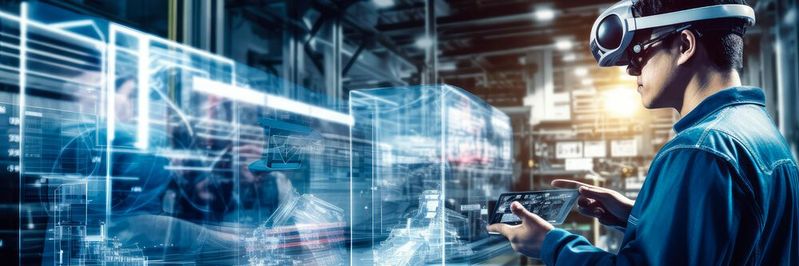
Companies that have already implemented digital twins report significant cost savings and productivity gains.
(Image: PNG City - stock.adobe.com)
*Frank Scheufens works as a Product Manager for Professional Visualization at PNY.
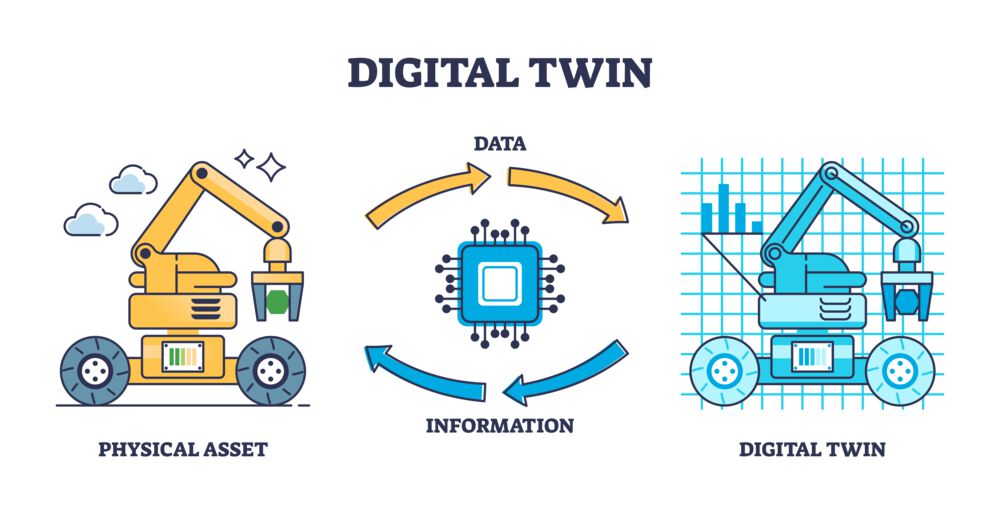
The technological revolution through digital twins offers endless possibilities, especially in the industrial sector. They are virtual replicas of physical assets, processes, or environments that are connected and synchronized in real time. This provides the potential to revolutionize all industries and significantly increase efficiency and productivity in the industrial sector.
Previously, data within companies was largely isolated, with proprietary formats that could not be easily utilized for other purposes. Technical innovations in this area, such as Open-USD and Nvidia Omniverse, now allow all users simultaneous access to data with different applications. This enables the creation of detailed digital twins incorporating all data, including sensors, robots, and even autonomous transport vehicles.
Efficiency redefined: The role of digital twins
Digital twins are physically accurate, virtual replicas of assets, processes, or environments—live, connected, perfectly synchronized, and with realistic physics, materials, lighting, rendering, and behavior. These models are updated and synchronized in real time via continuous data streams from sensors and other IoT devices. They are both AI-capable and AI-enabling. Moreover, they ensure that intelligent devices with advanced perception, reasoning, and recommendation capabilities interact with our physical world, offering advice and making autonomous decisions based on the laws of physics. In this context, AI-enabling means that digital twins can generate synthetic data to train or enhance AI models. This is a crucial point, as the necessary data are often unavailable or insufficient to achieve high AI accuracy.
The next decade will bring transformation for companies across all industries: they will leverage the capabilities of the metaverse and advanced simulations using the latest GPUs to develop products and services or enhance customer experiences. This will also increase their speed, agility, and operational efficiency.
There are already numerous examples of how companies in the energy, manufacturing, retail, telecommunications, and transportation sectors have significantly increased their efficiency and productivity using digital twins.
Why digital twins are indispensable for the future of industry
The use of digital twins offers numerous technological and operational benefits. Companies can continuously monitor their physical systems and production environments and make data-driven decisions. Virtual testing and simulations in a copy of the digital twin allow for optimizations to be made before changes are implemented in the real world. This reduces the risk of errors and downtime. For example, the motion sequences of autonomous transport vehicles can be tested and optimized in the digital twin's test environment without disrupting ongoing production. These precise and risk-free simulations lead to more efficient operations and cost savings.
Progress or Stagnation: Challenges in Implementation
Despite the clear advantages, there are also significant challenges in the development and implementation of digital twins. One of the biggest challenges is collecting and adapting the right data. Digital twins require extensive 3D data from various sources including CAD (Computer-Aided Design), CAE (Computer-Aided Engineering), PLM (Product Lifecycle Management), MRO (Maintenance, Repair, and Overhaul), GIS (Geographic Information Systems), BIM (Building Information Modeling), robotics, analytics, and IoT (Internet of Things) systems. Harmonizing and integrating these diverse data sources is a demanding task. Often these data are stored in different formats and standards, which complicates their consolidation. This integration process not only requires robust technological solutions but also a significant degree of coordination among different departments and external partners involved. Managing this complexity effectively is key to unlocking the full potential of digital twins.
The use of digital twins is increasingly becoming the norm, as companies that do not adopt this technology risk falling behind in international competition.
(Image:VectorMine - stock.adobe.com)
Data collection and processing require specialized knowledge and technical expertise, which may not be available in smaller companies. Advanced skills in areas such as data modeling, simulation techniques, and system integration are often necessary. Furthermore, ensuring data quality and accuracy is crucial, as inaccurate or incomplete data can lead to faulty models and simulations. For smaller companies lacking in-house expertise, collaborating with external consultants or adopting user-friendly digital twin platforms that simplify the integration and analysis process can be effective strategies. These platforms often provide guidance and tools to help manage data complexity and maintain high standards of data integrity. In addition, ongoing training and the development of a data-savvy workforce are integral to leveraging the full potential of digital twins effectively. As this technology becomes more mainstream, the availability of more comprehensive educational resources and the widespread adoption of standards will likely reduce entry barriers for smaller enterprises.
Date: 08.12.2025
Naturally, we always handle your personal data responsibly. Any personal data we receive from you is processed in accordance with applicable data protection legislation. For detailed information please see our privacy policy.
Consent to the use of data for promotional purposes
I hereby consent to Vogel Communications Group GmbH & Co. KG, Max-Planck-Str. 7-9, 97082 Würzburg including any affiliated companies according to §§ 15 et seq. AktG (hereafter: Vogel Communications Group) using my e-mail address to send editorial newsletters. A list of all affiliated companies can be found here
Newsletter content may include all products and services of any companies mentioned above, including for example specialist journals and books, events and fairs as well as event-related products and services, print and digital media offers and services such as additional (editorial) newsletters, raffles, lead campaigns, market research both online and offline, specialist webportals and e-learning offers. In case my personal telephone number has also been collected, it may be used for offers of aforementioned products, for services of the companies mentioned above, and market research purposes.
Additionally, my consent also includes the processing of my email address and telephone number for data matching for marketing purposes with select advertising partners such as LinkedIn, Google, and Meta. For this, Vogel Communications Group may transmit said data in hashed form to the advertising partners who then use said data to determine whether I am also a member of the mentioned advertising partner portals. Vogel Communications Group uses this feature for the purposes of re-targeting (up-selling, cross-selling, and customer loyalty), generating so-called look-alike audiences for acquisition of new customers, and as basis for exclusion for on-going advertising campaigns. Further information can be found in section “data matching for marketing purposes”.
In case I access protected data on Internet portals of Vogel Communications Group including any affiliated companies according to §§ 15 et seq. AktG, I need to provide further data in order to register for the access to such content. In return for this free access to editorial content, my data may be used in accordance with this consent for the purposes stated here. This does not apply to data matching for marketing purposes.
Right of revocation
I understand that I can revoke my consent at will. My revocation does not change the lawfulness of data processing that was conducted based on my consent leading up to my revocation. One option to declare my revocation is to use the contact form found at https://contact.vogel.de. In case I no longer wish to receive certain newsletters, I have subscribed to, I can also click on the unsubscribe link included at the end of a newsletter. Further information regarding my right of revocation and the implementation of it as well as the consequences of my revocation can be found in the data protection declaration, section editorial newsletter.
Another obstacle is the necessary IT infrastructure required to process and store large amounts of data. Companies must invest in powerful servers, network infrastructures, and data security measures to ensure the integrity and availability of data. To fully leverage the benefits of digital twins, high-performance hardware is also essential. Professional graphics processors enable everything from detailed industrial design and advanced special effects to complex scientific visualization and the integration of artificial intelligence. The Nvidia RTX 6000 Ada Lovelace is an example of graphics cards specifically developed for these applications. With its third-generation RT cores, fourth-generation Tensor cores, and CUDA cores, the RTX 6000 provides the necessary performance to accelerate computation-heavy AI workloads. These investments not only increase the capacity to handle complex simulations but also enhance the reliability and speed at which these calculations can be performed, significantly boosting the overall productivity and effectiveness of digital twin technologies.
However, the high costs and complex setup of this infrastructure can be daunting, especially for small and medium-sized enterprises.
Indeed, the implementation of digital twins requires not only technological but also cultural and organizational changes. Employees need to be trained and ready to accept new technologies and workflows. This often involves a shift in company thinking and a willingness to invest in digital transformation despite the associated uncertainties and risks. Educating staff about the benefits and potential of digital twins to improve efficiency, reduce costs, and enhance product and service quality can help foster a supportive culture for change. Furthermore, leadership must actively promote innovation and provide the necessary resources and support structures. Including employees in the planning and implementation phases can also mitigate resistance and increase acceptance as they become active participants in the transformation process. Ultimately, the successful integration of digital twins into business operations relies on a balanced approach that combines technological adoption with strategic management and cultural adaptation. This way, companies not only adapt to new technologies but also thrive, leveraging these advanced tools to their fullest potential.
The challenges at a glance:
High Initial Investments: Implementing digital twins requires significant investments in hardware, software, and expertise. Many companies are uncertain about the "Return on Investment" (ROI) and therefore hesitate to make such investments.
Traditional Work Methods: Many companies adhere to traditional work methods, which complicates the adoption of new technologies. A cultural change within the organizations is often necessary to fully utilize the benefits of digital twins.
Complexity of Technology: Implementing digital twins is technically demanding and requires specialized knowledge. The shortage of qualified personnel and the complexity of integrating various data systems pose additional challenges.
Lack of Service Providers: There are few specialized service providers available to assist companies with the implementation of digital twins. This makes it particularly challenging for small and medium-sized enterprises to acquire the necessary resources and expertise.
These challenges highlight that the successful deployment of digital twins is not only a technological task but also a strategic and organizational one. Companies that overcome these obstacles can achieve significant operational benefits and still gain a competitive edge.
The future is promising
The general interest in digital twins is tremendous, but currently, implementation is mainly occurring in large companies that already have the appropriate personnel and financial resources. After the USA, Europe is the second-largest region that is already using digital twins or working on their implementation.
Tools like Nvidia Omniverse, which was introduced three years ago, simplify the creation of digital twins. Generative AI also plays a significant role by enabling the automatic conversion of 2D plans into 3D models. This saves a lot of time and effort and makes it easier to get started with the technology.
The success stories from companies that have already implemented digital twins are making the adoption increasingly attractive for others, leading to a growing interest. Corresponding tools and applications are continuously improving, and the creation of a digital twin is becoming easier, which will also lead to more and more companies utilizing digital twins. Companies will not be able to ignore this technology if they want to remain competitive. In the future, tasks such as product development or process optimization will primarily occur virtually, as it can be more cost-effective and resource-efficient.



:quality(80)/p7i.vogel.de/wcms/dd/08/dd086510d9ae7b50181f6070e4463b44/0129363730v1.jpeg "Typical application for ionizing devices: Wrapping films. (Picture: ©Adobe Stock/SMC)")
:quality(80)/p7i.vogel.de/wcms/35/57/3557c819943c53acec41a0ccba87da4f/0130049064v1.jpeg "Researchers at the Fraunhofer IWU in Chemnitz have long known that many typical sheet metal parts can be manufactured more cost-effectively using hollow embossing rollers. Now there is news to report ... (Image:Fraunhofer IWU)")
:quality(80)/p7i.vogel.de/wcms/59/02/590246e3b3f415c65edbee377c14ca77/26-06-pi-fraunhofer-iws-41450-direktplattieren-pic-01-7771x4369v1v1.jpeg "The Fraunhofer IWS has developed the new \"direct laser cladding\" process, which creates a functional layer directly on the base body by applying a strip-shaped metal to rotationally symmetrical components in a spiral and bonding it locally by laser. (Image:Christoph Wilsnack/Fraunhofer IWS)")
:quality(80)/p7i.vogel.de/wcms/73/60/73608418789b1d9c393f5e2fa974eda2/0130209906v1.jpeg "The robots of the X6 generation from b+m enable very high painting quality and are also particularly compact and easy to maintain. (Image:Beckhoff)")
:quality(80)/p7i.vogel.de/wcms/78/e9/78e9188c25a8a94e67c34c9bf8ffe495/visual-agile-20robots-20and-20google-20deepmind-20partner-20to-20bring-20intelligence-20to-20robotics-2500x1406v1v1.jpeg "Together, the partners are developing adaptable, intelligent robots for a wide range of applications (Image:Agile Robots SE)")
:quality(80)/p7i.vogel.de/wcms/e7/66/e7669ecf0260ae8fc54c214e34e4902a/0130316817v1.jpeg "Siemens and Palo Alto Networks offer tested cybersecurity solution for industrial 5G. (Image:Siemens)")
:quality(80)/p7i.vogel.de/wcms/9f/55/9f55324832c4f426958031375124d9de/siemens-20ubtech-20hmnd-1920x1079v1v1.png "Ready for the factory floor: While Ubtech is planning mass production, Siemens is already testing humanoids in real factory applications in Erlangen. (Image:Siemens)")
:quality(80)/p7i.vogel.de/wcms/11/36/113695ed260e29c8c2d9d39dc5f9d869/0130213768v1.jpeg "AI can work cheaply in China and deliver the results rapidly all over the world. (Image:Dall-E / AI-generated)")
:quality(80)/p7i.vogel.de/wcms/62/5f/625f41e87ebfef156a98c8e6393e32fd/0130211654v1.jpeg "Axial flux motors have some advantages over radial flux motor—but their production is currently still expensive. (Image:RWTH Aachen University)")
:quality(80)/p7i.vogel.de/wcms/77/9b/779b0685d010dfe45c9c2cb1cfecd467/0128886425v1.jpeg "The BlueEye is the first \"real\" hyperspectral camera for the UV range and covers the wavelength range from 220 to 380nm. (Image:Inno-spec GmbH)")
:quality(80)/p7i.vogel.de/wcms/e4/51/e451d52ce0182fb0aaa46a5774f832ef/26-04-pi-fraunhofer-iws-21160-bioslide-pic-01-4128x2321v1v1.jpeg "With the BioSlide research project, the Fraunhofer IWS is investigating how sliding systems can be designed to be more sustainable and energy-efficient. New materials can be tested in a particularly application-oriented manner on this plain bearing test stand. (Image:Fraunhofer IWS)")
![Thanks to advanced 3D printing technology, a more efficient use of resources should contribute to lower-emission aviation—this is the goal of ['skai]-lab. (Image:Oleksandr Pashchenko - stock.adobe.com / AI-generated)](https://cdn1.vogel.de/nghHNSbySccfOjG3n1qCA-FVOjQ=/288x162/smart/filters:format(jpg):quality(80)/p7i.vogel.de/wcms/62/64/626424c97a16e69f871bf216c9629c2a/adobestock-1927043193--c2-a9-20oleksandr-20pashchenko-20-e2-80-93-20stock-adobe-com-ki-generiertv1v1.jpeg "Thanks to advanced 3D printing technology, a more efficient use of resources should contribute to lower-emission aviation—this is the goal of ['skai]-lab. (Image:Oleksandr Pashchenko - stock.adobe.com / AI-generated)")
:quality(80)/p7i.vogel.de/wcms/c3/c4/c3c4ce270b083eeac55654148611f064/0130237945v1.jpeg "China is not giving up on hydrogen, but is intensifying its efforts. (Image:freely licensed from Pixabay)")
:quality(80)/p7i.vogel.de/wcms/4e/c0/4ec0bd19390b169edfa23677373dcdf1/0130260089v1.jpeg "Renewable fuels can supply European road traffic, according to a study. (Image:Aral)")
:quality(80)/p7i.vogel.de/wcms/6f/c9/6fc9050301d745cad25585c6780f8f51/0130197341v1.jpeg "Production facilities are a worthwhile target and are therefore at risk. (Image:ABB Robotics)")
:quality(80)/p7i.vogel.de/wcms/b6/62/b662adc2cec8227d8172509bbfb6ee42/25c0207-107-4961x2789v1v1.jpeg "The GLB is the second model based on Mercedes' new MMA platform. Apparently, Geely's platform is better and cheaper, which is why the two companies are negotiating a partnership. (Image:Mercedes-Benz)")
:quality(80)/p7i.vogel.de/wcms/4d/dd/4dddf438e91f394c04a095dbfd109d1c/0130236430v1.jpeg "Measurement modules: The 720301 module in combination with the SL2000 enables RMS and power calculations, among other things. (Image:Yokogawa)")
:quality(80)/p7i.vogel.de/wcms/61/fc/61fcf95f5cca15494ad18343901ae585/0130317237v1.jpeg "With the AGI CPU, Arm says it is taking a \"historic step\": With the processor aimed at AI in data centers, the company is presenting itself for the first time as a provider of its own chips, not just as a pure IP licensor. (Image:Arm)")
:quality(80)/p7i.vogel.de/wcms/82/90/8290dfe3595b6c6b33726ae8b76172c7/0130319587v1.jpeg "The concept image illustrates how the pattern of tiny protrusions and depressions created on the substrate (MgO, bottom) controls the arrangement of atoms in the superconducting material (YBCO, top). At the interface between the two layers, an electronic structure enables superconductivity to occur at higher temperatures than previously possible. (Image:Chalmers University of Technology / Riccardo Arpaia)")
:fill(fff,0)/images.vogel.de/vogelonline/companyimg/76800/76895/65.jpg "FAULHABER_120mm.jpg ()")
:fill(fff,0)/p7i.vogel.de/companies/69/88/69882c428938e/tmts2026-ticec-banner-en-2000px.png "tmts2026-ticec-banner-en-2000px (https://www.tmts.tw/en)")
:fill(fff,0)/p7i.vogel.de/companies/67/eb/67eba621ef6ea/logo2.png "logo2 (Wuxi InfiMotion)")
:quality(80)/p7i.vogel.de/wcms/5e/a4/5ea4b957571a1f1c9ede4bc78acf3da8/0124306848v1.jpeg "Digital twin: Shared representation of a robotics system—left as a digital simulation, right in the real production environment. (Image:AI-generated)")
:quality(80)/p7i.vogel.de/wcms/e7/9b/e79b39c35df4076fa37df072805453e4/0126535909v1.jpeg "Power grids: The energy infrastructure must become more resilient and smarter. (Image:cocoparisienne)")