Porsche once pursued one of the most ambitious e-car strategies in the industry, now the Swabians announce a change of course—back to the internal combustion engine. What this is all about.
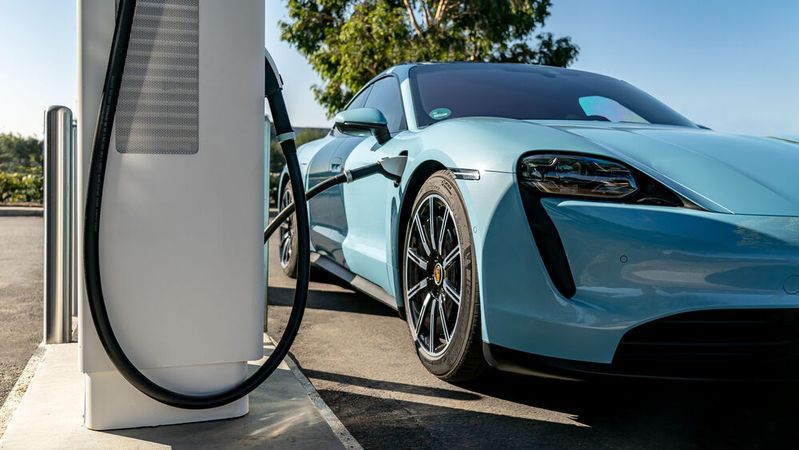
Taycan sales almost halved last year.
(Image: Porsche)
Electric cars and Porsche don't seem to go together at first glance. Where there was once a roar and stench in the seemingly old internal combustion engine world, there was only a faint hum to be heard. Nevertheless, the Zuffenhausen company (located in Germany) had set ambitious goals—now they are adjusting their strategy, among other things, due to weak demand and problems in China.
The group, which is majority-owned by Volkswagen, plans to use significant funds to counter the crisis: Porsche expects additional burdens of up to 800 million euros for the current year—among other things, to develop new cars with combustion or plug-in hybrid engines and to offer more special and exclusive equipment. Additionally, investments are to be made in battery activities, and the organization will be restructured. CEO Oliver Blume is accepting a significant drop in the operating margin for this, as the Volkswagen subsidiary unexpectedly announced on Thursday evening. Already in 2024, the company came under considerable pressure according to preliminary figures.
Weaker return
According to preliminary calculations, Porsche's operating margin last year was at the lower end of the targeted range of 14 to 15 percent. In 2023, Porsche had still achieved 18 percent. The weak performance in China and the introduction of new models in most of the automaker's model lines had a negative impact.
This year, the margin is likely to slip to 10 to 12 percent due to the expensive program to strengthen short- and medium-term earning power, but also due to market-related reduced sales expectations. Porsche actually has entirely different ambitions: In the long term, Blume aims to achieve more than 20 percent return on sales.
However, high investments are now necessary for this—that has been clear since Thursday. But why does Porsche have to rethink?
Farewell in installments
Porsche had long been one of the most ambitious e-car strategies in the industry. By 2030, more than 80 percent of sports and off-road vehicles were to roll off the production line with a fully electric drive. The electric motor is superior to the combustion engine in the long term, Porsche CEO Oliver Blume emphasized on more than one occasion. It was planned that almost all models would gradually be converted to electric drives, with the exception of the 911.
There have been signs for some time that the company is backing down on its ambition. Initially, it was emphasized that the goal depended on demand and the development of e-mobility worldwide. Later, it was said that existing combustion models would be refreshed and built in parallel for some time.
In the fall, the now disgraced CFO Lutz Meschke announced that they were considering equipping the originally purely electric vehicles with a hybrid drive or an internal combustion engine in the future. It's the fish that must find the worm tasty, it was said.
Problem child China
Because that does not seem to be the case at the moment: Demand for cars from Zuffenhausen is weakening. Last year, Porsche sold a good 310,700 units—three percent less than in 2023. In China, the world's most important car market, the decline was 28 percent. Porsche attributes the drop mainly to the difficult economic situation in the region.
Only a small portion of the sold vehicles had an electric motor: The Taycan, on the market since 2019 and modernized last year, sold poorly recently. In 2024, about 20,800 vehicles were delivered. Compared to the previous year, this number has almost halved.
Last year, after long delays, Porsche also converted the compact SUV Macan to electric drive in Europe. The car is now reaching customers in the midst of the electric lull. From September to December 2024, nearly 18,300 units were delivered. It's quite possible that this model—a bestseller so far—might get a combustion engine again. Porsche has not yet provided details about the strategic shift.
Does Blume's dual role remain an issue?
Stefan Reindl from the Institute for Automotive Business says: "The ongoing reports from the company will probably once again lead to a discussion about Oliver Blume's dual role as Porsche CEO and as Chairman of the Volkswagen Group." He may have to succumb to this pressure so that the profit driver Porsche can return to calmer waters after the board's restructuring.
Date: 08.12.2025
Naturally, we always handle your personal data responsibly. Any personal data we receive from you is processed in accordance with applicable data protection legislation. For detailed information please see our privacy policy.
Consent to the use of data for promotional purposes
I hereby consent to Vogel Communications Group GmbH & Co. KG, Max-Planck-Str. 7-9, 97082 Würzburg including any affiliated companies according to §§ 15 et seq. AktG (hereafter: Vogel Communications Group) using my e-mail address to send editorial newsletters. A list of all affiliated companies can be found here
Newsletter content may include all products and services of any companies mentioned above, including for example specialist journals and books, events and fairs as well as event-related products and services, print and digital media offers and services such as additional (editorial) newsletters, raffles, lead campaigns, market research both online and offline, specialist webportals and e-learning offers. In case my personal telephone number has also been collected, it may be used for offers of aforementioned products, for services of the companies mentioned above, and market research purposes.
Additionally, my consent also includes the processing of my email address and telephone number for data matching for marketing purposes with select advertising partners such as LinkedIn, Google, and Meta. For this, Vogel Communications Group may transmit said data in hashed form to the advertising partners who then use said data to determine whether I am also a member of the mentioned advertising partner portals. Vogel Communications Group uses this feature for the purposes of re-targeting (up-selling, cross-selling, and customer loyalty), generating so-called look-alike audiences for acquisition of new customers, and as basis for exclusion for on-going advertising campaigns. Further information can be found in section “data matching for marketing purposes”.
In case I access protected data on Internet portals of Vogel Communications Group including any affiliated companies according to §§ 15 et seq. AktG, I need to provide further data in order to register for the access to such content. In return for this free access to editorial content, my data may be used in accordance with this consent for the purposes stated here. This does not apply to data matching for marketing purposes.
Right of revocation
I understand that I can revoke my consent at will. My revocation does not change the lawfulness of data processing that was conducted based on my consent leading up to my revocation. One option to declare my revocation is to use the contact form found at https://contact.vogel.de. In case I no longer wish to receive certain newsletters, I have subscribed to, I can also click on the unsubscribe link included at the end of a newsletter. Further information regarding my right of revocation and the implementation of it as well as the consequences of my revocation can be found in the data protection declaration, section editorial newsletter.
The return to the combustion engine is a logical step for automotive expert Ferdinand Dudenhöffer. "Porsche, like Mercedes or VW, relied on the words and promises of politicians from Brussels and Berlin. And they were left stranded." The subsidies for e-cars were stopped overnight. Similarly, politicians told the story of synthetic fuels and the eternal life of the combustion engine. "With that, our politicians have reprogrammed customers' minds," said Dudenhöffer.



:quality(80)/p7i.vogel.de/wcms/60/eb/60ebe43de41f833157b476b2e1641811/0130090160v1.jpeg "The Surface Control Automotive measuring system from Micro-Epsilon automatically detects dents, scratches and other surface defects on body shells. (Image:Micro-Epsilon)")
:quality(80)/p7i.vogel.de/wcms/26/8a/268aba929d72bd089234bd512aab9b08/0130487474v1.jpeg "The works meeting at Volkswagen is over! Here is a brief overview of the most important aspects ... (Image:VW)")
:quality(80)/p7i.vogel.de/wcms/50/63/5063e5b91e7897c13b882440c7f106d4/0128575929v1.jpeg "How is Edge AI changing the industry? Local data processing meets distributed intelligence to promote sustainability and efficiency. (Picture: ©tippapatt - stock.adobe.com)")
:quality(80)/p7i.vogel.de/wcms/a0/47/a04725ef9bd09fb6c9341a1bea1b5d93/0130443083v1.jpeg "Here, a type of plastic pallet is produced by thermoforming (vacuum forming or deep drawing) at the corresponding division of New England Plastics in the USA. This division, which specializes in so-called liners, is now part of Ringmetall ... (Image:New England Plastics)")
:quality(80)/p7i.vogel.de/wcms/d3/3d/d33d26b35aa1e64f5c41d19d22c5c5dc/0130496518v1.jpeg "(Image:Speedbot)")
:quality(80)/p7i.vogel.de/wcms/f0/ca/f0caaaa9fc2347a5221760a94f92e831/0129880873v1.jpeg "Human-machine collaboration takes on a new quality. This is because the automation task is formulated in natural language and the AI takes over its implementation directly in the project. This allows users to implement Codesys projects more quickly. (Image:Codesys)")
:quality(80)/p7i.vogel.de/wcms/b7/36/b736dfebc16c42d6901d0d0e1f390493/3d-druck-20factory-20--20ki-20generiert-1920x1079v1.png "(Source: AI-generated)")
:quality(80)/p7i.vogel.de/wcms/79/b2/79b21aad663f4a7bd4472afc1c1afc62/0130433994v1.jpeg "Mission Joyride: The free-flying robot (shown here in the rendering) will relieve the ISS crew of logistics tasks from 2027 with its two mechanical arms. (Image:Icarus Robotics)")
:quality(80)/p7i.vogel.de/wcms/59/a2/59a2b11f0aa1b700eff02addd5de8703/adobestock-1788280853--c2-a9-20satria-20-e2-80-93-20stock-adobe-com-5081x2860v1v1.jpeg "Quantum computers require extreme cooling to temperatures close to absolute zero in order to keep qubits stable. (Image:satria - stock.adobe.com)")
:quality(80)/p7i.vogel.de/wcms/49/38/493876a248943456b7e4a6db6edfc454/0130230765v1.jpeg "Safe and reliable in aircraft construction: light-curing adhesive bond combined with universal fastening elements. (Source: Delo)")
:quality(80)/p7i.vogel.de/wcms/c1/43/c143c24b62e51b848b2586b52bcd20e2/0130468443v1.jpeg "Jörg Burzer, Head of Development at Mercedes Benz Group AG (Image:Mercedes)")
:quality(80)/p7i.vogel.de/wcms/24/8d/248dccded0abab4dc0a3a7abcc462884/0130497946v1.jpeg "A receiver test for 10BASE-T1S developed by Keysight promotes the testing of function-critical receivers to ensure the reliability and safety of future on-board networks. (Image:Keysight)")
:quality(80)/p7i.vogel.de/wcms/b5/c7/b5c749d16c8a2e789c1469c2c8c1c387/0130452780v1.jpeg "Volvo Trucks completes road tests with its new hydrogen-powered trucks. (Image:Volvo Trucks)")
:quality(80)/p7i.vogel.de/wcms/ba/69/ba6975f417a85147084f38dc2cd209e2/0130451386v1.jpeg "Together with Nvidia, Hyundai wants to develop an architecture that will be used for level 4 robotaxis (image) as well as for level 2 customer vehicles. (Image:Hyundai)")
:quality(80)/p7i.vogel.de/wcms/ee/09/ee09acbd6dc896df25affaa9e871e6e5/0130440053v1.jpeg "IMS chip module for simple system integration into an ion mobility spectrometer. (Image:Fraunhofer IPMS)")
:quality(80)/p7i.vogel.de/wcms/10/6c/106cd22de5f68a0f74639d654827228c/0130345302v1.jpeg "Made in India: According to the India Electronics and Semiconductor Association (IESA), the country should be able to produce between 75 and 80 million chips by the beginning of 2027, once the plants currently under construction become operational. (Image:Pixabay (Montage: Sebastian Gerstl))")
:quality(80)/p7i.vogel.de/wcms/a5/ed/a5ed6fda029d362732a293d6b19d74c4/0130444216v1.jpeg "Thirteen executives from the Chinese chip industry have drawn up a plan to achieve an 80% self-sufficiency rate for semiconductors by 2030. (Image:Maxim_Kazmin - stock.adobe.com)")
:quality(80)/p7i.vogel.de/wcms/31/a6/31a646018b34d8e0a44bfc8bf17837f6/0130361632v1.jpeg "For many companies, PFAS are considered indispensable in electronics production. (Image:freely licensed)")
:fill(fff,0)/images.vogel.de/vogelonline/companyimg/76800/76895/65.jpg "FAULHABER_120mm.jpg ()")
:quality(80)/p7i.vogel.de/wcms/9e/6f/9e6f304684298db4d9798f5c7b4b7a69/0126533664v1.jpeg "Oliver Blume has been CEO of Volkswagen and Porsche for a good three years. Now he is to lose his senior position at the head of Porsche. (Image:Volkswagen AG)")
:quality(80)/p7i.vogel.de/wcms/e7/08/e7082e4f1f287bb702bd07dc8a73e009/0126901054v1.jpeg "VW CEO Oliver Blume is also the head of Porsche. The dual role is a thorn in the side of shareholders. (Image:Porsche)")