It's time: Porsche has electrified the 911. Because with the facelift, in addition to the usual cosmetic changes, there is the new T-Hybrid for the first time. This leads to an explosion in performance.
With the mid-life facelift, in addition to the usual make-up, there is the new T-Hybrid for the first time.
(Image: Porsche)
Water cooling, double clutch, even the shape of the turn signals—for 60 years, the Porsche community has commented on even the smallest change to the 911 in advance with almost rebellious indignation. Only to then build the pedestal for the mother of all sports cars even higher and buy more cars than before. But this time, the uncompromising affection of the hasty high earners is put to a severe test.
The Swabians are bringing the big facelift for the current generation of their sports car to the market. Internally, it is designated as 992.2 and the prices start at just under 130,000 euros (approx. 141,000 USD). This facelift includes not only a revised design. There is now a modernized ambiance and more electronics—for example, no more mechanical instruments. In addition, the equipment has been reconfigured and—Porsche owes this to the petrolheads—there is a bit more power.
T-Hybrid: Electric drive hardly noticeable
The so-called T-Hybrid for the sporty GTS model also marks the start of electrification for the 911. Prices start at around 170,000 euros (approx. 185,000 USD) for the coupe without and about 180,000 euros (approx. 196,000 UDS) with all-wheel drive. The corresponding cabriolet starts at 185,000 euros (approx. 201,000 USD) , and the Targa, only available with all-wheel drive, at more than 190,000 euros (approx. 208,000 USD).
For some, it may be a relief, for others a disappointment: you feel absolutely nothing from the electric intervention in the drivetrain. At least not the way one would expect. Because whoever starts the Elfer—now with a start button instead of an ignition key—still hears a six-cylinder engine, which with its displacement increased from 3.0 to 3.6 liters even sounds a bit more bass-heavy. No matter how gently you accelerate or how slowly you drive: the sports car always uses the power of a boxer.
What one does feel, however, is the dramatically improved performance. Sure, instead of 480, there are now 540 hp on the vehicle registration. But even if you couldn't accuse the GTS of being sluggish before and the top speed of 312 km/h (211 mph) remains unchanged, the car now literally explodes with propulsion: On paper, it takes four tenths off the predecessor in the sprint from 0 to 100 km/h in three seconds. In practice, it feels as if you've been driving a Polo instead of a Porsche up to now—the new 911 responds so eagerly to the gas and throws itself towards the horizon with such vehemence with its up to 610 Nm. And because life doesn't always go in straight lines, the GTS comes standard with rear-axle steering for greater agility.
Electric turbocharger
For the electric boost, Porsche goes to great lengths. That's why they don't just screw a 41 kW E-machine with 150 Nm into the eight-speed dual-clutch gearbox and install a particularly lightweight and small 1.9 kWh battery in the bow, as they do with the Cayman or Panamera. This one cannot be charged at a socket—unlike the larger series. Instead, they install an electric turbocharger which applies pressure immediately when starting and serves as a generator under load in order to recharge the battery as quickly as possible.
Even though this elaborate package is noticeable during the test drive, it is hardly noticeable at the gas station. If driven sportily, the hybrid should be somewhat more economical than the previous GTS. But on paper, it uses 10.5 liters—just like its predecessor. So why is Porsche going to all this effort anyway? Because this way the Swabians at least offer more power and performance without more guilt. And because this engine meets the Euro-7 standard, giving petrol heads a future.
Porsche 911 as a pure combustion engine—Electric 718 in progress
After the facelift, Porsche offers the basic model and later again Turbo & Co with pure combustion engines. The OEM promises the electric enthusiasts the first electric sports car as a successor to the 718 for next year. And for the broad mass, they trust that it will go the way it has always gone—with the big and small revolutions in six decades of 911 history. The love for the Elfer is endless. And no matter how loud the outcry may be, for most people it turns back into enthusiasm after the maiden voyage.
Date: 08.12.2025
Naturally, we always handle your personal data responsibly. Any personal data we receive from you is processed in accordance with applicable data protection legislation. For detailed information please see our privacy policy.
Consent to the use of data for promotional purposes
I hereby consent to Vogel Communications Group GmbH & Co. KG, Max-Planck-Str. 7-9, 97082 Würzburg including any affiliated companies according to §§ 15 et seq. AktG (hereafter: Vogel Communications Group) using my e-mail address to send editorial newsletters. A list of all affiliated companies can be found here
Newsletter content may include all products and services of any companies mentioned above, including for example specialist journals and books, events and fairs as well as event-related products and services, print and digital media offers and services such as additional (editorial) newsletters, raffles, lead campaigns, market research both online and offline, specialist webportals and e-learning offers. In case my personal telephone number has also been collected, it may be used for offers of aforementioned products, for services of the companies mentioned above, and market research purposes.
Additionally, my consent also includes the processing of my email address and telephone number for data matching for marketing purposes with select advertising partners such as LinkedIn, Google, and Meta. For this, Vogel Communications Group may transmit said data in hashed form to the advertising partners who then use said data to determine whether I am also a member of the mentioned advertising partner portals. Vogel Communications Group uses this feature for the purposes of re-targeting (up-selling, cross-selling, and customer loyalty), generating so-called look-alike audiences for acquisition of new customers, and as basis for exclusion for on-going advertising campaigns. Further information can be found in section “data matching for marketing purposes”.
In case I access protected data on Internet portals of Vogel Communications Group including any affiliated companies according to §§ 15 et seq. AktG, I need to provide further data in order to register for the access to such content. In return for this free access to editorial content, my data may be used in accordance with this consent for the purposes stated here. This does not apply to data matching for marketing purposes.
Right of revocation
I understand that I can revoke my consent at will. My revocation does not change the lawfulness of data processing that was conducted based on my consent leading up to my revocation. One option to declare my revocation is to use the contact form found at https://contact.vogel.de. In case I no longer wish to receive certain newsletters, I have subscribed to, I can also click on the unsubscribe link included at the end of a newsletter. Further information regarding my right of revocation and the implementation of it as well as the consequences of my revocation can be found in the data protection declaration, section editorial newsletter.



:quality(80)/p7i.vogel.de/wcms/a0/47/a04725ef9bd09fb6c9341a1bea1b5d93/0130443083v1.jpeg "Here, a type of plastic pallet is produced by thermoforming (vacuum forming or deep drawing) at the corresponding division of New England Plastics in the USA. This division, which specializes in so-called liners, is now part of Ringmetall ... (Image:New England Plastics)")
:quality(80)/p7i.vogel.de/wcms/e3/42/e342b3c593ea92d56604d3be969e9c9a/0130437231v1.jpeg "Daimler Truck will be building even more trucks at its Czech plant in Cheb in the future. This is because it is now being expanded for strategic cost-saving reasons ... (Image:Daimler Truck)")
:quality(80)/p7i.vogel.de/wcms/23/99/23992bf2dcdc432c9b7209c34a4a7c48/0129733089v1.jpeg "Stork relies on the modular Neoswiss turning system from Iscar to shorten the set-up times for its sliding headstock lathes and work more productively. (Image:Iscar)")
:quality(80)/p7i.vogel.de/wcms/7d/e2/7de2923434b2f1a78ba5482d8d335269/0113143253v1.jpeg "In our China Market Insider we regularly provide you with relevant information directly from China. (Image:© Eisenhans - stock.adobe.com)")
:quality(80)/p7i.vogel.de/wcms/b7/36/b736dfebc16c42d6901d0d0e1f390493/3d-druck-20factory-20--20ki-20generiert-1920x1079v1.png "(Source: AI-generated)")
:quality(80)/p7i.vogel.de/wcms/79/b2/79b21aad663f4a7bd4472afc1c1afc62/0130433994v1.jpeg "Mission Joyride: The free-flying robot (shown here in the rendering) will relieve the ISS crew of logistics tasks from 2027 with its two mechanical arms. (Image:Icarus Robotics)")
:quality(80)/p7i.vogel.de/wcms/6b/45/6b4546fa6ebf305c3660326909363f32/0130437089v1.jpeg "Industrial AI in action: Rockwell Automation presents practical solutions for self-controlling production systems at the Hannover Messe. (Image:Rainer Jensen, Deutsche Messe)")
:quality(80)/p7i.vogel.de/wcms/78/e9/78e9188c25a8a94e67c34c9bf8ffe495/visual-agile-20robots-20and-20google-20deepmind-20partner-20to-20bring-20intelligence-20to-20robotics-2500x1406v1v1.jpeg "Together, the partners are developing adaptable, intelligent robots for a wide range of applications (Image:Agile Robots SE)")
:quality(80)/p7i.vogel.de/wcms/59/a2/59a2b11f0aa1b700eff02addd5de8703/adobestock-1788280853--c2-a9-20satria-20-e2-80-93-20stock-adobe-com-5081x2860v1v1.jpeg "Quantum computers require extreme cooling to temperatures close to absolute zero in order to keep qubits stable. (Image:satria - stock.adobe.com)")
:quality(80)/p7i.vogel.de/wcms/62/5f/625f41e87ebfef156a98c8e6393e32fd/0130211654v1.jpeg "Axial flux motors have some advantages over radial flux motor—but their production is currently still expensive. (Image:RWTH Aachen University)")
:quality(80)/p7i.vogel.de/wcms/f6/ae/f6aec4f6241b36ed5e3a990ac9176b42/0130429460v1.jpeg "Verne, Pony.ai and Uber want to launch a robotaxi service in Europe. (Image:Verne)")
:quality(80)/p7i.vogel.de/wcms/d7/88/d788699f2974708a332baa4e7a62fa9e/0130438967v1.jpeg "Skoda is withdrawing from China. The brand has produced well over three million vehicles there. (Image:Skoda car)")
:quality(80)/p7i.vogel.de/wcms/b0/43/b043b86899837532aad62d63368a917a/0130371361v1.jpeg "Skoda leaves the chinese market.
(Image:Skoda)")
:quality(80)/p7i.vogel.de/wcms/c3/c4/c3c4ce270b083eeac55654148611f064/0130237945v1.jpeg "China is not giving up on hydrogen, but is intensifying its efforts. (Image:freely licensed from Pixabay)")
:quality(80)/p7i.vogel.de/wcms/ee/09/ee09acbd6dc896df25affaa9e871e6e5/0130440053v1.jpeg "IMS chip module for simple system integration into an ion mobility spectrometer. (Image:Fraunhofer IPMS)")
:quality(80)/p7i.vogel.de/wcms/10/6c/106cd22de5f68a0f74639d654827228c/0130345302v1.jpeg "Made in India: According to the India Electronics and Semiconductor Association (IESA), the country should be able to produce between 75 and 80 million chips by the beginning of 2027, once the plants currently under construction become operational. (Image:Pixabay (Montage: Sebastian Gerstl))")
:quality(80)/p7i.vogel.de/wcms/a5/ed/a5ed6fda029d362732a293d6b19d74c4/0130444216v1.jpeg "Thirteen executives from the Chinese chip industry have drawn up a plan to achieve an 80% self-sufficiency rate for semiconductors by 2030. (Image:Maxim_Kazmin - stock.adobe.com)")
:quality(80)/p7i.vogel.de/wcms/31/a6/31a646018b34d8e0a44bfc8bf17837f6/0130361632v1.jpeg "For many companies, PFAS are considered indispensable in electronics production. (Image:freely licensed)")
:fill(fff,0)/images.vogel.de/vogelonline/companyimg/76800/76895/65.jpg "FAULHABER_120mm.jpg ()")
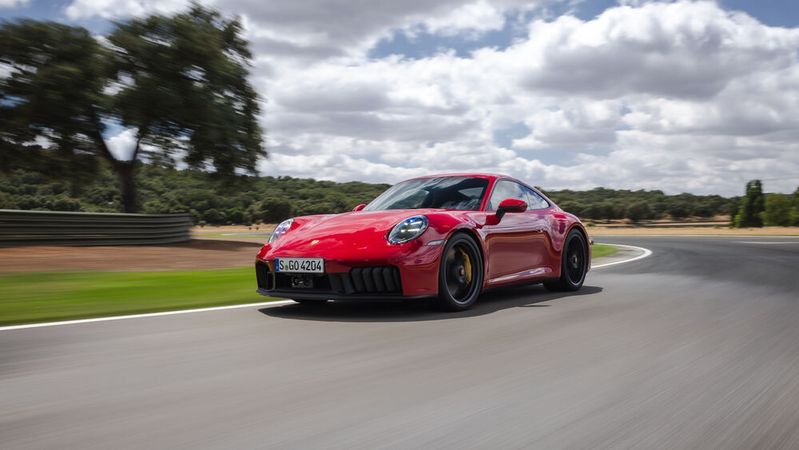
:quality(80)/p7i.vogel.de/wcms/43/bc/43bc0ef35f6303e6ec8226020bdbc398/0119416538v1.jpeg "Porsche is making a tremendous effort for the electric boost.(Image: Porsche)")
:quality(80)/p7i.vogel.de/wcms/60/fb/60fb8e69c985e7ab3cc7609b72352aee/0119416536v1.jpeg "The thermal models will be provided later.(Image: Porsche)")
:quality(80)/p7i.vogel.de/wcms/e5/ea/e5ea6abd5af4d7f5c6030f1c91d1f97a/0119416534v1.jpeg "Prices start at 170,600 euros for the coupe without and 178,800 euros with all-wheel drive, and 184,700 and 192,900 euros for the corresponding convertible or the targa only available with all-wheel drive.(Image: Porsche)")
:quality(80)/p7i.vogel.de/wcms/15/76/15767de3e91ae2ebdbec232dd6da7ad9/0119416531v1.jpeg "Driven sportily, the hybrid should be somewhat more economical than the previous GTS. But on paper it needs 10.5 liters - just like its predecessor.(Image: Porsche)")
:quality(80)/p7i.vogel.de/wcms/00/c9/00c995a3f608be396b744a44d588801e/0123951280v1.jpeg "Just in time for the start of spring, the Porsche Carrera S also enters the 992.2 generation. (Image:Porsche)")
:quality(80)/p7i.vogel.de/wcms/44/05/440559a04db9caf972de61aa993b028c/0124649008v1.jpeg "The Vantage Roadster is a luxury-class sports convertible with a V8 engine and 665 horsepower, wrapped in stunning design. (Aston Martin/Andy Morgan)")