A new pilot plant in Germany will enable the production of bio-based carbon fibers in the future. To this end, the processes are now being transferred to an industrial scale and the processes are being optimized. The plant is part of the Carbon Lab Factory Lausitz.
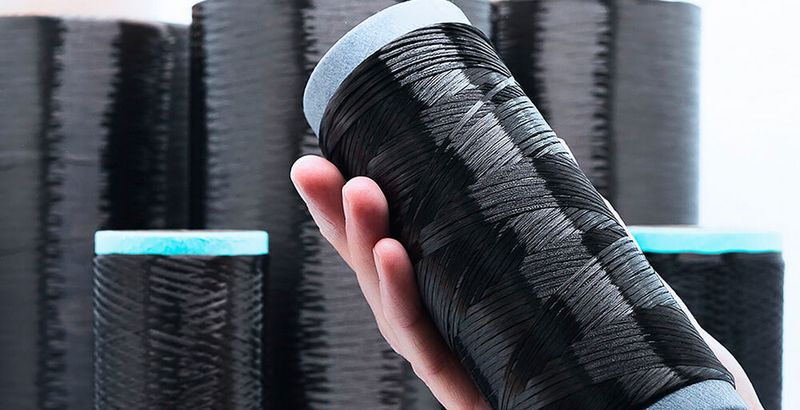
As part of the Carbon Lab Factory Lausitz, a pilot plant for the production of sustainable, cost-effective and competitive carbon fibers will be built at the Guben site.
(Image: Fraunhofer IAP / Kristin Stein)
Carbon fibers are high-performance materials that combine lightness with high strength and rigidity. They are particularly popular in lightweight construction—after all, it is an important lever for the development of high-performance and resource-efficient materials for key future industries. The lighter cars, airplanes, wind turbines or bicycles are, the more energy-efficiently they can be moved. But they are also becoming increasingly important for the generation, conversion and storage of energy, for example for batteries, fuel cells and other components of modern energy systems.
Conventional carbon fibers are mainly made from fossil raw materials. In order to expand the raw material base with sustainable alternatives, the focus is shifting to bio-based carbon fibers. They conserve resources, have a better CO2 balance and make the value chain more resilient. In addition, their properties can be specifically adapted to different applications. The industry is already showing strong demand for such alternatives.
Transferring Processes to An Industrial Scale
The production of bio-based carbon fibers is a specialty of the Fraunhofer IAP: In a first step, raw materials—e.g. cellulose or lignin from wood—are dissolved and spun into precursor fibers. These are then converted into carbon fibres through carbonization.
In order to transfer these processes to an industrial scale, a pilot plant is to be built in Guben as part of the Carbon Lab Factory Lausitz. The 58 million dollars project is being financed by the Brandenburg Ministry of Science, Research and Culture via Wirtschaftsregion Lausitz GmbH (WRL) and the federal government. The city of Guben is investing around 22 million dollars in the construction of the building in the Guben Industrial Park. The Fraunhofer IAP will use the remaining funding for the plant technology, material resources and initial equipment. The facilities are scheduled to go into operation from the end of 2029.
Focus on the Process Behaviour During Carbonization
Dr. André Lehmann, head of the Polymer Processing research division and the Fiber Technologies department at the Fraunhofer IAP, explains: "With the Carbon Lab Factory Lausitz in Guben, we are creating the conditions for a research and pilot infrastructure with which a wide variety of innovative precursor fibers can be produced up to the tonne scale."
Dr Jens Erdmann, head of the Polymer Engineering department at the Fraunhofer IAP, adds: "We are also setting up a laboratory carbonization plant that converts the novel precursor fibres into carbon fibres on a kilogram scale. This will allow us to efficiently assess the process behavior and potential, optimize the processes and gain valuable insights for a larger scale. We are also able to provide the industry with sample quantities for testing."
In close cooperation with partners in Lusatia, the Fraunhofer IAP is further developing the precursor and carbon fibers for various lightweight construction and energy applications and will thus specifically strengthen the transfer to industrial use.
Complementary to the Fraunhofer IAP project, a pilot plant for the production of carbon fibers on a ton scale is being set up in Lusatia, Saxony. The plant, operated by Chemnitz University of Technology (Germany), can process both conventional fibers and precursor fibers provided by the Fraunhofer IAP.
In cooperation with the Institute for Lightweight Construction and Value Creation Management at the Brandenburg University of Technology Cottbus-Senftenberg (Germany), carbon fiber-reinforced composite materials are also being tailored for a wide range of lightweight construction applications. Together with regional companies, the partners are testing demonstrators and prototypes. In this way, research results are transferred more quickly into industrial applications and the region is strengthened as a center for high-performance materials.
The Carbon Lab Factory Lusatia is embedded in the research infrastructure in Lusatia. "By combining the expertise of the participating institutions, the Carbon Lab Factory Lausitz is creating a globally unique, complete value chain in the region and beyond. This extends from renewable raw materials to components for lightweight construction applications," says Professor Böker, Director of the Fraunhofer IAP, who initiated the Carbon Lab Factory Lausitz together with Professor Kroll from Chemnitz University of Technology (Germany).
Date: 08.12.2025
Naturally, we always handle your personal data responsibly. Any personal data we receive from you is processed in accordance with applicable data protection legislation. For detailed information please see our privacy policy.
Consent to the use of data for promotional purposes
I hereby consent to Vogel Communications Group GmbH & Co. KG, Max-Planck-Str. 7-9, 97082 Würzburg including any affiliated companies according to §§ 15 et seq. AktG (hereafter: Vogel Communications Group) using my e-mail address to send editorial newsletters. A list of all affiliated companies can be found here
Newsletter content may include all products and services of any companies mentioned above, including for example specialist journals and books, events and fairs as well as event-related products and services, print and digital media offers and services such as additional (editorial) newsletters, raffles, lead campaigns, market research both online and offline, specialist webportals and e-learning offers. In case my personal telephone number has also been collected, it may be used for offers of aforementioned products, for services of the companies mentioned above, and market research purposes.
Additionally, my consent also includes the processing of my email address and telephone number for data matching for marketing purposes with select advertising partners such as LinkedIn, Google, and Meta. For this, Vogel Communications Group may transmit said data in hashed form to the advertising partners who then use said data to determine whether I am also a member of the mentioned advertising partner portals. Vogel Communications Group uses this feature for the purposes of re-targeting (up-selling, cross-selling, and customer loyalty), generating so-called look-alike audiences for acquisition of new customers, and as basis for exclusion for on-going advertising campaigns. Further information can be found in section “data matching for marketing purposes”.
In case I access protected data on Internet portals of Vogel Communications Group including any affiliated companies according to §§ 15 et seq. AktG, I need to provide further data in order to register for the access to such content. In return for this free access to editorial content, my data may be used in accordance with this consent for the purposes stated here. This does not apply to data matching for marketing purposes.
Right of revocation
I understand that I can revoke my consent at will. My revocation does not change the lawfulness of data processing that was conducted based on my consent leading up to my revocation. One option to declare my revocation is to use the contact form found at https://contact.vogel.de. In case I no longer wish to receive certain newsletters, I have subscribed to, I can also click on the unsubscribe link included at the end of a newsletter. Further information regarding my right of revocation and the implementation of it as well as the consequences of my revocation can be found in the data protection declaration, section editorial newsletter.



:quality(80)/p7i.vogel.de/wcms/c4/8f/c48fdd4e437b1bca2b0a2d3e77ec74ad/0130015902v1.jpeg "AI will gain importance in manufacturing in 2026. (Picture: ©miss irine - stock.adobe.com / AI-generated)")
:quality(80)/p7i.vogel.de/wcms/eb/9f/eb9f3da11ab6e979c15c195ff516b2ec/0130128194v1.jpeg "Clamping force 110,000 kilonewtons! This is the largest injection molding machine in the world currently under construction. It is being built at Engel in Austria and bears the name Duo 1200 US. Eight tie bars ensure stability. Find out more about this giant of plastics processing ... (Image:Angels)")
:quality(80)/p7i.vogel.de/wcms/1f/0f/1f0ffad77fb6daee3075c1d1534136c9/0130115952v1.jpeg "With the Trulaser Tube 7000, Trumpf has the latest generation of machines for laser tube processing to offer in time for Tube 2026. It is regarded as the most flexible and productive machine from Trumpf for this task ... (Image:Trump)")
:quality(80)/p7i.vogel.de/wcms/31/1f/311fb5b8aa1683b31cca284c8d33f443/0130073373v1.jpeg "Ceratizit has forged a very stable supply chain through a sophisticated and comprehensive recycling concept as well as through its holdings in tungsten mines. Here are some details ... (Image:Ceratite)")
:quality(80)/p7i.vogel.de/wcms/ab/23/ab2371c186380215b8311d1aeb4e47df/0130095643v1.jpeg "Geointelligent supply chain management provides valuable information, for example, about which control unit a microchip is installed in. (Picture: ©Aleksandr Matveev - stock.adobe.com)")
:quality(80)/p7i.vogel.de/wcms/b4/01/b401c197e3591f2bec3fb84ae810ac80/0130096280v1.jpeg "Only prophecies of doom! Jensen Huang, the head of chip giant Nvidia, dismisses any concerns that the huge sums currently being invested in AI data centers will not turn a profit one day ... (Image:Nvidia)")
:quality(80)/p7i.vogel.de/wcms/53/4f/534fe0f168f6ee070ded4a48faca4cef/business-wire-main-image-1103x620v1.jpeg "The new UR AI Trainer, developed by Universal Robots and Scale AI, is the first direct lab-to-factory solution for AI model training.
(Source: Universal Robots)")
:quality(80)/p7i.vogel.de/wcms/48/8a/488afa7c9416394023a5ea1095f4ee4b/rfc4800-1-787x443v1v1.jpeg "Precise, intelligent and robust sensors will play a key role in an increasingly automated and data-driven world. (Image:Novotechnology)")
:quality(80)/p7i.vogel.de/wcms/63/21/6321beb732bf7d92640df46d7aa77573/0130125122v1.jpeg "As part of the Carbon Lab Factory Lausitz, a pilot plant for the production of sustainable, cost-effective and competitive carbon fibers will be built at the Guben site. (Image:Fraunhofer IAP / Kristin Stein)")
:quality(80)/p7i.vogel.de/wcms/08/70/087062e2e1a9b9add5777410dd746ee9/adobestock-1923991605-5607x3156v1v1.jpeg "A new type of tactile sensor, inspired by human skin, even recognizes grains of sand. (Image:Curioso.Photography - stock.adobe.com)")
:quality(80)/p7i.vogel.de/wcms/7f/08/7f087d7013424d123ab7275cd2e3fe55/adobestock-809456218--c2-a9-20degimages-20-e2-80-93-20stock-adobe-com-ki-generiert-4179x2351v1v1.jpeg "The digital upgrading of existing machines conserves resources, saves energy and reduces the need for new production. (Image:Degimages - stock.adobe.com/AI-generated)")
:quality(80)/p7i.vogel.de/wcms/95/48/954885de5a930b6770191d7f35b477c4/0130110863v1.jpeg "Honda will not be launching the two electric cars 0 Saloon and 0 SUV presented in 2025 after all (Image:Honda)")
:quality(80)/p7i.vogel.de/wcms/34/e2/34e2a9e46e59eb28f09f9a5fdf41ff9a/0130091813v1.jpeg "Electrical drive trains require a multidimensional concept of performance characterization. Rohde & Schwarz has developed the MXO 3 oscilloscope series for this purpose. (Image:Rohde & Schwarz)")
:quality(80)/p7i.vogel.de/wcms/c9/2a/c92af18e41b077a518994a2ba60eb09f/0130037726v1.jpeg "The Renault subsidiary has presented a new brand strategy (Image:Alpine)")
:quality(80)/p7i.vogel.de/wcms/d8/fc/d8fc13ba0ae6e2180b3954cb1f1bd34c/0130060162v1.jpeg "Volkswagen has started series production of the ID Unyx 08. The model was developed in collaboration with Xpeng. (Image:Volkswagen)")
:quality(80)/p7i.vogel.de/wcms/33/4a/334a40bdce62798bd6eb90957e222d6a/0130085649v1.jpeg "From hardware manufacturer to software provider: Neocortec is increasingly licensing its NeoMesh protocol stack directly to OEMs and third-party manufacturers instead of relying exclusively on selling its own radio modules. (Image:mc/VCG)")
:quality(80)/p7i.vogel.de/wcms/5f/4a/5f4aae3a1c19fb2b1a2df58925afeca1/0130111244v1.jpeg "Power saver for the IoT: The Npzero module takes over sensor monitoring and sends the main processor into deep sleep. (Image:Manuel Christa)")
:quality(80)/p7i.vogel.de/wcms/0c/ac/0cacda94ed641488ba0ac4b9daa2bce5/0130073615v1.jpeg "Part of the experimental set-up for a quantum physics experiment in the laboratory of the Institute of Physics at Humboldt-Universität zu Berlin, Adlershof (Germany) campus. (Image:HU Berlin/S. Klenke)")
:fill(fff,0)/images.vogel.de/vogelonline/companyimg/76800/76895/65.jpg "FAULHABER_120mm.jpg ()")
:fill(fff,0)/p7i.vogel.de/companies/69/88/69882c428938e/tmts2026-ticec-banner-en-2000px.png "tmts2026-ticec-banner-en-2000px (https://www.tmts.tw/en)")
:quality(80):fill(efefef,0)/p7i.vogel.de/wcms/68/2b/682b2c790057d/elatec-titelbild-wp7-pac.png "Elatec Titelbild WP7 PAC")
:quality(80)/p7i.vogel.de/wcms/69/6b/696b9eb173d989320b480ef7e8f61a2a/0127406677v1.jpeg "The bio-based polymer Caramid is derived from 3-Caren, a terpene that occurs as a by-product in large quantities during cellulose production. Terpenes are natural organic compounds found in many plant parts such as leaves, flowers, and roots, and are the main components of resins and essential oils. (Image:Fraunhofer IGB)")
:quality(80)/p7i.vogel.de/wcms/83/14/8314dd76b76ddfcd3d5bdb4c8cf4a507/0125953757v1.jpeg "Stabilization oven for the oxidation of PAN fibers (Image:DITF)")