If you want to make machine tools more productive through higher feed rates and greater dynamics, you need to dissipate or compensate for the heat generated. Redex offers cooling-optimized and cooled rack and pinion drives and gearboxes for these purposes.
To maintain the precision of the machine tool at higher torques and speeds, heat must be dissipated from the drive train.
(Image: Redex)
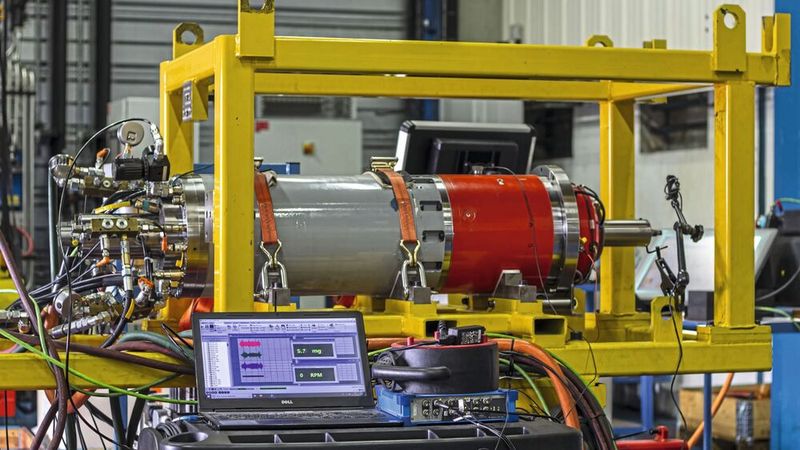
Not long ago, milling tables were limited to the production of prismatic parts with drilling and/or threading operations, whose round shapes were created through low-speed milling. Today, a multitasking machining center can produce cylindrical parts through high-speed turning and milling/drilling on the same machine—in a single setup—immediately boosting productivity. The only catch is that at too high speeds and torques, the resulting heat can lead to inaccuracies in machining.
Cooled motors and gearboxes are available for multitasking machine tools with high continuous speeds.
(Image: Redex)
The development of an outstanding multi-purpose machine tool requires adjustments in the drive type and machine structure to combine power, versatility, and precision. Technological changes are necessary for this.
Motor manufacturers already offer air- or water-cooled versions of motors that enable high continuous rotation speeds at acceptable operating temperatures. In this context, Redex has developed cooling options for its gearboxes over recent years. This way, heat is dissipated, and an operating temperature is maintained that aligns with the precision expected by the end user from a multitasking machine.
Possible Drive Solutions for Machine Tools
When selecting a suitable drive solution for linear movements for a new machine tool, three options are available:
Direct drive (linear motor)
Ball screw drive
Rack and pinion drive
Linear motors have become largely unaffordable due to the cost of magnetic elements, cables and additional cooling components. The high power consumption compared to servo motors also makes this option unattractive.
Although ball screws are widely used in the general machine tool market, they also have disadvantages when installed in multitasking machines: for example, heat build-up after repeated and intensive movement of the ball screw leads to positioning errors due to thermal expansion. This undesirable effect could affect the ability of the machine tool structure to pass the ISO 230-3:2020-6 tests for thermal deformation.
Taking these factors into account, rack and pinion drives prove to be a good solution for controlling the thermal behavior of feed drives in large multi-purpose machines. Redex has developed cooling-optimized rack and pinion drives for highly dynamic and heavy-duty movements.
Advantages of Cooling-Optimized Rack and Pinion Drives
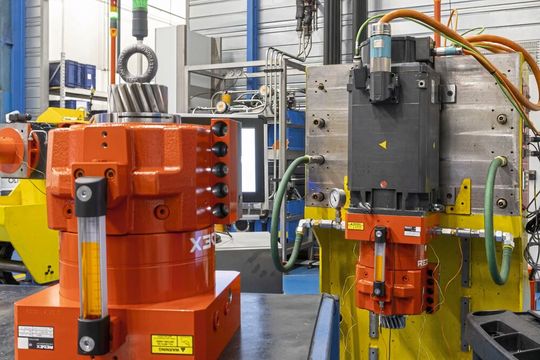
With cooled rack and pinion drives, there is no need to compensate for thermally induced changes in length when controlling the linear movement.
(Image: Redex)
Cooling-optimized rack and pinion drives are characterized by a low temperature at the contact point between the pinion and rack, regardless of the feed speed. In addition, there is no critical speed at high feed speeds, as the rack and pinion mesh at low speeds. Another practical feature is the modular and freely extendable travel length using rack segments, as well as the high and constant rigidity regardless of the position.
Cooled rack and pinion drives allow for easier control of the linear motion of a machine tool without the need to compensate for thermally induced length changes that can sometimes occur when using a ball screw or uncooled rack and pinion drive.
Keep Cool Under Pressure
The manufacturer has developed several cooling options to protect the drive from heat buildup when used in high-dynamic machine tools, such as multitasking models.
The company draws on its experience: About 40 years ago, it developed water-cooled, two-stage gearboxes for high-torque high-speed spindle drives in machine tools. It was the first manufacturer to offer cooled hollow shaft gearboxes to achieve a satisfactory operating temperature in the integration between the motor and the spindle. This gearbox maintained an operating temperature delta (Delta T) that was about 10 °C lower than that of the spindle and motor, even at speeds of up to 12,000 RPM.
In the latest development, the work of the engineering department focused on the newest generation of gearbox motors. Both the motor and the gearbox have been equipped with a cooling circuit to dissipate heat. This system ensures a low operating temperature. As a result, the spindle structure remains stable, which is necessary for precise turning and milling operations.
Predicting the Operating Temperature of Gearboxes
The rated power of planetary gearboxes is derived from the theoretical bearing and gear load capacities as a function of the load level at different speeds and the calculated service life. Redex engineers have developed a numerical model that can be used to predict the operating temperature of gearboxes and, in particular, their thermal behavior and efficiency. This model makes it possible to extrapolate a torque curve corresponding to the constant (thermal) power of the system in a given configuration. A test program with the RP series planetary gearboxes showed the correlation between theoretical and experimental data.
Date: 08.12.2025
Naturally, we always handle your personal data responsibly. Any personal data we receive from you is processed in accordance with applicable data protection legislation. For detailed information please see our privacy policy.
Consent to the use of data for promotional purposes
I hereby consent to Vogel Communications Group GmbH & Co. KG, Max-Planck-Str. 7-9, 97082 Würzburg including any affiliated companies according to §§ 15 et seq. AktG (hereafter: Vogel Communications Group) using my e-mail address to send editorial newsletters. A list of all affiliated companies can be found here
Newsletter content may include all products and services of any companies mentioned above, including for example specialist journals and books, events and fairs as well as event-related products and services, print and digital media offers and services such as additional (editorial) newsletters, raffles, lead campaigns, market research both online and offline, specialist webportals and e-learning offers. In case my personal telephone number has also been collected, it may be used for offers of aforementioned products, for services of the companies mentioned above, and market research purposes.
Additionally, my consent also includes the processing of my email address and telephone number for data matching for marketing purposes with select advertising partners such as LinkedIn, Google, and Meta. For this, Vogel Communications Group may transmit said data in hashed form to the advertising partners who then use said data to determine whether I am also a member of the mentioned advertising partner portals. Vogel Communications Group uses this feature for the purposes of re-targeting (up-selling, cross-selling, and customer loyalty), generating so-called look-alike audiences for acquisition of new customers, and as basis for exclusion for on-going advertising campaigns. Further information can be found in section “data matching for marketing purposes”.
In case I access protected data on Internet portals of Vogel Communications Group including any affiliated companies according to §§ 15 et seq. AktG, I need to provide further data in order to register for the access to such content. In return for this free access to editorial content, my data may be used in accordance with this consent for the purposes stated here. This does not apply to data matching for marketing purposes.
Right of revocation
I understand that I can revoke my consent at will. My revocation does not change the lawfulness of data processing that was conducted based on my consent leading up to my revocation. One option to declare my revocation is to use the contact form found at https://contact.vogel.de. In case I no longer wish to receive certain newsletters, I have subscribed to, I can also click on the unsubscribe link included at the end of a newsletter. Further information regarding my right of revocation and the implementation of it as well as the consequences of my revocation can be found in the data protection declaration, section editorial newsletter.
With this approach, the company predicts and evaluates the thermal operating limits in order to propose the optimal solution for heat dissipation and determine the most suitable cooling method.
Details of the RP Gearbox Series
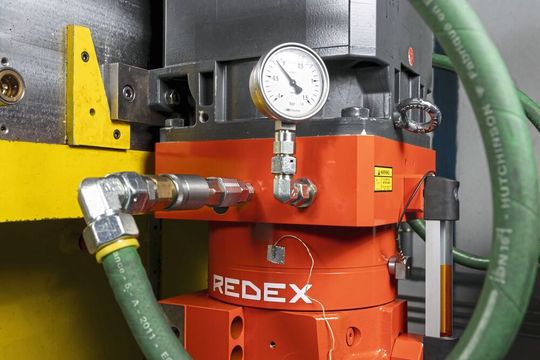
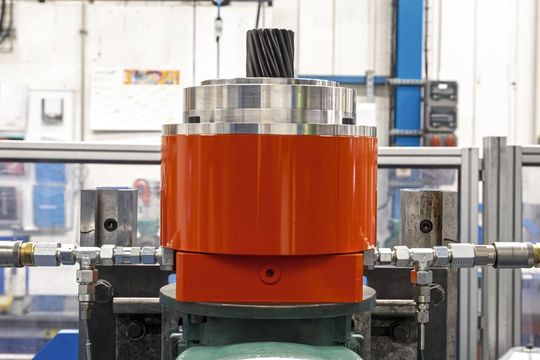
The RP planetary gearbox series offers two cooling options: Standard and special configuration. The standard configuration is a form of external forced lubrication in which cooling is achieved by recirculating the lubricating oil bath in a closed circuit, allowing losses to be dissipated via an oil/water or oil/air exchanger.
Redex offers a choice of forced lubrication or a cooling jacket as cooling options for the RP gearbox series.
(Image: Redex)
As a distinguishing feature from competitors, Redex offers holes as standard in both the SRP and KRP series gearboxes as well as those in the KRPX series, which facilitate the internal circulation of the coolant.
If the requirements of an application exceed the thermal capacity of a drive, the standard cooling option for RP series drives is a suitable option. For cooling drives on large multi-purpose machine tools, this is the simplest and most cost-effective solution from this manufacturer.
In the special versions, a cooling jacket is used instead of the external forced lubrication. The additional cooling jacket increases the size, weight and cost of the standard gearbox, but can be very effective for certain applications.
Application Tests with Temperature Control and Digital Twin
The company often develops and produces application-specific solutions for machine tool manufacturers. It tests these, including running tests with full temperature control and checking the nominal data of the gearbox. To support accurate simulations, the manufacturer has developed modeling systems that use digital twins.



:quality(80)/p7i.vogel.de/wcms/72/a0/72a0ffc94f0929c8b193b4bc40638d72/0129755066v1.jpeg "Tens of billions less! After Ford and General Motors, Stellantis is now also feeling the painful consequences of Donald Trump's decision to change its electric car strategy ... (Image:Stellantis)")
:quality(80)/p7i.vogel.de/wcms/7f/fd/7ffd32863352c40f562f4245e4766e61/0129745849v1.jpeg "After US President Donald Trump once again resorted to his favorite weapon, tariffs, concerns rose in the EU that the so-called tariff deal could become invalid. But it looks as if the sea remains relatively calm ... (Image:F. Schneidler)")
:quality(80)/p7i.vogel.de/wcms/53/69/5369bed136061188d873441dfefd6d6e/0129245111v1.jpeg "The company revised the factory layout even though construction work had already begun. (Image:Efeso Management Consultants)")
:quality(80)/p7i.vogel.de/wcms/d2/d7/d2d79e3fb84663cb7e918c88f123989b/0129733908v1.jpeg "Mineral decision! This is how lithium is mined. There is a lot of it in Chile, Australia, Bolivia and also in Zimbabwe. However, the latter country has now announced that the export of all minerals, including lithium concentrate, will be stopped. Read more about the reasons here ... (Image:Largbatt)")
:quality(80)/p7i.vogel.de/wcms/d9/bd/d9bd1bfa7d02f586e092f06c61ee3d9a/0129464423v1.jpeg "This is what the Black Soldier Fly (BSF) looks like. The first impression is of a common two-winged insect. But appearances are deceptive, because its larvae are true protein reactors, whose industriousness is now to be exploited for food ... (Image:Fly Friends)")
:quality(80)/p7i.vogel.de/wcms/13/4d/134dee0c2b8af6b4f28937ca5b586e0d/0129499541v1.jpeg "The industry now needs to build a flexible, powerful and sovereign infrastructure that can exploit the full potential of artificial intelligence while guaranteeing control over data and processes. (Picture: ©Gorodenkoff - stock.adobe.com)")
:quality(80)/p7i.vogel.de/wcms/c6/71/c671ce338f12be49d39d1b04b40a54f7/0129697443v1.jpeg "Claas is working on making its combine harvesters fit for refurbishment. (Image:Claas)")
:quality(80)/p7i.vogel.de/wcms/f2/4b/f24b8f1c3070e7f13e4f0ffd7854e75a/0129653538v1.jpeg "The production of the BMW iX3 is to be taken as far as possible in terms of sustainability. This is also ensured by the climate-friendly Blueprint recycled steel from Thyssenkrupp Steel ... (Image:BMW)")
:quality(80)/p7i.vogel.de/wcms/f5/7e/f57ef535ee35e7b3b7ff15a8a63cef10/eds-keyvisual-8000x4496v1.jpeg "(Source: European Defence Supply)")
:quality(80)/p7i.vogel.de/wcms/af/a3/afa312176d956068af20491957eef642/newsimage418262-3100x1745v1v1.jpeg "The autonomous shuttle of the Aula AI project during a demonstration of sensor data with artificial fog. (Image:University of Magdeburg)")
:quality(80)/p7i.vogel.de/wcms/84/2d/842d51915fa4fe69c72da5cc4ba52ed1/newsimage418103-3408x1917v1v1.jpeg "3 Printing can also be sustainable—if recyclable ink is used. (Image:Hereon/Steffen Niemann)")
:quality(80)/p7i.vogel.de/wcms/b0/78/b078e07634ffd4d5ee6b73af42cc7c55/newsimage418259-1000x563v1v1.jpeg "Magnesium during forming. (Image:TU Bergakademie Freiberg)")
:quality(80)/p7i.vogel.de/wcms/c7/5e/c75e5942cd1d7e6bce973391af6dafe8/0129757614v1.jpeg "Pony.ai is cooperating with Moore Threads to bring Level 4 autonomous driving to the roads in China more quickly. (Image:Pony.ai)")
:quality(80)/p7i.vogel.de/wcms/a8/9f/a89ff7a3e28a19c03a22fd16cf3404b4/0129761837v1.jpeg "KD and Hitachi High-Tech have concluded a distribution agreement. (Image:KD)")
:quality(80)/p7i.vogel.de/wcms/29/b5/29b536a22d9b5ac80387b02620cce554/20260212-sue-60-6000x3372v1v1.jpeg "The People Mover at its world premiere. The large polycarbonate windshield is clearly visible. One of several materials contributed by Covestro. (Image:UE | STUDIOS)")
:quality(80)/p7i.vogel.de/wcms/a0/3e/a03e71cec3a956df095607a0b176a7b0/0129584071v1.jpeg "Andreas Mindt will be Head of Design at the Volkswagen Group from March. (Image:Volkswagen AG)")
:quality(80)/p7i.vogel.de/wcms/eb/4e/eb4e449562174ec95a5b3d30fb0137a2/0129648135v1.jpeg "The III-V germanium PV module with an efficiency of 34.2% is currently the most efficient solar module in the world. (Image:Jacob Forster)")
:quality(80)/p7i.vogel.de/wcms/92/c2/92c23fd5d95286c8c8c634314f6b22f8/0129722027v1.jpeg "The Meta Group has signed a five-year contract for GPU and CPU deliveries to expand its AI capacities. The agreement covers the delivery of up to 6 gigawatts of GPU computing power with a total value of around USD 60 billion. (Image:freely licensed)")
:quality(80)/p7i.vogel.de/wcms/01/77/017742db7d5eb5964c297bb8917df701/0129696639v1.jpeg "Mini-STX K3921-N: The motherboard masters Intel's Core i3 and N-Series processors and can connect multiple monitors with Full HD. (Image:Kontron)")
:quality(80)/p7i.vogel.de/wcms/17/21/1721b98b7580a86c7790f607395878a1/0129697493v1.jpeg "Universal: Motors are used everywhere. (Image:Microchip Technology)")
:fill(fff,0)/images.vogel.de/vogelonline/companyimg/76800/76895/65.jpg "FAULHABER_120mm.jpg ()")
:fill(fff,0)/p7i.vogel.de/companies/69/88/69882c428938e/tmts2026-ticec-banner-en-2000px.png "tmts2026-ticec-banner-en-2000px (https://www.tmts.tw/en)")
:fill(fff,0)/p7i.vogel.de/companies/67/eb/67eba621ef6ea/logo2.png "logo2 (Wuxi InfiMotion)")
:quality(80)/p7i.vogel.de/wcms/c7/0e/c70e7d014eca846c4a835f1e10b89335/0125940639v1.jpeg "The KLLT profile rail guides adapt well to substructures with minor shape errors, which are often found in handling axes and assembly automation. (Image:Schaeffler)")
:quality(80)/p7i.vogel.de/wcms/73/41/73412c1a6fe312e62e55bdb9bd223fdc/0128086375v1.jpeg "Specifically for cleanrooms such as in battery production or the semiconductor industry, Igus has developed a new cleanroom-compatible ball bearing made of wear-resistant high-performance plastics. (Image:Igus)")