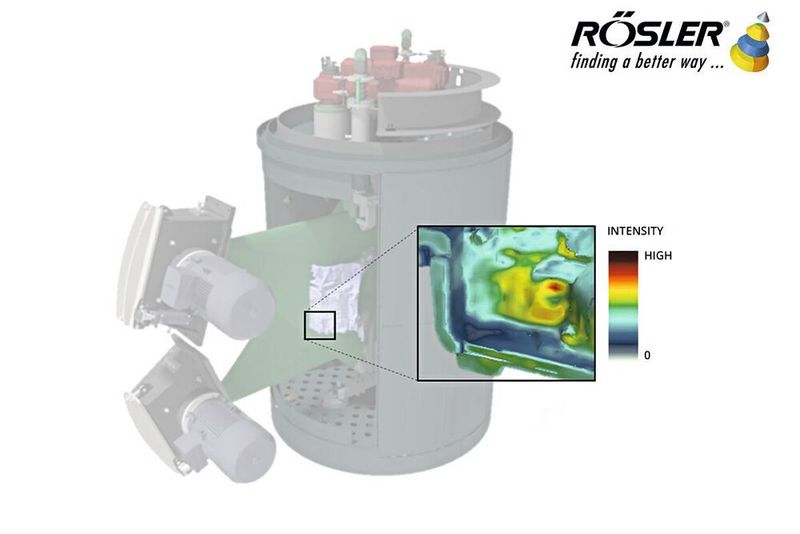
Blasting processes are indispensable in many industrial sectors. Regardless of the processing objective, the aim is to achieve the required blasting result in the shortest possible time, at the lowest possible cost and with minimal use of resources. Rösler meets these requirements through the use of state-of-the-art simulation software.
Completely quantitative simulation of blasting processes.
(Image: Rösler)
Whether it's cleaning blasting, deburring, pre-paint treatment or shot peening - blasting systems ensure the surface properties required for optimal further processing or product function in various applications. In these processes, companies face the task of improving productivity and cost efficiency and reducing energy and resource consumption. Rösler supports this through the use of the most modern simulation software for the design of blasting plants and the process design and optimization.
Results in line with requirements with the greatest possible efficiency
The simulation software allows all relevant physical processes of the blasting process as well as the workpieces to be processed to be displayed in 3D. This includes the fact that the type, amount, and flow of blasting media can be realistically simulated. The data generated in what's known as particle simulation allows precise statements about the amount of blasting material required and the energy with which it must hit the workpiece surfaces in order for a 100 percent coverage to be achieved. At the same time, based on this information, the necessary power and ideal positioning of the turbines in the blast chamber and corresponding workpiece holders can be defined. This results in blasting systems and processes that achieve the required result with the smallest possible number of turbines and a minimized energy input and wear. Investment and operating costs as well as resource consumption are thus minimized.
Gallery
Another advantage is that blasting systems for new components can be planned based solely on the CAD data of the workpieces - i.e. before real workpieces are available and the system can therefore be put into operation at the start of production. Time-consuming and costly tests with real parts are largely eliminated.
In addition, the simulation also provides insights into whether a component can be blasted in accordance with requirements in the given geometry. If this is not the case, the simulation results provide clues for component optimization.
Shorter planning time and improved process quality for large systems
The planning and commissioning of large blasting plants for components with a length of for example 20 meters, a width of five meters and a height of four meters and above, poses a special challenge. For workpieces with these dimensions, there are rarely facilities available for testing. The simulation and virtual verification of the blasting processes and results therefore make an important contribution to high process quality and efficiency for these systems. That's why Rösler has internally developed an additional tool for modeling appropriate systems and blasting processes. The realistic and correct depiction of the blasting patterns and blasting medium mass flows contributes to a high level of investment security on the one hand. On the other hand, the planning phase and commissioning of the plant take significantly less time.
Process bulk batches faster
In the case of blasting bulk material, for example in multi-tumbler systems (RMT), the mixing of blast goods and blasting media significantly influences the processing time and result. Here, among other things, the simulation of the drum-shaped blast chamber geometry allows the parts to be turned over more optimally, significantly reducing processing times. Concretely, this has already resulted in a time saving of around 25 percent per batch, which is equivalent to a corresponding increase in throughput.
Whether standard or large blasting plant - the filter system, along with the turbine, is one of the energy-intensive units of a blasting plant. Therefore, the air volume flow for extracting the dust created during blasting is also precisely examined by means of flow simulation. If the dust can be extracted more effectively through improved air guidance, the required filter size can possibly be reduced and energy saved. In any case, optimized extraction ensures shorter cycle times and thus higher productivity. In addition, the processed parts come out of the plant cleaner, which reduces the cleaning effort.
Digital turbine twin for efficiency improvement
In order to further reduce energy consumption and wear while increasing efficiency at the same time, Rösler works with digital twins of the blasting turbines. Through the complete integration of the particle flow, it can be virtually traced where wear occurs on the turbine and which geometric changes need to be made to minimize it. Corresponding simulations are also being conducted for a further increase in turbine efficiency, which contributes to additional energy savings.
Through the wide use of simulation technology both for the design of blasting systems and processes and for the optimization of extraction and turbine technology, Rösler's blasting systems are not only available faster. They also stand out due to their energy-saving and low-wear operation, thus providing the greatest possible customer benefit.
The development of vibratory grinding processes for the individual part processing of geometrically complex and difficult to process workpieces, such as knee implants, has so far required numerous series of tests. Therefore, such applications, for which a drag finisher is usually used, are also the focus of simulation technology at Rösler.
Date: 08.12.2025
Naturally, we always handle your personal data responsibly. Any personal data we receive from you is processed in accordance with applicable data protection legislation. For detailed information please see our privacy policy.
Consent to the use of data for promotional purposes
I hereby consent to Vogel Communications Group GmbH & Co. KG, Max-Planck-Str. 7-9, 97082 Würzburg including any affiliated companies according to §§ 15 et seq. AktG (hereafter: Vogel Communications Group) using my e-mail address to send editorial newsletters. A list of all affiliated companies can be found here
Newsletter content may include all products and services of any companies mentioned above, including for example specialist journals and books, events and fairs as well as event-related products and services, print and digital media offers and services such as additional (editorial) newsletters, raffles, lead campaigns, market research both online and offline, specialist webportals and e-learning offers. In case my personal telephone number has also been collected, it may be used for offers of aforementioned products, for services of the companies mentioned above, and market research purposes.
Additionally, my consent also includes the processing of my email address and telephone number for data matching for marketing purposes with select advertising partners such as LinkedIn, Google, and Meta. For this, Vogel Communications Group may transmit said data in hashed form to the advertising partners who then use said data to determine whether I am also a member of the mentioned advertising partner portals. Vogel Communications Group uses this feature for the purposes of re-targeting (up-selling, cross-selling, and customer loyalty), generating so-called look-alike audiences for acquisition of new customers, and as basis for exclusion for on-going advertising campaigns. Further information can be found in section “data matching for marketing purposes”.
In case I access protected data on Internet portals of Vogel Communications Group including any affiliated companies according to §§ 15 et seq. AktG, I need to provide further data in order to register for the access to such content. In return for this free access to editorial content, my data may be used in accordance with this consent for the purposes stated here. This does not apply to data matching for marketing purposes.
Right of revocation
I understand that I can revoke my consent at will. My revocation does not change the lawfulness of data processing that was conducted based on my consent leading up to my revocation. One option to declare my revocation is to use the contact form found at https://contact.vogel.de. In case I no longer wish to receive certain newsletters, I have subscribed to, I can also click on the unsubscribe link included at the end of a newsletter. Further information regarding my right of revocation and the implementation of it as well as the consequences of my revocation can be found in the data protection declaration, section editorial newsletter.



:quality(80)/p7i.vogel.de/wcms/a0/47/a04725ef9bd09fb6c9341a1bea1b5d93/0130443083v1.jpeg "Here, a type of plastic pallet is produced by thermoforming (vacuum forming or deep drawing) at the corresponding division of New England Plastics in the USA. This division, which specializes in so-called liners, is now part of Ringmetall ... (Image:New England Plastics)")
:quality(80)/p7i.vogel.de/wcms/23/99/23992bf2dcdc432c9b7209c34a4a7c48/0129733089v1.jpeg "Stork relies on the modular Neoswiss turning system from Iscar to shorten the set-up times for its sliding headstock lathes and work more productively. (Image:Iscar)")
:quality(80)/p7i.vogel.de/wcms/7d/e2/7de2923434b2f1a78ba5482d8d335269/0113143253v1.jpeg "In our China Market Insider we regularly provide you with relevant information directly from China. (Image:© Eisenhans - stock.adobe.com)")
:quality(80)/p7i.vogel.de/wcms/9d/2b/9d2b802f800e5caf17b2831e74228cd3/screenshot-202026-03-03-20103822-609x343v1v1.png "Visual comparison: on the left, a clean, burr-free cut edge; on the right, typical burr formation with oxidation discoloration. This illustrates how strongly parameter control and gas management influence the quality of the result. (CO₂ laser, oxygen cutting gas, sheet thickness approx. 15 mm). (Image:Picture: Rime)")
:quality(80)/p7i.vogel.de/wcms/b7/36/b736dfebc16c42d6901d0d0e1f390493/3d-druck-20factory-20--20ki-20generiert-1920x1079v1.png "(Source: AI-generated)")
:quality(80)/p7i.vogel.de/wcms/79/b2/79b21aad663f4a7bd4472afc1c1afc62/0130433994v1.jpeg "Mission Joyride: The free-flying robot (shown here in the rendering) will relieve the ISS crew of logistics tasks from 2027 with its two mechanical arms. (Image:Icarus Robotics)")
:quality(80)/p7i.vogel.de/wcms/6b/45/6b4546fa6ebf305c3660326909363f32/0130437089v1.jpeg "Industrial AI in action: Rockwell Automation presents practical solutions for self-controlling production systems at the Hannover Messe. (Image:Rainer Jensen, Deutsche Messe)")
:quality(80)/p7i.vogel.de/wcms/78/e9/78e9188c25a8a94e67c34c9bf8ffe495/visual-agile-20robots-20and-20google-20deepmind-20partner-20to-20bring-20intelligence-20to-20robotics-2500x1406v1v1.jpeg "Together, the partners are developing adaptable, intelligent robots for a wide range of applications (Image:Agile Robots SE)")
:quality(80)/p7i.vogel.de/wcms/59/a2/59a2b11f0aa1b700eff02addd5de8703/adobestock-1788280853--c2-a9-20satria-20-e2-80-93-20stock-adobe-com-5081x2860v1v1.jpeg "Quantum computers require extreme cooling to temperatures close to absolute zero in order to keep qubits stable. (Image:satria - stock.adobe.com)")
:quality(80)/p7i.vogel.de/wcms/49/38/493876a248943456b7e4a6db6edfc454/0130230765v1.jpeg "Safe and reliable in aircraft construction: light-curing adhesive bond combined with universal fastening elements. (Source: Delo)")
:quality(80)/p7i.vogel.de/wcms/b5/c7/b5c749d16c8a2e789c1469c2c8c1c387/0130452780v1.jpeg "Volvo Trucks completes road tests with its new hydrogen-powered trucks. (Image:Volvo Trucks)")
:quality(80)/p7i.vogel.de/wcms/ba/69/ba6975f417a85147084f38dc2cd209e2/0130451386v1.jpeg "Together with Nvidia, Hyundai wants to develop an architecture that will be used for level 4 robotaxis (image) as well as for level 2 customer vehicles. (Image:Hyundai)")
:quality(80)/p7i.vogel.de/wcms/93/4d/934de334b47abaa526c78cba1417d7af/0130343495v1.jpeg "The new SU7 is available in three price categories, \"Standard\", \"Pro\" and \"Max\" (Image:Xiaomi)")
:quality(80)/p7i.vogel.de/wcms/df/a0/dfa048434bb94f1b7d030e346b25b3ae/0130373541v1.jpeg "From August, BMW will be producing the i3 at its main plant in Munich - which the car manufacturer has extensively rebuilt for this purpose. (Image:Rainer Haeckl)")
:quality(80)/p7i.vogel.de/wcms/ee/09/ee09acbd6dc896df25affaa9e871e6e5/0130440053v1.jpeg "IMS chip module for simple system integration into an ion mobility spectrometer. (Image:Fraunhofer IPMS)")
:quality(80)/p7i.vogel.de/wcms/10/6c/106cd22de5f68a0f74639d654827228c/0130345302v1.jpeg "Made in India: According to the India Electronics and Semiconductor Association (IESA), the country should be able to produce between 75 and 80 million chips by the beginning of 2027, once the plants currently under construction become operational. (Image:Pixabay (Montage: Sebastian Gerstl))")
:quality(80)/p7i.vogel.de/wcms/a5/ed/a5ed6fda029d362732a293d6b19d74c4/0130444216v1.jpeg "Thirteen executives from the Chinese chip industry have drawn up a plan to achieve an 80% self-sufficiency rate for semiconductors by 2030. (Image:Maxim_Kazmin - stock.adobe.com)")
:quality(80)/p7i.vogel.de/wcms/31/a6/31a646018b34d8e0a44bfc8bf17837f6/0130361632v1.jpeg "For many companies, PFAS are considered indispensable in electronics production. (Image:freely licensed)")
:fill(fff,0)/images.vogel.de/vogelonline/companyimg/76800/76895/65.jpg "FAULHABER_120mm.jpg ()")
:fill(fff,0)/p7i.vogel.de/companies/69/88/69882c428938e/tmts2026-ticec-banner-en-2000px.png "tmts2026-ticec-banner-en-2000px (https://www.tmts.tw/en)")
:quality(80)/p7i.vogel.de/wcms/1f/a4/1fa43304fb7f2b80b0386587263f9bd7/0116743724.jpeg "Flow analysis including particle deposition of an exhaust box.(Image: Rösler)")
:quality(80)/p7i.vogel.de/wcms/22/9f/229fdb09eb425263f97ffa0ab315131b/0116743727.jpeg "Analysis and optimization of vibratory finishing processes with regard to the movement and effect of the grinding media on the component.(Image: Rösler)")
:quality(80)/p7i.vogel.de/wcms/cf/6c/cf6c0a82951e420e7c5960569bbd10a8/0116743722.jpeg "Completely quantitative simulation of blasting processes.(Image: Rösler)")
:quality(80)/p7i.vogel.de/wcms/5e/47/5e47efbcf1fcb05112b89b96157fb024/0123946657v1.jpeg "With its 75 meters in length and a production volume of 122,000 tons per year, the preservation line KON 47/3-HD is a powerhouse. (Image:Rösler)")
:quality(80)/p7i.vogel.de/wcms/c8/d8/c8d800c47b002d6d225ea7410a689326/0127880018v1.jpeg "The new setup concept further reduces processing time. Previously, the worms had to be clamped on both sides; now, they are simply placed in the workpiece holder. (Image:Rösler Oberflächentechnik GmbH)")