In the EU project InShaPe, the project partners optimized the additive manufacturing of metals. To achieve this, the researchers combined AI-driven beam shaping with multispectral imaging (MSI) in powder bed fusion of metals (PBF-LB/M). The results: manufacturing rate sextupled, production costs halved, energy consumption and material waste significantly reduced.
Manufacturing rate sextupled, production costs halved, energy consumption and material waste significantly reduced while simultaneously improving component quality—this summarizes the research results of the EU project InShaPe.
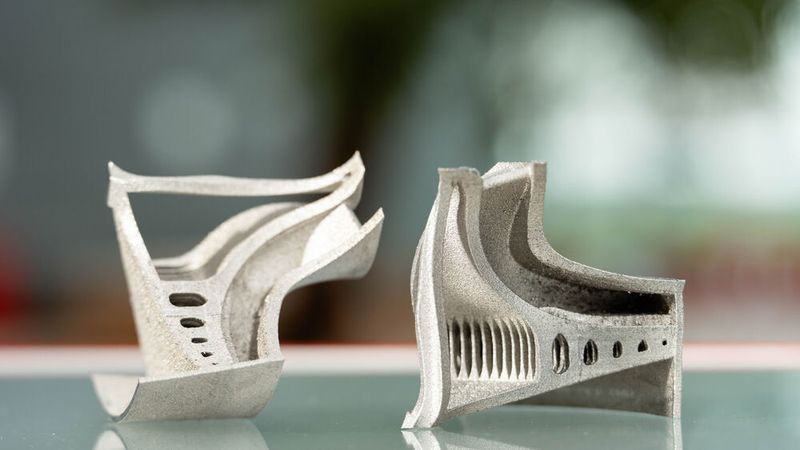
(Image: Frederik Watzka)
Powder bed-based additive manufacturing of metals is now considered a key technology for producing complex metal components. Nevertheless, rigid laser beam profiles and insufficient process monitoring methods often cause issues in the melting process, leading to material defects and production stoppages. This results in waste, increased energy consumption, and production costs, while fundamentally slowing down the production process. In the EU project InShaPe, a consortium addressed these challenges and developed a new manufacturing approach combining AI-driven beam shaping and multispectral imaging in its research work. The project aimed to significantly improve the efficiency, cost-effectiveness, and sustainability of this manufacturing process. These innovations were successfully tested by the project partners on five demanding industrial demonstrators from aerospace, the energy sector, and mechanical engineering. The Chair for Laser-based Additive Manufacturing at the Technical University of Munich (TUM) coordinated the project and carried it out together with ten other partners from eight countries. The European Union supported InShaPe with $8.48 million USD from the "Horizon Europe" framework program.
Productivity Increased Sixfold—New Manufacturing Process Proves Effective in Practice
The InShaPe project partners succeeded in significantly increasing the productivity of the PBF-LB/M process. For various industrial applications, they achieved productivity increases of over 600 percent (6.2x), including production rates of up to 5.69 in³/hfor Inconel 718 components. The original production rate was 0.91 in³/h. At the same time, the consortium managed to reduce costs by 50 percent, achieving a key project objective. Inconel 718 is a nickel-chromium alloy characterized by high strength, corrosion resistance, and heat resistance. It is commonly used for components exposed to high temperatures, pressures, or corrosive environments, such as in aerospace.
The innovation of beam shaping and multispectral imaging (MSI) was demonstrated by the project partners in five industrial use cases: an impeller for aerospace (Inconel 718), an industrial gas turbine part (Inconel 718), a part of a spacecraft combustion chamber (CuCrNb), a cylinder head for a chainsaw engine (AlSi10Mg), and components of satellite antennas for space communication.
AI-Driven Beam Shaping And Multispectral Imaging in Interaction
The intelligent beam shaping and multispectral imaging work closely together to significantly improve the additive manufacturing process. The laser beam profile is adapted specifically for each component, taking geometry and material into account. This improves the quality of the component and enables faster processing by reducing defects such as cracks, splashes, and condensate formation, which would otherwise cause rework and/or waste. During the InShaPe research, a ring-shaped beam profile—combined with optimized scanning strategies—proved particularly advantageous for diverse applications. Here, the laser energy is applied not through a Gaussian profile but through a ring-shaped intensity distribution to create the melt pool. This results in a more stable melt zone and more uniform material processing.
In parallel, the new multispectral imaging captures signals in different wavelength ranges and monitors the PBF-LB/M process in real time. This allows thermal changes in the melt pool to be detected early. The captured data flows directly into process control. Errors that previously led to production interruptions or rework can now be corrected, enabling the process to continue without significant delays.
We look forward to this technology being integrated into industrial systems in the near future, contributing to advancements in process control, quality assurance, and application performance across various sectors.
Prof. Dr.-Ing. Katrin Wudy
Pioneer for the Industrial Adoption of Serial Production
Overall, this approach marks an important advancement toward industrial serial production using PBF-LB/M: the interplay of intelligent beam shaping and MSI-based process control results in a more stable melting process, reduces sources of error, and enables targeted, resource-efficient energy use. This allows complex metal components to be produced faster, more cost-effectively, and more sustainably—while achieving higher quality and significantly increased productivity. InShaPe thus paves the way for the accelerated industrial adoption of AI-driven beam shaping and MSI-based process control, strengthening technological progress in additive manufacturing—particularly for the aerospace, energy, and automotive industries. "There is significant interest from academia and industry in our work. We look forward to seeing this technology integrated into industrial systems in the near future, contributing to advancements in process control, quality assurance, and application performance across various sectors," says InShaPe coordinator Prof. Dr.-Ing. Katrin Wudy from the School of Engineering and Design at the Technical University of Munich.
Date: 08.12.2025
Naturally, we always handle your personal data responsibly. Any personal data we receive from you is processed in accordance with applicable data protection legislation. For detailed information please see our privacy policy.
Consent to the use of data for promotional purposes
I hereby consent to Vogel Communications Group GmbH & Co. KG, Max-Planck-Str. 7-9, 97082 Würzburg including any affiliated companies according to §§ 15 et seq. AktG (hereafter: Vogel Communications Group) using my e-mail address to send editorial newsletters. A list of all affiliated companies can be found here
Newsletter content may include all products and services of any companies mentioned above, including for example specialist journals and books, events and fairs as well as event-related products and services, print and digital media offers and services such as additional (editorial) newsletters, raffles, lead campaigns, market research both online and offline, specialist webportals and e-learning offers. In case my personal telephone number has also been collected, it may be used for offers of aforementioned products, for services of the companies mentioned above, and market research purposes.
Additionally, my consent also includes the processing of my email address and telephone number for data matching for marketing purposes with select advertising partners such as LinkedIn, Google, and Meta. For this, Vogel Communications Group may transmit said data in hashed form to the advertising partners who then use said data to determine whether I am also a member of the mentioned advertising partner portals. Vogel Communications Group uses this feature for the purposes of re-targeting (up-selling, cross-selling, and customer loyalty), generating so-called look-alike audiences for acquisition of new customers, and as basis for exclusion for on-going advertising campaigns. Further information can be found in section “data matching for marketing purposes”.
In case I access protected data on Internet portals of Vogel Communications Group including any affiliated companies according to §§ 15 et seq. AktG, I need to provide further data in order to register for the access to such content. In return for this free access to editorial content, my data may be used in accordance with this consent for the purposes stated here. This does not apply to data matching for marketing purposes.
Right of revocation
I understand that I can revoke my consent at will. My revocation does not change the lawfulness of data processing that was conducted based on my consent leading up to my revocation. One option to declare my revocation is to use the contact form found at https://contact.vogel.de. In case I no longer wish to receive certain newsletters, I have subscribed to, I can also click on the unsubscribe link included at the end of a newsletter. Further information regarding my right of revocation and the implementation of it as well as the consequences of my revocation can be found in the data protection declaration, section editorial newsletter.
Future-Proof Authentication with Universal RFID Readers



:quality(80)/p7i.vogel.de/wcms/72/a0/72a0ffc94f0929c8b193b4bc40638d72/0129755066v1.jpeg "Tens of billions less! After Ford and General Motors, Stellantis is now also feeling the painful consequences of Donald Trump's decision to change its electric car strategy ... (Image:Stellantis)")
:quality(80)/p7i.vogel.de/wcms/7f/fd/7ffd32863352c40f562f4245e4766e61/0129745849v1.jpeg "After US President Donald Trump once again resorted to his favorite weapon, tariffs, concerns rose in the EU that the so-called tariff deal could become invalid. But it looks as if the sea remains relatively calm ... (Image:F. Schneidler)")
:quality(80)/p7i.vogel.de/wcms/53/69/5369bed136061188d873441dfefd6d6e/0129245111v1.jpeg "The company revised the factory layout even though construction work had already begun. (Image:Efeso Management Consultants)")
:quality(80)/p7i.vogel.de/wcms/d2/d7/d2d79e3fb84663cb7e918c88f123989b/0129733908v1.jpeg "Mineral decision! This is how lithium is mined. There is a lot of it in Chile, Australia, Bolivia and also in Zimbabwe. However, the latter country has now announced that the export of all minerals, including lithium concentrate, will be stopped. Read more about the reasons here ... (Image:Largbatt)")
:quality(80)/p7i.vogel.de/wcms/d9/bd/d9bd1bfa7d02f586e092f06c61ee3d9a/0129464423v1.jpeg "This is what the Black Soldier Fly (BSF) looks like. The first impression is of a common two-winged insect. But appearances are deceptive, because its larvae are true protein reactors, whose industriousness is now to be exploited for food ... (Image:Fly Friends)")
:quality(80)/p7i.vogel.de/wcms/13/4d/134dee0c2b8af6b4f28937ca5b586e0d/0129499541v1.jpeg "The industry now needs to build a flexible, powerful and sovereign infrastructure that can exploit the full potential of artificial intelligence while guaranteeing control over data and processes. (Picture: ©Gorodenkoff - stock.adobe.com)")
:quality(80)/p7i.vogel.de/wcms/c6/71/c671ce338f12be49d39d1b04b40a54f7/0129697443v1.jpeg "Claas is working on making its combine harvesters fit for refurbishment. (Image:Claas)")
:quality(80)/p7i.vogel.de/wcms/f2/4b/f24b8f1c3070e7f13e4f0ffd7854e75a/0129653538v1.jpeg "The production of the BMW iX3 is to be taken as far as possible in terms of sustainability. This is also ensured by the climate-friendly Blueprint recycled steel from Thyssenkrupp Steel ... (Image:BMW)")
:quality(80)/p7i.vogel.de/wcms/f5/7e/f57ef535ee35e7b3b7ff15a8a63cef10/eds-keyvisual-8000x4496v1.jpeg "(Source: European Defence Supply)")
:quality(80)/p7i.vogel.de/wcms/af/a3/afa312176d956068af20491957eef642/newsimage418262-3100x1745v1v1.jpeg "The autonomous shuttle of the Aula AI project during a demonstration of sensor data with artificial fog. (Image:University of Magdeburg)")
:quality(80)/p7i.vogel.de/wcms/84/2d/842d51915fa4fe69c72da5cc4ba52ed1/newsimage418103-3408x1917v1v1.jpeg "3 Printing can also be sustainable—if recyclable ink is used. (Image:Hereon/Steffen Niemann)")
:quality(80)/p7i.vogel.de/wcms/b0/78/b078e07634ffd4d5ee6b73af42cc7c55/newsimage418259-1000x563v1v1.jpeg "Magnesium during forming. (Image:TU Bergakademie Freiberg)")
:quality(80)/p7i.vogel.de/wcms/c7/5e/c75e5942cd1d7e6bce973391af6dafe8/0129757614v1.jpeg "Pony.ai is cooperating with Moore Threads to bring Level 4 autonomous driving to the roads in China more quickly. (Image:Pony.ai)")
:quality(80)/p7i.vogel.de/wcms/a8/9f/a89ff7a3e28a19c03a22fd16cf3404b4/0129761837v1.jpeg "KD and Hitachi High-Tech have concluded a distribution agreement. (Image:KD)")
:quality(80)/p7i.vogel.de/wcms/29/b5/29b536a22d9b5ac80387b02620cce554/20260212-sue-60-6000x3372v1v1.jpeg "The People Mover at its world premiere. The large polycarbonate windshield is clearly visible. One of several materials contributed by Covestro. (Image:UE | STUDIOS)")
:quality(80)/p7i.vogel.de/wcms/a0/3e/a03e71cec3a956df095607a0b176a7b0/0129584071v1.jpeg "Andreas Mindt will be Head of Design at the Volkswagen Group from March. (Image:Volkswagen AG)")
:quality(80)/p7i.vogel.de/wcms/eb/4e/eb4e449562174ec95a5b3d30fb0137a2/0129648135v1.jpeg "The III-V germanium PV module with an efficiency of 34.2% is currently the most efficient solar module in the world. (Image:Jacob Forster)")
:quality(80)/p7i.vogel.de/wcms/92/c2/92c23fd5d95286c8c8c634314f6b22f8/0129722027v1.jpeg "The Meta Group has signed a five-year contract for GPU and CPU deliveries to expand its AI capacities. The agreement covers the delivery of up to 6 gigawatts of GPU computing power with a total value of around USD 60 billion. (Image:freely licensed)")
:quality(80)/p7i.vogel.de/wcms/01/77/017742db7d5eb5964c297bb8917df701/0129696639v1.jpeg "Mini-STX K3921-N: The motherboard masters Intel's Core i3 and N-Series processors and can connect multiple monitors with Full HD. (Image:Kontron)")
:quality(80)/p7i.vogel.de/wcms/17/21/1721b98b7580a86c7790f607395878a1/0129697493v1.jpeg "Universal: Motors are used everywhere. (Image:Microchip Technology)")
:fill(fff,0)/images.vogel.de/vogelonline/companyimg/76800/76895/65.jpg "FAULHABER_120mm.jpg ()")
:fill(fff,0)/p7i.vogel.de/companies/69/88/69882c428938e/tmts2026-ticec-banner-en-2000px.png "tmts2026-ticec-banner-en-2000px (https://www.tmts.tw/en)")
:fill(fff,0)/p7i.vogel.de/companies/67/eb/67eba621ef6ea/logo2.png "logo2 (Wuxi InfiMotion)")
:quality(80)/p7i.vogel.de/wcms/dd/d4/ddd497299aa6fd4106fa8a78f9abca70/0125885537v1.jpeg "Prof. Dr.-Ing. Katrin Wudy, TUM School of Engineering and Design, coordinator of the EU project InShaPe(Image: Frederik Watzka)")
:quality(80)/p7i.vogel.de/wcms/fc/bf/fcbf153ea7e16166cb6975479ec6e6ad/0125885527v1.jpeg "Industrial gas turbine component for the energy sector (Material: IN718)(Image: Frederik Watzka)")
:quality(80)/p7i.vogel.de/wcms/5a/1d/5a1dd2914fae000c2fd7eeae27b2ccaf/0125885535v1.jpeg "Cylinder head of a chainsaw engine (Material: AlSi10Mg)(Image: Frederik Watzka)")
:quality(80)/p7i.vogel.de/wcms/c5/6d/c56d63a63ffaa3d05d839f440f4849be/0125885528v1.jpeg "Impeller for aerospace (Material: IN718)(Image: Frederik Watzka)")
:quality(80):fill(efefef,0)/p7i.vogel.de/wcms/67/ae/67ae0b9ac31f8/elatec-wp-universal-reader.png "Elatec WP Universal Reader")
:quality(80)/p7i.vogel.de/wcms/f1/c4/f1c437d2910f26c755f075c1483dc570/0125826799v1.jpeg "The additive manufacturing of metal is becoming more efficient, cheaper, and sustainable. This is the result of the research efforts by the Bayfor consortium. Read here about all the other achievements so far... (Image:TUM)")
:quality(80)/p7i.vogel.de/wcms/1c/18/1c188a2a23605e9e8d83344404d69eff/0128047590v1.jpeg "When the laser learns: Laser-based welding processes can be optimized in real time thanks to machine learning. (Image:Empa)")