For the production of accumulators within the scope of automotive electrification, manufacturers need pilot plants where coating variants and processing technologies can be tested under conditions close to production. A conversation with a Swiss engineering company that operates in this field worldwide.
Core elements of lithium-ion accumulators are thin metal foils coated on both sides with special masses. Quality assurance is carried out using CIS sensors.
(Image: Compar)
The automotive industry expects explosive growth in the coming decades with the transition from combustion to electric drives. The key to this is the further development of batteries, whose performance and costs have not yet met customer expectations. Manufacturers need pilot plants to test coating variants and processing technologies under production-like conditions. A Swiss engineering firm is active worldwide in this field.
"We have evolved from a manufacturer of textile dyeing machines to a globally active engineering partner for sophisticated coating technologies," reports Clemens Disch, Sales & Marketing Manager of Mathis AG in Oberhasli, Switzerland. With around 60 employees, the family-run company develops and implements state-of-the-art coating systems for high-tech industries such as the automotive sector, the chemical industry, the manufacturing of Li-ion batteries, and solar cell producers. As a partner to their customers, Mathis specialists help create truly functional plant technologies for new ideas and technological approaches. With such pilot plants, customers can test the practical feasibility of new approaches. This allows thorough examination of the feasibility of the plant concept, ensuring that large-scale plants built later with high capital expenditure deliver the desired results. For such projects, Mathis relies on a tightly-knit network of proven supply and development partners from the surrounding area.
"Although the principle has been known for some time, lithium-ion batteries remain one of the hottest development topics for automotive manufacturers," adds Nico Brand from the technical engineering department. The everyday usability of currently available solutions regarding range, charging speed, cycle stability, and cost cannot convince many customers. To make progress, numerous possible variants must be investigated and optimized. In principle, such a battery is made up of cells, each consisting of an anode and cathode with an intermediate separator foil. The anode is a copper foil coated with a graphite-containing anode material. The cathode consists of aluminum with a coating containing ions of transition metals such as cobalt, nickel, manganese, or iron. The separator foil is permeable to the lithium ions of the electrolyte, thus enabling charge transport. The coatings are applied as a pasty mass in one or multiple layers, either simultaneously or sequentially. They contain partly highly toxic solvents, requiring elaborate drying and exhaust air cleaning processes. The application is carried out by various methods such as slot die coating or doctor blades in thicknesses between 10 to 350 micrometers. To produce efficiently, as wide bands as possible are often processed industrially, on which separate strips are applied. Sometimes, the strips are also executed in an interrupted manner, creating separate "patches." Depending on the equipment, the coating is initially applied on only one side or simultaneously on both the top and bottom sides. In single-sided processes, the band is then coated on the opposite side in a second pass. For the production of the actual batteries, the finished bands are cut into appropriately sized pieces, with no offset allowed between the top and bottom sides.
Fast CIS special sensor technology for position control
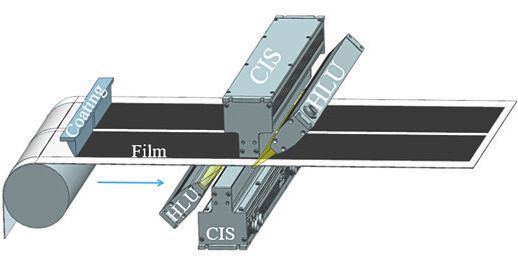
"One of the critical points in manufacturing such coating systems is thus the precise adherence to tight position tolerances between the layers on the top and bottom sides of the foils," explains Clemens Disch. The reference is always the band edge on the right in the running direction. Relative to this, the coating must maintain a defined distance with a position tolerance of ± 0.2 millimeters. The CCD camera systems used so far were not reliable; the current width of 760 millimeters (approx. 29,9 inches) already required the use of several cameras side by side. Instead, the choice fell on a so-called Contact Image Sensor (CIS). These are "line cameras," as also used in copying systems. However, much higher accuracy and speed are required for coating. The CIS sensor now used is 800 millimeters wide and consists of nearly 19,000 linearly arranged monochrome photocells with fixed-focus optics. The individual photocells have a spacing of 0.042 millimeters. Also integrated are two rows of LEDs, each in front of and behind the row of photocells. A significant difference from the simple CIS sensors in copiers is the scan speed, as the band running through at up to 10 meters (approx. 32,8 feet) per minute must be captured with a sampling rate of almost four MHz.
Another important aspect in selecting the sensor is the ability to handle the most challenging contrast ratios, from metallic shiny and reflective to matte black absorbing. Therefore, in this case, an additional setup with a diagonally arranged light bar was required. Two such systems are used per plant, one for the top and one for the bottom of the band. The upper sensor measures both the band edge position and the width of the coating(s), while the lower sensor only monitors the band position.
Date: 08.12.2025
Naturally, we always handle your personal data responsibly. Any personal data we receive from you is processed in accordance with applicable data protection legislation. For detailed information please see our privacy policy.
Consent to the use of data for promotional purposes
I hereby consent to Vogel Communications Group GmbH & Co. KG, Max-Planck-Str. 7-9, 97082 Würzburg including any affiliated companies according to §§ 15 et seq. AktG (hereafter: Vogel Communications Group) using my e-mail address to send editorial newsletters. A list of all affiliated companies can be found here
Newsletter content may include all products and services of any companies mentioned above, including for example specialist journals and books, events and fairs as well as event-related products and services, print and digital media offers and services such as additional (editorial) newsletters, raffles, lead campaigns, market research both online and offline, specialist webportals and e-learning offers. In case my personal telephone number has also been collected, it may be used for offers of aforementioned products, for services of the companies mentioned above, and market research purposes.
Additionally, my consent also includes the processing of my email address and telephone number for data matching for marketing purposes with select advertising partners such as LinkedIn, Google, and Meta. For this, Vogel Communications Group may transmit said data in hashed form to the advertising partners who then use said data to determine whether I am also a member of the mentioned advertising partner portals. Vogel Communications Group uses this feature for the purposes of re-targeting (up-selling, cross-selling, and customer loyalty), generating so-called look-alike audiences for acquisition of new customers, and as basis for exclusion for on-going advertising campaigns. Further information can be found in section “data matching for marketing purposes”.
In case I access protected data on Internet portals of Vogel Communications Group including any affiliated companies according to §§ 15 et seq. AktG, I need to provide further data in order to register for the access to such content. In return for this free access to editorial content, my data may be used in accordance with this consent for the purposes stated here. This does not apply to data matching for marketing purposes.
Right of revocation
I understand that I can revoke my consent at will. My revocation does not change the lawfulness of data processing that was conducted based on my consent leading up to my revocation. One option to declare my revocation is to use the contact form found at https://contact.vogel.de. In case I no longer wish to receive certain newsletters, I have subscribed to, I can also click on the unsubscribe link included at the end of a newsletter. Further information regarding my right of revocation and the implementation of it as well as the consequences of my revocation can be found in the data protection declaration, section editorial newsletter.
Swiss support for high-tech sensor from the Far East
"A suitable sensor is found in the product range of a Chinese manufacturer," Brand recalls. A decisive prerequisite for the choice was – in addition to fulfilling the required hardware properties – the comprehensive engineering support from its Swiss representative, Compar AG in nearby Freienbach. Compar is a system integrator for machine vision and robotics with decades of experience and has developed a software platform called Visionexpert for this purpose. Visionexpert is a flexible tool for solving various tasks in the field of image capture and optical defect detection. Thanks to its ease of use and numerous interfaces, it is ideal for the efficient development of customer-specific solutions.
After making contact in mid-2022, an initial order was placed in August. This was followed by several months of development cooperation, which proceeded to the mutual satisfaction of both parties. Compar set up the CIS sensors fully for the task, so no calibration is required later. In addition, the software was developed for optimal lighting adjustment, image evaluation, and translation into control signals for correcting the band position on the rollers.
Mathis was able to secure an initial order for a pilot coating system equipped with CIS sensors in January 2023, with the internal approval of the functionally assembled line occurring in May 2023. Customer approval followed after a successfully passed Factory Acceptance Test (FAT) in December 2023. The CIS sensor has been functioning smoothly since the first installation. Meanwhile, Mathis is already equipping a second line with this sensor technology, and four more projects are already in the pipeline.
Further projects planned
"Compar has decades of experience in developing camera-based systems for automation and quality control and has proven to be a competent and responsive partner," says Disch. The CIS system initially remained at Compar for two months after delivery to work out the optimal settings for different films and coating variants. This particularly involved the lighting, for which an additional inclined light bar was installed. Subsequently, the system was mounted on the pilot plant. Here, Mathis' software department integrated the signals from the CIS control into the PLC of the band system. The collaboration worked very well right from the start. Compar proved to be a development partner on an equal footing, always responding quickly to questions or problems. Even after the system was installed in the band system, Compar employees were often on-site within less than an hour if needed. They also had good experiences with online support and collaboration by phone. Compar has proven to be a supply partner with whom they look forward to engaging in further projects in the future, according to C. Disch.



:quality(80)/p7i.vogel.de/wcms/60/eb/60ebe43de41f833157b476b2e1641811/0130090160v1.jpeg "The Surface Control Automotive measuring system from Micro-Epsilon automatically detects dents, scratches and other surface defects on body shells. (Image:Micro-Epsilon)")
:quality(80)/p7i.vogel.de/wcms/26/8a/268aba929d72bd089234bd512aab9b08/0130487474v1.jpeg "The works meeting at Volkswagen is over! Here is a brief overview of the most important aspects ... (Image:VW)")
:quality(80)/p7i.vogel.de/wcms/50/63/5063e5b91e7897c13b882440c7f106d4/0128575929v1.jpeg "How is Edge AI changing the industry? Local data processing meets distributed intelligence to promote sustainability and efficiency. (Picture: ©tippapatt - stock.adobe.com)")
:quality(80)/p7i.vogel.de/wcms/a0/47/a04725ef9bd09fb6c9341a1bea1b5d93/0130443083v1.jpeg "Here, a type of plastic pallet is produced by thermoforming (vacuum forming or deep drawing) at the corresponding division of New England Plastics in the USA. This division, which specializes in so-called liners, is now part of Ringmetall ... (Image:New England Plastics)")
:quality(80)/p7i.vogel.de/wcms/29/d8/29d83fa92093c7f247429e060be46c7b/0130378625v1.jpeg "Secures and monitors circuits directly in the field: Turck's IP67 TBIF fuse with IO-Link (Image:Turck GmbH)")
:quality(80)/p7i.vogel.de/wcms/d3/3d/d33d26b35aa1e64f5c41d19d22c5c5dc/0130496518v1.jpeg "(Image:Speedbot)")
:quality(80)/p7i.vogel.de/wcms/f0/ca/f0caaaa9fc2347a5221760a94f92e831/0129880873v1.jpeg "Human-machine collaboration takes on a new quality. This is because the automation task is formulated in natural language and the AI takes over its implementation directly in the project. This allows users to implement Codesys projects more quickly. (Image:Codesys)")
:quality(80)/p7i.vogel.de/wcms/b7/36/b736dfebc16c42d6901d0d0e1f390493/3d-druck-20factory-20--20ki-20generiert-1920x1079v1.png "(Source: AI-generated)")
:quality(80)/p7i.vogel.de/wcms/79/b2/79b21aad663f4a7bd4472afc1c1afc62/0130433994v1.jpeg "Mission Joyride: The free-flying robot (shown here in the rendering) will relieve the ISS crew of logistics tasks from 2027 with its two mechanical arms. (Image:Icarus Robotics)")
:quality(80)/p7i.vogel.de/wcms/59/a2/59a2b11f0aa1b700eff02addd5de8703/adobestock-1788280853--c2-a9-20satria-20-e2-80-93-20stock-adobe-com-5081x2860v1v1.jpeg "Quantum computers require extreme cooling to temperatures close to absolute zero in order to keep qubits stable. (Image:satria - stock.adobe.com)")
:quality(80)/p7i.vogel.de/wcms/49/38/493876a248943456b7e4a6db6edfc454/0130230765v1.jpeg "Safe and reliable in aircraft construction: light-curing adhesive bond combined with universal fastening elements. (Source: Delo)")
:quality(80)/p7i.vogel.de/wcms/26/e1/26e1c8d1f56a588b078196508a069155/0130500702v1.jpeg "Hyundai plans a large truck for North America (Image:Hyundai)")
:quality(80)/p7i.vogel.de/wcms/61/eb/61eb2c9fe2ec3295593bd63ebc610f59/0130504331v1.jpeg "Headquarters of the Chinese truck start-up Zeron. (Image:Jiangsu 01 Automobile Technology/Screen shot)")
:quality(80)/p7i.vogel.de/wcms/c2/57/c257d627beec10e94252cde72830adf6/0130472803v1.jpeg "With the Twingo E-Tech, Renault is now launching a purely electrically powered new edition of the Twingo small car (Image:Renault)")
:quality(80)/p7i.vogel.de/wcms/c1/43/c143c24b62e51b848b2586b52bcd20e2/0130468443v1.jpeg "Jörg Burzer, Head of Development at Mercedes Benz Group AG (Image:Mercedes)")
:quality(80)/p7i.vogel.de/wcms/89/f2/89f2b2de703956abfb30ea456d77a463/0130471595v1.jpeg "The joint venture between TDK and Nippon Chemical Industrial focuses on the development of ceramic materials for electronic components. (Image:TDK Corporation)")
:quality(80)/p7i.vogel.de/wcms/e4/a0/e4a0da27805e96aa8976f04add4b3bec/0130458429v1.jpeg "Fit for extreme conditions: This illustration shows a photonic chip whose components have been bonded with high stability using the new connection technology. (Image:NIST)")
:quality(80)/p7i.vogel.de/wcms/9b/84/9b845ee38e4fb3c8ea07d1735d9e36fd/0130451629v1.jpeg "The windshield as a projection screen: a high-precision and low-latency system architecture is required for implementation. This requires the seamless integration of different technologies. (Image:Harman)")
:quality(80)/p7i.vogel.de/wcms/86/e0/86e09ea9c278d112c55b995b843abfee/0130494578v1.jpeg "PV system on the roof of the Elbfabrik, a Fraunhofer IFF research factory. A sensor system can detect faults in large-scale PV systems at an early stage. (Image:Fraunhofer IFF/Anne Bornkessel)")
:fill(fff,0)/images.vogel.de/vogelonline/companyimg/76800/76895/65.jpg "FAULHABER_120mm.jpg ()")
:fill(fff,0)/p7i.vogel.de/companies/68/a4/68a47beec75ce/logo-cmyk-de.jpeg "logo-cmyk-de (https://www.datatec.eu/)")
:quality(80)/p7i.vogel.de/wcms/40/75/40750ad541cf3fa9e32d70ae2d3b3dc0/0120104680v1.jpeg "In the elaborate drying section, the web is kept in suspension over the entire stretch using nozzles.(Image: Vollrath)")
:quality(80)/p7i.vogel.de/wcms/2d/8f/2d8f97d5ad05401244d4a8354a5fe798/0120104674v1.jpeg "A copper foil coated on both sides with graphite-containing anode mass in patch mode.(Image: Compar)")
:quality(80)/p7i.vogel.de/wcms/01/dc/01dc02da31c0141a94d04d642ee4eb03/0120104685v1.jpeg "\"With pilot plants, customers can validate new processes and thus ensure that the large plants built later also deliver the desired result,\" explains Clemens Disch, Sales & Marketing Manager at Mathis.(Image: Disch)")
:quality(80)/p7i.vogel.de/wcms/50/f9/50f97105e0ecd37beb9f945bfe5c9708/0120104696v1.jpeg "The control display gives an impression of the dimensions and complexity of the plant.(Image: Vollrath)")
:quality(80)/p7i.vogel.de/wcms/00/90/00907b4860e11d3060011778c1244187/0125027192v1.jpeg "The calendars from Dürr Ingecal are used for film compaction in both wet and dry coating. (Image:Dürr Systems AG)")
:quality(80)/p7i.vogel.de/wcms/6b/6f/6b6fff754fedf05375e5255460743297/0129197850v1.jpeg "A new core-shell design for anodes aims to reduce storage losses during the first charge cycle of sodium-ion batteries. (Image:BAM)")