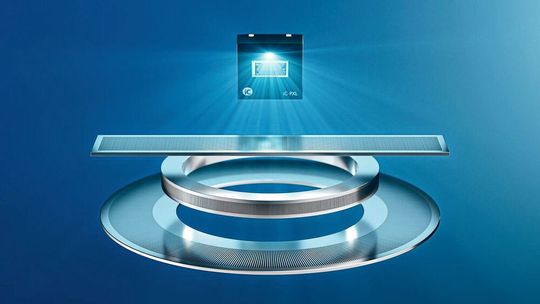
The iC-PXL3212 is an optical, reflective, and lens-less encoder IC. It features integrated HD phased array photo sensors and a blue LED chip. The encoder IC is suitable for a variety of applications.
Optical Encoder: The iC-PXL3212 developed by iC-Haus can be used in both linear and rotary applications. The encoder ICs can be used in medical technology, automobile manufacturing, or industry.
(Image: iC-Haus)
Goran Pandza is responsible for sales and application for encoder systems at iC-Haus.
The iC-PX series from iC-Haus offers optical, reflective, lens-less encoder ICs with integrated HD phased array photo sensors and a blue LED chip. The current generation of encoder ICs of the type iC-PXL3212 offers extended functionality and performance while maintaining a compact form factor, as it relies on the 180-nanometer CMOS process.
The newly added functions include higher digital interpolation and the possibility of operation in analog mode. The improved amplifier circuit achieves particularly high-quality analog signals. There is also OPT Flex Count, which in the factory allows resolution of the interpretation core to be defined according to the specific application. Another advantage of the iC-PXL3212 is that it can be used in both linear and rotary applications.
Optical Encoder for Medical Technology: Prosthetics Example
The technological advancement of the iC-PX not only improves well-known applications such as incremental rotary encoders, miniature motors, actuators, X-Y and linear tables, or robots for factory automation, but also opens up entirely new application areas for this encoder. A particularly promising segment is prosthetics within medical technology, especially the trend towards active prosthetic systems. Active prostheses offer the wearer improved stability and position recognition through direct current miniature motors and intelligent microprocessor control. As a result, stable and efficient movement is enabled that much closer resembles the natural movement apparatus than with passive prostheses.
The microprocessor used receives data from high-resolution angle and pressure sensors, on the basis of which it controls motion and damping mechanisms. A related application is active exoskeletons, which are increasingly being used in workplace safety and health care in logistics, construction, and industry. The iC-PXL3212 is well suited for such complex tasks due to its precision, processor performance, and functionality. The small form factor and generous alignment tolerances of about ±0.5 mm radially and tangentially meet typical requirements in prosthetics.
Use under special environmental parameters: Lidar and drones
Lidar sensors (Light Detection and Ranging) play a key role in a variety of applications, from autonomous driving to real-time measurements and drone navigation. In these systems, precise control of rotating mirrors, which distribute the laser light in a rotating manner, is essential for the accuracy and performance of Lidar measurements. Optical encoders play a crucial role in controlling the motion of rotating mirrors that distribute the laser light in a rotating manner. The components used always require a compact design and easy integration into machine systems. The iC-PXL3212 offers high accuracy and individual parameterization of the resolution. Especially for drones, the wide temperature range of -40 to 125 °C is advantageous.
Laser engraving for embodiment of measure
The principle of reflection scanning provides further flexibility in the application possibilities of the optical encoder iC-PXL3212. A blue LED with a wavelength of 460 to 480 nm is used. The optically high-resolution sensor can use a line pattern engraved directly into stainless steel and selected other metals with lasers as a measure embodiment. In contrast to adhesive measure embodiments, particularly dense and robust applications are created, which meet the high requirements for quality and service lives in medical technology, the automotive sector, or demanding industrial applications.
Development and integration into application production
iC-Haus offers comprehensive evaluation kits to support the use of its products in customer applications. These kits enable quick and efficient testing and evaluation of the sensor in the lab. The iC-PXL3212 is pre-installed on a circuit board, along with corresponding measure embodiments or code disks. By connecting with a second board, all output signals can be captured, facilitating the testing of various operating modes. The manufacturer iC-Haus offers customized layouts for code disks to meet the individual requirements and applications of customers. (heh)
Date: 08.12.2025
Naturally, we always handle your personal data responsibly. Any personal data we receive from you is processed in accordance with applicable data protection legislation. For detailed information please see our privacy policy.
Consent to the use of data for promotional purposes
I hereby consent to Vogel Communications Group GmbH & Co. KG, Max-Planck-Str. 7-9, 97082 Würzburg including any affiliated companies according to §§ 15 et seq. AktG (hereafter: Vogel Communications Group) using my e-mail address to send editorial newsletters. A list of all affiliated companies can be found here
Newsletter content may include all products and services of any companies mentioned above, including for example specialist journals and books, events and fairs as well as event-related products and services, print and digital media offers and services such as additional (editorial) newsletters, raffles, lead campaigns, market research both online and offline, specialist webportals and e-learning offers. In case my personal telephone number has also been collected, it may be used for offers of aforementioned products, for services of the companies mentioned above, and market research purposes.
Additionally, my consent also includes the processing of my email address and telephone number for data matching for marketing purposes with select advertising partners such as LinkedIn, Google, and Meta. For this, Vogel Communications Group may transmit said data in hashed form to the advertising partners who then use said data to determine whether I am also a member of the mentioned advertising partner portals. Vogel Communications Group uses this feature for the purposes of re-targeting (up-selling, cross-selling, and customer loyalty), generating so-called look-alike audiences for acquisition of new customers, and as basis for exclusion for on-going advertising campaigns. Further information can be found in section “data matching for marketing purposes”.
In case I access protected data on Internet portals of Vogel Communications Group including any affiliated companies according to §§ 15 et seq. AktG, I need to provide further data in order to register for the access to such content. In return for this free access to editorial content, my data may be used in accordance with this consent for the purposes stated here. This does not apply to data matching for marketing purposes.
Right of revocation
I understand that I can revoke my consent at will. My revocation does not change the lawfulness of data processing that was conducted based on my consent leading up to my revocation. One option to declare my revocation is to use the contact form found at https://contact.vogel.de. In case I no longer wish to receive certain newsletters, I have subscribed to, I can also click on the unsubscribe link included at the end of a newsletter. Further information regarding my right of revocation and the implementation of it as well as the consequences of my revocation can be found in the data protection declaration, section editorial newsletter.
Insight into the encoder IC
The iC-PXL3212 uses a blue LED with a wavelength of 460 to 480 nm. Together with a high-resolution optical sensor, this LED is used to scan a line pattern engraved or etched directly into stainless steel and other metals as a scale. The functionality is based on the blue LED emitting light with a wavelength that can be particularly well detected by the optical sensor.
By using blue LEDs instead of conventional infrared LEDs, the sensor can capture the measurement pattern with high resolution and accuracy. This approach enables particularly dense and robust applications, as the scale is directly incorporated into the metal rather than using an additional adhesive film. The combination of blue LED and high-resolution sensor in the iC-PXL3212 allows for precise position detection. This is especially advantageous for applications such as prosthetics, Lidar systems, or robotics.



:quality(80)/p7i.vogel.de/wcms/51/1b/511b420dbcc296aec09e3bffb051b8a8/0133581587v1.jpeg "The cables connect numerous machine components—often in confined spaces. (Image:Helu)")
:quality(80)/p7i.vogel.de/wcms/b5/67/b5676f3bfb36251ed31f9a0cccf650b6/0133167827v1.jpeg "Thanks to JumboFlex Generation 2, employees can effortlessly move wheelchairs weighing as much as 40 kilograms. (Image:Lard)")
:quality(80)/p7i.vogel.de/wcms/5e/c6/5ec615b7a51440f668259f2af9158cb9/0132654694v1.jpeg "Strategic Partnerships in Industry: As buyers and restructuring partners, Chinese investors are increasingly helping to preserve jobs in Germany. (Image: ©Anatolii Rymarchuk - stock.adobe.com)")
:quality(80)/p7i.vogel.de/wcms/eb/2b/eb2bd1b8487afe577b37363cd02f16ff/0113143253v1.jpeg "In our China Market Insider, we regularly provide you with relevant information straight from China. (Image:© Eisenhans - stock.adobe.com)")
:quality(80)/p7i.vogel.de/wcms/aa/3e/aa3e2603a812f8e7d33c00ba8ae28c9f/0133507886v1.jpeg "With the Iggy Rob, igus is bringing a humanoid robot into factories for a price of 47,999 euros ($54,718). (Image: igus)")
:quality(80)/p7i.vogel.de/wcms/92/64/92645c64ffbb6980976d39102388d120/0113143253v1.jpeg "In our China Market Insider, we regularly provide you with relevant information straight from China. (Image:© Eisenhans - stock.adobe.com)")
:quality(80)/p7i.vogel.de/wcms/c7/05/c70542511e0824ee491f7b55e21fa429/0133598424v1.jpeg "In logistics, AI is often implemented only on a case-by-case basis; data is stored in separate systems, and inventory levels, status values, and priorities are not defined consistently. (Image: ©m-project - stock.adobe.com)")
:quality(80)/p7i.vogel.de/wcms/3a/9c/3a9c1fd546e1f041b86bb1d03cf39101/0133610524v1.jpeg "The Mason W-01 combines industrial-grade humanoid hardware, Physical AI-based perception, and autonomous task planning. (Image:Nova X Robotics)")
:quality(80)/p7i.vogel.de/wcms/e7/94/e794290f265afbd0ffc7a06c4fe9d425/adobestock-1887113836--hypnotics-14-stock-adobe-com-ki-generiertv1.jpeg "In both autonomous driving and industrial production, there is growing skepticism as to whether full autonomy is always desirable. (Source: © Hypnotics 14 – stock.adobe.com / AI-generated)")
:quality(80)/p7i.vogel.de/wcms/a8/71/a8712e5c6ef536228444ab5275cedfe2/adobestock-340905887--gorodenkoff-stock-adobe-comv1.jpeg "A new position paper outlines the conditions that the business community, academia, and policymakers must jointly establish in order to ensure the long-term viability of industry in Germany and Europe. (Source: © Gorodenkoff – stock.adobe.com)")
:quality(80)/p7i.vogel.de/wcms/7d/eb/7deb25ca674fa4c781a9d1fab083f7cf/parker-entwicklungszentrum-hresv1.jpeg "The centerpiece of the Parker Center for Drive and Control Technology in Offenbach is the exhibition area. (Source: Parker Hannifin)")
:quality(80)/p7i.vogel.de/wcms/3d/ff/3dff5e51c24b30c8dc37c1d024887157/0133602931v1.jpeg "Just a few years ago, SpaceX specialists were working on the world’s largest rocket—the Starship. Now, Elon Musk’s company has reached a milestone during a test flight: Earth’s orbit! But there was also a downside... (Image: SpaceX)")
:quality(80)/p7i.vogel.de/wcms/78/ab/78abbfbab0565fabb19efe637aea30e8/nio-power-swap-station-4-china-guangzhou-2024-1400x933-jpgv1.webp "Nio and Geely are collaborating on battery replacement for electric cars. (Source: Nio)")
:quality(80)/p7i.vogel.de/wcms/2e/58/2e58c664e733dd182666606f850c5da4/0133400664v1.jpeg "The IM6 is sort of the crossover version of the IM5. (Image:MG Motor)")
:quality(80)/p7i.vogel.de/wcms/40/5f/405f41f4075e8798878011f0932a8195/0133509065v1.jpeg "Caruso has integrated Hyundai into its platform. (Image:Hyundai)")
:quality(80)/p7i.vogel.de/wcms/06/98/06989beb3f95b8fb06d71190c86cffde/tabletv1.jpeg "The cockpit view during a test drive in the simulator. (Source: Uccello et al., IEEE OJITS 2026)")
:quality(80)/p7i.vogel.de/wcms/40/34/4034915f85470ad8264659267e4f02d0/0133655653v1.jpeg "Cariad, Volkswagen's software subsidiary, continues to struggle. Now, another round of layoffs has been announced, which will result in the loss of many jobs ... (Image:Cariad)")
:quality(80)/p7i.vogel.de/wcms/e4/2a/e42af12e2a0816bb3d25fac9932903e9/0133646920v1.jpeg "TSMC's U.S. headquarters in Arizona: According to various media reports, the world's largest contract semiconductor manufacturer may be planning to build up to six additional fabs in the state of Texas. (Image:TSMC)")
:quality(80)/p7i.vogel.de/wcms/de/8c/de8c694e560ce8e8d7d43fa5b91917b3/0133668420v1.jpeg "Open-source AI tools: DeepSeek and Huawei are making programming tools for Ascend processors available, with the aim of simplifying development, chip communication, and AI computations on Huawei's hardware—and thereby intensifying competition with Nvidia. (Image:Dall-E / AI-generated)")
:quality(80)/p7i.vogel.de/wcms/86/25/8625a62499a6e70e629a2ddde2f01dcb/0133671173v1.jpeg "\"OpenAI\" has repeatedly experienced problems in which AI models have accessed the internet without authorization in order to carry out their tasks. The company has now fired three people whom it no longer trusts ... (Image:AI-generated)")
:fill(fff,0)/images.vogel.de/vogelonline/companyimg/76800/76895/65.jpg "FAULHABER_120mm.jpg ()")
:fill(fff,0)/p7i.vogel.de/companies/69/de/69de1b7403b0d/simtos-logo.jpeg "simtos-logo (SIMTOS)")
:quality(80)/p7i.vogel.de/wcms/3b/27/3b27f6c5848be73acecb04054bf0a146/0130115209v1.jpeg "Spectroscopic glucose measurement with infrared spectroscopy enables more regular measurements without physical strain. (Image:Endrich)")
:quality(80)/p7i.vogel.de/wcms/f3/56/f3568508f969e8560cf1c8d3a3f2885c/0127958464v1.jpeg "According to the manufacturer, Contrinex's photoelectric miniature sensors are the smallest optical sensors with integrated electronics on the market. They are available as diffuse sensors or through-beam sensors. (Image:Contrinex, Shutterstock/asharkyu)")