Plenty of space at a good price: The Opel Grandland relies on classic crossover virtues and is also suitable for long distances. Provided the right engine is chosen.
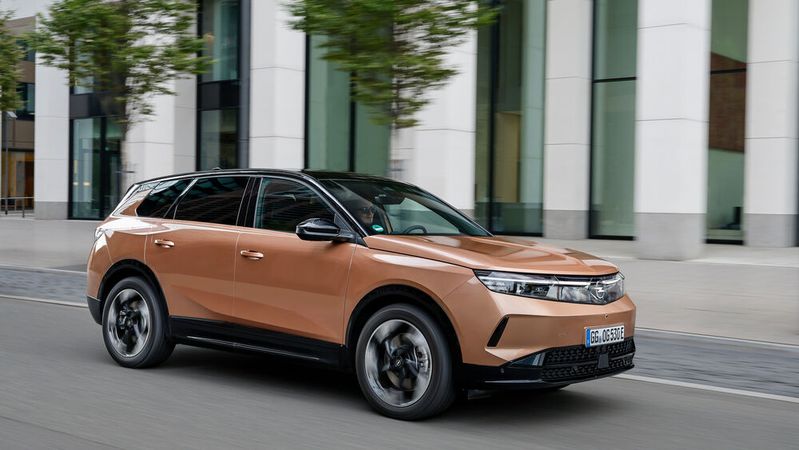
The Grandland has grown in the new generation.
(Image: Opel)
A bit more estate, a bit less SUV—the elongated proportions and the clean, elegant exterior suit the newly launched second generation of the Opel Grandland well. Visually, it has nothing in common with its somewhat chubby predecessor. At 4.65 meters (approx. 15.3 ft) in length, it surpasses competitors like the VW Tiguan and the Ford Kuga, sometimes significantly, and is around 18 centimeters (approx. 7 inches) longer than its own predecessor. Its height increase of three centimeters is barely noticeable: the new model appears much more elongated and dynamic than the first edition. This impression is supported by the purist and less playful body design with a closed grille and modern LED rear strip. The large Opel SUV has "grown up," one might justifiably say in this case.
This is also true for the interior, which is more understated compared to the more expressively designed technical twin, the Peugeot 3008. The Opel easily matches the quality of materials and workmanship: there's no bare or hard plastic in the cockpit, the airy second row, or the generously carpeted trunk. With all seats in place, there's room for 550 liters, and folding the divided rear seats down allows for 1,641 liters of luggage space. The Grandland is practical in front as well, offering a variety of storage options that accommodate everything from coins to large 1.5-liter plastic bottles. Particularly original is the closed smartphone charging tray with a dark-tinted window, which conceals but does not completely hide the phone—useful for when an incoming call lights up the display.
Stable Stellantis Infotainment System
The central control element in the driver's seat is a large touchscreen featuring the latest version of the Stellantis infotainment system. It now operates quickly and stably, and despite a wide range of functions, operation is generally smooth. The only exception is the seat and steering wheel heating, which, unlike other climate functions, no longer has physical buttons but only variably placed buttons on the display. The fact that these are not always visible in every screen setting is at least a minor drawback in the transitional seasons.
Opel has also not included classic instruments. Instead, there is a narrow screen behind the steering wheel for the essential driving information, flanked by the (optional) head-up display, which also shows speed limits and additional navigation instructions.
In tuning the suspension, Opel has attempted to distinguish itself somewhat from the more comfort-oriented French philosophy. Even though the dampers can sometimes be a bit unresponsive to short irregularities, the Grandland remains balanced overall. It's comfortable in the city, maneuverable in curves, and confident on the highway—in typical use scenarios, it impresses without aiming to set or wanting to set specific accents.
However, its forte remains long-distance—primarily due to its traditionally good seats. These are available in two quality levels—optionally with adjustable side bolsters. But even the basic version without climate control, massage, and electric adjustment is persuasive.
Electric Motor for City Driving
This is also generally true for the drive. The test car featured the most economical option, with 107 kW/145 HP, consisting of a robust 1.2-liter three-cylinder petrol engine and a six-speed dual-clutch transmission, along with a small 48-volt electric motor. The latter primarily assists the turbocharged engine during starts and in urban stop-and-go traffic. Remarkably, it frequently handles the drive power all on its own in these situations, while the petrol engine waits quietly in the background, ready to audibly kick in when the battery is empty or there is a higher power demand.
What works well in the city and gives the large SUV a nimble character reaches its limits in rural areas. The front-wheel-drive Opel takes more than ten seconds to reach 100 km/h (approx. 62 mph), necessitating good planning for typical overtaking maneuvers on country roads. Many might expect a little more poise from a car of this size. Here, the driver notices that the crossover, weighing around 1.6 tons, is not exactly a lightweight. Given this, the Opel performs decently in terms of fuel consumption, using about 6.4 liters per 100 kilometers (approx. 62 miles) on average. Those who manage to keep the car in electric coasting mode as often as possible, especially in the city and at a steady pace on country roads, can achieve consumption figures starting with a five.
A worthy alternative to the gasoline engine are the more electrified variants. The plug-in hybrid based on the four-cylinder is more refined and significantly more powerful. The electric motor also accelerates faster, is completely silent, and the least harmful to the climate. However, at just over 40,000 euros (45,708 USD) and nearly 47,000 euros (53,706.90 USD), both are also significantly more expensive than the gasoline version.
Date: 08.12.2025
Naturally, we always handle your personal data responsibly. Any personal data we receive from you is processed in accordance with applicable data protection legislation. For detailed information please see our privacy policy.
Consent to the use of data for promotional purposes
I hereby consent to Vogel Communications Group GmbH & Co. KG, Max-Planck-Str. 7-9, 97082 Würzburg including any affiliated companies according to §§ 15 et seq. AktG (hereafter: Vogel Communications Group) using my e-mail address to send editorial newsletters. A list of all affiliated companies can be found here
Newsletter content may include all products and services of any companies mentioned above, including for example specialist journals and books, events and fairs as well as event-related products and services, print and digital media offers and services such as additional (editorial) newsletters, raffles, lead campaigns, market research both online and offline, specialist webportals and e-learning offers. In case my personal telephone number has also been collected, it may be used for offers of aforementioned products, for services of the companies mentioned above, and market research purposes.
Additionally, my consent also includes the processing of my email address and telephone number for data matching for marketing purposes with select advertising partners such as LinkedIn, Google, and Meta. For this, Vogel Communications Group may transmit said data in hashed form to the advertising partners who then use said data to determine whether I am also a member of the mentioned advertising partner portals. Vogel Communications Group uses this feature for the purposes of re-targeting (up-selling, cross-selling, and customer loyalty), generating so-called look-alike audiences for acquisition of new customers, and as basis for exclusion for on-going advertising campaigns. Further information can be found in section “data matching for marketing purposes”.
In case I access protected data on Internet portals of Vogel Communications Group including any affiliated companies according to §§ 15 et seq. AktG, I need to provide further data in order to register for the access to such content. In return for this free access to editorial content, my data may be used in accordance with this consent for the purposes stated here. This does not apply to data matching for marketing purposes.
Right of revocation
I understand that I can revoke my consent at will. My revocation does not change the lawfulness of data processing that was conducted based on my consent leading up to my revocation. One option to declare my revocation is to use the contact form found at https://contact.vogel.de. In case I no longer wish to receive certain newsletters, I have subscribed to, I can also click on the unsubscribe link included at the end of a newsletter. Further information regarding my right of revocation and the implementation of it as well as the consequences of my revocation can be found in the data protection declaration, section editorial newsletter.
Fair Price for Mild Hybrid
With a price of 36,400 euros (41,594.28 USD) for the mild hybrid in the base "Edition" trim, the Grandland is fairly priced. Especially when compared to its Peugeot sibling, which is about 4,000 euros (4,570.80 USD) more expensive for the same powertrain. Opel does not skimp on features: with 19-inch wheels, dual-zone climate control, and parking assistance, all class standards are already on board. The top "GS" trim adds a few visual upgrades, matrix headlights, and a larger central display (16 instead of 10 inches). Additional equipment items are available in mostly well-packaged and reasonably priced bundles (1,100 to 2,900 euros, approx. 1,256 to 3,313 USD). Opel largely avoids single options beyond wheels and colors for cost and complexity reasons.
The Grandland offers what is required in its class: plenty of space, a modern appearance, and a bearable price level. One must be willing to accept that the base engine is not much more than the average. The Opel becomes more confident with the electric drives, which, however, are more demanding on the budget.
Secure and Compliant Authentication in Laboratories



:quality(80)/p7i.vogel.de/wcms/a0/47/a04725ef9bd09fb6c9341a1bea1b5d93/0130443083v1.jpeg "Here, a type of plastic pallet is produced by thermoforming (vacuum forming or deep drawing) at the corresponding division of New England Plastics in the USA. This division, which specializes in so-called liners, is now part of Ringmetall ... (Image:New England Plastics)")
:quality(80)/p7i.vogel.de/wcms/e3/42/e342b3c593ea92d56604d3be969e9c9a/0130437231v1.jpeg "Daimler Truck will be building even more trucks at its Czech plant in Cheb in the future. This is because it is now being expanded for strategic cost-saving reasons ... (Image:Daimler Truck)")
:quality(80)/p7i.vogel.de/wcms/23/99/23992bf2dcdc432c9b7209c34a4a7c48/0129733089v1.jpeg "Stork relies on the modular Neoswiss turning system from Iscar to shorten the set-up times for its sliding headstock lathes and work more productively. (Image:Iscar)")
:quality(80)/p7i.vogel.de/wcms/7d/e2/7de2923434b2f1a78ba5482d8d335269/0113143253v1.jpeg "In our China Market Insider we regularly provide you with relevant information directly from China. (Image:© Eisenhans - stock.adobe.com)")
:quality(80)/p7i.vogel.de/wcms/b7/36/b736dfebc16c42d6901d0d0e1f390493/3d-druck-20factory-20--20ki-20generiert-1920x1079v1.png "(Source: AI-generated)")
:quality(80)/p7i.vogel.de/wcms/79/b2/79b21aad663f4a7bd4472afc1c1afc62/0130433994v1.jpeg "Mission Joyride: The free-flying robot (shown here in the rendering) will relieve the ISS crew of logistics tasks from 2027 with its two mechanical arms. (Image:Icarus Robotics)")
:quality(80)/p7i.vogel.de/wcms/6b/45/6b4546fa6ebf305c3660326909363f32/0130437089v1.jpeg "Industrial AI in action: Rockwell Automation presents practical solutions for self-controlling production systems at the Hannover Messe. (Image:Rainer Jensen, Deutsche Messe)")
:quality(80)/p7i.vogel.de/wcms/78/e9/78e9188c25a8a94e67c34c9bf8ffe495/visual-agile-20robots-20and-20google-20deepmind-20partner-20to-20bring-20intelligence-20to-20robotics-2500x1406v1v1.jpeg "Together, the partners are developing adaptable, intelligent robots for a wide range of applications (Image:Agile Robots SE)")
:quality(80)/p7i.vogel.de/wcms/59/a2/59a2b11f0aa1b700eff02addd5de8703/adobestock-1788280853--c2-a9-20satria-20-e2-80-93-20stock-adobe-com-5081x2860v1v1.jpeg "Quantum computers require extreme cooling to temperatures close to absolute zero in order to keep qubits stable. (Image:satria - stock.adobe.com)")
:quality(80)/p7i.vogel.de/wcms/62/5f/625f41e87ebfef156a98c8e6393e32fd/0130211654v1.jpeg "Axial flux motors have some advantages over radial flux motor—but their production is currently still expensive. (Image:RWTH Aachen University)")
:quality(80)/p7i.vogel.de/wcms/f6/ae/f6aec4f6241b36ed5e3a990ac9176b42/0130429460v1.jpeg "Verne, Pony.ai and Uber want to launch a robotaxi service in Europe. (Image:Verne)")
:quality(80)/p7i.vogel.de/wcms/d7/88/d788699f2974708a332baa4e7a62fa9e/0130438967v1.jpeg "Skoda is withdrawing from China. The brand has produced well over three million vehicles there. (Image:Skoda car)")
:quality(80)/p7i.vogel.de/wcms/b0/43/b043b86899837532aad62d63368a917a/0130371361v1.jpeg "Skoda leaves the chinese market.
(Image:Skoda)")
:quality(80)/p7i.vogel.de/wcms/c3/c4/c3c4ce270b083eeac55654148611f064/0130237945v1.jpeg "China is not giving up on hydrogen, but is intensifying its efforts. (Image:freely licensed from Pixabay)")
:quality(80)/p7i.vogel.de/wcms/ee/09/ee09acbd6dc896df25affaa9e871e6e5/0130440053v1.jpeg "IMS chip module for simple system integration into an ion mobility spectrometer. (Image:Fraunhofer IPMS)")
:quality(80)/p7i.vogel.de/wcms/10/6c/106cd22de5f68a0f74639d654827228c/0130345302v1.jpeg "Made in India: According to the India Electronics and Semiconductor Association (IESA), the country should be able to produce between 75 and 80 million chips by the beginning of 2027, once the plants currently under construction become operational. (Image:Pixabay (Montage: Sebastian Gerstl))")
:quality(80)/p7i.vogel.de/wcms/a5/ed/a5ed6fda029d362732a293d6b19d74c4/0130444216v1.jpeg "Thirteen executives from the Chinese chip industry have drawn up a plan to achieve an 80% self-sufficiency rate for semiconductors by 2030. (Image:Maxim_Kazmin - stock.adobe.com)")
:quality(80)/p7i.vogel.de/wcms/31/a6/31a646018b34d8e0a44bfc8bf17837f6/0130361632v1.jpeg "For many companies, PFAS are considered indispensable in electronics production. (Image:freely licensed)")
:fill(fff,0)/images.vogel.de/vogelonline/companyimg/76800/76895/65.jpg "FAULHABER_120mm.jpg ()")
:quality(80)/p7i.vogel.de/wcms/04/22/0422caa4322943dad3999bb0bfd53171/0124487695v1.jpeg "The interior is designed in a positively understated manner.(Image: Opel)")
:quality(80)/p7i.vogel.de/wcms/e4/9c/e49c626859668ad933f7ca938901a1ed/0124487689v1.jpeg "The space is good both in the front and the rear.(Image: Opel)")
:quality(80)/p7i.vogel.de/wcms/67/05/6705bef7a21c155c3dcf9f01bdaebd82/0124487698v1.jpeg "The brand also shines at the rear.(Image: Opel)")
:quality(80)/p7i.vogel.de/wcms/9b/c3/9bc3a2bbbb12ba1b9af15b0ead0c4e3e/0124487687v1.jpeg "The body appears clean and modern.(Image: Opel)")
:quality(80):fill(efefef,0)/p7i.vogel.de/wcms/67/ac/67acb931a438c/elatec-wp-gmp.png "Elatec WP GMP")
:quality(80)/p7i.vogel.de/wcms/0f/81/0f811fbca27521942bb6fe2d4c416704/0124831830v1.jpeg "Quite a substantial car, the new Skoda Kodiaq. (Image:Skoda)")
:quality(80)/p7i.vogel.de/wcms/83/8b/838b7f985ca0828585ec9526b87b3a4f/0125135904v1.jpeg "Audi now also offers the Q6 with a coupe rear. (Image:Audi)")