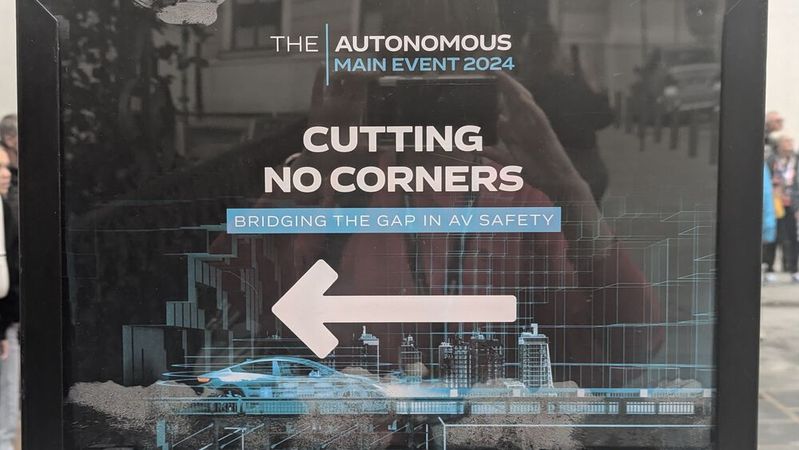
On September 24, 2024, the industry event "The Autonomous Main Event" marked its fifth anniversary at the historic Vienna Hofburg. Themed "Cutting No Corners: Bridging the Gap in AV Safety," the event highlighted the critical importance of integrating autonomous driving technology with safety as its core focus. The conference underscored that successful implementation in real-world scenarios requires prioritizing safety at every step. A series of workshops were held the day before, covering diverse topics to encourage deeper insights and collaboration on autonomous vehicle (AV) safety.
The Vienna Hofburg hosted "The Autonomous Main Event" for the fifth time, which this year was themed "No Compromises on the Path to Autonomous Driving."
(Image: Stefanie Eckardt)
580 participants attending either in person or virtually, along with more than 250 participating companies, celebrated the fifth anniversary of The Autonomous Main Event, emphasizing the importance of safety on the path to autonomous driving. Under the theme "Cutting No Corners: Bridging the Gap in AV Safety," which translates to "No Compromises on the Path to Safe Autonomous Driving," the industry demonstrated that it takes the public's concerns seriously and aims to gain the trust of potential users of autonomous mobility through safe technology. "For autonomous driving, safety is the main concern of consumers," stated Dr. Dirk Linzmeier, CEO of TTTech Auto, emphasizing, "What we know is that partnerships and ecosystems are crucial for success in safety design. Safety is neither an area for competition nor for compromise—it's about getting it right." But what does the right approach look like? To answer this question, The Autonomous Main Event brought together car manufacturers, suppliers, semiconductor makers, and software companies, including TTTech Auto, NXP Semiconductors, Aurora, Volvo, Continental, Mobileye, Toyota, SDVerse, Volkswagen, Bosch, Elektrobit, Infineon, Qualcomm, Audi, Denso, and Green Hills Software.
Software-defined vehicles
While customer experience in vehicles was primarily defined by hardware in the past, software now plays a much stronger role. End consumers increasingly expect integration of the vehicle into their digital world. Additionally, new features for connectivity, automation, and personalization will increasingly be realized through software in the future. By regularly updating these functions, the vehicle's value can be enhanced throughout its entire lifecycle. Undoubtedly, there are many opportunities. "Software-defined vehicles define a new era in the automotive sector," emphasized Lars Reger, CTO of NXP in his keynote. By 2030, it is expected that 90 percent of vehicles manufactured will be SDVs. However, "Great opportunities typically bring great technological challenges, especially when it comes to implementing the most crucial feature—safety." Reger gave insights into how the right technology can help minimize the complexity of SDVs in terms of safety. Understanding the risks in developing an SDV was also discussed by Stefan Poledna of TTTech Auto, Ethan Sorrelgreen from Woven by Toyota, Max Lemke from the EU Commission, Michael Fait from Thoughtworks, and Prashant Guati from SDVerse. "Software is never done; we need to think like a software company, not like traditional firms from the automotive sector," Michael Fait highlighted one of the issues. The outcome of the panel discussion: Implementing innovative architectures and methodologies helps realize robust and cost-effective software updates while maintaining the highest safety standards. No company can handle this alone. An example of successful collaboration is the working group for Safety and Architecture, which has tackled a methodological approach to safety architecture. In December last year, the working group published a report identifying, describing, and evaluating logical architectures, as well as showing how these architectures can be implemented in hardware and software. Another result: Asymmetrical architectures that allow majority voting are suitable for automated driving. The working group is now developing a second edition, based on five subsequent work packages, including: sufficient independence of sensor systems, security, validation of high-availability infrastructure, observation post-deployment, and additional conceptual system architectures. This second edition is expected to be released at The Autonomous Main Event 2025, scheduled for September 17-18.
Legislation in Focus
Panel discussion number two focused on regulations and legislation for autonomous vehicles. Participants Janett Fahrenholz from Volkswagen, Richard Damm from KBA and UNECE, Stefan Oexl from Torc Robotics, and Fabrizio Ugo Scelsi from Vay emphasized that global harmonization of regulations for autonomous vehicles is urgently needed. Richard Damm from KBA, who is also the chair of the UNECE working group, stated that the UN aims to publish regulations for Level 4 vehicles by mid-2026. Until then, every manufacturer is likely to "cook their own soup" and use the best opportunities available, as Stefan Oexl highlighted: "Our preferred location for tests is where we want to enter the market firstand that has to be a suitable regulatory environment. For us, that’s Texas. There’s little rain, hardly any snow, and the traffic is less complex and more predictable than in other places." It was agreed that the first use case for autonomous driving is more likely to be in the commercial vehicle sector than in passenger cars. This was also illustrated by the fireside chat from Volvo and Aurora, who are also conducting tests in the commercial vehicle environment in Texas, and the presentation by Nikolai Setzer, CEO of Continental, who chose his keynote to highlight the close partnership with Aurora.
Last but not least, the final panel discussion of a busy day highlighted how synergies can be leveraged across industry segments. Looking beyond one's own field is always helpful, for example, to incorporate insights from autonomous agricultural machinery into the automotive sector. (se)
Date: 08.12.2025
Naturally, we always handle your personal data responsibly. Any personal data we receive from you is processed in accordance with applicable data protection legislation. For detailed information please see our privacy policy.
Consent to the use of data for promotional purposes
I hereby consent to Vogel Communications Group GmbH & Co. KG, Max-Planck-Str. 7-9, 97082 Würzburg including any affiliated companies according to §§ 15 et seq. AktG (hereafter: Vogel Communications Group) using my e-mail address to send editorial newsletters. A list of all affiliated companies can be found here
Newsletter content may include all products and services of any companies mentioned above, including for example specialist journals and books, events and fairs as well as event-related products and services, print and digital media offers and services such as additional (editorial) newsletters, raffles, lead campaigns, market research both online and offline, specialist webportals and e-learning offers. In case my personal telephone number has also been collected, it may be used for offers of aforementioned products, for services of the companies mentioned above, and market research purposes.
Additionally, my consent also includes the processing of my email address and telephone number for data matching for marketing purposes with select advertising partners such as LinkedIn, Google, and Meta. For this, Vogel Communications Group may transmit said data in hashed form to the advertising partners who then use said data to determine whether I am also a member of the mentioned advertising partner portals. Vogel Communications Group uses this feature for the purposes of re-targeting (up-selling, cross-selling, and customer loyalty), generating so-called look-alike audiences for acquisition of new customers, and as basis for exclusion for on-going advertising campaigns. Further information can be found in section “data matching for marketing purposes”.
In case I access protected data on Internet portals of Vogel Communications Group including any affiliated companies according to §§ 15 et seq. AktG, I need to provide further data in order to register for the access to such content. In return for this free access to editorial content, my data may be used in accordance with this consent for the purposes stated here. This does not apply to data matching for marketing purposes.
Right of revocation
I understand that I can revoke my consent at will. My revocation does not change the lawfulness of data processing that was conducted based on my consent leading up to my revocation. One option to declare my revocation is to use the contact form found at https://contact.vogel.de. In case I no longer wish to receive certain newsletters, I have subscribed to, I can also click on the unsubscribe link included at the end of a newsletter. Further information regarding my right of revocation and the implementation of it as well as the consequences of my revocation can be found in the data protection declaration, section editorial newsletter.
This article was first published on our sister website www.next-mobility.de (german language)



:quality(80)/p7i.vogel.de/wcms/dd/08/dd086510d9ae7b50181f6070e4463b44/0129363730v1.jpeg "Typical application for ionizing devices: Wrapping films. (Picture: ©Adobe Stock/SMC)")
:quality(80)/p7i.vogel.de/wcms/35/57/3557c819943c53acec41a0ccba87da4f/0130049064v1.jpeg "Researchers at the Fraunhofer IWU in Chemnitz have long known that many typical sheet metal parts can be manufactured more cost-effectively using hollow embossing rollers. Now there is news to report ... (Image:Fraunhofer IWU)")
:quality(80)/p7i.vogel.de/wcms/59/02/590246e3b3f415c65edbee377c14ca77/26-06-pi-fraunhofer-iws-41450-direktplattieren-pic-01-7771x4369v1v1.jpeg "The Fraunhofer IWS has developed the new \"direct laser cladding\" process, which creates a functional layer directly on the base body by applying a strip-shaped metal to rotationally symmetrical components in a spiral and bonding it locally by laser. (Image:Christoph Wilsnack/Fraunhofer IWS)")
:quality(80)/p7i.vogel.de/wcms/73/60/73608418789b1d9c393f5e2fa974eda2/0130209906v1.jpeg "The robots of the X6 generation from b+m enable very high painting quality and are also particularly compact and easy to maintain. (Image:Beckhoff)")
:quality(80)/p7i.vogel.de/wcms/78/e9/78e9188c25a8a94e67c34c9bf8ffe495/visual-agile-20robots-20and-20google-20deepmind-20partner-20to-20bring-20intelligence-20to-20robotics-2500x1406v1v1.jpeg "Together, the partners are developing adaptable, intelligent robots for a wide range of applications (Image:Agile Robots SE)")
:quality(80)/p7i.vogel.de/wcms/e7/66/e7669ecf0260ae8fc54c214e34e4902a/0130316817v1.jpeg "Siemens and Palo Alto Networks offer tested cybersecurity solution for industrial 5G. (Image:Siemens)")
:quality(80)/p7i.vogel.de/wcms/9f/55/9f55324832c4f426958031375124d9de/siemens-20ubtech-20hmnd-1920x1079v1v1.png "Ready for the factory floor: While Ubtech is planning mass production, Siemens is already testing humanoids in real factory applications in Erlangen. (Image:Siemens)")
:quality(80)/p7i.vogel.de/wcms/11/36/113695ed260e29c8c2d9d39dc5f9d869/0130213768v1.jpeg "AI can work cheaply in China and deliver the results rapidly all over the world. (Image:Dall-E / AI-generated)")
:quality(80)/p7i.vogel.de/wcms/62/5f/625f41e87ebfef156a98c8e6393e32fd/0130211654v1.jpeg "Axial flux motors have some advantages over radial flux motor—but their production is currently still expensive. (Image:RWTH Aachen University)")
:quality(80)/p7i.vogel.de/wcms/77/9b/779b0685d010dfe45c9c2cb1cfecd467/0128886425v1.jpeg "The BlueEye is the first \"real\" hyperspectral camera for the UV range and covers the wavelength range from 220 to 380nm. (Image:Inno-spec GmbH)")
:quality(80)/p7i.vogel.de/wcms/e4/51/e451d52ce0182fb0aaa46a5774f832ef/26-04-pi-fraunhofer-iws-21160-bioslide-pic-01-4128x2321v1v1.jpeg "With the BioSlide research project, the Fraunhofer IWS is investigating how sliding systems can be designed to be more sustainable and energy-efficient. New materials can be tested in a particularly application-oriented manner on this plain bearing test stand. (Image:Fraunhofer IWS)")
![Thanks to advanced 3D printing technology, a more efficient use of resources should contribute to lower-emission aviation—this is the goal of ['skai]-lab. (Image:Oleksandr Pashchenko - stock.adobe.com / AI-generated)](https://cdn1.vogel.de/nghHNSbySccfOjG3n1qCA-FVOjQ=/288x162/smart/filters:format(jpg):quality(80)/p7i.vogel.de/wcms/62/64/626424c97a16e69f871bf216c9629c2a/adobestock-1927043193--c2-a9-20oleksandr-20pashchenko-20-e2-80-93-20stock-adobe-com-ki-generiertv1v1.jpeg "Thanks to advanced 3D printing technology, a more efficient use of resources should contribute to lower-emission aviation—this is the goal of ['skai]-lab. (Image:Oleksandr Pashchenko - stock.adobe.com / AI-generated)")
:quality(80)/p7i.vogel.de/wcms/c3/c4/c3c4ce270b083eeac55654148611f064/0130237945v1.jpeg "China is not giving up on hydrogen, but is intensifying its efforts. (Image:freely licensed from Pixabay)")
:quality(80)/p7i.vogel.de/wcms/4e/c0/4ec0bd19390b169edfa23677373dcdf1/0130260089v1.jpeg "Renewable fuels can supply European road traffic, according to a study. (Image:Aral)")
:quality(80)/p7i.vogel.de/wcms/6f/c9/6fc9050301d745cad25585c6780f8f51/0130197341v1.jpeg "Production facilities are a worthwhile target and are therefore at risk. (Image:ABB Robotics)")
:quality(80)/p7i.vogel.de/wcms/b6/62/b662adc2cec8227d8172509bbfb6ee42/25c0207-107-4961x2789v1v1.jpeg "The GLB is the second model based on Mercedes' new MMA platform. Apparently, Geely's platform is better and cheaper, which is why the two companies are negotiating a partnership. (Image:Mercedes-Benz)")
:quality(80)/p7i.vogel.de/wcms/4d/dd/4dddf438e91f394c04a095dbfd109d1c/0130236430v1.jpeg "Measurement modules: The 720301 module in combination with the SL2000 enables RMS and power calculations, among other things. (Image:Yokogawa)")
:quality(80)/p7i.vogel.de/wcms/61/fc/61fcf95f5cca15494ad18343901ae585/0130317237v1.jpeg "With the AGI CPU, Arm says it is taking a \"historic step\": With the processor aimed at AI in data centers, the company is presenting itself for the first time as a provider of its own chips, not just as a pure IP licensor. (Image:Arm)")
:quality(80)/p7i.vogel.de/wcms/82/90/8290dfe3595b6c6b33726ae8b76172c7/0130319587v1.jpeg "The concept image illustrates how the pattern of tiny protrusions and depressions created on the substrate (MgO, bottom) controls the arrangement of atoms in the superconducting material (YBCO, top). At the interface between the two layers, an electronic structure enables superconductivity to occur at higher temperatures than previously possible. (Image:Chalmers University of Technology / Riccardo Arpaia)")
:fill(fff,0)/images.vogel.de/vogelonline/companyimg/76800/76895/65.jpg "FAULHABER_120mm.jpg ()")
:fill(fff,0)/p7i.vogel.de/companies/68/a4/68a47beec75ce/logo-cmyk-de.jpeg "logo-cmyk-de (https://www.datatec.eu/)")
:fill(fff,0)/p7i.vogel.de/companies/67/eb/67eba621ef6ea/logo2.png "logo2 (Wuxi InfiMotion)")
:quality(80)/p7i.vogel.de/wcms/63/30/6330cfbbedf32b0e2be89e609bd967cd/0118199939v1.jpeg "SDVs represent a profound change in the automotive industry, promising a new level of safety, efficiency, and user comfort. (Image:Royalty-free)")
:quality(80)/p7i.vogel.de/wcms/63/38/6338d37a3c8ab010341b844e33351846/0118753635v1.jpeg "Hyundai and Plus are testing an autonomous, heavy-duty fuel cell truck. (Image:Hyundai)")
:quality(80)/p7i.vogel.de/wcms/43/83/43837501e21d5e1077ff861308360f14/0127068583v1.jpeg "On September 17 and 18, 2025, the industry event The Autonomous took place at the Vienna Hofburg. (Image:Stefanie Eckardt)")
:quality(80)/p7i.vogel.de/wcms/03/02/0302d573269f6ea47cb468c99156615f/0126473575v1.jpeg "Volkswagen Group's booth at the IAA Mobility 2025. (Image:VDA/IAA Mobility)")