The Porsche Supervisory Board is holding a special meeting to discuss a successor to Oliver Blume. One name is already being discussed.
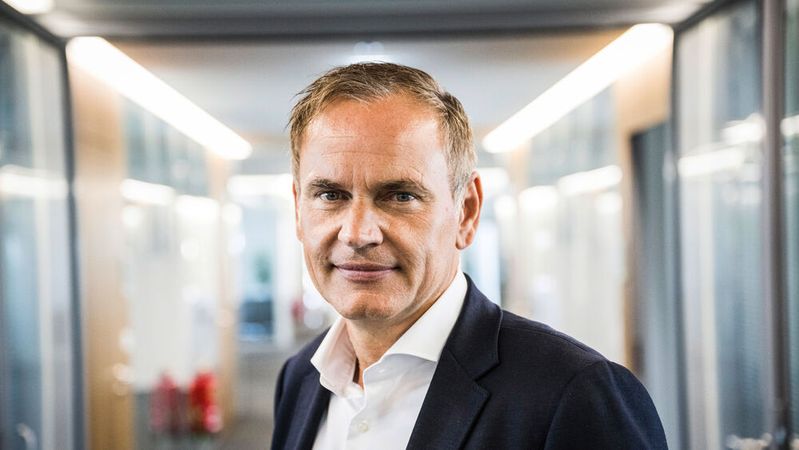
Oliver Blume has been CEO of Volkswagen and Porsche for a good three years. Now he is to lose his senior position at the head of Porsche.
(Image: Volkswagen AG)
Oliver Blume is to be replaced as Chairman of the Executive Board of sports car manufacturer Porsche. The Executive Committee of the Supervisory Board has instructed the Chairman of the Supervisory Board to hold talks with him about an amicable early departure from the Executive Board, as the company announced in Stuttgart. A possible date was not specified. Blume will remain head of VW, it said. This Friday afternoon (October 17), the Porsche Supervisory Board is to discuss the personnel matter in a meeting convened at short notice.
According to the company, former McLaren boss Michael Leiters is available as a possible successor. Negotiations are currently underway with him. Leiters, who holds a doctorate in mechanical engineering, previously worked at Porsche for 13 years and at Ferrari before joining McLaren.
Blume's Role Dubbed "Part-Time CEO"
If the dismissal is confirmed, a rather unique constellation in the German corporate landscape will come to an end: the 57-year-old Blume has led two listed companies for around three years. Ten years ago - in October 2015 - he became Chairman of the Executive Board of Porsche. On September 1, 2022 - shortly before the Porsche IPO - he took over as CEO of the parent company Volkswagen.
There had been speculation about the withdrawal for some time. Shareholder representatives have long been critical of Blume's dual role. Not only because of the huge workload, but also because of possible conflicts of interest. They repeatedly called on the top manager to opt for the management of one of the groups. Hendrik Schmidt from fund provider DWS, for example, criticized the fact that Porsche and VW were the only listed companies in Germany to have a "part-time CEO". In view of the tasks at both companies, the trade unions and works council also felt that the time had come to separate the positions again in terms of personnel.
Blume let such accusations bounce off him. Even if the tone has changed in recent months: he defended his dual role to the end as a recipe for success with more advantages than disadvantages. For a long time, support came from the billionaire Porsche and Piëch families, who control the majority of voting rights in the Volkswagen Group. But what does the top manager's track record look like - and what construction sites will he leave behind for his successor?
Blume took over Porsche in top condition. Up to this point, 2015 had been the most successful financial year in the company's history. At his first annual press conference, the manager spoke of an "extraordinary result, even by Porsche standards". That was already a foretaste of everything that was to follow.
For years, things went almost exclusively upwards in Zuffenhausen - with sales figures, turnover and profits. When Blume took office, Porsche was selling around 225,000 cars a year. In 2023, the year with the highest sales to date, it was a good 320,000 sports and off-road vehicles. Profit after tax has more than doubled during his time in office.
One of Blume's greatest successes: the IPO in September 2022. After years of speculation and months of scrutiny, Volkswagen raised almost 9.4 billion euros with the IPO. This made it the largest initial public offering in Germany since Deutsche Telekom in 1996, even though the economic conditions were anything but rosy due to the consequences of coronavirus and the war in Ukraine.
The stock with the abbreviation "P911" - named after the iconic 911 sports car - then soared. In December 2022, the company was already included in the leading Dax index. This made Porsche "happy and proud", said Blume at the time. In the meantime, Porsche was also worth more on the stock market than its parent company VW. The shares reached a high of almost 120 euros in spring 2022 - after an issue price of 82.50 euros.
The Construction Sites of the Blume Era
Despite the good run, the problems piled up, particularly in the home stretch of the Blume era, which lasted almost ten years. Sales figures left a lot to be desired - especially in China and the USA. And profits also plummeted recently. Group net profit from January to June amounted to 718 million euros - 71 percent less than a year earlier.
Date: 08.12.2025
Naturally, we always handle your personal data responsibly. Any personal data we receive from you is processed in accordance with applicable data protection legislation. For detailed information please see our privacy policy.
Consent to the use of data for promotional purposes
I hereby consent to Vogel Communications Group GmbH & Co. KG, Max-Planck-Str. 7-9, 97082 Würzburg including any affiliated companies according to §§ 15 et seq. AktG (hereafter: Vogel Communications Group) using my e-mail address to send editorial newsletters. A list of all affiliated companies can be found here
Newsletter content may include all products and services of any companies mentioned above, including for example specialist journals and books, events and fairs as well as event-related products and services, print and digital media offers and services such as additional (editorial) newsletters, raffles, lead campaigns, market research both online and offline, specialist webportals and e-learning offers. In case my personal telephone number has also been collected, it may be used for offers of aforementioned products, for services of the companies mentioned above, and market research purposes.
Additionally, my consent also includes the processing of my email address and telephone number for data matching for marketing purposes with select advertising partners such as LinkedIn, Google, and Meta. For this, Vogel Communications Group may transmit said data in hashed form to the advertising partners who then use said data to determine whether I am also a member of the mentioned advertising partner portals. Vogel Communications Group uses this feature for the purposes of re-targeting (up-selling, cross-selling, and customer loyalty), generating so-called look-alike audiences for acquisition of new customers, and as basis for exclusion for on-going advertising campaigns. Further information can be found in section “data matching for marketing purposes”.
In case I access protected data on Internet portals of Vogel Communications Group including any affiliated companies according to §§ 15 et seq. AktG, I need to provide further data in order to register for the access to such content. In return for this free access to editorial content, my data may be used in accordance with this consent for the purposes stated here. This does not apply to data matching for marketing purposes.
Right of revocation
I understand that I can revoke my consent at will. My revocation does not change the lawfulness of data processing that was conducted based on my consent leading up to my revocation. One option to declare my revocation is to use the contact form found at https://contact.vogel.de. In case I no longer wish to receive certain newsletters, I have subscribed to, I can also click on the unsubscribe link included at the end of a newsletter. Further information regarding my right of revocation and the implementation of it as well as the consequences of my revocation can be found in the data protection declaration, section editorial newsletter.
The once successful sports car manufacturer has become a company in crisis mode. This has not gone unnoticed on the stock market: the value of the share has more than halved since its peak. Most recently, the value fluctuated around 41 euros. At the beginning of September, Porsche was also kicked out of the DAX.
In a letter to the workforce in the summer, Blume outlined several reasons for the misery: In China, the market segment for expensive luxury products had literally collapsed in a short space of time. In the USA, the increased tariffs and, in particular, the current development of the US dollar put pressure on Porsche's business. Problems for which his successor will have to find solutions.
From E-Cars Back to Combustion Engines
In addition, the turnaround to electric cars is not working: No other brand in the VW Group had set itself a similarly ambitious target. More than 80 percent of all new Porsche cars were to be fully electric by 2030. There is not much left of that. In the first half of the year, the proportion of fully electric cars was 23.5 percent. E-mobility is developing much more slowly in many markets than "we and many experts had expected years ago", says Blume.
As a result, the Zuffenhausen-based company has changed tack - it now wants to develop more vehicles with combustion engines and plug-in hybrids again. There is also little left of the management's once grand battery plans. In future, the battery subsidiary Cellforce will only be involved in research and development, and up to 200 jobs are to be lost there. Porsche is expecting the move to cost billions more.
The car manufacturer must therefore cut back - and shrink its structures. By 2029, around 1,900 jobs are to be cut in the Stuttgart region in a socially responsible manner. A further savings program is to be put together in the autumn. This is currently being negotiated with the works council.
These Are the Biggest Tasks at VW
Even if Blume can concentrate fully on VW: He is also likely to keep an eye on the problems at Porsche from Wolfsburg. This is because the weak performance of the former profit giants Porsche and Audi has recently weighed on the Group. In the second quarter, the long-weakening core brand actually generated more operating profit than the premium brands combined.
Even after the end of the wage dispute with IG Metall, there are still plenty of unresolved issues within the Group: Negotiations must now be held with IG Metall until the end of 2026 on a change to the wage structure, which VW hopes will lead to further savings. And the core brand plans to cut almost one in four jobs in Germany by 2030. The Group must now show how this can be achieved without a single redundancy.
VW wants to reduce overcapacities and increase the profit margin of the low-profit core brand with the austerity measures. Blume cannot hope for much support from the employees: Resentment had grown during the crisis. Added to this are the Group's permanent construction sites: the collapsing business in China, the sluggish electric ramp-up, the Group's own software company Cariad, the construction of its own battery factories and the race for autonomous driving.



:quality(80)/p7i.vogel.de/wcms/dd/08/dd086510d9ae7b50181f6070e4463b44/0129363730v1.jpeg "Typical application for ionizing devices: Wrapping films. (Picture: ©Adobe Stock/SMC)")
:quality(80)/p7i.vogel.de/wcms/35/57/3557c819943c53acec41a0ccba87da4f/0130049064v1.jpeg "Researchers at the Fraunhofer IWU in Chemnitz have long known that many typical sheet metal parts can be manufactured more cost-effectively using hollow embossing rollers. Now there is news to report ... (Image:Fraunhofer IWU)")
:quality(80)/p7i.vogel.de/wcms/59/02/590246e3b3f415c65edbee377c14ca77/26-06-pi-fraunhofer-iws-41450-direktplattieren-pic-01-7771x4369v1v1.jpeg "The Fraunhofer IWS has developed the new \"direct laser cladding\" process, which creates a functional layer directly on the base body by applying a strip-shaped metal to rotationally symmetrical components in a spiral and bonding it locally by laser. (Image:Christoph Wilsnack/Fraunhofer IWS)")
:quality(80)/p7i.vogel.de/wcms/73/60/73608418789b1d9c393f5e2fa974eda2/0130209906v1.jpeg "The robots of the X6 generation from b+m enable very high painting quality and are also particularly compact and easy to maintain. (Image:Beckhoff)")
:quality(80)/p7i.vogel.de/wcms/78/e9/78e9188c25a8a94e67c34c9bf8ffe495/visual-agile-20robots-20and-20google-20deepmind-20partner-20to-20bring-20intelligence-20to-20robotics-2500x1406v1v1.jpeg "Together, the partners are developing adaptable, intelligent robots for a wide range of applications (Image:Agile Robots SE)")
:quality(80)/p7i.vogel.de/wcms/e7/66/e7669ecf0260ae8fc54c214e34e4902a/0130316817v1.jpeg "Siemens and Palo Alto Networks offer tested cybersecurity solution for industrial 5G. (Image:Siemens)")
:quality(80)/p7i.vogel.de/wcms/9f/55/9f55324832c4f426958031375124d9de/siemens-20ubtech-20hmnd-1920x1079v1v1.png "Ready for the factory floor: While Ubtech is planning mass production, Siemens is already testing humanoids in real factory applications in Erlangen. (Image:Siemens)")
:quality(80)/p7i.vogel.de/wcms/11/36/113695ed260e29c8c2d9d39dc5f9d869/0130213768v1.jpeg "AI can work cheaply in China and deliver the results rapidly all over the world. (Image:Dall-E / AI-generated)")
:quality(80)/p7i.vogel.de/wcms/62/5f/625f41e87ebfef156a98c8e6393e32fd/0130211654v1.jpeg "Axial flux motors have some advantages over radial flux motor—but their production is currently still expensive. (Image:RWTH Aachen University)")
:quality(80)/p7i.vogel.de/wcms/77/9b/779b0685d010dfe45c9c2cb1cfecd467/0128886425v1.jpeg "The BlueEye is the first \"real\" hyperspectral camera for the UV range and covers the wavelength range from 220 to 380nm. (Image:Inno-spec GmbH)")
:quality(80)/p7i.vogel.de/wcms/e4/51/e451d52ce0182fb0aaa46a5774f832ef/26-04-pi-fraunhofer-iws-21160-bioslide-pic-01-4128x2321v1v1.jpeg "With the BioSlide research project, the Fraunhofer IWS is investigating how sliding systems can be designed to be more sustainable and energy-efficient. New materials can be tested in a particularly application-oriented manner on this plain bearing test stand. (Image:Fraunhofer IWS)")
![Thanks to advanced 3D printing technology, a more efficient use of resources should contribute to lower-emission aviation—this is the goal of ['skai]-lab. (Image:Oleksandr Pashchenko - stock.adobe.com / AI-generated)](https://cdn1.vogel.de/nghHNSbySccfOjG3n1qCA-FVOjQ=/288x162/smart/filters:format(jpg):quality(80)/p7i.vogel.de/wcms/62/64/626424c97a16e69f871bf216c9629c2a/adobestock-1927043193--c2-a9-20oleksandr-20pashchenko-20-e2-80-93-20stock-adobe-com-ki-generiertv1v1.jpeg "Thanks to advanced 3D printing technology, a more efficient use of resources should contribute to lower-emission aviation—this is the goal of ['skai]-lab. (Image:Oleksandr Pashchenko - stock.adobe.com / AI-generated)")
:quality(80)/p7i.vogel.de/wcms/c3/c4/c3c4ce270b083eeac55654148611f064/0130237945v1.jpeg "China is not giving up on hydrogen, but is intensifying its efforts. (Image:freely licensed from Pixabay)")
:quality(80)/p7i.vogel.de/wcms/4e/c0/4ec0bd19390b169edfa23677373dcdf1/0130260089v1.jpeg "Renewable fuels can supply European road traffic, according to a study. (Image:Aral)")
:quality(80)/p7i.vogel.de/wcms/6f/c9/6fc9050301d745cad25585c6780f8f51/0130197341v1.jpeg "Production facilities are a worthwhile target and are therefore at risk. (Image:ABB Robotics)")
:quality(80)/p7i.vogel.de/wcms/b6/62/b662adc2cec8227d8172509bbfb6ee42/25c0207-107-4961x2789v1v1.jpeg "The GLB is the second model based on Mercedes' new MMA platform. Apparently, Geely's platform is better and cheaper, which is why the two companies are negotiating a partnership. (Image:Mercedes-Benz)")
:quality(80)/p7i.vogel.de/wcms/4d/dd/4dddf438e91f394c04a095dbfd109d1c/0130236430v1.jpeg "Measurement modules: The 720301 module in combination with the SL2000 enables RMS and power calculations, among other things. (Image:Yokogawa)")
:quality(80)/p7i.vogel.de/wcms/61/fc/61fcf95f5cca15494ad18343901ae585/0130317237v1.jpeg "With the AGI CPU, Arm says it is taking a \"historic step\": With the processor aimed at AI in data centers, the company is presenting itself for the first time as a provider of its own chips, not just as a pure IP licensor. (Image:Arm)")
:quality(80)/p7i.vogel.de/wcms/82/90/8290dfe3595b6c6b33726ae8b76172c7/0130319587v1.jpeg "The concept image illustrates how the pattern of tiny protrusions and depressions created on the substrate (MgO, bottom) controls the arrangement of atoms in the superconducting material (YBCO, top). At the interface between the two layers, an electronic structure enables superconductivity to occur at higher temperatures than previously possible. (Image:Chalmers University of Technology / Riccardo Arpaia)")
:fill(fff,0)/p7i.vogel.de/companies/67/eb/67eba621ef6ea/logo2.png "logo2 (Wuxi InfiMotion)")
:quality(80)/p7i.vogel.de/wcms/e7/08/e7082e4f1f287bb702bd07dc8a73e009/0126901054v1.jpeg "VW CEO Oliver Blume is also the head of Porsche. The dual role is a thorn in the side of shareholders. (Image:Porsche)")
:quality(80)/p7i.vogel.de/wcms/05/10/05100b54af0855e60402ea38d094505e/0127265738v1.jpeg "Volkswagen China CEO Ralf Brandstätter: \"Our measure of success is profitability, not just market share.\" (Image:Volkswagen AG)")
:quality(80)/p7i.vogel.de/wcms/42/8a/428adc51a4a923a3e09e275250e20c32/0127428765v1.jpeg "Michael Leiters is the new one who will take the wheel at Porsche after Oliver Blume ... (Image:dpa)")
:quality(80)/p7i.vogel.de/wcms/e7/08/e7082e4f1f287bb702bd07dc8a73e009/0126901054v1.jpeg "VW CEO Oliver Blume is also the head of Porsche. The dual role is a thorn in the side of shareholders. (Image:Porsche)")