The chip company Nvidia aims to expand its leading role in artificial intelligence technology. Company CEO Jensen Huang presented the current AI platform: the Blackwell chip. It is even more powerful than the current Grace Hopper.
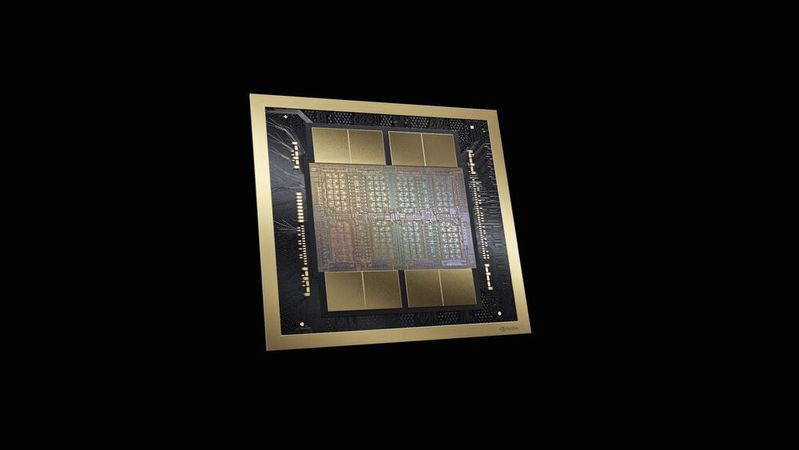
With the Blackwell AI chip, Nvidia aims to usher in the next generation of artificial intelligence.
(Image: Nvidia)
Nvidia is benefiting from the current boom in artificial intelligence. To ensure the company continues to play a leading role in AI technology, Nvidia CEO Jensen Huang introduced a new generation of AI computing platform in his keynote last Monday. The system, named Blackwell, is described by Nvidia as "the driving force behind a new industrial revolution." The AI chip is named after the American mathematician David Blackwell.
The company also aims to expand its role in content creation with artificial intelligence. "The Blackwell system is 30 times better at this than Hopper," emphasized Huang on Monday at the company's in-house developer conference GTC in San Jose.
The GB200 Grace Blackwell chip connects two Tensor-Core GPUs of type B200 with the Grace CPU via a die-to-die link. Specifically, it is the Ultra-Low-Power NVLink with a data rate of 900 GB/s. The Blackwell GPU, developed by Nvidia, is supposed to be capable of computing models with up to 10 trillion parameters. For this purpose, there are 208 billion transistors available on the chip.
For correspondingly high AI computing power, systems operated with the GB200 can be connected to the Ethernet platforms Quantum-X800 InfiniBand and Spectrum-X800. This allows for speeds of up to 800 Gbit/s to be achieved.
Use of the Blackwell chip
The GB200 is used as a key component in the GB200 NVL72. This is a high-performance, water-cooled rack solution that contains 36 GB200 accelerators. Each GB200 accelerator consists of a Grace CPU and two Blackwell GPUs, as opposed to the previous GH200 accelerator, which contained a Grace CPU and a Hopper GPU.
The GPUs are no longer located on the same board as the Grace CPU but on a separate module within the server. The connection between the Grace CPU and the Blackwell GPUs is via NVLink C2C with a bidirectional bandwidth of 900 GB/s. Each GB200 accelerator has a total memory capacity of 864 GBytes, with each of the two Blackwell GPUs equipped with 192 GBytes of HBM3E memory connected to the Grace CPU.
Processing data with the BlueField-3
The GB200 NVL72 includes the BlueField-3 data processing units, enabling cloud network acceleration, composable storage, zero-trust security, and GPU compute elasticity in hyperscale AI clouds.
This combination offers up to a 30-fold increase in performance compared to the same number of H100 Tensor Core GPUs for Nvidia's LLM inference workloads. Additionally, the GB200 NVL72 reduces costs and energy consumption by up to 25 times. This integration of BlueField-3 into the GB200 NVL72 enables advanced features and a significant improvement in performance and efficiency in compute-intensive AI applications and cloud environments.
What is possible with the AI chip
Nvidia's hardware dominates data centers for AI training. In addition, Nvidia plans to expand its role in creating content with artificial intelligence. CEO Jensen Huang emphasized that the Blackwell system is 30 times better than Hopper for AI training. Besides this performance optimization, Nvidia offers new software that can also be used via interfaces in the cloud.
"With Grace Hopper, for example, you could have trained the chatbot ChatGPT within three months with 8,000 Nvidia chips and a power consumption of 15 megawatts," said Huang. "With Blackwell, you can do that in the same time with 2,000 chips and 4 megawatts of power."
The future of artificial intelligence
Nvidia has developed a computer system for the future aimed at having most content not retrieved pre-made from storage, but rather freshly generated by AI software based on the current situation.
Jensen Huang, CEO of Nvidia, is convinced that this development is imminent. An example of this is the possibility, in the future, to communicate with buildings via chatbot instead of accessing data in various locations. This vision demonstrates the progress in AI technology and how it will be capable of generating personalized and contextual content in real-time, thus taking interactions with technology to a new level.
Date: 08.12.2025
Naturally, we always handle your personal data responsibly. Any personal data we receive from you is processed in accordance with applicable data protection legislation. For detailed information please see our privacy policy.
Consent to the use of data for promotional purposes
I hereby consent to Vogel Communications Group GmbH & Co. KG, Max-Planck-Str. 7-9, 97082 Würzburg including any affiliated companies according to §§ 15 et seq. AktG (hereafter: Vogel Communications Group) using my e-mail address to send editorial newsletters. A list of all affiliated companies can be found here
Newsletter content may include all products and services of any companies mentioned above, including for example specialist journals and books, events and fairs as well as event-related products and services, print and digital media offers and services such as additional (editorial) newsletters, raffles, lead campaigns, market research both online and offline, specialist webportals and e-learning offers. In case my personal telephone number has also been collected, it may be used for offers of aforementioned products, for services of the companies mentioned above, and market research purposes.
Additionally, my consent also includes the processing of my email address and telephone number for data matching for marketing purposes with select advertising partners such as LinkedIn, Google, and Meta. For this, Vogel Communications Group may transmit said data in hashed form to the advertising partners who then use said data to determine whether I am also a member of the mentioned advertising partner portals. Vogel Communications Group uses this feature for the purposes of re-targeting (up-selling, cross-selling, and customer loyalty), generating so-called look-alike audiences for acquisition of new customers, and as basis for exclusion for on-going advertising campaigns. Further information can be found in section “data matching for marketing purposes”.
In case I access protected data on Internet portals of Vogel Communications Group including any affiliated companies according to §§ 15 et seq. AktG, I need to provide further data in order to register for the access to such content. In return for this free access to editorial content, my data may be used in accordance with this consent for the purposes stated here. This does not apply to data matching for marketing purposes.
Right of revocation
I understand that I can revoke my consent at will. My revocation does not change the lawfulness of data processing that was conducted based on my consent leading up to my revocation. One option to declare my revocation is to use the contact form found at https://contact.vogel.de. In case I no longer wish to receive certain newsletters, I have subscribed to, I can also click on the unsubscribe link included at the end of a newsletter. Further information regarding my right of revocation and the implementation of it as well as the consequences of my revocation can be found in the data protection declaration, section editorial newsletter.
Techniques originally developed by Nvidia for graphics cards have long since proven themselves in computing work for applications with artificial intelligence. Competitors such as Intel and AMD have so far been unable to catch up. This is causing Nvidia's business - and stock value - to grow rapidly. Large AI companies like Microsoft, Google, and Amazon are already planning to deploy Blackwell.



:quality(80)/p7i.vogel.de/wcms/d1/ef/d1ef6b6f7d4543f7999980bacccaf22b/0133499261v1.jpeg "As the growing imbalance in trade relations with China continues to widen, the EU Chamber of Commerce foresees a day when trade with China will have to be seriously reevaluated ... (Image: AI-generated)")
:quality(80)/p7i.vogel.de/wcms/fe/1f/fe1fa5ee713f94deaba963dc24c3abc5/0133299273v1.jpeg "The Flexistar enables highly flexible production of laser-welded tubes thanks to its tool-free clamping system. (Image:Because Technology, LLC)")
:quality(80)/p7i.vogel.de/wcms/1b/5a/1b5ac72f83db4dbee3ff91e51bc398f4/0133496095v1.jpeg "BASF announces that it will take the next step toward producing the polyurethane precursor MDI in India ... (Image:BASF)")
:quality(80)/p7i.vogel.de/wcms/3f/cf/3fcfa390902944ffcf24e7fe973cc3ee/0133486258v1.jpeg "Do you need to create secure connections on structures using blind rivets, but space is tight? Then you should take a closer look at the Universalgrip from Gesipa ... (Image: Gesipa)")
:quality(80)/p7i.vogel.de/wcms/60/ef/60ef4f07e4829b2c2929befc0f353c58/0133511729v1.jpeg "Humanoid robots can match human performance in certain tasks. (Image:Gemini / AI-generated)")
:quality(80)/p7i.vogel.de/wcms/2e/99/2e99726b522e4b35b690e25eb6a42643/0133463991v1.jpeg "Robotics: In AMR applications, connection technology must reliably transmit power, signals, and data despite vibration and shock loads—in very confined spaces and in a way that allows for regular maintenance. (Image:Hyperever)")
:quality(80)/p7i.vogel.de/wcms/d0/18/d01801e3d5dbd7bc9d0b4f60408b630c/0133468429v1.jpeg "Quality requirements for film packaging are on the rise. At the same time, many companies are turning to recyclable film materials, which, however, have their own challenges. Fraunhofer researchers have therefore developed a fast system that detects problems in real time. (Image:Fraunhofer IKTS)")
:quality(80)/p7i.vogel.de/wcms/b1/06/b106cf44923ce39565c3264982fd20eb/0133414574v1.jpeg "Robots Build Robots: At the new Ubtech factory, automated systems even handle parts of the material supply and logistics for the production of humanoid robots. (Image:Ubtech)")
:quality(80)/p7i.vogel.de/wcms/c0/52/c052f405eb55fc3d08c4837e77206fc0/adobestock-2021845957--aucartstudio-stock-adobe-com-ki-generiertv1.jpeg "An innovation from China to combat extreme summer heat: A novel coating lowers temperatures. (Source: © AucArtStudio – stock.adobe.com_AI-generated)")
:quality(80)/p7i.vogel.de/wcms/66/a7/66a7b78159caeacce57136529688799f/0133503398v1.jpeg "Sunlight Makes Stone! These stone blocks weren't made the traditional way. Instead, they were additively manufactured from sand using a laser. In the future, however, the laser is set to be replaced by concentrated sunlight—if the startup Addisol is successful... (Image:Addisol / F. Fiedler)")
:quality(80)/p7i.vogel.de/wcms/72/b9/72b995c2c8d812c5e2115cbef31e035a/0133462727v1.jpeg "Eggl manufactures center hoods that are precisely tailored to each cooking island—whether standard size or custom shape. They are made entirely of stainless steel and are individually customized in terms of size and filter arrangement. (Image:SPI)")
:quality(80)/p7i.vogel.de/wcms/13/5d/135dfae6229ceaf5c55467a43e8f7257/adobestock-1879961393--ardi-stock-adobe-com-ki-generiertv1.jpeg "Annoying chatterboxes or awkward silences in response to questions—a moderator should specifically prepare for difficult situations in order to navigate them effectively. (Image:ardi - stock.adobe.com_AI-generated)")
:quality(80)/p7i.vogel.de/wcms/aa/a2/aaa2c6dd2daa24b485cddbf9297590c0/0133467318v1.jpeg "Battery Monitoring: Battery monitoring using electrochemical impedance spectroscopy offers several advantages. (Image:TI)")
:quality(80)/p7i.vogel.de/wcms/39/b2/39b21bf03be1683831862239a369987c/0133469638v1.jpeg "Data from autonomous vehicles and robots operating autonomously is in high demand, and Ruqi wants to capitalize on this. (Image:Ruqi Mobility)")
:quality(80)/p7i.vogel.de/wcms/8a/bb/8abbb6217220595edc1549ac9b84f307/0133429906v1.jpeg "The IAA in Hanover showcased the ambitions of Chinese commercial vehicle manufacturers in Europe. (Image:Wehner - VCG)")
:quality(80)/p7i.vogel.de/wcms/0c/53/0c5313ef91c14b6df0d0996efc33c8ad/jpg03568-bearbeitetv1.jpeg "The category winners of the 2027 German Car of the Year award. (Source: GCOTY)")
:quality(80)/p7i.vogel.de/wcms/f3/d8/f3d870d8f31a5a5110449c929ea3e641/0133470449v1.jpeg "The new Nexora sensor family from Teledyne e2v: These CMOS image sensors combine BSI technology with a global shutter and are available in 12- and 16-megapixel versions. (Image:Teledyne)")
:quality(80)/p7i.vogel.de/wcms/11/2e/112eabc5fb41e1a401f0e93e9326ef51/0133489329v1.jpeg "A sandbox limits the actions an AI agent can take, but it is not an impenetrable barrier. Only multiple independent layers of protection prevent an escape from immediately granting access to production systems. (Image:freely licensed)")
:quality(80)/p7i.vogel.de/wcms/18/ba/18bae45f9e6f7cacc203d56f3bc26e3c/0133455937v1.jpeg "Google did not make the incidents public until after receiving an inquiry from the “Wall Street Journal.” (Image:Google)")
:quality(80)/p7i.vogel.de/wcms/65/58/655895abe42a598e146fe47baf7c54db/0133441212v1.jpeg "Wukong, a 72-qubit quantum processor manufactured by Origin Quantum. (Image:Origin Quantum)")
:fill(fff,0)/images.vogel.de/vogelonline/companyimg/76800/76895/65.jpg "FAULHABER_120mm.jpg ()")
:fill(fff,0)/p7i.vogel.de/companies/69/88/69882c428938e/tmts2026-ticec-banner-en-2000px.png "tmts2026-ticec-banner-en-2000px (https://www.tmts.tw/en)")
:fill(fff,0)/p7i.vogel.de/companies/69/de/69de1b7403b0d/simtos-logo.jpeg "simtos-logo (SIMTOS)")
:quality(80)/p7i.vogel.de/wcms/73/4c/734c9a1fff02c319fef8213ec166b22e/0127734400v1.jpeg "From left: Dorothee Bär (Federal Minister for Research, Technology, and Space), Jensen Huang (CEO Nvidia), Tim Höttges (CEO Deutsche Telekom), Dr. Karsten Wildberger (Federal Minister for Digital Affairs and State Modernization). (Image:Deutsche Telekom AG / Marc Steffen Unger)")
:quality(80)/p7i.vogel.de/wcms/b4/01/b401c197e3591f2bec3fb84ae810ac80/0130096280v1.jpeg "Only prophecies of doom! Jensen Huang, the head of chip giant Nvidia, dismisses any concerns that the huge sums currently being invested in AI data centers will not turn a profit one day ... (Image:Nvidia)")