With Solidworks 2024, the new version of the portfolio for 3D design and engineering applications, Dassault Systèmes aims to further simplify the development of innovative products. Andreas Spieler, CRE Industry Consultant Director EuroCentral at Dassault Systèmes, explains how this is achieved and also presents his top 3 features.
Dassault Systèmes traditionally introduces the new Solidworks version at the end of the year – and 2023 was no exception: Solidworks 2024 is available and impresses, among other things, with its compatibility with older versions.
(Image: Dassault Systèmes)
The product development process is challenging: In line with the increasing demands of customers, it's necessary to develop products with ever greater functionality, whose production and operation consume as little energy and material as possible. At the same time, development and production costs should decrease. Added to this are networking, digitalization, and high demands on collaboration.
With the current 2024 version of Solidworks, Dassault Systèmes aims to continue supporting its users by integrating new functions and extensions of existing solutions that were implemented based on the desires of the user community – for example, for smarter and faster collaboration with teams and partners. Indeed, as Andreas Spieler, CRE Industry Consultant Director EuroCentral at Dassault Systèmes, explains, the current biggest challenge lies in the price and competitive pressure in the market: "Often, companies have to keep up with cheaper competing products while at the same time customizing their offerings and bringing innovative products to the market in order to meet their customers' requirements."
With the new versions of Solidworks, we always pursue the goal of further simplifying the work of users.
Andreas Spieler, CRE Industry Consultant Director EuroCentral at Dassault Systems
Another challenge Spieler sees is the continuous development of technologies used in design, construction, and manufacturing – artificial intelligence being at the forefront. For this, on one hand, qualified workers are desperately needed in every industry; on the other hand, the continuous further education of employees is essential.
The three most important features for the designer
Software that efficiently supports the user in these challenges is therefore indispensable. For Spieler, the following three new features in Solidworks 2024 are crucial:
An important new feature in Solidworks 2024 is the ability to create multi-body parts. This involves converting an entire assembly into a separate, single multi-body part that is linked to the parent assembly. Subsequent platform applications also support this feature, so that replication processes such as material removal for the multi-body part can be carried out. The advantages over version 2023 include associativity and the ability to select what is transferred into the multi-body part, for example, surface bodies, axes, planes, coordinate systems, and very importantly: also the material.
Solidworks files are now also backward compatible and can be saved as Solidworks 2023 or Solidworks 2022 files. Most importantly: The documents are fully functional. Thanks to this compatibility with earlier versions, users can share files with others who are using older Solidworks versions, significantly expanding the possibilities for collaboration.
Furthermore, the Defeature rule sets are worth highlighting. These are a series of rules to simplify the components in a model. Designers can specify criteria for component selection, defeature method, and a defeature orientation. Application examples include rule sets to simplify Toolbox parts or replace complex parts with a silhouette representation. These guidelines can also be saved and applied to other models.
Further innovations in Solidworks 2024: AI, cloud services, and simulation
Generative AI tools became mainstream in 2023. Like every technological advance, this development has its pros and cons. But Spieler is confident, "AI-supported design tools will improve our way of working, no question". Therefore, AI is also integrated into Dassault Systèmes' solutions: The next generation of Solidworks Cloud includes the Design Assistant function. "Based on artificial intelligence and machine learning, the assistant makes suggestions to automate repetitive tasks. With each use of certain tools, such as parametric design, sheet metal design, and structural design, the AI learns and provides more accurate recommendations the next time," explains Spieler.
Within the 3D Creator design role in the 3D Experience Works portfolio, three sub-functions of the Design Assistant are to be highlighted:
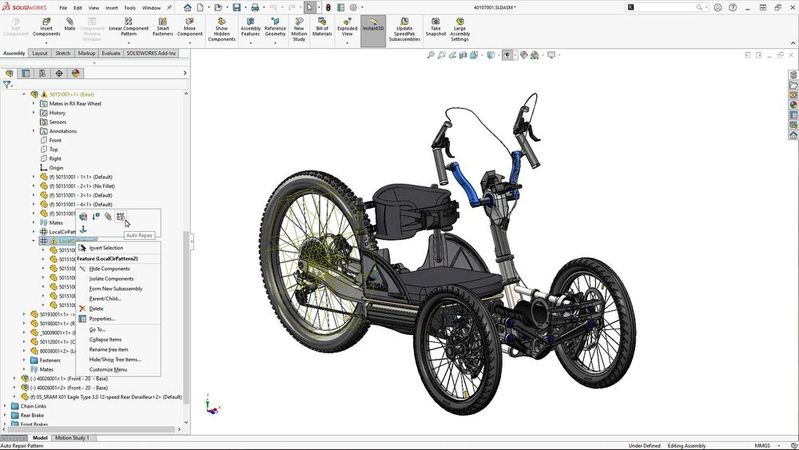
The Mate Helper allows you to automatically insert multiple referenced copies of components into the assembly by recognizing and suggesting positions for replication.
With Smart Mate, the connections are automatically assigned by the system as a component is moved into the corresponding position.
The Selection Helper enables predictions and suggestions on which model elements should be selected and modified in the next step of the work.
The trend towards the use of cloud solutions is clearly noticeable in the world of engineering. It starts with simple data exchange and goes up to a complete PLM solution. Dassault Systèmes responds to this among other things with the cloud services of the 3D Experience platform, which not only allows companies to securely visually share data but also provides a holistic real-time view of their business processes and the entire ecosystem, as Spieler explains. "As a company and innovation platform, it connects all stakeholders, product and project information, as well as solutions in a single, collaborative environment. It acts as a central point of information, thereby optimizing processes for cross-departmental collaboration," Spieler continues. Especially advantageous is the unique scalability of the 3D Experience platform, which opens up new opportunities for companies from young startups to large firms in the development of innovative products.
Date: 08.12.2025
Naturally, we always handle your personal data responsibly. Any personal data we receive from you is processed in accordance with applicable data protection legislation. For detailed information please see our privacy policy.
Consent to the use of data for promotional purposes
I hereby consent to Vogel Communications Group GmbH & Co. KG, Max-Planck-Str. 7-9, 97082 Würzburg including any affiliated companies according to §§ 15 et seq. AktG (hereafter: Vogel Communications Group) using my e-mail address to send editorial newsletters. A list of all affiliated companies can be found here
Newsletter content may include all products and services of any companies mentioned above, including for example specialist journals and books, events and fairs as well as event-related products and services, print and digital media offers and services such as additional (editorial) newsletters, raffles, lead campaigns, market research both online and offline, specialist webportals and e-learning offers. In case my personal telephone number has also been collected, it may be used for offers of aforementioned products, for services of the companies mentioned above, and market research purposes.
Additionally, my consent also includes the processing of my email address and telephone number for data matching for marketing purposes with select advertising partners such as LinkedIn, Google, and Meta. For this, Vogel Communications Group may transmit said data in hashed form to the advertising partners who then use said data to determine whether I am also a member of the mentioned advertising partner portals. Vogel Communications Group uses this feature for the purposes of re-targeting (up-selling, cross-selling, and customer loyalty), generating so-called look-alike audiences for acquisition of new customers, and as basis for exclusion for on-going advertising campaigns. Further information can be found in section “data matching for marketing purposes”.
In case I access protected data on Internet portals of Vogel Communications Group including any affiliated companies according to §§ 15 et seq. AktG, I need to provide further data in order to register for the access to such content. In return for this free access to editorial content, my data may be used in accordance with this consent for the purposes stated here. This does not apply to data matching for marketing purposes.
Right of revocation
I understand that I can revoke my consent at will. My revocation does not change the lawfulness of data processing that was conducted based on my consent leading up to my revocation. One option to declare my revocation is to use the contact form found at https://contact.vogel.de. In case I no longer wish to receive certain newsletters, I have subscribed to, I can also click on the unsubscribe link included at the end of a newsletter. Further information regarding my right of revocation and the implementation of it as well as the consequences of my revocation can be found in the data protection declaration, section editorial newsletter.
The requirements for products, their quality, and associated services are constantly increasing, innovations are expected more quickly, and processes are becoming more complex due to global collaboration. And the later problems are identified in the product development process, the higher the effort and cost of making changes. Therefore, the goal must be to test and optimize the product as early and as thoroughly as possible before manufacturing physical prototypes. Fortunately, there is simulation. In Solidworks 2024, it plays a significant role, as Spieler says: "With the new versions of Solidworks, we always aim to further simplify the work of our users. That's why we integrate various performance improvements into our well-known Solidworks simulation solutions through Solidworks 2024."
As part of the new workflows for optimized working, there is, for example, an automation for the calculation of battery cells. Additionally, the cloud postprocessor has been improved, which significantly reduces the time to display results – even for comprehensive simulations. There is also an efficiency increase in thermal simulations through extended possibilities for meshing the boundary layer elements in flow simulations. In the long list of improvements, according to Spieler, electromagnetic simulation also stands out, made possible by high cloud computing power and GPU acceleration.



:quality(80)/p7i.vogel.de/wcms/a2/9b/a29bb02b3f1e34962e28579dccfbbc49/0129266114v1.jpeg "Bevel gears on workpiece carriers in the rotary indexing conveyor of the VSC 400 DDS - the pick-up spindle removes the workpiece precisely and reproducibly for hard machining at EWS. (Image:Emag)")
:quality(80)/p7i.vogel.de/wcms/c0/2c/c02c6f8c4c079cc5db6a21c00affcecd/0128311235v1.jpeg "Tatra chose a Fastems FPC3000 system as the automation solution, which initially contains twelve pallet spaces, and in a later stage 18 pallet spaces and a linear conveyor. (Image:Starrag/Ralf Baumgarten)")
:quality(80)/p7i.vogel.de/wcms/45/e4/45e497fad5299ffbb7278c1636a261ba/0129304667v1.jpeg "Screw head forming with heat: The heads of the blanks are heated to over 1,000 °C in the induction stage. (Image:Aachen mechanical engineering)")
:quality(80)/p7i.vogel.de/wcms/bc/df/bcdfa690253179f44dfa43986e35e3d4/0129302450v1.jpeg "The VSC 400 DDS retrofit machine from EMAG at EWS Weigele with tool shuttle for external tool preparation - the basis for reliable hard machining of gears. (Image:Emag Systems)")
:quality(80)/p7i.vogel.de/wcms/a3/0c/a30c4c3a36910e92d6082fde37261730/0129555015v1.jpeg "From command recipient to decision-maker: thanks to Agentic AI, robots no longer just stubbornly execute pre-programmed scripts. Instead, they analyze visual data in real time and decide autonomously on the next process step (Image:Nano Banana / AI-generated)")
:quality(80)/p7i.vogel.de/wcms/19/97/1997c06eb2970b0528308f315d0c8e2b/0129538778v1.jpeg "Robots on demand: Rental robots can offer advantages for small and medium-sized companies in particular. (Image:Christopher White)")
:quality(80)/p7i.vogel.de/wcms/99/2e/992e57a54c4ddeaafc113de8e56f2b73/0129501004v1.jpeg "Sereact's AI-based control system can process new and unknown items without prior data collection. (Image:Sereact)")
:quality(80)/p7i.vogel.de/wcms/97/3a/973acc83133c28605f855d750523142e/0129492013v1.jpeg "During the opening, Agile One symbolically pressed the start button. (Image:Deutsche Telekom AG / Cindy Albrecht)")
:quality(80)/p7i.vogel.de/wcms/3f/7f/3f7f9f45ebccd4751d41106866314aea/newsimage418028-2772x1559v1v1.jpeg "Live in the ice channel—detailed recordings in real time make the smallest mistakes and thus time losses in the luge run visible. (Image:Mittweida University of Applied Sciences)")
:quality(80)/p7i.vogel.de/wcms/05/b7/05b7c58dcf5a7fc900348d1c30f7c116/0129540459v1.jpeg "Researchers from Stuttgart have investigated whether the \"technology\" behind hairy elephant trunks, which function as a sensitive gripping system, can also be used in robotics. (Image:Zoo Magic)")
:quality(80)/p7i.vogel.de/wcms/5c/6b/5c6ba3b01c770e0430c88a902149b004/0129558666v1.jpeg "Using quantum computing for highly complex industrial applications: this is what the Q-Genesys project is working on. (Picture: ©Kale Galaxy - stock.adobe.com)")
:quality(80)/p7i.vogel.de/wcms/f8/2d/f82d45c2610205e2c0c188968022890d/more-liftoff-power-first-ariane-6-with-four-boosters-launched-4781x2691v1v1.jpeg "The Ariane 6 can be modularly adapted to any mission—either with two or four boosters and a variable payload fairing length. (Image:ESA-M. Pedoussaut)")
:quality(80)/p7i.vogel.de/wcms/fb/c5/fbc5a1d3151a05241d0b5afc0f017759/0129596854v1.jpeg "The prospects for European cell production have been poor for some time. The reasons for this are high production costs, technical difficulties in ramping up production and overcapacity on the market. (Image:McKinsey)")
:quality(80)/p7i.vogel.de/wcms/69/38/69381399780e10e1bbb446a6a5bfd3e1/0129500927v1.jpeg "Complex design, simple production: With the \"Front-IQ Light\" headlamp, a film is three-dimensionally formed directly in the tool thanks to Colorform technology. (Image:Leonard Kurz)")
:quality(80)/p7i.vogel.de/wcms/8b/9f/8b9f51efadd797e743e11f6b5d4e2070/cupra-summit-2025-tavascan-17-8071x4538v1v1.jpeg "The Tavascan model from Cupra is produced in China and imported into the EU. As a result, it has so far been subject to the regulation for punitive tariffs on electric cars from China. (Image:Cupra Seat)")
:quality(80)/p7i.vogel.de/wcms/d6/c2/d6c29fed2099d2471cf31ea0e660f91e/0129501568v1.jpeg "BMW's sixth-generation cylindrical lithium-ion cells. (Image:BMW)")
:quality(80)/p7i.vogel.de/wcms/9d/3e/9d3e2184ac4490544bd6436d7ad1eb03/3d-interconnect-designer-1600x899v1.jpeg "3D Interconnect Designer simplifies high-speed 3D interconnect design for silicon bridges and interposers. (Source: Keysight)")
:quality(80)/p7i.vogel.de/wcms/18/87/1887248f7eb3fabfbbfb90b3b7e4e79e/0129551381v1.jpeg "Digital self-determination: Red Hat's new assessment tool helps companies regain full control over their IT infrastructure. (Image:AI-generated)")
:quality(80)/p7i.vogel.de/wcms/68/ec/68ec268edc51a26c4e6e2de7187e8e4f/0129456364v1.jpeg "The storage facilities are being built at three locations in Lithuania. (Image:Nidec Conversion)")
:quality(80)/p7i.vogel.de/wcms/a0/36/a03679debcdda99158f4eaa0d6fbe43d/0129505643v1.jpeg "Arduino App Lab: The current release 0.4.0 brings a number of helpful new features. (Image:Arduino)")
:fill(fff,0)/p7i.vogel.de/companies/69/88/69882c428938e/tmts2026-ticec-banner-en-2000px.png "tmts2026-ticec-banner-en-2000px (https://www.tmts.tw/en)")
:fill(fff,0)/p7i.vogel.de/companies/67/eb/67eba621ef6ea/logo2.png "logo2 (Wuxi InfiMotion)")
:quality(80)/p7i.vogel.de/wcms/9d/9d/9d9d4133b43f9c226c246bcc4b6d2f3e/0116082395v1.jpeg "Der Selection Helper schlägt Verrundungen an 13 gefundenen Kanten vor.(Bild: Dassault Systèmes)")
:quality(80)/p7i.vogel.de/wcms/62/87/6287debc49b808de1abcdd07d895be25/0116082394v1.jpeg "Bei der Platzierung einer Schraube (unten rechts in blau) erkennt der Mate Helper die drei weiteren Positionen für eine Schraube auf der Platte (gelb).(Bild: Dassault Systèmes)")
:quality(80)/p7i.vogel.de/wcms/1e/e6/1ee676276d3647ae9c06173a84df3186/0116082383v1.jpeg "Ein wichtiges neues Feature in Solidworks 2024 ist die Möglichkeit Mehrköper-Teile zu erzeugen. Beispiel einer Baugruppe (rechts) und das davon abgeleitete Mehrkörperteil (links). (Bild: Dassault Systèmes)")
:quality(80)/p7i.vogel.de/wcms/3c/8d/3c8df0e2615fe5210565ac2e5f1af0eb/0116082391v1.jpeg "„Speichern unter“-Dialog mit der Auswahl der zu speichernden Version.(Bild: Dassault Systèmes)")
:quality(80)/p7i.vogel.de/wcms/04/cf/04cf3c90ab23fec8a08e05c5153fc503/0124959209v1.jpeg "Cobots, autonomous transport systems, and industrial robots in one environment: System integrators create creative solutions—and require a wide variety of software for this. (Image:Kuka)")
:quality(80)/p7i.vogel.de/wcms/4c/21/4c21ad6e334d3c15981608c75ec6a628/0125867170v1.jpeg "We showcase solutions and tips that ensure greater efficiency in design. (Image:Kisters)")