The summer also offers some exciting robotics products for the industry, including new AMRs from Comau, an online simulation tool from Universal Robots, and a cleanroom robot from Kuka.
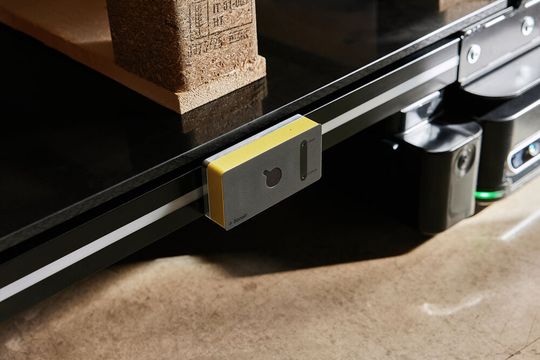
Sonair presents the world's first safe 3D ultrasound sensor for autonomous robots.
(Image: Sonair)
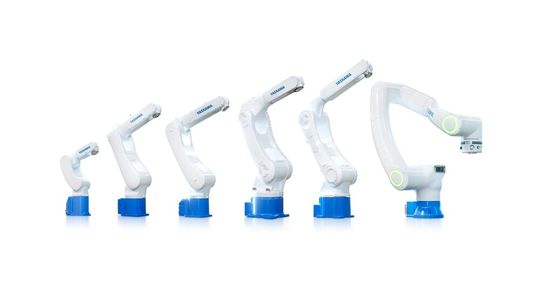
Motoman Next for Intelligent Adaptive Robotics With AI
With Motoman Next, PC software developers can immediately program robot applications without robotics knowledge.
(Image: Yaskawa)
Yaskawa facilitates entry into AI-based robotics with Motoman Next, a new system comprising robot and control hardware as well as software. Users, software developers, and system integrators can thus easily implement adaptive, intelligent robotic applications that were previously considered difficult or uneconomical to automate due to the required hand-eye coordination. Specifically, the robot control unit (RCU) is supplemented by an autonomous control unit (ACU) based on a high-performance NVIDIA Jetson Orin NX edge device with an integrated CPU and GPU. This system runs a Linux host operating system that enables easy installation and execution of Docker containers. Yaskawa already provides essential robotics basic functionalities in the form of preinstalled software services and skills on this platform.
Simple Configuration of Robot Cells
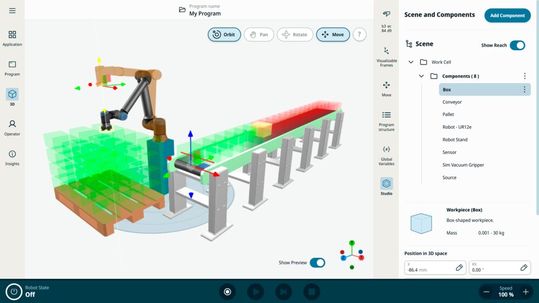
With UR Studio, users can interact with the entire UR robot portfolio as well as various components such as pallets, machines, workpieces, and end-effectors—including common UR grippers.
(Image: Universal Robots)
Universal Robots has released UR Studio, an online simulation tool based on Polyscope X, UR's open and AI-capable software platform. The tool allows customers, partners, and system integrators to create realistic online simulations of their robot cells at a 1:1 scale. Every key function can be simulated—from robot movements, reach, speed, and workflows to cycle time calculations. UR Studio thus enables the straightforward planning of an optimally configured cell.
New Robot Family for Intralogistics
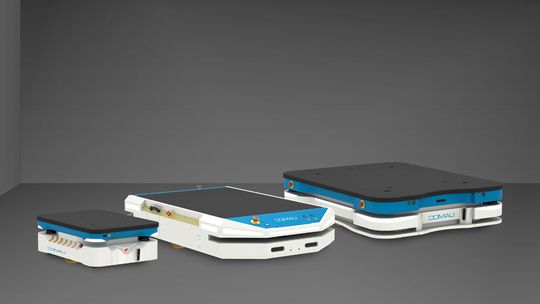
With three different models offering payloads of 660 lbs, 1,100 lbs, and 3,300 lbs, Comau's AMRs support a wide range of logistics tasks.
(Image: Comau)
Comau has introduced its My MR family of autonomous mobile robots (AMRs). The My MR platform was designed to meet the increasing demands of intralogistics in manufacturing, warehousing, logistics, and highly automated environments. With a modular, scalable, and fully autonomous solution, it addresses challenges such as labor shortages, inefficient material handling, and safety concerns. Unlike other automation systems or manual handling processes, My MR offers advanced features such as intelligent fleet management, real-time obstacle avoidance, and seamless line integration.
An Alternative to LiDAR Systems
Acoustic detection and ranging (ADAR), a patented innovation from Sonair, is a new category of 3D depth sensors. It enables autonomous robots to have omnidirectional depth perception, allowing them to "hear" their surroundings in real-time in 3D by using airborne sound waves to interpret spatial information.
(Image: Helene Nesset / Sonair)
Sonair has unveiled the world's first safe 3D ultrasonic sensor for autonomous robots. ADAR is designed to enhance workplace safety in environments shared by humans and robots. A typical 2D LiDAR safety scanner in an AMR only detects a person's legs in a horizontal plane. In contrast, Sonair’s patented ADAR technology (Acoustic Detection and Ranging) identifies people and objects in 3D. A single ADAR sensor provides a complete field of view of 180 x 180 degrees and a range of 5 meters for the robot's safety function—similar to a virtual protective shield. ADAR was developed in compliance with ISO13849:2023 Performance Level d/SIL2. Sonair aims to achieve safety certification for ADAR by the end of 2025.
Easily Integrable Robotics System
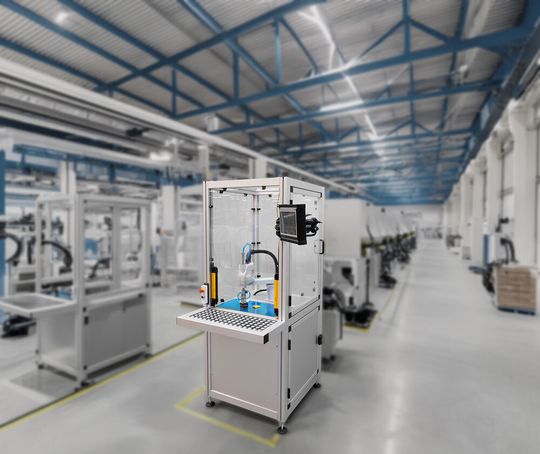
The robot cell is available in three sizes and thus accommodates various types of assembly.
(Image: RK Rose+Krieger)
With its modular cell, RK Rose+Krieger has introduced another system solution for integrating robotics into assembly processes. Based on its component program, the manufacturer developed a standard concept that can be adapted to individual automation requirements. The centerpiece is the Sensor Board technology, which supports the integrated robotic arm with automatic position detection of workpiece carriers. The modular cell consists of a SCARA or articulated robot mounted on a base plate made from RK profile technology. The technology operates with sensors instead of camera systems, making it independent of changing light conditions, dirt, or dust.
Highest Precision Even At A Distance
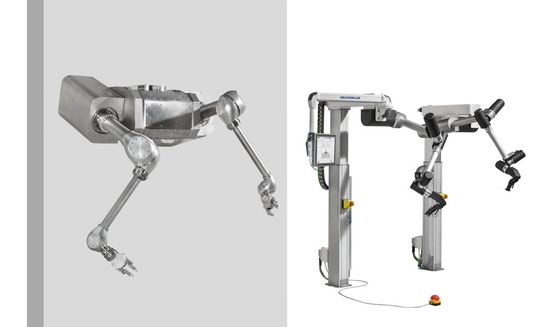
Specifically designed for force-feedback applications in teleoperation—whether in medicine, research, or nuclear technology—the Sensojoints enable absolutely realistic force transmission in real-time.
(Image: Sensodrive)
For work in nuclear-contaminated environments, telemanipulation has established itself as a key technology. The Telbot system by Wälischmiller Engineering GmbH sets new standards in this field. The robot arm, consisting of six joint axes with a gripper, operates with high precision in radioactive areas, while the operator remains at a safe distance—protected in a control center. The robot arm is controlled via the Te.I.D. control arm, a highly precise input manipulator that provides the operator with a fully realistic haptic experience through force feedback. The Sensojoint complete drives from Sensodrive, used in the control arm, enable precise feedback of all forces acting on the robot arm—as if the operator were directly guiding the gripper.
Reliable And Straightforward Safety
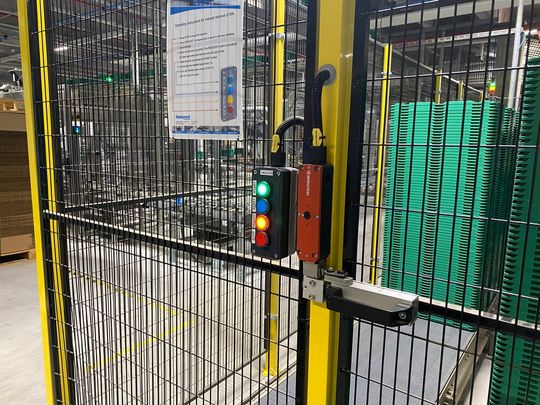
The SLC interlock switch from Bernstein contributes to safe human-machine coexistence.
(Image: Bernstein)
If an error occurs or the robot needs to be stopped for another reason, it is important to ensure that employee safety remains a top priority. The SLC interlock switch from Bernstein precisely and securely regulates access to the safety area of a robot cell. The SLC keeps the door closed as long as the robot is operating inside. An emergency release mounted on the front of the SLC allows the safety door to be opened immediately from the outside in an emergency. Conversely, the escape release located on the back of the switch enables instant opening from the inside in case of an emergency.
Date: 08.12.2025
Naturally, we always handle your personal data responsibly. Any personal data we receive from you is processed in accordance with applicable data protection legislation. For detailed information please see our privacy policy.
Consent to the use of data for promotional purposes
I hereby consent to Vogel Communications Group GmbH & Co. KG, Max-Planck-Str. 7-9, 97082 Würzburg including any affiliated companies according to §§ 15 et seq. AktG (hereafter: Vogel Communications Group) using my e-mail address to send editorial newsletters. A list of all affiliated companies can be found here
Newsletter content may include all products and services of any companies mentioned above, including for example specialist journals and books, events and fairs as well as event-related products and services, print and digital media offers and services such as additional (editorial) newsletters, raffles, lead campaigns, market research both online and offline, specialist webportals and e-learning offers. In case my personal telephone number has also been collected, it may be used for offers of aforementioned products, for services of the companies mentioned above, and market research purposes.
Additionally, my consent also includes the processing of my email address and telephone number for data matching for marketing purposes with select advertising partners such as LinkedIn, Google, and Meta. For this, Vogel Communications Group may transmit said data in hashed form to the advertising partners who then use said data to determine whether I am also a member of the mentioned advertising partner portals. Vogel Communications Group uses this feature for the purposes of re-targeting (up-selling, cross-selling, and customer loyalty), generating so-called look-alike audiences for acquisition of new customers, and as basis for exclusion for on-going advertising campaigns. Further information can be found in section “data matching for marketing purposes”.
In case I access protected data on Internet portals of Vogel Communications Group including any affiliated companies according to §§ 15 et seq. AktG, I need to provide further data in order to register for the access to such content. In return for this free access to editorial content, my data may be used in accordance with this consent for the purposes stated here. This does not apply to data matching for marketing purposes.
Right of revocation
I understand that I can revoke my consent at will. My revocation does not change the lawfulness of data processing that was conducted based on my consent leading up to my revocation. One option to declare my revocation is to use the contact form found at https://contact.vogel.de. In case I no longer wish to receive certain newsletters, I have subscribed to, I can also click on the unsubscribe link included at the end of a newsletter. Further information regarding my right of revocation and the implementation of it as well as the consequences of my revocation can be found in the data protection declaration, section editorial newsletter.
Precise Position Control Via Torque
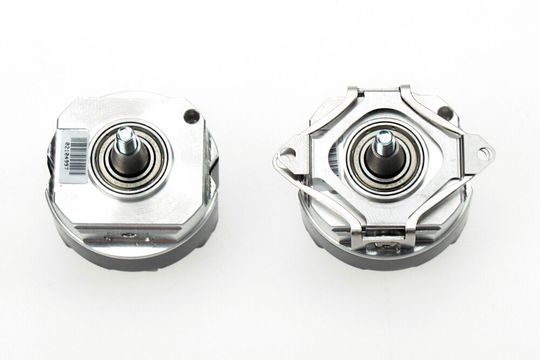
The Acuro AD37 is the flagship of Hengstler's absolute encoders.
(Image: Hengstler GmbH)
The encoders of the Acuro series from Hengstler enable precise position determination even when powered off—without prior calibration at a reference point. Depending on the application area and requirements, users can choose between absolute single-turn encoders and absolute multi-turn encoders. They are available in versions with housings or as built-in encoders. Absolute encoders of the Acuro series not only offer high absolute accuracy and repeatability but also feature a high level of functional safety: The Acuro AD37 and Acuro AD58S meet both the SIL3 criteria and those of Performance Level e (PLe), Category 3 (according to EN ISO 13849).
New Benchmarks in Cleanroom
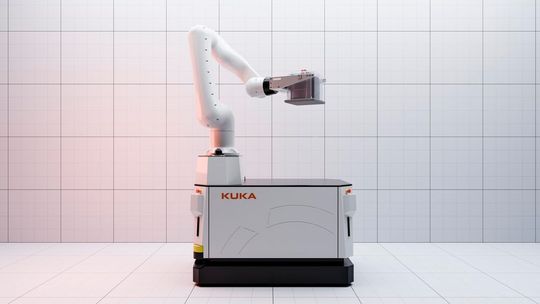
The six-axis robot LBR iisy CR, installed on a mobile platform, efficiently performs pick-and-place applications, material transport, or palletizing tasks.
(Image: Kuka)
With the new KMR iisy CR, Kuka introduces its versatile autonomous mobile robot (AMR) as a cleanroom variant in the payload classes of 24 and 33 pounds. The cleanroom models have been certified by the Fraunhofer Institute and meet the requirements of ISO Cleanroom Class 3 according to DIN EN ISO 14644-1. Consisting of a mobile platform and the integrated six-axis robot LBR iisy CR, the KMR iisy CR is the optimal solution for cleanroom environments thanks to its low-particle, low-emission design and ESD certification. After quick and easy installation, it efficiently and cost-effectively performs pick-and-place tasks, material transport, or palletizing applications.
Future-Proof Authentication with Universal RFID Readers



:quality(80)/p7i.vogel.de/wcms/1d/85/1d856c359855885a633f48d9f77fe69c/0130227630v1.jpeg "Two \"HBZ AeroCell 160\" in the Moyola factory. The machines mark a significant milestone in Moyola's ongoing commitment to performance, innovation and global competitiveness. (Image:Moyola)")
:quality(80)/p7i.vogel.de/wcms/78/e3/78e3db1b32fb30c9a9195e36864db885/0129830906v1.jpeg "Siemens and Caphenia sign the partnership agreement. From left to right: Nicky Ahnert, Jürgen Giegerich, Frank Knauf (all Siemens), Dr. Mark Misselhorn, Dr. Andreas Waibel (both Caphenia). (Image:Siemens)")
:quality(80)/p7i.vogel.de/wcms/5a/d7/5ad72fd14971344dbfed431e07ae6423/0130200276v1.jpeg "A new machining job needs to be processed! Open the drawer—but the right tool is missing! That's what happens when you work with old data. But EVO Informationssysteme has an AI tool that means the problem will never slow down production again. (Image:EVO Information Systems)")
:quality(80)/p7i.vogel.de/wcms/53/f7/53f7dadbe4d656a3fd4f4077445f29f6/0129828707v1.jpeg "Thanks to its compact design and drilling/unscrewing function, the Fire Birdie is suitable for applications with limited installation space and frequent tool changes. (Image:Marcel Kraibühler)")
:quality(80)/p7i.vogel.de/wcms/21/3b/213b5e5454b0c4344ba0eaa700857607/0129635774v1.jpeg "The QRV flow control valves from Lee are available in sizes from 5.5 to 18 mm and cover a flow rate of 0.2 to 20 l/min. Depending on the version, the pressure range is either between 0.1 and 2.75 bar (1.5 - 40 psi) or between 0.17 and 2 bar (2.5 - 30 psi). (Image:Lee)")
:quality(80)/p7i.vogel.de/wcms/63/e9/63e9db3259a656cca88c5f7158af3fcb/0129385769v1.jpeg "The Agibot A2 at a Fortune China event in December 2025. (Image:Agibot)")
:quality(80)/p7i.vogel.de/wcms/df/a1/dfa1786a3b05f5ff2e51d0f633695c57/0130137877v1.jpeg "Openclaw inspires AI communities. (Image:Openclaw.ai)")
:quality(80)/p7i.vogel.de/wcms/16/9c/169ce3040d09673a91a403598d15dbf1/0130162776v1.jpeg "From networked cameras to vacuum robots, industrial robots, drones and humanoids, AI is moving ever closer to sensors and actuators as it develops from \"basic intelligence\" to \"multi-purpose intelligence\", while software-defined architectures make long-term systems flexibly upgradeable for new functions and AI models. (Image:Globalfoundries)")
:quality(80)/p7i.vogel.de/wcms/78/28/7828775af76773458b4d1409ceb1cf0c/368945-20dam-20imagery-digital-transformation-pc-1920x1079v1v1.jpeg "Complex development projects with high regulatory requirements, such as in the aerospace industry, benefit in particular from the Intelligent Product Lifecycle. (Image:PTC)")
:quality(80)/p7i.vogel.de/wcms/e7/82/e7822e208621ba2ae892d609e60481e8/texas-20uni-850x478v1v1.jpeg "Superfoam is a composite that is capable of absorbing 10 times more energy than a conventional foam. (Image:Abbey Toronjo/Texas A&M University Division of Marketing & Communications)")
:quality(80)/p7i.vogel.de/wcms/da/4d/da4da8d34671dc6bce80e496212de877/0129850788v1.jpeg "Mate-XT Go supports the arms and shoulders during overhead work and repetitive tasks and is designed to significantly reduce muscle strain in everyday working life. (Image:Comau)")
:quality(80)/p7i.vogel.de/wcms/3f/cc/3fccb748b0fe16f1f61249d94c72f126/0130149439v1.jpeg "Requirements for integrated power supply systems: Precise AC and DC power supply systems that not only provide energy, but also reliably combine measurement, analysis and system integration. (Image:Schulz Electronic)")
:quality(80)/p7i.vogel.de/wcms/2b/0b/2b0b5ff55299be32174cb0ed76718253/0130177406v1.jpeg "Rolls-Royce has received funding of 70 million US dollars from the EU public-private partnership \"Joint Undertakings for Clean Aviation\". (Image:Rolls-Royce)")
:quality(80)/p7i.vogel.de/wcms/95/7e/957ed49b185794b3e76b9e610a8a389f/0130217926v1.jpeg "Bosch wants to offer components for e-vehicles in India together with Tata. (Image:Bosch)")
:quality(80)/p7i.vogel.de/wcms/d8/11/d8118b193939ca897a4962aeb1bbc5ae/0130224537v1.jpeg "Opel plans to participate in the Formula Ene racing series from fall 2026 with the fully electric Gen4 racing cars. (Image:Opel)")
:quality(80)/p7i.vogel.de/wcms/92/f1/92f12f22e5045c6af002ab48a59841d0/0130171646v1.jpeg "The US electric vehicle manufacturer Rivian is to supply self-driving vehicles to Uber. (Image:Rivian)")
:quality(80)/p7i.vogel.de/wcms/3a/50/3a50d3f269f38f14d7a25a93c6f2b2f8/0130147601v1.jpeg "The compact modulator enables fast and energy-efficient data transmission and can be manufactured cost-effectively. (Image:Hugo Larocque, EPFL)")
:quality(80)/p7i.vogel.de/wcms/54/d3/54d34bf24912ac87780c1fbfa745dad7/0130174841v1.jpeg "Simulation can help to optimize material flows in production. (Image:freely licensed)")
:quality(80)/p7i.vogel.de/wcms/1f/8e/1f8e294ac0af3a801575c7e1400cc830/0130164847v1.jpeg "While micro-injection molding takes 10 to 12 weeks for critical components, 3D printing offers faster manufacturing and greater flexibility for design iterations, Collins said. (Image:Boston Micro Fabrication)")
:quality(80)/p7i.vogel.de/wcms/ae/8f/ae8f87001d67841b6a6f9e3efb5a2f1a/0130176499v1.jpeg "Almost 160 exhibitors and 2,400 participants came to Munich for LOPEC 2026 to find out about printed electronics. (Image:Messe München GmbH)")
:fill(fff,0)/images.vogel.de/vogelonline/companyimg/76800/76895/65.jpg "FAULHABER_120mm.jpg ()")
:fill(fff,0)/p7i.vogel.de/companies/67/eb/67eba621ef6ea/logo2.png "logo2 (Wuxi InfiMotion)")
:quality(80):fill(efefef,0)/p7i.vogel.de/wcms/67/ae/67ae0b9ac31f8/elatec-wp-universal-reader.png "Elatec WP Universal Reader")
:quality(80)/p7i.vogel.de/wcms/20/48/2048d7a876ec38da1df64a5c3c12d1ba/0129069977v1.jpeg "0129069977v1 (Image:AI-generated)")
:quality(80)/p7i.vogel.de/wcms/86/d3/86d3e80177392a7d11f68a6ed8bb0aa8/0127182524v1.jpeg "The Atro modular industrial robot system enables robot solutions to be implemented that are precisely tailored to the application and seamlessly integrated into TwinCAT. (Image:Beckhoff Automation GmbH & Co. KG)")