A newly developed milling kinematics on a linear axis enables the machining of lightweight materials, metals, and steels with an industrial robot, achieving manufacturing tolerances of up to 0.1 millimeters. This could open up new application areas.
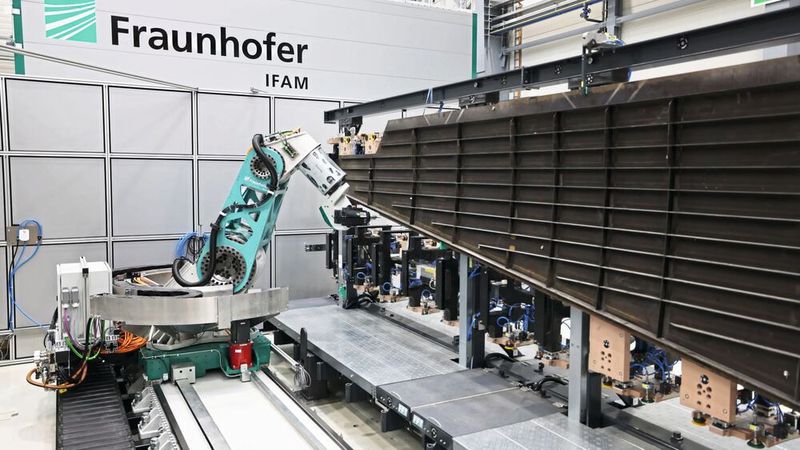
The newly developed milling kinematics with hybrid drive on a linear axis processes a CFRP aircraft vertical stabilizer at full scale.
(Image: Fraunhofer IFAM)
The Lower Saxony Lufo project "Roboter Made in Niedersachsen 2" (shortly: Romani 2) investigated how to bridge the gap between industrial robots and machine tools. The Fraunhofer IFAM in Stade, Germany led the consortium for the R&D work. Project partners included Broetje-Automation GmbH, Hexagon Aicon Etalon GmbH, and Siemens AG. Additionally, Airbus Operations GmbH and A&T Service GmbH contributed as associated partners.
In the project, two robot kinematics designed for machining were explored. They were optimized for accurate path processes through control-side settings and metrological support, and were tested based on real aviation applications at full scale.
During their research, the Fraunhofer IFAM team assembled a prototype kinematics, which had been developed in a previous research project: the Flexible Kinematics 4.1, or Flexmatik 4.1. This device features a novel hybrid drive. In the collaborative project Flexmatik 4.1, Fraunhofer IFAM, along with Fraunhofer IPK and Fraunhofer LBF, developed a robot with significantly improved dynamic properties for challenging tasks, such as processing demanding materials. At the conclusion of the Romani 2 project, the team succeeded in precisely machining not only a carbon fiber reinforced polymer (CFRP) vertical stabilizer from the associated partner Airbus but also a test body made of steel.
Industrial robots versus machine tools
Serial industrial robots, due to their construction, not only allow for a wide variety of machine designs but also require little floor space relative to the working area they provide. Because they are efficient and versatile, they have become established in various manufacturing and production processes. This is particularly true for automated handling and assembly. Additionally, industrial robots are increasingly found in other areas, such as the machining of lightweight materials.
However, industrial robots encounter limitations due to their restricted dynamic properties and higher compliance compared to machine tools, especially when faced with increasing demands from harder materials or more stringent tolerances. Machine tools, on account of their kinematic design, exhibit low compliance and high precision. However, when scaling up to larger components in the meter range, this machine design requires a significant investment in materials and capital.
Machining of large-scale CFRP components at 1:1 scale
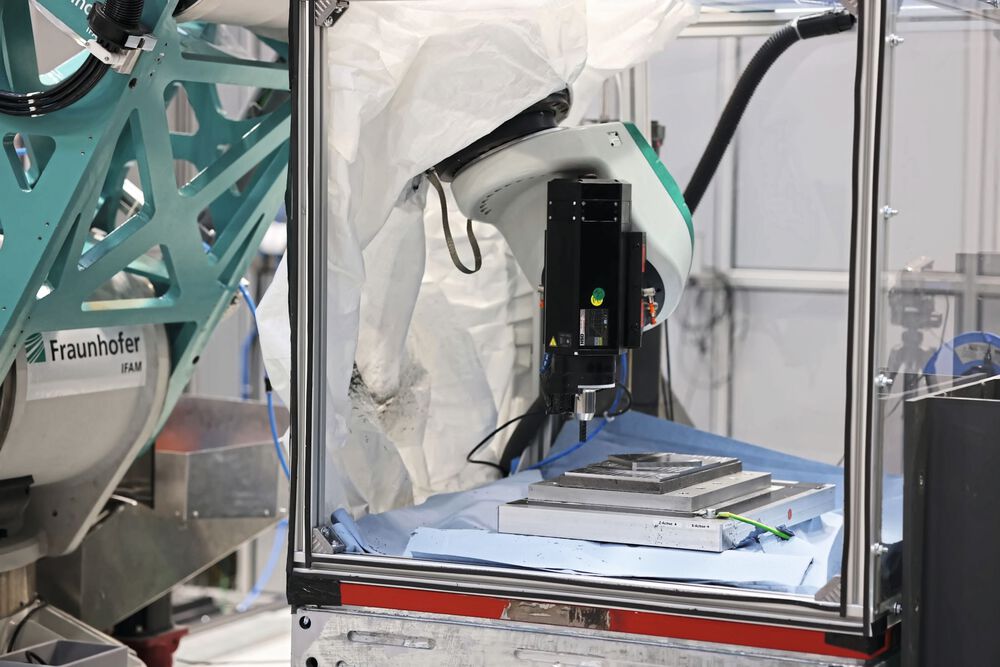
The high-precision machining of a test piece made of steel demonstrates, from the perspective of the project partners, that the robot with a hybrid drive on the linear axis is capable of bridging the gap between industrial robots and machine tools.
(Image:Fraunhofer IFAM)
In recent years, the use of new manufacturing methods has led to further developments in the design freedom and structural integrity of near-net-shape components made from carbon fiber-reinforced plastics (CFRP) in aircraft construction. Due to economic and technical requirements, high-precision mechanical post-processing of large components in the meter range, with tolerance specifications in the sub-millimeter range, is typically performed using large tool machines in gantry design. Due to their kinematic structure, these gantry machines are quite large, often dictating the layout of production facilities and offering limited flexibility to adapt to changes in the production process.
An alternative machine concept is provided by the industrial robot, which includes workspace expansion through a mobile platform, the integration of multiple robots, or the use of translational additional axes, such as linear axes. Compared to gantry systems or machine tools, this machine concept is considerably more space-saving and is not economically bound to individual large components. Additionally, the use of special foundations is eliminated, which facilitates future modifications of production lines. In the Romani 2 project, the prototype robot was combined with a linear axis for path-accurate motion, which was also developed in the Flexmatik 4.1 project.
Although industrial robots have already been successfully used in the machining of thin shell components in aviation, increasing robustness against occurring process forces and tackling more demanding machining tasks is the next step for expanding the use of industrial robots in the production of large components in the aviation sector.
Hybrid drive improves the dynamic behavior of serial industrial robots
In the Romani 2 project, automation and production technology experts at Fraunhofer IFAM constructed and evaluated a serial prototype robot. The self-developed kinematics were fundamentally designed to meet the needs of path processes. The goal was to ensure a manufacturing tolerance of at least ± 0.1 millimeters in the processing of large components, starting from the very first part.
This prototype robot, including the linear axis, was previously developed as part of the Flexmatik 4.1 project, which concluded with the manufacturing of all components. The assembly of the entire kinematics, commissioning, control-side optimization and further development, as well as intensive examination of the robot kinematics, were then tasks within the Romani 2 project. Accuracy investigations of the prototype robot confirmed that the targeted goal of 0.1 millimeters was achieved!
Date: 08.12.2025
Naturally, we always handle your personal data responsibly. Any personal data we receive from you is processed in accordance with applicable data protection legislation. For detailed information please see our privacy policy.
Consent to the use of data for promotional purposes
I hereby consent to Vogel Communications Group GmbH & Co. KG, Max-Planck-Str. 7-9, 97082 Würzburg including any affiliated companies according to §§ 15 et seq. AktG (hereafter: Vogel Communications Group) using my e-mail address to send editorial newsletters. A list of all affiliated companies can be found here
Newsletter content may include all products and services of any companies mentioned above, including for example specialist journals and books, events and fairs as well as event-related products and services, print and digital media offers and services such as additional (editorial) newsletters, raffles, lead campaigns, market research both online and offline, specialist webportals and e-learning offers. In case my personal telephone number has also been collected, it may be used for offers of aforementioned products, for services of the companies mentioned above, and market research purposes.
Additionally, my consent also includes the processing of my email address and telephone number for data matching for marketing purposes with select advertising partners such as LinkedIn, Google, and Meta. For this, Vogel Communications Group may transmit said data in hashed form to the advertising partners who then use said data to determine whether I am also a member of the mentioned advertising partner portals. Vogel Communications Group uses this feature for the purposes of re-targeting (up-selling, cross-selling, and customer loyalty), generating so-called look-alike audiences for acquisition of new customers, and as basis for exclusion for on-going advertising campaigns. Further information can be found in section “data matching for marketing purposes”.
In case I access protected data on Internet portals of Vogel Communications Group including any affiliated companies according to §§ 15 et seq. AktG, I need to provide further data in order to register for the access to such content. In return for this free access to editorial content, my data may be used in accordance with this consent for the purposes stated here. This does not apply to data matching for marketing purposes.
Right of revocation
I understand that I can revoke my consent at will. My revocation does not change the lawfulness of data processing that was conducted based on my consent leading up to my revocation. One option to declare my revocation is to use the contact form found at https://contact.vogel.de. In case I no longer wish to receive certain newsletters, I have subscribed to, I can also click on the unsubscribe link included at the end of a newsletter. Further information regarding my right of revocation and the implementation of it as well as the consequences of my revocation can be found in the data protection declaration, section editorial newsletter.
A key element in improving the dynamic behavior of the prototype robot, in addition to structural optimization, is the use of an innovative drive concept in the basic axes. By using an additional direct drive, parallel to the conventional gear drive, a moment can be applied directly on the load side.
This hybrid concept allows for the compensation of unwanted effects of the gearbox and damping of high frequency excitations. At the same time, it ensures high energy efficiency in static and quasi-static load cases.
The kinematics are controlled using a Siemens controller, the Sinumerik One. As a result, the widespread expertise in operating CNC machines can be utilized without the need for retraining on new types of controllers. In the Romani 2 project, control components for the hybrid drive were further developed to ensure that the full potential of the drive is now accessible within this proven industrial control system.
Linear axis + hybrid drive robot = wide range of applications
The combination of a serial articulated arm kinematics with a linear axis offers several advantages over large gantry systems and special machines for processing. The smaller footprint and the modular design of the linear axis allow for high flexibility of the system. By using two tensioned pinion-rack drives, reversal effects are compensated, achieving sufficiently high drive stiffness of the linear axis carriage for path-accurate robotic processes. Due to the high structural stiffness of the linear axis, the influences on robot accuracy are minimal despite significant lever arms at the point of load application. In the project, path accuracies of 0.15 millimeters for large components up to 7 meters were achieved. The researchers at Fraunhofer IFAM believe that higher accuracy is attainable through the compensation of additional static factors, such as temperature, rather than by compensating for further dynamic effects.
A significant improvement in the guidance behavior and disturbance suppression of the serial robot kinematics at the axis level is achieved through the use of direct drives. The direct mechanical transmission of motor torques to the kinematics also allows for an increased jerk setting of all primary axes. This is 10 to 100 times higher compared to conventional robots with servo drives, thereby offering substantial potential for increasing productivity.Moreover, a significant increase in path accuracy at high travel speeds can be demonstrated. At a high feed rate of 10 meters per minute, path accuracy within the range of the previously measured static accuracy is observable. Damping of the first eigenmodes, caused by the gearbox drives, also offers the potential for improved disturbance suppression. This enhances the overall precision and effectiveness of the robotic system, especially in applications requiring high-speed movements.Moreover, a significant increase in path accuracy at high travel speeds can be demonstrated. At a high feed rate of 10 meters per minute, path accuracy within the range of the previously measured static accuracy is observable. Damping of the first eigenmodes, caused by the gearbox drives, also offers the potential for improved disturbance suppression. This enhances the overall precision and effectiveness of the robotic system, especially in applications requiring high-speed movements.
Outlook
In the next step, the researchers at Fraunhofer IFAM plan to further develop the new technology alongside industry partners until it is ready for mass production. There are a multitude of applications for industrial robots with hybrid drives: The range extends, in combination with a linear axis, from machining tasks in the aerospace sector such as lighter composite structures and aluminum alloys to the processing of harder materials, such as steel or titanium, which are used in the rail, commercial vehicle, shipbuilding, and energy sectors. Previously, machining such components and materials robustly with industrial robots was not feasible at an industrial scale. Specifically, machining difficult-to-cut materials using industrial robots with hybrid drives may prove to be promising for the future.
A significant improvement in the guidance behavior and disturbance suppression of the serial robot kinematics at the axis level is achieved through the use of direct drives. The direct mechanical transmission of motor torques to the kinematics also allows for an increased jerk setting of all primary axes. This is 10 to 100 times higher compared to conventional robots with servo drives, thereby offering substantial potential for increasing productivity.
Moreover, a significant increase in path accuracy at high travel speeds can be demonstrated. At a high feed rate of 10 meters per minute, path accuracy within the range of the previously measured static accuracy is observable. Damping of the first eigenmodes, caused by the gearbox drives, also offers the potential for improved disturbance suppression. This enhances the overall precision and effectiveness of the robotic system, especially in applications requiring high-speed movements.
With the machining of a steel test piece, the next step has been taken to open up new application areas for industrial robots. The test piece included various geometries such as corners, surfaces, and circles. The machining was carried out with the processing parameters provided by the tool manufacturer.
Outlook
In the next step, the researchers at Fraunhofer IFAM plan to further develop the new technology alongside industry partners until it is ready for mass production. There are a multitude of applications for industrial robots with hybrid drives: The range extends, in combination with a linear axis, from machining tasks in the aerospace sector such as lighter composite structures and aluminum alloys to the processing of harder materials, such as steel or titanium, which are used in the rail, commercial vehicle, shipbuilding, and energy sectors. Previously, machining such components and materials robustly with industrial robots was not feasible at an industrial scale. Specifically, machining difficult-to-cut materials using industrial robots with hybrid drives may prove to be promising for the future.



:quality(80)/p7i.vogel.de/wcms/dd/08/dd086510d9ae7b50181f6070e4463b44/0129363730v1.jpeg "Typical application for ionizing devices: Wrapping films. (Picture: ©Adobe Stock/SMC)")
:quality(80)/p7i.vogel.de/wcms/35/57/3557c819943c53acec41a0ccba87da4f/0130049064v1.jpeg "Researchers at the Fraunhofer IWU in Chemnitz have long known that many typical sheet metal parts can be manufactured more cost-effectively using hollow embossing rollers. Now there is news to report ... (Image:Fraunhofer IWU)")
:quality(80)/p7i.vogel.de/wcms/59/02/590246e3b3f415c65edbee377c14ca77/26-06-pi-fraunhofer-iws-41450-direktplattieren-pic-01-7771x4369v1v1.jpeg "The Fraunhofer IWS has developed the new \"direct laser cladding\" process, which creates a functional layer directly on the base body by applying a strip-shaped metal to rotationally symmetrical components in a spiral and bonding it locally by laser. (Image:Christoph Wilsnack/Fraunhofer IWS)")
:quality(80)/p7i.vogel.de/wcms/73/60/73608418789b1d9c393f5e2fa974eda2/0130209906v1.jpeg "The robots of the X6 generation from b+m enable very high painting quality and are also particularly compact and easy to maintain. (Image:Beckhoff)")
:quality(80)/p7i.vogel.de/wcms/78/e9/78e9188c25a8a94e67c34c9bf8ffe495/visual-agile-20robots-20and-20google-20deepmind-20partner-20to-20bring-20intelligence-20to-20robotics-2500x1406v1v1.jpeg "Together, the partners are developing adaptable, intelligent robots for a wide range of applications (Image:Agile Robots SE)")
:quality(80)/p7i.vogel.de/wcms/e7/66/e7669ecf0260ae8fc54c214e34e4902a/0130316817v1.jpeg "Siemens and Palo Alto Networks offer tested cybersecurity solution for industrial 5G. (Image:Siemens)")
:quality(80)/p7i.vogel.de/wcms/9f/55/9f55324832c4f426958031375124d9de/siemens-20ubtech-20hmnd-1920x1079v1v1.png "Ready for the factory floor: While Ubtech is planning mass production, Siemens is already testing humanoids in real factory applications in Erlangen. (Image:Siemens)")
:quality(80)/p7i.vogel.de/wcms/11/36/113695ed260e29c8c2d9d39dc5f9d869/0130213768v1.jpeg "AI can work cheaply in China and deliver the results rapidly all over the world. (Image:Dall-E / AI-generated)")
:quality(80)/p7i.vogel.de/wcms/62/5f/625f41e87ebfef156a98c8e6393e32fd/0130211654v1.jpeg "Axial flux motors have some advantages over radial flux motor—but their production is currently still expensive. (Image:RWTH Aachen University)")
:quality(80)/p7i.vogel.de/wcms/77/9b/779b0685d010dfe45c9c2cb1cfecd467/0128886425v1.jpeg "The BlueEye is the first \"real\" hyperspectral camera for the UV range and covers the wavelength range from 220 to 380nm. (Image:Inno-spec GmbH)")
:quality(80)/p7i.vogel.de/wcms/e4/51/e451d52ce0182fb0aaa46a5774f832ef/26-04-pi-fraunhofer-iws-21160-bioslide-pic-01-4128x2321v1v1.jpeg "With the BioSlide research project, the Fraunhofer IWS is investigating how sliding systems can be designed to be more sustainable and energy-efficient. New materials can be tested in a particularly application-oriented manner on this plain bearing test stand. (Image:Fraunhofer IWS)")
![Thanks to advanced 3D printing technology, a more efficient use of resources should contribute to lower-emission aviation—this is the goal of ['skai]-lab. (Image:Oleksandr Pashchenko - stock.adobe.com / AI-generated)](https://cdn1.vogel.de/nghHNSbySccfOjG3n1qCA-FVOjQ=/288x162/smart/filters:format(jpg):quality(80)/p7i.vogel.de/wcms/62/64/626424c97a16e69f871bf216c9629c2a/adobestock-1927043193--c2-a9-20oleksandr-20pashchenko-20-e2-80-93-20stock-adobe-com-ki-generiertv1v1.jpeg "Thanks to advanced 3D printing technology, a more efficient use of resources should contribute to lower-emission aviation—this is the goal of ['skai]-lab. (Image:Oleksandr Pashchenko - stock.adobe.com / AI-generated)")
:quality(80)/p7i.vogel.de/wcms/c3/c4/c3c4ce270b083eeac55654148611f064/0130237945v1.jpeg "China is not giving up on hydrogen, but is intensifying its efforts. (Image:freely licensed from Pixabay)")
:quality(80)/p7i.vogel.de/wcms/4e/c0/4ec0bd19390b169edfa23677373dcdf1/0130260089v1.jpeg "Renewable fuels can supply European road traffic, according to a study. (Image:Aral)")
:quality(80)/p7i.vogel.de/wcms/6f/c9/6fc9050301d745cad25585c6780f8f51/0130197341v1.jpeg "Production facilities are a worthwhile target and are therefore at risk. (Image:ABB Robotics)")
:quality(80)/p7i.vogel.de/wcms/b6/62/b662adc2cec8227d8172509bbfb6ee42/25c0207-107-4961x2789v1v1.jpeg "The GLB is the second model based on Mercedes' new MMA platform. Apparently, Geely's platform is better and cheaper, which is why the two companies are negotiating a partnership. (Image:Mercedes-Benz)")
:quality(80)/p7i.vogel.de/wcms/4d/dd/4dddf438e91f394c04a095dbfd109d1c/0130236430v1.jpeg "Measurement modules: The 720301 module in combination with the SL2000 enables RMS and power calculations, among other things. (Image:Yokogawa)")
:quality(80)/p7i.vogel.de/wcms/61/fc/61fcf95f5cca15494ad18343901ae585/0130317237v1.jpeg "With the AGI CPU, Arm says it is taking a \"historic step\": With the processor aimed at AI in data centers, the company is presenting itself for the first time as a provider of its own chips, not just as a pure IP licensor. (Image:Arm)")
:quality(80)/p7i.vogel.de/wcms/82/90/8290dfe3595b6c6b33726ae8b76172c7/0130319587v1.jpeg "The concept image illustrates how the pattern of tiny protrusions and depressions created on the substrate (MgO, bottom) controls the arrangement of atoms in the superconducting material (YBCO, top). At the interface between the two layers, an electronic structure enables superconductivity to occur at higher temperatures than previously possible. (Image:Chalmers University of Technology / Riccardo Arpaia)")
:fill(fff,0)/images.vogel.de/vogelonline/companyimg/76800/76895/65.jpg "FAULHABER_120mm.jpg ()")
:fill(fff,0)/p7i.vogel.de/companies/67/eb/67eba621ef6ea/logo2.png "logo2 (Wuxi InfiMotion)")
:quality(80)/p7i.vogel.de/wcms/06/39/0639d9356c160cf1eb36072eb77a5a7c/hochpr-c3-a4zise-20bearbeitung-20eines-20pr-c3-bcfk-c3-b6rpers-20aus-20stahl-4000x2250v1.jpeg "The successful high-precision machining of a steel part shows that the machining robot on the linear axis is able to close the gap between industrial robots and machine tools. (Image: Fraunhofer IFAM)")
:quality(80)/p7i.vogel.de/wcms/da/78/da781ee7a171a683026e669d03268052/0125773339v1.jpeg "Typical application area: Industrial robots are used in numerous different production steps in the automotive industry. (Image:KUKA Group)")