Following Donald Trump's election victory, Chinese carmakers and suppliers may face several new challenges, particularly with his announced intention to increase tariffs. However, Beijing maintains an optimistic long-term perspective, believing that such protectionist measures could ultimately benefit China's automotive industry by accelerating innovation and expanding its presence in emerging markets.
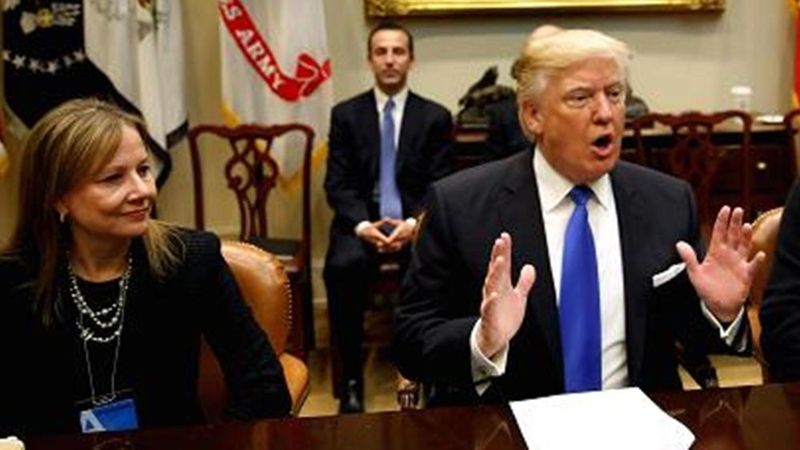
Donald Trump during his first term in office. If he becomes President of the USA for a second time in January, a lot is likely to change for companies in the automotive industry.
(Bild: The White House/Auto-Medienportal.Net)
China's automotive industry anticipates a further escalation in the trade war with the United States following Donald Trump's election victory. Should Trump act on his campaign promises, new obstacles may emerge for Chinese carmakers and suppliers. However, some in Beijing believe that in the long run, U.S. protectionism could ultimately benefit Chinese manufacturers by encouraging domestic growth and innovation.
During his campaign, Trump addressed the Detroit Economic Club in the historically influential car city, Detroit, declaring that Chinese automotive imports would face tariffs as high as 100% or even 200%. According to South China Morning Post, Trump emphasized that these measures were designed to protect what remains of the U.S. auto industry, signaling aggressive trade policies targeting Chinese manufacturers.
Trump also specifically targeted Chinese car exports from Mexico, hinting at punitive tariffs on such products. Companies like BYD, a major Chinese automaker, had been considering building factories in Mexico to bypass direct U.S. trade barriers. However, during the uncertainty of the election campaign, BYD and others put their "location scouting" efforts on hold.
Renegotiating the USMCA Free Trade Agreement
The potential loophole allowing Chinese exports to bypass U.S. tariffs via Mexico seems unlikely to remain open during Donald Trump’s second term, which begins on January 21. Trump has pledged to renegotiate the trilateral U.S.-Mexico-Canada Agreement (USMCA), specifically targeting imports from China. The detailed nature of his campaign rhetoric on this matter suggests it was more than mere electioneering.
Under the Biden administration, 100% tariffs on direct imports of Chinese electric vehicles (EVs) were introduced, coming into effect about a month ago. This means the immediate impact of "Trump 2.0" policies on China’s auto industry might be limited since these tariffs are already in place. However, it is widely anticipated that Trump will not roll back these measures. The tariffs, originally aimed at bolstering the Democrats’ election strategy, have not yielded significant political advantages, nor are they expected to be a priority for repeal under Trump's administration.
Trump has made it clear that he intends to seal off the US market from Chinese cars. As far as direct imports are concerned, he has spoken of tariffs of 100, 200 or even “1,000 percent” that should apply in the future. He considers the word “tariff” to be “the greatest word in the dictionary”.
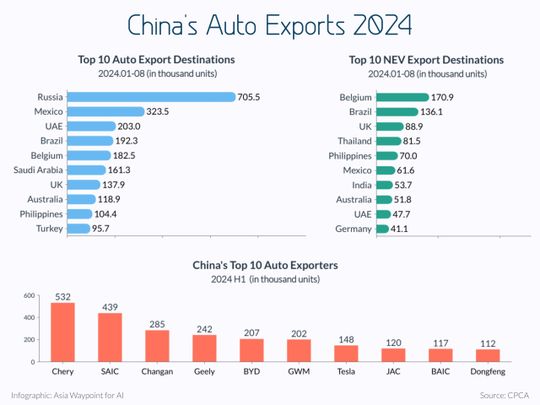
The most important export countries for China's automakers (data from January to August 2024).
(Bild: VCG)
hinese automakers exported 61,000 vehicles to the U.S. in the first eight months of this year, compared to 180,000 units sent to Belgium during the same period. This highlights the relatively low direct impact of Trump’s election victory on China's OEMs. The Chinese automotive portal Gasgoo commented that the immediate effect of this political development on Chinese original equipment manufacturers (OEMs) would be minimal.
Challenges for Chinese Suppliers
The situation appears more troubling for Chinese automotive suppliers. During the same timeframe, they exported vehicle parts and components worth $12 billion (approximately €11.3 billion) to the U.S. Trump, during his campaign, proposed a potential new 10% tariff on all imported goods, with a particularly steep 60% tariff on goods originating from China. Such measures, if enacted, could severely affect Chinese suppliers who rely heavily on the U.S. market for their exports.
Another front against China's automotive industry, already opened under Biden's administration by China hawks in the U.S. government, is likely to intensify under Trump from Beijing's perspective: the argument of "national security" to keep connected Chinese cars out of the U.S. market. This industry in China is still in its infancy. Last year, fewer than 400,000 so-called ICVs (intelligent, connected vehicles) were sold in the country. However, the Chinese government has ambitious plans for autonomous driving, and this segment is expected to become increasingly significant in the coming years.
Dwindling Access to Chinese Research
Given China's current economic slowdown, the new hurdles for automotive exports are far from welcome. However, many observers in China believe that U.S. protectionism could benefit the Chinese automotive industry in the long run.
One key reason is that such barriers will push China to intensify its efforts to independently develop advanced automotive technologies. These include better car chips, software for autonomous driving, and intelligent electric vehicles. This focus is seen as a credible response, extending beyond reactions to the U.S. election.
Across more than 100 science and technology parks in China, innovative ideas shaping the future of mobility are being tested and implemented. Examples include AI-driven semiconductors and new materials for electric vehicle batteries. As the U.S.—and Europe—implement tariffs or other trade barriers against China, they risk losing access to this vibrant ecosystem of innovation and the advancements it fosters.
Date: 08.12.2025
Naturally, we always handle your personal data responsibly. Any personal data we receive from you is processed in accordance with applicable data protection legislation. For detailed information please see our privacy policy.
Consent to the use of data for promotional purposes
I hereby consent to Vogel Communications Group GmbH & Co. KG, Max-Planck-Str. 7-9, 97082 Würzburg including any affiliated companies according to §§ 15 et seq. AktG (hereafter: Vogel Communications Group) using my e-mail address to send editorial newsletters. A list of all affiliated companies can be found here
Newsletter content may include all products and services of any companies mentioned above, including for example specialist journals and books, events and fairs as well as event-related products and services, print and digital media offers and services such as additional (editorial) newsletters, raffles, lead campaigns, market research both online and offline, specialist webportals and e-learning offers. In case my personal telephone number has also been collected, it may be used for offers of aforementioned products, for services of the companies mentioned above, and market research purposes.
Additionally, my consent also includes the processing of my email address and telephone number for data matching for marketing purposes with select advertising partners such as LinkedIn, Google, and Meta. For this, Vogel Communications Group may transmit said data in hashed form to the advertising partners who then use said data to determine whether I am also a member of the mentioned advertising partner portals. Vogel Communications Group uses this feature for the purposes of re-targeting (up-selling, cross-selling, and customer loyalty), generating so-called look-alike audiences for acquisition of new customers, and as basis for exclusion for on-going advertising campaigns. Further information can be found in section “data matching for marketing purposes”.
In case I access protected data on Internet portals of Vogel Communications Group including any affiliated companies according to §§ 15 et seq. AktG, I need to provide further data in order to register for the access to such content. In return for this free access to editorial content, my data may be used in accordance with this consent for the purposes stated here. This does not apply to data matching for marketing purposes.
Right of revocation
I understand that I can revoke my consent at will. My revocation does not change the lawfulness of data processing that was conducted based on my consent leading up to my revocation. One option to declare my revocation is to use the contact form found at https://contact.vogel.de. In case I no longer wish to receive certain newsletters, I have subscribed to, I can also click on the unsubscribe link included at the end of a newsletter. Further information regarding my right of revocation and the implementation of it as well as the consequences of my revocation can be found in the data protection declaration, section editorial newsletter.
Emerging Markets in Southeast Asia and the Middle East
Additionally, under Trump, the U.S. is likely to retreat further and build artificial barriers around its domestic auto industry. By doing so, it leaves new growth markets in Southeast Asia and the Middle East open to China, several seasoned analysts concurred following Trump's victory.
Regarding the Chinese government’s stance, it remained composed in its initial official statements. "China’s policy towards the U.S. remains consistent," said Mao Ning, a spokesperson for the Ministry of Foreign Affairs in Beijing. It is based on the principles of "mutual respect, peaceful coexistence, and ‘win-win’ cooperation."
* Henrik Bork is Founder and General Manager of AsiaWaypoint, Beijing/PR China



:quality(80)/p7i.vogel.de/wcms/dd/08/dd086510d9ae7b50181f6070e4463b44/0129363730v1.jpeg "Typical application for ionizing devices: Wrapping films. (Picture: ©Adobe Stock/SMC)")
:quality(80)/p7i.vogel.de/wcms/35/57/3557c819943c53acec41a0ccba87da4f/0130049064v1.jpeg "Researchers at the Fraunhofer IWU in Chemnitz have long known that many typical sheet metal parts can be manufactured more cost-effectively using hollow embossing rollers. Now there is news to report ... (Image:Fraunhofer IWU)")
:quality(80)/p7i.vogel.de/wcms/59/02/590246e3b3f415c65edbee377c14ca77/26-06-pi-fraunhofer-iws-41450-direktplattieren-pic-01-7771x4369v1v1.jpeg "The Fraunhofer IWS has developed the new \"direct laser cladding\" process, which creates a functional layer directly on the base body by applying a strip-shaped metal to rotationally symmetrical components in a spiral and bonding it locally by laser. (Image:Christoph Wilsnack/Fraunhofer IWS)")
:quality(80)/p7i.vogel.de/wcms/73/60/73608418789b1d9c393f5e2fa974eda2/0130209906v1.jpeg "The robots of the X6 generation from b+m enable very high painting quality and are also particularly compact and easy to maintain. (Image:Beckhoff)")
:quality(80)/p7i.vogel.de/wcms/78/e9/78e9188c25a8a94e67c34c9bf8ffe495/visual-agile-20robots-20and-20google-20deepmind-20partner-20to-20bring-20intelligence-20to-20robotics-2500x1406v1v1.jpeg "Together, the partners are developing adaptable, intelligent robots for a wide range of applications (Image:Agile Robots SE)")
:quality(80)/p7i.vogel.de/wcms/e7/66/e7669ecf0260ae8fc54c214e34e4902a/0130316817v1.jpeg "Siemens and Palo Alto Networks offer tested cybersecurity solution for industrial 5G. (Image:Siemens)")
:quality(80)/p7i.vogel.de/wcms/9f/55/9f55324832c4f426958031375124d9de/siemens-20ubtech-20hmnd-1920x1079v1v1.png "Ready for the factory floor: While Ubtech is planning mass production, Siemens is already testing humanoids in real factory applications in Erlangen. (Image:Siemens)")
:quality(80)/p7i.vogel.de/wcms/11/36/113695ed260e29c8c2d9d39dc5f9d869/0130213768v1.jpeg "AI can work cheaply in China and deliver the results rapidly all over the world. (Image:Dall-E / AI-generated)")
:quality(80)/p7i.vogel.de/wcms/62/5f/625f41e87ebfef156a98c8e6393e32fd/0130211654v1.jpeg "Axial flux motors have some advantages over radial flux motor—but their production is currently still expensive. (Image:RWTH Aachen University)")
:quality(80)/p7i.vogel.de/wcms/77/9b/779b0685d010dfe45c9c2cb1cfecd467/0128886425v1.jpeg "The BlueEye is the first \"real\" hyperspectral camera for the UV range and covers the wavelength range from 220 to 380nm. (Image:Inno-spec GmbH)")
:quality(80)/p7i.vogel.de/wcms/e4/51/e451d52ce0182fb0aaa46a5774f832ef/26-04-pi-fraunhofer-iws-21160-bioslide-pic-01-4128x2321v1v1.jpeg "With the BioSlide research project, the Fraunhofer IWS is investigating how sliding systems can be designed to be more sustainable and energy-efficient. New materials can be tested in a particularly application-oriented manner on this plain bearing test stand. (Image:Fraunhofer IWS)")
![Thanks to advanced 3D printing technology, a more efficient use of resources should contribute to lower-emission aviation—this is the goal of ['skai]-lab. (Image:Oleksandr Pashchenko - stock.adobe.com / AI-generated)](https://cdn1.vogel.de/nghHNSbySccfOjG3n1qCA-FVOjQ=/288x162/smart/filters:format(jpg):quality(80)/p7i.vogel.de/wcms/62/64/626424c97a16e69f871bf216c9629c2a/adobestock-1927043193--c2-a9-20oleksandr-20pashchenko-20-e2-80-93-20stock-adobe-com-ki-generiertv1v1.jpeg "Thanks to advanced 3D printing technology, a more efficient use of resources should contribute to lower-emission aviation—this is the goal of ['skai]-lab. (Image:Oleksandr Pashchenko - stock.adobe.com / AI-generated)")
:quality(80)/p7i.vogel.de/wcms/c3/c4/c3c4ce270b083eeac55654148611f064/0130237945v1.jpeg "China is not giving up on hydrogen, but is intensifying its efforts. (Image:freely licensed from Pixabay)")
:quality(80)/p7i.vogel.de/wcms/4e/c0/4ec0bd19390b169edfa23677373dcdf1/0130260089v1.jpeg "Renewable fuels can supply European road traffic, according to a study. (Image:Aral)")
:quality(80)/p7i.vogel.de/wcms/6f/c9/6fc9050301d745cad25585c6780f8f51/0130197341v1.jpeg "Production facilities are a worthwhile target and are therefore at risk. (Image:ABB Robotics)")
:quality(80)/p7i.vogel.de/wcms/b6/62/b662adc2cec8227d8172509bbfb6ee42/25c0207-107-4961x2789v1v1.jpeg "The GLB is the second model based on Mercedes' new MMA platform. Apparently, Geely's platform is better and cheaper, which is why the two companies are negotiating a partnership. (Image:Mercedes-Benz)")
:quality(80)/p7i.vogel.de/wcms/4d/dd/4dddf438e91f394c04a095dbfd109d1c/0130236430v1.jpeg "Measurement modules: The 720301 module in combination with the SL2000 enables RMS and power calculations, among other things. (Image:Yokogawa)")
:quality(80)/p7i.vogel.de/wcms/61/fc/61fcf95f5cca15494ad18343901ae585/0130317237v1.jpeg "With the AGI CPU, Arm says it is taking a \"historic step\": With the processor aimed at AI in data centers, the company is presenting itself for the first time as a provider of its own chips, not just as a pure IP licensor. (Image:Arm)")
:quality(80)/p7i.vogel.de/wcms/82/90/8290dfe3595b6c6b33726ae8b76172c7/0130319587v1.jpeg "The concept image illustrates how the pattern of tiny protrusions and depressions created on the substrate (MgO, bottom) controls the arrangement of atoms in the superconducting material (YBCO, top). At the interface between the two layers, an electronic structure enables superconductivity to occur at higher temperatures than previously possible. (Image:Chalmers University of Technology / Riccardo Arpaia)")
:fill(fff,0)/images.vogel.de/vogelonline/companyimg/76800/76895/65.jpg "FAULHABER_120mm.jpg ()")
:fill(fff,0)/p7i.vogel.de/companies/67/eb/67eba621ef6ea/logo2.png "logo2 (Wuxi InfiMotion)")
:quality(80)/p7i.vogel.de/wcms/f8/6e/f86ea177f4b1300870c4f5dc77ca7118/d-20ai-byd-20explorer-20one-201-1600x899v1-999x562v1.jpeg "The carmaker BYD has bought its own freighters for export. (Bild: BYD)")
:quality(80)/p7i.vogel.de/wcms/ad/e6/ade63075de87766504b7b0bf003c70b7/0126968882v1.jpeg "The attention of Chinese regulatory authorities is currently on Nvidia (symbolic image). (Image:Dall-E / AI-generated)")
:quality(80)/p7i.vogel.de/wcms/e0/3e/e03e049fa7028781ae609b898ef61b03/0113143253v1.jpeg "In our China Market Insider, we regularly provide you with relevant information directly from China. (Image:© Eisenhans - stock.adobe.com)")