


:quality(80)/p7i.vogel.de/wcms/22/21/222188d6bb12615d57768ba523fc4462/0129282193v1.jpeg "With the special milling cutter from Iscar's Multi-Master series, Eisele saves almost 200 seconds of machining time per component. (Image:Iscar)")
:quality(80)/p7i.vogel.de/wcms/0e/02/0e02d56de3a46514ab0ee9628082b595/0113143253v1.jpeg "In our China Market Insider, we regularly provide you with relevant information directly from China. (Image:© Eisenhans - stock.adobe.com)")
:quality(80)/p7i.vogel.de/wcms/d3/8b/d38be31e36c76946078dbc27dd06eb3e/0130590945v1.jpeg "From left to right: Cornelius Kiesel, President of Zimmermann Inc., Brian Czapla, Sales Manager at Century Tool, Yousif Sallan, Project Manager at Zimmermann Inc. and Tom Bradford, Production Manager at Century Tool in front of the \"FZU37\" portal milling machine. (Image:Ivette Gersh Photography)")
:quality(80)/p7i.vogel.de/wcms/a4/18/a4183e1d5d818ecdcc7ff3ebd5568838/line-album-325-260408-1-1477x831v1.jpeg "TMTS 2026 (Image: Victoria Sonnenberg)")
:quality(80)/p7i.vogel.de/wcms/8e/b9/8eb9066e31655a551f25a256c949cc19/0130542642v1.jpeg "Symbolic image: Robotics manufacturers are on the way to mass production of humanoids. (Image:Dall-E / AI-generated)")
:quality(80)/p7i.vogel.de/wcms/57/2e/572eca8289966c32964ef4206d6240ff/0130350923v1.jpeg "Agentic AI refers to systems that not only evaluate information, but can also derive action steps from it and support operational processes. (Picture: ©GamePixel - stock.adobe.com)")
:quality(80)/p7i.vogel.de/wcms/f6/22/f622329f66f3d9330861eaa378abbec4/0130596771v1.jpeg "The newly introduced AI reference design is one of the first to be developed for the Nvidia Vera Rubin NVL72 racks. (symbolic image) (Picture: ©Framestock - stock.adobe.com)")
:quality(80)/p7i.vogel.de/wcms/cb/02/cb02d24324dfacafb2f0a2228065eb39/0130583507v1.jpeg "Lennart Baramsky, designer at BMW Group Designworks, shows that design today is created in networked systems—no longer in the classic order of idea, sketch and elaboration. (Picture:Designworks Munich)")
:quality(80)/p7i.vogel.de/wcms/14/27/142774c1c27785d56d8ab10131fb648d/adobestock-844361487--c2-a9-20jk-kyoto-20-e2-80-93-20stock-adobe-com-ki-generiertv1.jpeg "Large-scale or rapidly growing IoT scenarios in factory automation can often only be implemented using conventional cabling with considerable infrastructure costs. Wireless technologies can offer great added value when used in a complementary and sensible way. (Source: © JK_kyoto - stock.adobe.com / AI-generated)")
:quality(80)/p7i.vogel.de/wcms/3d/bf/3dbfb672adb0446d40669e6403baf3b6/adobestock-1421003638--c2-a9-20tenpixels-20--20stock-adobe-comv1.jpeg "Many processes in design and development are undergoing change. PLM solutions ensure greater efficiency thanks to transparency and data consistency. (Source: © TenPixels - stock.adobe.com)")
:quality(80)/p7i.vogel.de/wcms/b7/36/b736dfebc16c42d6901d0d0e1f390493/3d-druck-20factory-20--20ki-20generiert-1920x1079v1.png "(Source: AI-generated)")
:quality(80)/p7i.vogel.de/wcms/cf/3c/cf3c0062175086734baf2df773155fad/0130592310v1.jpeg "Bosch's Cockpit & ADAS Integration Platform integrates the previously separate infotainment and driver assistance functions into one system-on-chip. (Image:Bosch)")
:quality(80)/p7i.vogel.de/wcms/0b/64/0b64fa6f43a1f9c8e6fd60055f9d27ed/0130580085v1.jpeg "Stellantis is negotiating with Leapmotor about an Opel model to be developed in China. (Image:Opel)")
:quality(80)/p7i.vogel.de/wcms/87/f8/87f87cbd3669c82cf8a929f50541f806/0130618626v1.jpeg "Microchip's new hybrid MCU system-in-package SAM9X75 enables MPU computing power with the familiar development environment of MCU-based designs, (Image:Microchip)")
:quality(80)/p7i.vogel.de/wcms/6b/63/6b635ddc12a03c966cc8c6e836dcdcb2/0130616488v1.jpeg "Keep your hands off the wheel, it may soon be said throughout Europe! Because Tesla wants to introduce its \"Full Self Driving\" (FDS) driver assistance system, at least in the \"Monitored\" version ... (Picture:Tesla)")
:quality(80)/p7i.vogel.de/wcms/e4/54/e454fcca7009b106cda2e228992a7a47/0130565746v1.jpeg "Hand in hand: Intel CEO Lip-Bu Tan enters into a strategic partnership with his company in the grandiose Terafab project. But the scope, timeframe and purpose remain vague. (Image:SemWiki/X)")
:quality(80)/p7i.vogel.de/wcms/22/32/22328957aafda3529c5b0069c0790595/0130537290v1.jpeg "Human knowledge, artificial intelligence: intelligent data processing directly at the point of use requires the interaction of AI, hardware expertise and concrete application experience. (Image:Dall-E / AI-generated)")
:quality(80)/p7i.vogel.de/wcms/ed/ff/edfff4eab0635db8530fcc8da1943fd4/0130612359v1.jpeg "Using a special microlens array, Korean researchers have developed a wide-angle camera that is less than 1 mm (0.04 inches) thick and offers a field of view of 140 degrees. (Image:freely licensed)")
:quality(80)/p7i.vogel.de/wcms/5b/ce/5bce61e34469f5ee12a03442b071ae04/0130561321v1.jpeg "On the way to the moon: To ensure a smooth launch of the Artemis II mission, NASA validated the rocket and launch platform in advance using decentralized DAQ systems from Dewetron. (Image:NASA/Bill Ingalls)")
:quality(80):fill(efefef,0)/p7i.vogel.de/wcms/65/f0/65f0715271f4e/dassault-wpcover-mm.png "Dassault_WPCover_MM")
Date: 08.12.2025
Naturally, we always handle your personal data responsibly. Any personal data we receive from you is processed in accordance with applicable data protection legislation. For detailed information please see our privacy policy.
Consent to the use of data for promotional purposes
I hereby consent to Vogel Communications Group GmbH & Co. KG, Max-Planck-Str. 7-9, 97082 Würzburg including any affiliated companies according to §§ 15 et seq. AktG (hereafter: Vogel Communications Group) using my e-mail address to send editorial newsletters. A list of all affiliated companies can be found here
Newsletter content may include all products and services of any companies mentioned above, including for example specialist journals and books, events and fairs as well as event-related products and services, print and digital media offers and services such as additional (editorial) newsletters, raffles, lead campaigns, market research both online and offline, specialist webportals and e-learning offers. In case my personal telephone number has also been collected, it may be used for offers of aforementioned products, for services of the companies mentioned above, and market research purposes.
Additionally, my consent also includes the processing of my email address and telephone number for data matching for marketing purposes with select advertising partners such as LinkedIn, Google, and Meta. For this, Vogel Communications Group may transmit said data in hashed form to the advertising partners who then use said data to determine whether I am also a member of the mentioned advertising partner portals. Vogel Communications Group uses this feature for the purposes of re-targeting (up-selling, cross-selling, and customer loyalty), generating so-called look-alike audiences for acquisition of new customers, and as basis for exclusion for on-going advertising campaigns. Further information can be found in section “data matching for marketing purposes”.
In case I access protected data on Internet portals of Vogel Communications Group including any affiliated companies according to §§ 15 et seq. AktG, I need to provide further data in order to register for the access to such content. In return for this free access to editorial content, my data may be used in accordance with this consent for the purposes stated here. This does not apply to data matching for marketing purposes.
Right of revocation
I understand that I can revoke my consent at will. My revocation does not change the lawfulness of data processing that was conducted based on my consent leading up to my revocation. One option to declare my revocation is to use the contact form found at https://contact.vogel.de. In case I no longer wish to receive certain newsletters, I have subscribed to, I can also click on the unsubscribe link included at the end of a newsletter. Further information regarding my right of revocation and the implementation of it as well as the consequences of my revocation can be found in the data protection declaration, section editorial newsletter.
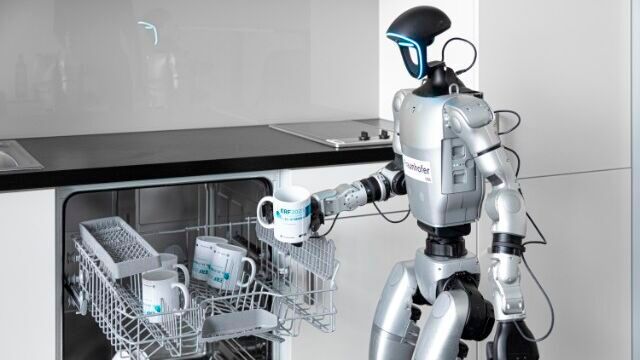
:quality(80)/p7i.vogel.de/wcms/3f/72/3f72e30d61f3522bff192171b60776a4/0130245214v1.jpeg "No idea what else your humanoid robot can do, or where it fails? Then it might be worth taking a look at the Humanoid Capabilities Navigator, which now helps you to find the right robot for a job, or to improve humanoids in a targeted manner ... (Image:Fraunhofer IPA)")
:quality(80)/p7i.vogel.de/wcms/7a/8c/7a8c794298b8ca6bff26624afdb4ad33/0125511346v1.jpeg "Model and replica: Humanoid robots, like here at Mercedes-Benz, are intended to automate nearly every task and assist humans. (Image:Mercedes-Benz AG)")