


:quality(80)/p7i.vogel.de/wcms/c2/57/c257474faf6095a24bacfd98524bc7f8/0130090188v1.jpeg "With the Coromill MR20 milling system, the cutting tool specialist Sandvik Coromant is bringing a product that should make a name for itself in tool and mold making, as well as in aerospace components, to what the manufacturer claims it can do ... (Image:Sandvik Coromant)")
:quality(80)/p7i.vogel.de/wcms/87/f8/87f88a6b4e47ea77b22b1eb88db533a8/0130110840v1.jpeg "Zenadrone, a subsidiary of Zenatec, is in the process of developing an operational low-cost drone as a disposable concept (symbolic image). The first prototype already exists. The aim is to counter the increasing number of enemy drone attacks in the future without spending a lot of money ... (Image:Cenadrone)")
:quality(80)/p7i.vogel.de/wcms/c4/8f/c48fdd4e437b1bca2b0a2d3e77ec74ad/0130015902v1.jpeg "AI will gain importance in manufacturing in 2026. (Picture: ©miss irine - stock.adobe.com / AI-generated)")
:quality(80)/p7i.vogel.de/wcms/eb/9f/eb9f3da11ab6e979c15c195ff516b2ec/0130128194v1.jpeg "Clamping force 110,000 kilonewtons! This is the largest injection molding machine in the world currently under construction. It is being built at Engel in Austria and bears the name Duo 1200 US. Eight tie bars ensure stability. Find out more about this giant of plastics processing ... (Image:Angels)")
:quality(80)/p7i.vogel.de/wcms/f0/35/f035afad8613734aaefe4d6778d21309/0129554823v1.jpeg "The Aquis Touch S multi-channel measuring, control and recording device ensures that the quality parameters of the cooling media are correct. (Image:Jumo)")
:quality(80)/p7i.vogel.de/wcms/ab/23/ab2371c186380215b8311d1aeb4e47df/0130095643v1.jpeg "Geointelligent supply chain management provides valuable information, for example, about which control unit a microchip is installed in. (Picture: ©Aleksandr Matveev - stock.adobe.com)")
:quality(80)/p7i.vogel.de/wcms/b4/01/b401c197e3591f2bec3fb84ae810ac80/0130096280v1.jpeg "Only prophecies of doom! Jensen Huang, the head of chip giant Nvidia, dismisses any concerns that the huge sums currently being invested in AI data centers will not turn a profit one day ... (Image:Nvidia)")
:quality(80)/p7i.vogel.de/wcms/53/4f/534fe0f168f6ee070ded4a48faca4cef/business-wire-main-image-1103x620v1.jpeg "The new UR AI Trainer, developed by Universal Robots and Scale AI, is the first direct lab-to-factory solution for AI model training.
(Source: Universal Robots)")
:quality(80)/p7i.vogel.de/wcms/63/21/6321beb732bf7d92640df46d7aa77573/0130125122v1.jpeg "As part of the Carbon Lab Factory Lausitz, a pilot plant for the production of sustainable, cost-effective and competitive carbon fibers will be built at the Guben site. (Image:Fraunhofer IAP / Kristin Stein)")
:quality(80)/p7i.vogel.de/wcms/08/70/087062e2e1a9b9add5777410dd746ee9/adobestock-1923991605-5607x3156v1v1.jpeg "A new type of tactile sensor, inspired by human skin, even recognizes grains of sand. (Image:Curioso.Photography - stock.adobe.com)")
:quality(80)/p7i.vogel.de/wcms/7f/08/7f087d7013424d123ab7275cd2e3fe55/adobestock-809456218--c2-a9-20degimages-20-e2-80-93-20stock-adobe-com-ki-generiert-4179x2351v1v1.jpeg "The digital upgrading of existing machines conserves resources, saves energy and reduces the need for new production. (Image:Degimages - stock.adobe.com/AI-generated)")
:quality(80)/p7i.vogel.de/wcms/24/1b/241b271e20d9171e063a4f284a748ee9/0130115596v1.jpeg "(Image:Chery)")
:quality(80)/p7i.vogel.de/wcms/5e/11/5e11044efcf1b31e6dd361b293587cbc/0130110355v1.jpeg "Lotus boss Qingfeng Feng wants to continue to offer exclusive models. (Image:Lotus)")
:quality(80)/p7i.vogel.de/wcms/95/48/954885de5a930b6770191d7f35b477c4/0130110863v1.jpeg "Honda will not be launching the two electric cars 0 Saloon and 0 SUV presented in 2025 after all (Image:Honda)")
:quality(80)/p7i.vogel.de/wcms/34/e2/34e2a9e46e59eb28f09f9a5fdf41ff9a/0130091813v1.jpeg "Electrical drive trains require a multidimensional concept of performance characterization. Rohde & Schwarz has developed the MXO 3 oscilloscope series for this purpose. (Image:Rohde & Schwarz)")
:quality(80)/p7i.vogel.de/wcms/f2/48/f24888ee4cf187dcaf569ede74cdec14/0130104146v1.jpeg "Compact AI power: The SIM8668 and SIM8666 smart modules from Simcom combine a quad-core CPU with an integrated NPU for resource-saving industrial and robotics applications in the smallest of spaces. (Image:Chip: Simcom/Background: AI-generated)")
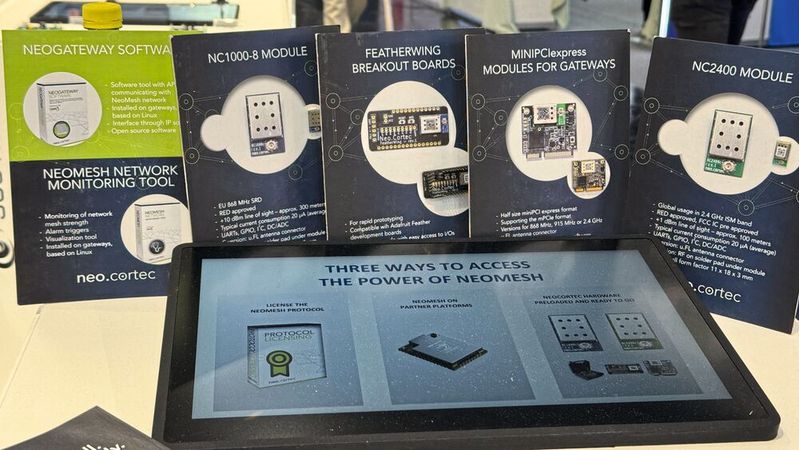
:quality(80)/p7i.vogel.de/wcms/33/4a/334a40bdce62798bd6eb90957e222d6a/0130085649v1.jpeg "From hardware manufacturer to software provider: Neocortec is increasingly licensing its NeoMesh protocol stack directly to OEMs and third-party manufacturers instead of relying exclusively on selling its own radio modules. (Image:mc/VCG)")
:quality(80)/p7i.vogel.de/wcms/5f/4a/5f4aae3a1c19fb2b1a2df58925afeca1/0130111244v1.jpeg "Power saver for the IoT: The Npzero module takes over sensor monitoring and sends the main processor into deep sleep. (Image:Manuel Christa)")
:quality(80)/p7i.vogel.de/wcms/0c/ac/0cacda94ed641488ba0ac4b9daa2bce5/0130073615v1.jpeg "Part of the experimental set-up for a quantum physics experiment in the laboratory of the Institute of Physics at Humboldt-Universität zu Berlin, Adlershof (Germany) campus. (Image:HU Berlin/S. Klenke)")
:fill(fff,0)/p7i.vogel.de/companies/68/a4/68a47beec75ce/logo-cmyk-de.jpeg "logo-cmyk-de (https://www.datatec.eu/)")
:fill(fff,0)/p7i.vogel.de/companies/67/eb/67eba621ef6ea/logo2.png "logo2 (Wuxi InfiMotion)")
:quality(80)/p7i.vogel.de/wcms/7e/65/7e65c77030327643b1ae1b153fdb55e4/0130085126v1.jpeg "The new web-based management tool from Neocortec: It visualizes the topology and status of the self-organizing mesh networks in real time.(Image: Neocortec)")
:quality(80)/p7i.vogel.de/wcms/98/44/9844a649d01a97526fc108b6001cd0ec/0130085660v1.jpeg "From hardware manufacturer to software provider: Neocortec is increasingly licensing its NeoMesh protocol stack directly to OEMs and third-party manufacturers instead of relying exclusively on selling its own radio modules.(Image: mc/VCG)")
:quality(80)/p7i.vogel.de/wcms/e1/0b/e10b02d084c502ea71e60ec5f2725eb3/0130085667v1.jpeg "From hardware manufacturer to software provider: Neocortec is increasingly licensing its NeoMesh protocol stack directly to OEMs and third-party manufacturers instead of relying exclusively on selling its own radio modules.(Image: mc/VCG)")
:quality(80)/p7i.vogel.de/wcms/8c/24/8c24b2746a791a9fb573ae189f1d90b2/0130085672v1.jpeg "From hardware manufacturer to software provider: Neocortec is increasingly licensing its NeoMesh protocol stack directly to OEMs and third-party manufacturers instead of relying exclusively on selling its own radio modules.(Image: mc/VCG)")
:quality(80):fill(efefef,0)/p7i.vogel.de/wcms/67/ad/67adf92d254d2/elatec-wp-smart-factory.png "Elatec WP Smart Factory")
Date: 08.12.2025
Naturally, we always handle your personal data responsibly. Any personal data we receive from you is processed in accordance with applicable data protection legislation. For detailed information please see our privacy policy.
Consent to the use of data for promotional purposes
I hereby consent to Vogel Communications Group GmbH & Co. KG, Max-Planck-Str. 7-9, 97082 Würzburg including any affiliated companies according to §§ 15 et seq. AktG (hereafter: Vogel Communications Group) using my e-mail address to send editorial newsletters. A list of all affiliated companies can be found here
Newsletter content may include all products and services of any companies mentioned above, including for example specialist journals and books, events and fairs as well as event-related products and services, print and digital media offers and services such as additional (editorial) newsletters, raffles, lead campaigns, market research both online and offline, specialist webportals and e-learning offers. In case my personal telephone number has also been collected, it may be used for offers of aforementioned products, for services of the companies mentioned above, and market research purposes.
Additionally, my consent also includes the processing of my email address and telephone number for data matching for marketing purposes with select advertising partners such as LinkedIn, Google, and Meta. For this, Vogel Communications Group may transmit said data in hashed form to the advertising partners who then use said data to determine whether I am also a member of the mentioned advertising partner portals. Vogel Communications Group uses this feature for the purposes of re-targeting (up-selling, cross-selling, and customer loyalty), generating so-called look-alike audiences for acquisition of new customers, and as basis for exclusion for on-going advertising campaigns. Further information can be found in section “data matching for marketing purposes”.
In case I access protected data on Internet portals of Vogel Communications Group including any affiliated companies according to §§ 15 et seq. AktG, I need to provide further data in order to register for the access to such content. In return for this free access to editorial content, my data may be used in accordance with this consent for the purposes stated here. This does not apply to data matching for marketing purposes.
Right of revocation
I understand that I can revoke my consent at will. My revocation does not change the lawfulness of data processing that was conducted based on my consent leading up to my revocation. One option to declare my revocation is to use the contact form found at https://contact.vogel.de. In case I no longer wish to receive certain newsletters, I have subscribed to, I can also click on the unsubscribe link included at the end of a newsletter. Further information regarding my right of revocation and the implementation of it as well as the consequences of my revocation can be found in the data protection declaration, section editorial newsletter.
:quality(80)/p7i.vogel.de/wcms/0d/0e/0d0eb1b0fc691a47ef0a8342e318d6ad/0124368676v1.jpeg "With Modbus Cloud Connect from Grandcentrix, all devices running Modbus RTU can connect with the cloud via cellular-based IoT. (Image:Grandcentrix)")
:quality(80)/p7i.vogel.de/wcms/c2/c1/c2c1ee9e92113eb45140e8f868420219/0124272206v1.jpeg "Dracula Technologies aims to shed light, literally, on the sustainable energy supply of IoT sensors and make conventional batteries obsolete. (Image:freely licensed)")