Moore's Law, the principle predicting that the number of transistors on a chip doubles every two years, has driven exponential growth in computing power. However, it is now approaching its physical limits.
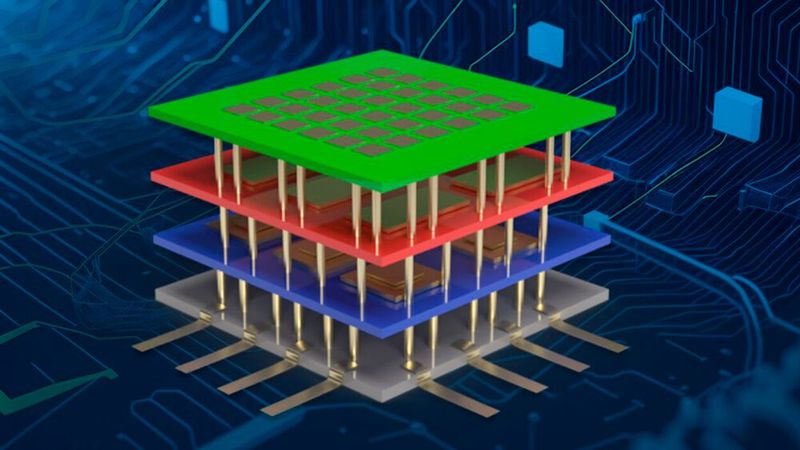
Researchers have demonstrated large-scale 3D integration of semiconductors and also characterized tens of thousands of components with 2D transistors made from 2D semiconductors, which could potentially make electronic devices and systems smarter and more versatile.
(Image: Elizabeth Flores-Gomez Murray/Materials Research Institute)
Today's most advanced chips contain nearly 50 billion transistors in an area no larger than a thumb nail. The task of fitting even more transistors into this limited space is becoming increasingly difficult, as researchers at Penn State University have found.
In a study published in "Nature", Saptarshi Das, associate professor of engineering and mechanics and co-author of the study, and his team propose a very interesting solution: seamless implementation of 3D integration with 2D materials.
In the world of semiconductors, 3D integration means the vertical stacking of several layers of semiconductor components. This approach not only makes it easier to pack more silicon-based transistors onto a computer chip, commonly referred to as "More Moore", but also allows the use of transistors from 2D materials to incorporate various functions into different layers of the stack, a concept known as "More than Moore".
With the work described in the study, Saptarshi and the team show feasible ways that go beyond the scaling of current technology to achieve both "More Moore" and "More than Moore" through monolithic 3D integration.
Monolithic 3D integration as an opportunity
Monolithic 3D integration is a manufacturing process in which the researchers fabricate the components directly on the underlying layer, unlike the traditional process in which independently manufactured layers are stacked.
"Monolithic 3D integration offers the highest density of vertical—which would require microbumps, where two chips are connected together, allowing more space for the fabrication of connections," said Najam Sakib, a scientific associate and co-author of the study.
According to Darsith Jayachandran, a scientific associate in engineering, monolithic 3D integration poses significant challenges as conventional silicon components would melt at processing temperatures. "A challenge is the upper limit of the process temperature of 450 °C for the back-end integration of silicon-based chips—our monolithic 3D integration approach significantly reduces this temperature to less than 200 °C," Jayachandran said, explaining that the upper limit of the process temperature is the maximum allowable temperature before the prefabricated structures are damaged. "Incompatible process temperature budgets make monolithic 3D integration with silicon chips a challenge, but 2D materials can withstand the temperatures required for the process."
The researchers utilized existing techniques for their approach, but they are the first to successfully achieve a monolithic 3D integration on this scale with 2D transistors from 2D semiconductors, called transition metal dichalcogenides. Stacking the components vertically in 3D integration also enabled more energy-efficient data processing, as it solved a surprising problem for such tiny things as transistors on a computer chip: the distance.
"By vertically stacking components, the distance between components is reduced, as is the delay and power consumption," said Rahul Pendurthi, also a co-author of the study.
More Moore and More than Moore
By reducing the distance between the components, the researchers achieved "More Moore". By incorporating transistors from 2D materials, the researchers also met the "More than Moore" criterion. The 2D materials are known for their unique electronic and optical properties, including light sensitivity, making them ideally suitable as sensors as well.
This is useful, the researchers say, as the number of networked devices and "edge" systems, things like smartphones or wireless weather stations that collect data at the "edge" of a network, continues to increase. "More Than Moore refers to a concept in the world of technology where we not only make computer chips smaller and faster, but also equip them with more features," said Muhtasim Ul Karim Sadaf, a scientific associate. "It's about equipping our electronic devices with new and useful features, such as better sensors, improved battery management, or other special functions, to make our devices smarter and more versatile."
According to the researchers, using 2D components for 3D integration has numerous other advantages. One of these is the higher mobility of the charge carriers, meaning the way an electrical charge is transported in semiconductor materials. Another advantage is the ultra-thin design, which allows the researchers to accommodate more transistors on each level of the 3D integration and achieve a higher computing power.
Date: 08.12.2025
Naturally, we always handle your personal data responsibly. Any personal data we receive from you is processed in accordance with applicable data protection legislation. For detailed information please see our privacy policy.
Consent to the use of data for promotional purposes
I hereby consent to Vogel Communications Group GmbH & Co. KG, Max-Planck-Str. 7-9, 97082 Würzburg including any affiliated companies according to §§ 15 et seq. AktG (hereafter: Vogel Communications Group) using my e-mail address to send editorial newsletters. A list of all affiliated companies can be found here
Newsletter content may include all products and services of any companies mentioned above, including for example specialist journals and books, events and fairs as well as event-related products and services, print and digital media offers and services such as additional (editorial) newsletters, raffles, lead campaigns, market research both online and offline, specialist webportals and e-learning offers. In case my personal telephone number has also been collected, it may be used for offers of aforementioned products, for services of the companies mentioned above, and market research purposes.
Additionally, my consent also includes the processing of my email address and telephone number for data matching for marketing purposes with select advertising partners such as LinkedIn, Google, and Meta. For this, Vogel Communications Group may transmit said data in hashed form to the advertising partners who then use said data to determine whether I am also a member of the mentioned advertising partner portals. Vogel Communications Group uses this feature for the purposes of re-targeting (up-selling, cross-selling, and customer loyalty), generating so-called look-alike audiences for acquisition of new customers, and as basis for exclusion for on-going advertising campaigns. Further information can be found in section “data matching for marketing purposes”.
In case I access protected data on Internet portals of Vogel Communications Group including any affiliated companies according to §§ 15 et seq. AktG, I need to provide further data in order to register for the access to such content. In return for this free access to editorial content, my data may be used in accordance with this consent for the purposes stated here. This does not apply to data matching for marketing purposes.
Right of revocation
I understand that I can revoke my consent at will. My revocation does not change the lawfulness of data processing that was conducted based on my consent leading up to my revocation. One option to declare my revocation is to use the contact form found at https://contact.vogel.de. In case I no longer wish to receive certain newsletters, I have subscribed to, I can also click on the unsubscribe link included at the end of a newsletter. Further information regarding my right of revocation and the implementation of it as well as the consequences of my revocation can be found in the data protection declaration, section editorial newsletter.
While most academic research is conducted with small prototypes, this study demonstrated 3D integration on a large scale by characterizing tens of thousands of components. According to Das, this performance bridges the gap between science and industry and could lead to future partnerships where the industry utilizes the 2D materials and facilities of Penn State University.
The progress in scaling was made possible by the availability of high-quality transition metal dichalcogenides on a wafer scale, developed by researchers from the Two-Dimensional Crystal Consortium (2DCC-MIP) at Penn State, a material innovation platform of the U.S. National Science Foundation (NSF).
Progress through materials research
"This breakthrough once again demonstrates the essential role of materials research as the foundation of the semiconductor industry and the competitiveness of the USA," said Charles Ying, program director for the NSF's material innovation platforms. "The years of effort of the consortium for two-dimensional crystals at Penn State, to improve the quality and size of 2D materials, has made it possible to achieve the 3D integration of semiconductors on a scale that could be of great significance for electronics."
According to Das, this technological advance is just the first step. "Our ability to demonstrate a large number of components on a wafer scale shows that we have been able to translate this research to a scale that can be appreciated by the semiconductor industry," Das said.
"We have built 30,000 transistors into each layer, which could be a record number. This puts Penn State in a unique position to lead part of the work and collaborate with the American semiconductor industry to advance this research."
The National Science Foundation and the Army Research Office supported this research project. (sb)



:quality(80)/p7i.vogel.de/wcms/dd/08/dd086510d9ae7b50181f6070e4463b44/0129363730v1.jpeg "Typical application for ionizing devices: Wrapping films. (Picture: ©Adobe Stock/SMC)")
:quality(80)/p7i.vogel.de/wcms/35/57/3557c819943c53acec41a0ccba87da4f/0130049064v1.jpeg "Researchers at the Fraunhofer IWU in Chemnitz have long known that many typical sheet metal parts can be manufactured more cost-effectively using hollow embossing rollers. Now there is news to report ... (Image:Fraunhofer IWU)")
:quality(80)/p7i.vogel.de/wcms/59/02/590246e3b3f415c65edbee377c14ca77/26-06-pi-fraunhofer-iws-41450-direktplattieren-pic-01-7771x4369v1v1.jpeg "The Fraunhofer IWS has developed the new \"direct laser cladding\" process, which creates a functional layer directly on the base body by applying a strip-shaped metal to rotationally symmetrical components in a spiral and bonding it locally by laser. (Image:Christoph Wilsnack/Fraunhofer IWS)")
:quality(80)/p7i.vogel.de/wcms/73/60/73608418789b1d9c393f5e2fa974eda2/0130209906v1.jpeg "The robots of the X6 generation from b+m enable very high painting quality and are also particularly compact and easy to maintain. (Image:Beckhoff)")
:quality(80)/p7i.vogel.de/wcms/78/e9/78e9188c25a8a94e67c34c9bf8ffe495/visual-agile-20robots-20and-20google-20deepmind-20partner-20to-20bring-20intelligence-20to-20robotics-2500x1406v1v1.jpeg "Together, the partners are developing adaptable, intelligent robots for a wide range of applications (Image:Agile Robots SE)")
:quality(80)/p7i.vogel.de/wcms/e7/66/e7669ecf0260ae8fc54c214e34e4902a/0130316817v1.jpeg "Siemens and Palo Alto Networks offer tested cybersecurity solution for industrial 5G. (Image:Siemens)")
:quality(80)/p7i.vogel.de/wcms/9f/55/9f55324832c4f426958031375124d9de/siemens-20ubtech-20hmnd-1920x1079v1v1.png "Ready for the factory floor: While Ubtech is planning mass production, Siemens is already testing humanoids in real factory applications in Erlangen. (Image:Siemens)")
:quality(80)/p7i.vogel.de/wcms/11/36/113695ed260e29c8c2d9d39dc5f9d869/0130213768v1.jpeg "AI can work cheaply in China and deliver the results rapidly all over the world. (Image:Dall-E / AI-generated)")
:quality(80)/p7i.vogel.de/wcms/62/5f/625f41e87ebfef156a98c8e6393e32fd/0130211654v1.jpeg "Axial flux motors have some advantages over radial flux motor—but their production is currently still expensive. (Image:RWTH Aachen University)")
:quality(80)/p7i.vogel.de/wcms/77/9b/779b0685d010dfe45c9c2cb1cfecd467/0128886425v1.jpeg "The BlueEye is the first \"real\" hyperspectral camera for the UV range and covers the wavelength range from 220 to 380nm. (Image:Inno-spec GmbH)")
:quality(80)/p7i.vogel.de/wcms/e4/51/e451d52ce0182fb0aaa46a5774f832ef/26-04-pi-fraunhofer-iws-21160-bioslide-pic-01-4128x2321v1v1.jpeg "With the BioSlide research project, the Fraunhofer IWS is investigating how sliding systems can be designed to be more sustainable and energy-efficient. New materials can be tested in a particularly application-oriented manner on this plain bearing test stand. (Image:Fraunhofer IWS)")
![Thanks to advanced 3D printing technology, a more efficient use of resources should contribute to lower-emission aviation—this is the goal of ['skai]-lab. (Image:Oleksandr Pashchenko - stock.adobe.com / AI-generated)](https://cdn1.vogel.de/nghHNSbySccfOjG3n1qCA-FVOjQ=/288x162/smart/filters:format(jpg):quality(80)/p7i.vogel.de/wcms/62/64/626424c97a16e69f871bf216c9629c2a/adobestock-1927043193--c2-a9-20oleksandr-20pashchenko-20-e2-80-93-20stock-adobe-com-ki-generiertv1v1.jpeg "Thanks to advanced 3D printing technology, a more efficient use of resources should contribute to lower-emission aviation—this is the goal of ['skai]-lab. (Image:Oleksandr Pashchenko - stock.adobe.com / AI-generated)")
:quality(80)/p7i.vogel.de/wcms/c3/c4/c3c4ce270b083eeac55654148611f064/0130237945v1.jpeg "China is not giving up on hydrogen, but is intensifying its efforts. (Image:freely licensed from Pixabay)")
:quality(80)/p7i.vogel.de/wcms/4e/c0/4ec0bd19390b169edfa23677373dcdf1/0130260089v1.jpeg "Renewable fuels can supply European road traffic, according to a study. (Image:Aral)")
:quality(80)/p7i.vogel.de/wcms/6f/c9/6fc9050301d745cad25585c6780f8f51/0130197341v1.jpeg "Production facilities are a worthwhile target and are therefore at risk. (Image:ABB Robotics)")
:quality(80)/p7i.vogel.de/wcms/b6/62/b662adc2cec8227d8172509bbfb6ee42/25c0207-107-4961x2789v1v1.jpeg "The GLB is the second model based on Mercedes' new MMA platform. Apparently, Geely's platform is better and cheaper, which is why the two companies are negotiating a partnership. (Image:Mercedes-Benz)")
:quality(80)/p7i.vogel.de/wcms/4d/dd/4dddf438e91f394c04a095dbfd109d1c/0130236430v1.jpeg "Measurement modules: The 720301 module in combination with the SL2000 enables RMS and power calculations, among other things. (Image:Yokogawa)")
:quality(80)/p7i.vogel.de/wcms/61/fc/61fcf95f5cca15494ad18343901ae585/0130317237v1.jpeg "With the AGI CPU, Arm says it is taking a \"historic step\": With the processor aimed at AI in data centers, the company is presenting itself for the first time as a provider of its own chips, not just as a pure IP licensor. (Image:Arm)")
:quality(80)/p7i.vogel.de/wcms/82/90/8290dfe3595b6c6b33726ae8b76172c7/0130319587v1.jpeg "The concept image illustrates how the pattern of tiny protrusions and depressions created on the substrate (MgO, bottom) controls the arrangement of atoms in the superconducting material (YBCO, top). At the interface between the two layers, an electronic structure enables superconductivity to occur at higher temperatures than previously possible. (Image:Chalmers University of Technology / Riccardo Arpaia)")
:fill(fff,0)/images.vogel.de/vogelonline/companyimg/76800/76895/65.jpg "FAULHABER_120mm.jpg ()")
:fill(fff,0)/p7i.vogel.de/companies/67/eb/67eba621ef6ea/logo2.png "logo2 (Wuxi InfiMotion)")
:quality(80)/p7i.vogel.de/wcms/b5/37/b537369c112278de2cb4e1c61656d2ba/0119362664v1.jpeg "Diamond MOSFETs: These components operate more energy-efficiently and can withstand much higher breakdown voltages. Now the manufacture of diamond MOSFETs has been successful. (Image:Samuel Faber on Pixabay)")
:quality(80)/p7i.vogel.de/wcms/b5/32/b532d819a7aec29f1cd85ad30f4cf516/0128508030v1.jpeg "A new manufacturing technique, in which multiple active components are stacked on the back of a computer chip, could significantly increase the energy efficiency of microelectronics. (Image:Dall-E / AI-generated)")
:quality(80)/p7i.vogel.de/wcms/c2/a8/c2a8a93f306c1475489dff074ad59731/0129967672v1.jpeg "Figure 1: Imec's logic technology roadmap showing the extension of the nanosheet era from 2nm to the A10 node with the outer-wall forksheet, before the transition to CFET for A7 and beyond. (Image:imec)")