Moia is Europe's first provider of autonomous shuttles. However, the company no longer wants to operate as a ride-hailer, but as a system provider. That is why the parent company VW is now looking for investors.
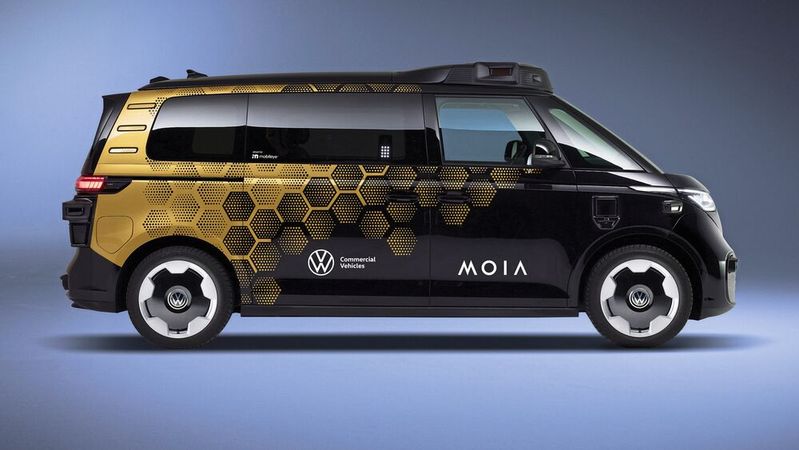
Moia has developed a self-driving van. But instead of offering driving services, the VW subsidiary wants to sell such systems.
(Image: Moia)
Right at the start of the test lap in the VW ID Buzz AD, an emergency vehicle with blue lights comes from behind. All vehicles in both lanes make way, including the electric VW bus with Moia paintwork. The AD stands for Autonomous Drive. Although there is a person in the driver's seat, they only intervene in emergencies. The engineers at Volkswagen ADMT (Autonomous Driving Mobility and Transport) have taught the VW bus to drive at level 4.
In Hamburg in June, Moia shows media representatives how well this works in practice. Passing the ramparts, the route leads from Holstenwall via Millerntorplatz towards Reeperbahn. Here the B4 splits into six lanes. Finding the right lane is a challenge even for drivers without local knowledge. The Moia shuttle masters the task perfectly and turns left into Helgoländer Allee as planned.
The road leads slightly downhill to the harbor. Day-tripper buses are parked to the left and right of the road. An oncoming truck drives far too far into the lane of the ID Buzz AD. It swerves as far to the right as possible and stops briefly before continuing its journey. The cameras and sensors have recognized the situation well and reacted accordingly. Driving according to the traffic regulations is a must, reacting confidently to exceptional situations is the free program.
"VW beats Tesla"
The unveiling of Europe's first Level 4 shuttle a few days later is correspondingly self-assured. Sascha Meyer, CEO of Moia, Christian Senger, CEO of ADMT, Hamburg's transport senator Anjes Tjarks and VW Group CEO Oliver Blume unveiled the Moia bus at the Baakenhöft Cruise Center in the port of Hamburg. Some media headlines afterwards: "VW beats Tesla with production-ready robotaxi". A bold comparison, as Tesla launched its test operation with passengers in Austin just five days later. In Hamburg, passengers have been able to register for a closed user test with Moia since July. Trips in the test area are expected to start in September 2025, with series operation of the autonomous Moia shuttles in the Hanseatic city not starting until the end of 2026 or possibly the beginning of 2027. Tesla could surprise us with an earlier start.
Yellow Belts
A direct comparison of the two systems is difficult. Tesla relies on a car with "vision only", i.e. exclusively cameras. The Moia bus uses 27 self-cleaning sensors, including 13 cameras, nine lidar and five radars. An NFC chip next to the sliding door is used for passenger authentication. The door only opens if it is the booked shuttle. If you book the ride for someone else, they can enter a numerical code on a keypad in the windshield. Cameras and sensors also work inside. If there is no driver on board, the technology has to check whether the luggage is safely stowed in the former passenger area, the sliding door is clear and all passengers are well. The seat belts are yellow, as this makes it easier for the image recognition system to determine whether a passenger is actually wearing a seat belt. In addition to a USB port for charging mobile devices, each row of seats has a call button for a voice connection with the Moia control center and a red emergency button. A screen shows up to four passengers how long it will be until they get off.
Partners: Apex.AI and Mobileye
Moia has been developing autonomous shuttles for five years. Back then, the company relied on the support of Argo AI. Ford and Volkswagen had invested in the start-up from Pittsburgh. But progress was too slow. In the fall of 2022, Oliver Blume pulled the ripcord. Volkswagen wrote off the investment. The supplier Mobileye became the new partner. Tools from Apex.Ai were used for software development. The Silicon Valley-based company is led by founder and CEO Jan Becker, who had already worked on assistance systems for Volkswagen in the late 1990s.
Date: 08.12.2025
Naturally, we always handle your personal data responsibly. Any personal data we receive from you is processed in accordance with applicable data protection legislation. For detailed information please see our privacy policy.
Consent to the use of data for promotional purposes
I hereby consent to Vogel Communications Group GmbH & Co. KG, Max-Planck-Str. 7-9, 97082 Würzburg including any affiliated companies according to §§ 15 et seq. AktG (hereafter: Vogel Communications Group) using my e-mail address to send editorial newsletters. A list of all affiliated companies can be found here
Newsletter content may include all products and services of any companies mentioned above, including for example specialist journals and books, events and fairs as well as event-related products and services, print and digital media offers and services such as additional (editorial) newsletters, raffles, lead campaigns, market research both online and offline, specialist webportals and e-learning offers. In case my personal telephone number has also been collected, it may be used for offers of aforementioned products, for services of the companies mentioned above, and market research purposes.
Additionally, my consent also includes the processing of my email address and telephone number for data matching for marketing purposes with select advertising partners such as LinkedIn, Google, and Meta. For this, Vogel Communications Group may transmit said data in hashed form to the advertising partners who then use said data to determine whether I am also a member of the mentioned advertising partner portals. Vogel Communications Group uses this feature for the purposes of re-targeting (up-selling, cross-selling, and customer loyalty), generating so-called look-alike audiences for acquisition of new customers, and as basis for exclusion for on-going advertising campaigns. Further information can be found in section “data matching for marketing purposes”.
In case I access protected data on Internet portals of Vogel Communications Group including any affiliated companies according to §§ 15 et seq. AktG, I need to provide further data in order to register for the access to such content. In return for this free access to editorial content, my data may be used in accordance with this consent for the purposes stated here. This does not apply to data matching for marketing purposes.
Right of revocation
I understand that I can revoke my consent at will. My revocation does not change the lawfulness of data processing that was conducted based on my consent leading up to my revocation. One option to declare my revocation is to use the contact form found at https://contact.vogel.de. In case I no longer wish to receive certain newsletters, I have subscribed to, I can also click on the unsubscribe link included at the end of a newsletter. Further information regarding my right of revocation and the implementation of it as well as the consequences of my revocation can be found in the data protection declaration, section editorial newsletter.
Investors Wanted
Becker is supporting Moia in developing an operating system for MaaS (Mobility as a Service). This follows a larger Group plan. "With Moia's experience, we have a good chance of securing five to ten percent of the autonomous driving market," says Oliver Blume on the evening of the vehicle presentation. Management consultants McKinsey estimate that sales for autonomous driving in Europe and the USA will reach 300 to 400 billion US dollars by 2035. But Oliver Blume does not want to take on the venture alone. According to a report in Manager Magazin, Blume is looking for investors. He is planning a capital increase at Moia to involve minority shareholders.
Robotaxi is Cheaper
Sufficient capital is in circulation: Since 2010, over 860 billion US dollars have been invested worldwide in the ACES sector (Autonomous, Connected, Electric, Shared). Of this, 93 percent of the money does not come from the automotive industry, but from venture capital companies and technology groups. The figures were compiled by Philipp Kampshoff and his team. The German is a Senior Partner at McKinsey and heads the Center for Future Mobility based in Houston. His prediction is that it will soon be cheaper for half of the inhabitants of major US cities to travel by robo-taxi than to own a car. Kampshoff does not give an exact date, but he uses the annual mileage as a yardstick. It becomes cheaper from around 12,000 km (~7,456 miles). From a mileage of 22,000 km (~13,672 miles), it becomes cheaper for 80 percent of city dwellers to use a robotaxi.
New Business Model
For Blume, it is clear that global car sales will fall in the coming years, irrespective of current discussions about customs duties. So he is focusing on the market that promises growth. At the same time, the costs for operators are falling. McKinsey estimates that one kilometer in a level 4 vehicle costs the operator 8.18 US dollars today. This will fall by 84 percent to 1.32 US dollars by 2035. Blume does not want Moia to grow as a fleet operator, but to become a technology and system provider for autonomous mobility solutions.
Out for Hanover
Many observers were surprised by the sudden closure of Moia in Hanover in mid-July. The company said that it no longer wanted to apply for a new concession to operate the service. The passenger volume was too low. Everything had started in the capital of Lower Saxony in 2018 before the business was expanded to Hamburg in 2019.
The Hanseatic city is becoming a showcase for the mobility of tomorrow. Moia is part of the Alike project funded by the Federal Ministry of Digital and Transport. Together with Hamburger Hochbahn and the Institute of Transportation at the Karlsruhe Institute of Technology (KIT), the autonomous shuttles Moia and the Mover are taking to the streets. The latter comes from Holon, a Benteler subsidiary. According to the initiators' plans, up to 10,000 autonomous shuttles should be on the road in the Hanseatic city by 2030.
Uber and Waymo
Moia already has its first interested party with regard to the platform business. At the end of 2025, Uber will be testing the VW ID Buzz AD in Los Angeles. The US provider is also interested in reducing costs for drivers. In the first quarter of 2025, 8.5 million people worldwide were driving on behalf of Uber. The ride-hailing service has long been synonymous with cab and delivery services in North America. Competitor Lyft will be using the Holon Shuttle Mover in the USA from the end of 2026.
Both driving services fear the competition from Waymo. Although they have significantly fewer vehicles under contract, they are already driving autonomously today. Following negative headlines about abusive Uber drivers in the USA, acceptance of autonomous transportation is increasing. Waymo currently operates a fleet of 1,500 vehicles in four major US cities. In the coming year, the autonomous fleet is to be expanded by 2,000 vehicles and three cities. With more than 250,000 paid trips per week, Waymo's wealth of technical experience is hard to catch up with.
Public transportation as a customer
The major transportation services are one potential customer for Moia technology. Local public transport is another. In the outskirts of cities as well as in rural areas, the large public bus that makes its rounds every hour is far too big and expensive. Autonomous on-demand shuttles could do the job more cheaply. Customers would probably even be more satisfied because such a shuttle can react flexibly to demand. Here, too, Moia already has a customer. BVG in Berlin wants to test the autonomous shuttle vehicle in a pilot project.
However, the VW ID Buzz AD is not only designed for city driving. The technology allows speeds of up to 120 km/h (~75 mph). This means that the bus can also take the highway and connect two cities or take passengers to the airport.



:quality(80)/p7i.vogel.de/wcms/51/1b/511b420dbcc296aec09e3bffb051b8a8/0133581587v1.jpeg "The cables connect numerous machine components—often in confined spaces. (Image:Helu)")
:quality(80)/p7i.vogel.de/wcms/b5/67/b5676f3bfb36251ed31f9a0cccf650b6/0133167827v1.jpeg "Thanks to JumboFlex Generation 2, employees can effortlessly move wheelchairs weighing as much as 40 kilograms. (Image:Lard)")
:quality(80)/p7i.vogel.de/wcms/5e/c6/5ec615b7a51440f668259f2af9158cb9/0132654694v1.jpeg "Strategic Partnerships in Industry: As buyers and restructuring partners, Chinese investors are increasingly helping to preserve jobs in Germany. (Image: ©Anatolii Rymarchuk - stock.adobe.com)")
:quality(80)/p7i.vogel.de/wcms/eb/2b/eb2bd1b8487afe577b37363cd02f16ff/0113143253v1.jpeg "In our China Market Insider, we regularly provide you with relevant information straight from China. (Image:© Eisenhans - stock.adobe.com)")
:quality(80)/p7i.vogel.de/wcms/aa/3e/aa3e2603a812f8e7d33c00ba8ae28c9f/0133507886v1.jpeg "With the Iggy Rob, igus is bringing a humanoid robot into factories for a price of 47,999 euros ($54,718). (Image: igus)")
:quality(80)/p7i.vogel.de/wcms/92/64/92645c64ffbb6980976d39102388d120/0113143253v1.jpeg "In our China Market Insider, we regularly provide you with relevant information straight from China. (Image:© Eisenhans - stock.adobe.com)")
:quality(80)/p7i.vogel.de/wcms/c7/05/c70542511e0824ee491f7b55e21fa429/0133598424v1.jpeg "In logistics, AI is often implemented only on a case-by-case basis; data is stored in separate systems, and inventory levels, status values, and priorities are not defined consistently. (Image: ©m-project - stock.adobe.com)")
:quality(80)/p7i.vogel.de/wcms/3a/9c/3a9c1fd546e1f041b86bb1d03cf39101/0133610524v1.jpeg "The Mason W-01 combines industrial-grade humanoid hardware, Physical AI-based perception, and autonomous task planning. (Image:Nova X Robotics)")
:quality(80)/p7i.vogel.de/wcms/e7/94/e794290f265afbd0ffc7a06c4fe9d425/adobestock-1887113836--hypnotics-14-stock-adobe-com-ki-generiertv1.jpeg "In both autonomous driving and industrial production, there is growing skepticism as to whether full autonomy is always desirable. (Source: © Hypnotics 14 – stock.adobe.com / AI-generated)")
:quality(80)/p7i.vogel.de/wcms/a8/71/a8712e5c6ef536228444ab5275cedfe2/adobestock-340905887--gorodenkoff-stock-adobe-comv1.jpeg "A new position paper outlines the conditions that the business community, academia, and policymakers must jointly establish in order to ensure the long-term viability of industry in Germany and Europe. (Source: © Gorodenkoff – stock.adobe.com)")
:quality(80)/p7i.vogel.de/wcms/7d/eb/7deb25ca674fa4c781a9d1fab083f7cf/parker-entwicklungszentrum-hresv1.jpeg "The centerpiece of the Parker Center for Drive and Control Technology in Offenbach is the exhibition area. (Source: Parker Hannifin)")
:quality(80)/p7i.vogel.de/wcms/3d/ff/3dff5e51c24b30c8dc37c1d024887157/0133602931v1.jpeg "Just a few years ago, SpaceX specialists were working on the world’s largest rocket—the Starship. Now, Elon Musk’s company has reached a milestone during a test flight: Earth’s orbit! But there was also a downside... (Image: SpaceX)")
:quality(80)/p7i.vogel.de/wcms/78/ab/78abbfbab0565fabb19efe637aea30e8/nio-power-swap-station-4-china-guangzhou-2024-1400x933-jpgv1.webp "Nio and Geely are collaborating on battery replacement for electric cars. (Source: Nio)")
:quality(80)/p7i.vogel.de/wcms/2e/58/2e58c664e733dd182666606f850c5da4/0133400664v1.jpeg "The IM6 is sort of the crossover version of the IM5. (Image:MG Motor)")
:quality(80)/p7i.vogel.de/wcms/40/5f/405f41f4075e8798878011f0932a8195/0133509065v1.jpeg "Caruso has integrated Hyundai into its platform. (Image:Hyundai)")
:quality(80)/p7i.vogel.de/wcms/06/98/06989beb3f95b8fb06d71190c86cffde/tabletv1.jpeg "The cockpit view during a test drive in the simulator. (Source: Uccello et al., IEEE OJITS 2026)")
:quality(80)/p7i.vogel.de/wcms/40/34/4034915f85470ad8264659267e4f02d0/0133655653v1.jpeg "Cariad, Volkswagen's software subsidiary, continues to struggle. Now, another round of layoffs has been announced, which will result in the loss of many jobs ... (Image:Cariad)")
:quality(80)/p7i.vogel.de/wcms/e4/2a/e42af12e2a0816bb3d25fac9932903e9/0133646920v1.jpeg "TSMC's U.S. headquarters in Arizona: According to various media reports, the world's largest contract semiconductor manufacturer may be planning to build up to six additional fabs in the state of Texas. (Image:TSMC)")
:quality(80)/p7i.vogel.de/wcms/de/8c/de8c694e560ce8e8d7d43fa5b91917b3/0133668420v1.jpeg "Open-source AI tools: DeepSeek and Huawei are making programming tools for Ascend processors available, with the aim of simplifying development, chip communication, and AI computations on Huawei's hardware—and thereby intensifying competition with Nvidia. (Image:Dall-E / AI-generated)")
:quality(80)/p7i.vogel.de/wcms/86/25/8625a62499a6e70e629a2ddde2f01dcb/0133671173v1.jpeg "\"OpenAI\" has repeatedly experienced problems in which AI models have accessed the internet without authorization in order to carry out their tasks. The company has now fired three people whom it no longer trusts ... (Image:AI-generated)")
:fill(fff,0)/images.vogel.de/vogelonline/companyimg/76800/76895/65.jpg "FAULHABER_120mm.jpg ()")
:fill(fff,0)/p7i.vogel.de/companies/69/de/69de1b7403b0d/simtos-logo.jpeg "simtos-logo (SIMTOS)")
:quality(80)/p7i.vogel.de/wcms/c1/ca/c1ca4004b322db66b4d7a4858ce4693b/0129153436v1.jpeg "Apollo Go in China recorded over eleven million journeys between September 2020 and mid-2025. (Image:Baidu)")
:quality(80)/p7i.vogel.de/wcms/01/6b/016b8d46def018255d2d6987b7ecf874/w1-pack-shot-2v1.jpeg "Waymo has announced a robotaxi service for Munich. (Source: Waymo)")