Automation and the use of industrial robots in sheet metal processing are advancing rapidly. This reduces production costs in cutting, bending, and welding sheet metal but requires significant investments.
Therefore, a growing consolidation in the Chinese market is currently being observed, where many of the estimated 80,000 to 100,000 Chinese companies in the industry have to give up, while a number of large "national champions" are emerging, which are faring better compared to foreign competitors, such as Trumpf in Germany, year by year.
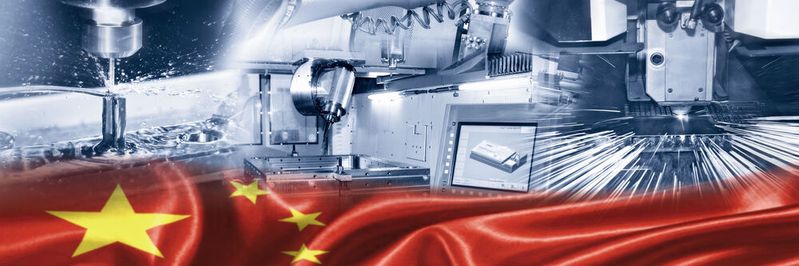
The two most important trends currently shaping the future of sheet metal processing in China are automation and digitalization, which have been systematically promoted by the government in Beijing as part of its "Made in China 2025" modernization plan for ten years.
Manufacturing with CNC machines has long since become established at leading Chinese companies, such as in the Yangtze River Delta at Dongshan Precision, Baoxin Technology, Jiangsu Tongrun Equipment, or the Xinpeng Company. The use of digital twins is also spreading rapidly.
The delta remains one of the leading regional industrial centers in the People's Republic. For this reason, successful foreign manufacturers in China, such as Trumpf, Rittal, the Sanmina Corporation, and Murata Machinery, have also invested in sheet metal processing facilities there.
However, a second region is currently becoming increasingly important. The Pearl River Delta in Guangdong Province, around Guangzhou, Foshan, or Dongguan, part of the generously supported "Greater Bay Area" by Beijing, is attracting many investments in the most advanced sheet metal processing production lines.
Electromobility and communication technology are booming
Here in southern China, it is particularly clear which downstream industries will generate the strongest increase in demand for sheet metal processing in the near future. The future industry of e-mobility, for example, is booming in China and demands more and more and increasingly lighter car roofs, roof racks, or engine mounts made of aluminum or steel.
Another growth industry is manifesting thanks to Huawei and its suppliers in Shenzhen in the rapidly growing cluster of manufacturers of the latest communication technologies, which in turn is boosting the business of sheet metal processors in the region.
Other future industries in the Chinese manufacturing sector relevant to sheet metal processing include renewable energies (housings for wind turbines, aluminum frames for solar panels, etc.), as well as consumer electronics and the space industry, where China is currently showing great ambition in the race with the USA.
In both regional clusters in the Pearl River and Yangtze River deltas, a strong trend towards hydroforming processes is particularly noticeable in the course of modernization. But artificial intelligence and machine learning are also being rapidly integrated into the processes to meet customers' desire for increasingly customized and precise components.
Another direction of modernization that will continue to intensify in the foreseeable future is sustainable or "green production." Not only are modern manufacturing plants in China becoming increasingly energy-efficient and thus more cost-effective overall, they are also increasingly processing modern materials and processes to provide their customers in Europe and North America with the environmental certificates that are required there.
China's own desire for increasingly sustainable and climate-friendly manufacturing, which culminates in the promise of Chinese State and Party leader Xi Jinping to achieve climate neutrality by 2060, is also driving this trend in sheet metal processing towards greener, resource-efficient, and emission-reducing production methods.
The outlook for the medium to long-term future shows that China's sheet metal processing companies are likely to become more internationally competitive year by year.
In the course of its new development paradigm with "high-quality productive forces," which include factors such as automation, big data, and robotics, China will propel its sheet metal processing industry even further into the age of digitalization and artificial intelligence in the coming years.
Date: 08.12.2025
Naturally, we always handle your personal data responsibly. Any personal data we receive from you is processed in accordance with applicable data protection legislation. For detailed information please see our privacy policy.
Consent to the use of data for promotional purposes
I hereby consent to Vogel Communications Group GmbH & Co. KG, Max-Planck-Str. 7-9, 97082 Würzburg including any affiliated companies according to §§ 15 et seq. AktG (hereafter: Vogel Communications Group) using my e-mail address to send editorial newsletters. A list of all affiliated companies can be found here
Newsletter content may include all products and services of any companies mentioned above, including for example specialist journals and books, events and fairs as well as event-related products and services, print and digital media offers and services such as additional (editorial) newsletters, raffles, lead campaigns, market research both online and offline, specialist webportals and e-learning offers. In case my personal telephone number has also been collected, it may be used for offers of aforementioned products, for services of the companies mentioned above, and market research purposes.
Additionally, my consent also includes the processing of my email address and telephone number for data matching for marketing purposes with select advertising partners such as LinkedIn, Google, and Meta. For this, Vogel Communications Group may transmit said data in hashed form to the advertising partners who then use said data to determine whether I am also a member of the mentioned advertising partner portals. Vogel Communications Group uses this feature for the purposes of re-targeting (up-selling, cross-selling, and customer loyalty), generating so-called look-alike audiences for acquisition of new customers, and as basis for exclusion for on-going advertising campaigns. Further information can be found in section “data matching for marketing purposes”.
In case I access protected data on Internet portals of Vogel Communications Group including any affiliated companies according to §§ 15 et seq. AktG, I need to provide further data in order to register for the access to such content. In return for this free access to editorial content, my data may be used in accordance with this consent for the purposes stated here. This does not apply to data matching for marketing purposes.
Right of revocation
I understand that I can revoke my consent at will. My revocation does not change the lawfulness of data processing that was conducted based on my consent leading up to my revocation. One option to declare my revocation is to use the contact form found at https://contact.vogel.de. In case I no longer wish to receive certain newsletters, I have subscribed to, I can also click on the unsubscribe link included at the end of a newsletter. Further information regarding my right of revocation and the implementation of it as well as the consequences of my revocation can be found in the data protection declaration, section editorial newsletter.
Foreign quality manufacturers, including those in Germany, will have to brace themselves to defend their global market shares.
*Henrik Bork is Managing Director at Asia Waypoint, a consulting agency specializing in China, based in Beijing. "China Market Insider" is a joint project of the Vogel Communications Group, Würzburg (Germany), and Jigong Vogel Media Advertising in Beijing.



:quality(80)/p7i.vogel.de/wcms/f9/7d/f97deef8fde21c8630d76411b18a20a7/0129803665v1.jpeg "Skoda has invested well over 220 million US dollars in the high-tech battery plant that has now opened in Mlada Boleslav. It has now started its work, which is highly automated ... (Image:Skoda)")
:quality(80)/p7i.vogel.de/wcms/f5/61/f561ad7c72ed41fd7a67ad9c481cb15d/0129799343v1.jpeg "Engine-generator units (MGU) from Steyr Motors are at work in the Leopard 2 main battle tank and the Leguan bridge vehicle (pictured). An extended contract is now to secure at least 500 more systems of this type for the Bundeswehr ... (Image:German Armed Forces)")
:quality(80)/p7i.vogel.de/wcms/6c/b5/6cb5ce2155433f6e73b16399adc4c561/0113143253v1.jpeg "In our China Market Insider we regularly provide you with relevant information directly from China. (Image:© Eisenhans - stock.adobe.com)")
:quality(80)/p7i.vogel.de/wcms/7f/fd/7ffd32863352c40f562f4245e4766e61/0129745849v1.jpeg "After US President Donald Trump once again resorted to his favorite weapon, tariffs, concerns rose in the EU that the so-called tariff deal could become invalid. But it looks as if the sea remains relatively calm ... (Image:F. Schneidler)")
:quality(80)/p7i.vogel.de/wcms/9c/ac/9cac6246660e746c5a3989399ac4d250/0128561645v1.jpeg "Artificial intelligence can drive efficiency in smart factories through centralized data management and predictive maintenance. (Picture: ©Fardived - stock.adobe.com)")
:quality(80)/p7i.vogel.de/wcms/6b/e2/6be235b5ad8a442ccd9d164b0b300d8b/0129763992v1.jpeg "As early as 2020, the Zimmer Group announced that it would convert its production to be sustainably CO2-neutral. (Image:Zimmer Group)")
:quality(80)/p7i.vogel.de/wcms/d4/ba/d4bab9481e66f8570f40eb8ef2a90198/0129795613v1.jpeg "A camera inspection during removal ensures that the components are placed correctly in the KLTs. (Image:Yaskawa Europe)")
:quality(80)/p7i.vogel.de/wcms/cb/56/cb56e42b01638b618e8d1b9b38f32faa/0129810132v1.jpeg "From summer 2026, \"AEON\" will support people at the BMW plant in Leipzig. (Image:diephotodesigner.de/BMW)")
:quality(80)/p7i.vogel.de/wcms/b5/5e/b55ed9355e0395ec0caf111d6af6b494/adobestock-495980372--c2-a9-20natali-mis-20-e2-80-93-20stock-adobe-com-6720x3778v1v1.jpeg "Which engineering skills will be in vogue in 2026? (Image:natali_mis - stock.adobe.com)")
:quality(80)/p7i.vogel.de/wcms/bf/a5/bfa5d882e93f159ce93e933742272b00/nord-vibn-cmyk-2196x1235v1v1.jpeg "With digital twins for virtual commissioning, Nord supports customers in ensuring that systems are available more quickly, even with complex drive systems. (Image:Nord Drivesystems)")
:quality(80)/p7i.vogel.de/wcms/f5/7e/f57ef535ee35e7b3b7ff15a8a63cef10/eds-keyvisual-8000x4496v1.jpeg "(Source: European Defence Supply)")
:quality(80)/p7i.vogel.de/wcms/af/a3/afa312176d956068af20491957eef642/newsimage418262-3100x1745v1v1.jpeg "The autonomous shuttle of the Aula AI project during a demonstration of sensor data with artificial fog. (Image:University of Magdeburg)")
:quality(80)/p7i.vogel.de/wcms/cb/23/cb23acd8e9de969d52522692b62b1892/0129680605v1.jpeg "The Z22198 is an extremely compact, three-axis IEPE acceleration sensor for measuring oscillations (vibrations) and shocks in demanding applications. With an edge length of just 0.24 inches and a weight of 0.03 ounces, it is ideal for lightweight structures and confined spaces. (Image:Copyright 2020 ScROGERS,All Rights Reserved)")
:quality(80)/p7i.vogel.de/wcms/c4/40/c44043c61f9dd99b80ccca398c284018/0129795093v1.jpeg "Subaru manufactures the E-Outback at its Yajima plant, marking the first time it has produced an electric vehicle in-house. (Image:Subaru)")
:quality(80)/p7i.vogel.de/wcms/fe/18/fe1824e572677900655c854f6c92c391/0129811281v1.jpeg "BMW and CATL deepen their partnership and work together on the battery pass. (Image:BMW)")
:quality(80)/p7i.vogel.de/wcms/15/54/15546b27b3a679871325ef6d92509a95/0129750872v1.jpeg "Webasto plans to open its third plant for sunroofs in India. (Image:Webasto)")
:quality(80)/p7i.vogel.de/wcms/70/14/70142aa050f8d3f7784c5ddbb2aba5f1/0129778339v1.jpeg "The software investments in production have saved time in Lacon production. (Image:Lacon)")
:quality(80)/p7i.vogel.de/wcms/5c/0f/5c0fee074c4b6c8e8c0993f3217c2f5a/0129773718v1.jpeg "The General Fusion demonstration reactor. (Image:General Fusion)")
:quality(80)/p7i.vogel.de/wcms/7f/c1/7fc1c83b8509df676d27518b82aaef02/0129764984v1.jpeg "China Resources Microelectronics (CR Micro) has announced its intention to increase the prices of its own products. (Image:China Resources Microelectronics)")
:quality(80)/p7i.vogel.de/wcms/eb/4e/eb4e449562174ec95a5b3d30fb0137a2/0129648135v1.jpeg "The III-V germanium PV module with an efficiency of 34.2% is currently the most efficient solar module in the world. (Image:Jacob Forster)")
:fill(fff,0)/images.vogel.de/vogelonline/companyimg/76800/76895/65.jpg "FAULHABER_120mm.jpg ()")
:fill(fff,0)/p7i.vogel.de/companies/67/eb/67eba621ef6ea/logo2.png "logo2 (Wuxi InfiMotion)")
:quality(80)/p7i.vogel.de/wcms/d5/6e/d56e97cb8afab17e93794c1cca214228/0129419457v1.jpeg "China is investing heavily in its domestic semiconductor ecosystem. If you want to be part of it, you should know in advance where which cluster is located and which technology it is driving forward. (Image:Dall-E / AI-generated)")
:quality(80)/p7i.vogel.de/wcms/d3/dc/d3dcf298e0307f60cd98cd3e2ad137f0/0113143253v1.jpeg "In our China Market Insider, we regularly provide you with relevant information directly from China. (Image:© Eisenhans - stock.adobe.com)")